
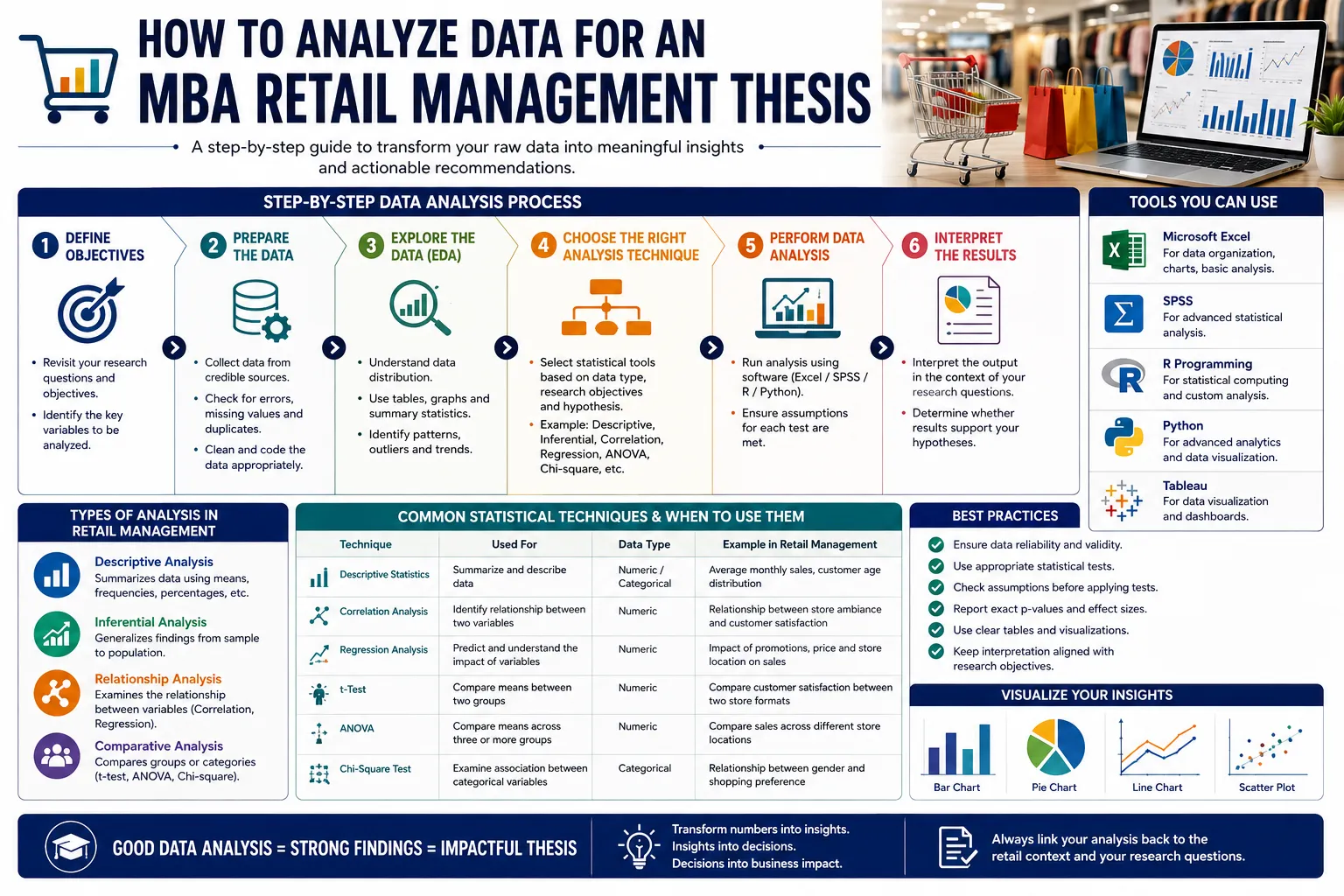
Once you've collected your survey responses or transactional retail data, the actual analysis is where your thesis either becomes a genuine contribution or a missed opportunity. Retail management research typically calls for one of two distinct analytical paths: structural equation modeling for survey-based consumer behavior data, or pattern-mining techniques for transactional sales data. This guide walks through how to analyze data for an MBA retail management thesis using both approaches, so you can choose and execute the one that actually fits your research question.
Path 1: PLS-SEM for Survey-Based Consumer Behavior Data
If your research involves testing a theoretical model — how perceived usefulness relates to purchase intention, how service quality relates to loyalty, or similar hypothesized relationships between constructs — Partial Least Squares Structural Equation Modeling (PLS-SEM) is likely your strongest analytical choice.
Why PLS-SEM Fits Retail Consumer Research So Well
PLS-SEM is particularly appropriate when your structural model is complex, involving many constructs and multiple indicators per construct, and when you're extending an existing theory rather than starting from scratch. Its key advantage is the ability to simultaneously estimate both measurement and structural models, rather than treating them as entirely separate analytical steps.
Two practical advantages make PLS-SEM especially relevant for MBA-level retail research specifically: it does not require your data to meet strict distributional assumptions, instead using a bootstrapping approach to determine statistical significance — a genuine advantage given how survey data collected from real consumers often doesn't follow textbook-perfect distributions. And it performs notably well even with comparatively smaller datasets, an important practical consideration when large-scale data collection isn't feasible within a standard MBA thesis timeline.
The Three-Stage PLS-SEM Process
Stage 1: Data Screening and Diagnostics
Before any modeling begins, verify your dataset's suitability by checking for missing data, outliers, and multivariate assumptions including normality, linearity, and multicollinearity. This stage is foundational — skipping it undermines the credibility of everything that follows, no matter how sophisticated your subsequent modeling is.
Stage 2: Measurement Model Assessment
This stage evaluates whether your constructs are being measured well, checking:
- Internal consistency reliability — commonly assessed using Cronbach's alpha and composite reliability
- Convergent validity — evaluated using average variance extracted (AVE)
- Discriminant validity — examined using the Fornell-Larcker criterion and the heterotrait-monotrait (HTMT) ratio
Only once your measurement model passes these checks should you proceed to testing your actual hypotheses — a measurement model that fails these checks means your constructs aren't measuring what you intend them to, regardless of how interesting your hypothesized relationships might be.
Stage 3: Structural Model Assessment
This stage tests your hypothesized relationships between constructs, using path coefficients, t-values, and confidence intervals — typically estimated through bootstrapping with 5,000 resamples. Coefficients of determination (R²) assess your model's overall explanatory power, and f² effect sizes evaluate the specific impact of individual predictor variables. This is where you actually test whether, for example, perceived value significantly predicts purchase intention, and how strong that relationship is.
Path 2: RFM Analysis and Market Basket Analysis for Transactional Data
If your research instead involves analyzing actual retail transaction data — a retailer's sales records rather than survey responses — a different analytical toolkit fits better.
RFM Analysis for Customer Segmentation
RFM analysis is a widely used customer segmentation technique in retail analytics, scoring customers on three dimensions:
- Recency — how recently a customer made a purchase
- Frequency — how often they purchase
- Monetary Value — how much they spend
Customers are scored on each dimension based on their purchasing history, then grouped into distinct segments — for example, "High-Value Customers" characterized by frequent, high-value purchases. This kind of segmentation is directly useful for retail management research examining customer retention, loyalty program design, or targeted marketing effectiveness.
Market Basket Analysis for Cross-Selling Insights
Market basket analysis, a complementary technique, uses frequent itemset mining algorithms — Apriori or FP-Growth are the most common — to identify which products are commonly purchased together. This generates association rules useful for cross-selling strategy, store layout decisions, and promotional bundling — genuinely practical retail insights that connect academic analysis directly to operational decision-making.
Preparing Transactional Data for Analysis
Before running either RFM or basket analysis, your transactional data needs preparation:
- Handle missing values by removing rows with missing customer IDs or purchase information
- Format date fields consistently across the entire dataset
- Group transactions by customer to build each customer's full purchase history
- Split item lists into individual items to enable item-pair-level analysis for basket analysis specifically
Practical Tools for This Kind of Analysis
Python is commonly used for retail data preprocessing and pattern mining, handling the frequent itemset mining and association rule generation involved in basket analysis. Results are often visualized using business intelligence tools like Power BI, producing interactive, business-friendly dashboards — a genuinely useful presentation format if your thesis includes recommendations aimed at practical retail decision-making, not just academic findings.
Choosing Between the Two Paths
Your choice between PLS-SEM and RFM/basket analysis should follow directly from your data type and research question, not personal preference:
- Choose PLS-SEM if you're testing a theoretical model of consumer attitudes, perceptions, or behavioral intentions using survey data
- Choose RFM/basket analysis if you have access to actual transactional sales data and your research question concerns customer segmentation, purchasing patterns, or cross-selling opportunities
Some ambitious MBA theses combine both — for example, using RFM segmentation to identify customer groups, then using survey data and PLS-SEM to understand what drives loyalty specifically within the highest-value segment. This kind of combination is more resource-intensive but can produce a genuinely richer contribution if your timeline supports it.
Step-by-Step: Analyzing Your Retail Management Thesis Data
- Confirm whether your data is survey-based (calling for PLS-SEM) or transactional (calling for RFM/basket analysis)
- For survey data: conduct data screening for missing values, outliers, and multivariate assumptions
- For survey data: assess your measurement model (reliability, convergent validity, discriminant validity) before proceeding
- For survey data: test your structural model using bootstrapped path coefficients, checking R² and f² values
- For transactional data: clean and prepare your dataset (missing values, date formatting, customer-level grouping)
- For transactional data: calculate RFM scores and segment customers into meaningful groups
- For transactional data: run market basket analysis to identify frequently co-purchased items, if relevant to your research question
- Interpret your findings explicitly in terms of practical retail management implications, not just statistical output
Practical Checklist: Is Your Retail Data Analysis Ready?
- Data type (survey-based or transactional) clearly identified, determining the appropriate analytical path
- For PLS-SEM: data screening completed before measurement model assessment
- For PLS-SEM: measurement model reliability and validity confirmed before testing hypotheses
- For PLS-SEM: structural model tested using bootstrapped path coefficients, with R² and f² reported
- For transactional data: missing values, date formatting, and customer-level grouping completed before analysis
- For transactional data: RFM segments are meaningfully differentiated and clearly labeled
- For transactional data: basket analysis association rules are interpreted for practical retail relevance
- Findings are connected explicitly to practical retail management implications, not left as purely statistical output
Two Practical Scenarios
Scenario 1 — Using PLS-SEM to Test a Consumer Trust Model
A scholar studying consumer trust in quick commerce platforms collected 220 survey responses testing a model linking delivery reliability, app usability, and price transparency to overall trust and repurchase intention. After data screening confirmed no major issues, the measurement model showed strong composite reliability and AVE values above the accepted threshold for each construct, allowing the scholar to proceed confidently to structural model testing. Bootstrapped path coefficients revealed delivery reliability as the strongest predictor of trust, with a clear, quantified effect size — a specific, defensible finding directly useful for the quick commerce platforms being studied.
Scenario 2 — Using RFM Segmentation to Identify Retention Priorities
A scholar analyzing a mid-sized retailer's loyalty program transaction data used RFM analysis to segment approximately 3,000 customers into distinct groups. The analysis revealed a sizable "at-risk" segment — customers with historically high monetary value but declining recency — that hadn't been identified through the retailer's existing basic segmentation. This finding directly informed the thesis's practical recommendations, proposing a targeted re-engagement campaign specifically for this at-risk high-value segment rather than a generic, undifferentiated retention strategy.
Common Mistakes MBA Retail Management Thesis Writers Make Analyzing Data
- Choosing PLS-SEM for transactional data or RFM analysis for survey data, mismatching the technique to the actual data type.
- Skipping measurement model assessment and moving straight to structural model testing without confirming construct reliability and validity first.
- Treating RFM segments generically without connecting them to specific, actionable retail management recommendations.
- Not cleaning transactional data properly before RFM or basket analysis, risking distorted segments from missing IDs or inconsistent date formats.
- Reporting statistical output without practical interpretation, leaving findings disconnected from genuine retail management implications.
Frequently Asked Questions
How do you analyze data for an MBA retail management thesis?
Choose your analytical approach based on your data type: use PLS-SEM (following data screening, measurement model assessment, then structural model testing) for survey-based consumer behavior data testing a theoretical model, or use RFM analysis and market basket analysis for transactional retail sales data focused on customer segmentation and purchasing patterns.
Why does the analysis approach matter for an MBA retail management thesis?
Retail research spans genuinely different data types — survey-based attitudinal data and transactional behavioral data — and using the wrong analytical technique for your specific data type produces weaker, less defensible findings regardless of how much data was collected.
How does data analysis quality affect an MBA thesis's overall contribution?
Since retail management research often aims to generate practically useful insights, findings that stay purely statistical without being interpreted into specific retail management implications weaken the thesis's real-world relevance and contribution.
How long does it take to complete an MBA thesis using this approach?
PLS-SEM analysis on survey data of a feasible MBA scale typically proceeds faster than large-scale transactional analysis requiring extensive data cleaning, though both are achievable within a standard thesis timeline with proper planning.
Is professional help available to analyze data for an MBA retail management thesis?
Yes. ThesisLikho's PhD-qualified experts have guided 10,000+ scholars through PLS-SEM analysis, RFM and basket analysis, and complete MBA thesis writing assistance tailored to individual research designs.
Get Expert Guidance on Your MBA Retail Management Data Analysis
Whether your thesis calls for PLS-SEM modeling of consumer survey data or RFM and basket analysis of transactional retail data, executing the analysis correctly takes careful, technique-specific attention. If you'd like expert input on your PLS-SEM model, customer segmentation analysis, or interpreting your findings for practical retail relevance, ThesisLikho's PhD-qualified team offers data analysis support, statistical modeling guidance, and complete MBA thesis writing assistance. If you need expert guidance with your data analysis, results chapter, or overall thesis structure, you can explore our MBA Thesis Assistance service.
Get Free MBA Thesis Consultation → https://thesislikho.com/writing-services/thesis-assistance-mba