
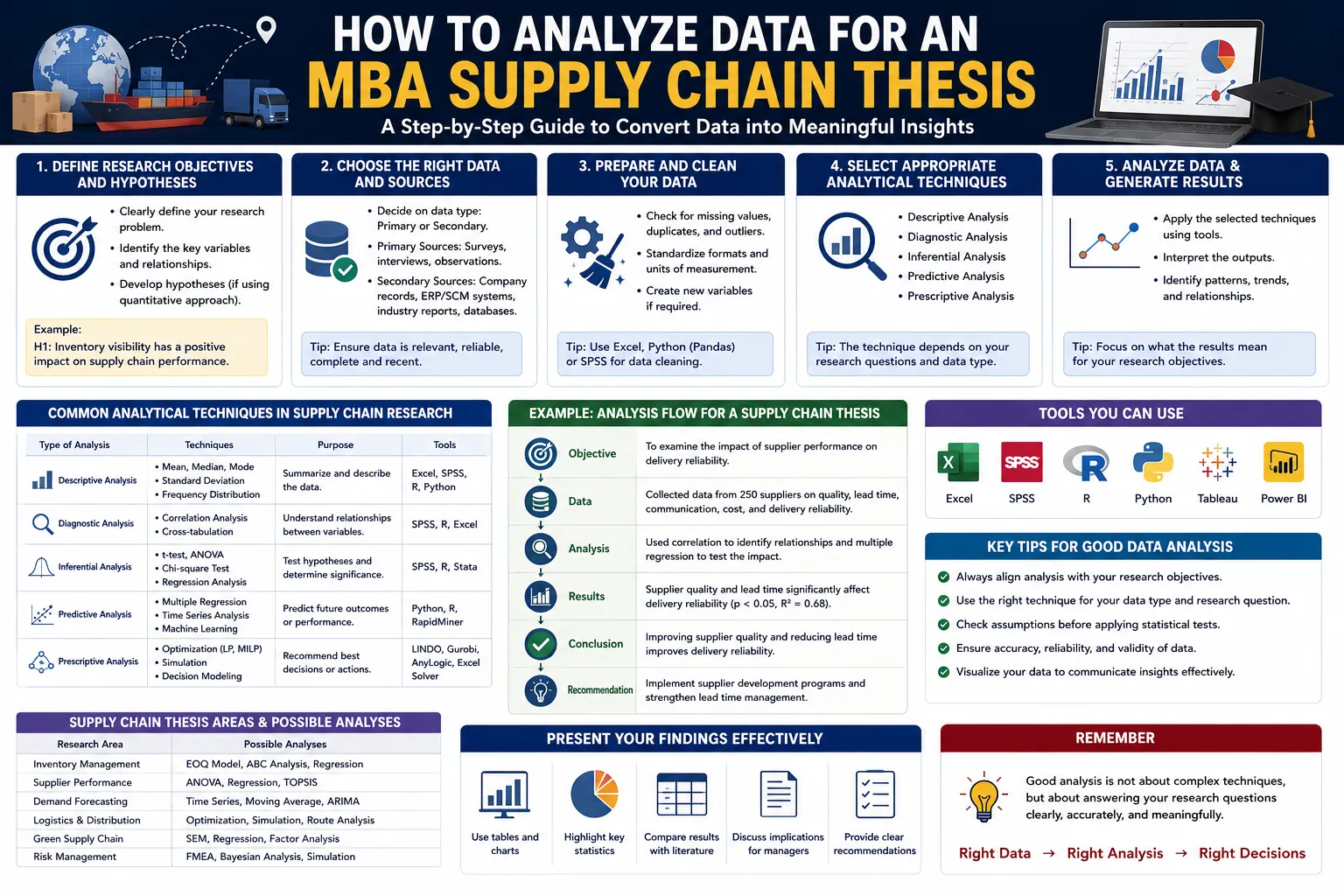
Supply chain research carries a specific analytical challenge: your data often needs to capture how a whole system behaves over time — inventory levels, order flows, service levels — not just static relationships between variables at a single point. This makes data analysis for an MBA supply chain thesis look a little different from more conventional survey-based business research. This guide walks through the specific frameworks and analytical approaches that make supply chain thesis data genuinely defensible.
Choose Your Analytical Framework Based on Your Research Question
Supply chain thesis research broadly splits into two analytical traditions: performance measurement using standardized frameworks like SCOR, and system behavior modeling using simulation. Which one fits depends on whether your research question asks "how well is this supply chain currently performing?" (measurement) or "what happens if we change this specific parameter?" (simulation). Many strong theses combine elements of both.
Using the SCOR Model for Performance Measurement
Why SCOR Is the Standard Framework
The Supply Chain Operations Reference (SCOR) model is one of the most widely used frameworks for measuring supply chain performance. It maps all major processes from upstream suppliers to downstream customers across five core dimensions — Plan, Source, Make, Deliver, and Return — and provides standardized, measurable Key Performance Indicators for each process. Using SCOR gives your thesis an established, internationally recognized structure rather than an ad-hoc set of metrics you've assembled yourself.
Understanding SCOR's Hierarchical Metric Structure
SCOR metrics are organized hierarchically across three levels. Level 1 gives you a high-level view of overall supply chain performance. Level 2 metrics help diagnose which specific processes are driving a Level 1 result, and Level 3 metrics similarly diagnose issues identified at Level 2. This hierarchy is genuinely useful for thesis analysis: rather than simply reporting that "delivery performance is weak," you can drill down through the levels to identify the specific root cause — whether it's a sourcing delay, a production bottleneck, or a logistics issue.
A Practical SCOR-Based Methodology for Your Thesis
A common, well-established approach for MBA-level supply chain research follows these steps: first, identify the relevant KPIs from the SCOR framework that match your research question. Second, validate those KPIs using a questionnaire completed by industry experts within your studied company or sector — this confirms the indicators you've chosen are genuinely meaningful to practitioners, not just theoretically relevant. Third, calculate the actual values for each validated indicator using your collected data. Fourth, normalize these values so indicators measured on different scales become comparable. Finally, combine the normalized indicators using a weighting method — the Analytical Hierarchy Process (AHP) is commonly used — to produce an overall, defensible performance score.
A representative published example of this methodology surveyed 120 respondents representing procurement, logistics, and operations functions across manufacturing firms, assessing 25 KPIs across the five SCOR dimensions through structured surveys, and validated the underlying measurement model through confirmatory factor analysis. This gives you a realistic sense of the scale and rigor expected for a SCOR-based supply chain study.
Using Simulation for System Behavior Analysis
When Simulation Fits Better Than Survey-Based Measurement
If your research question is about what would happen under a different set of conditions — a different reorder policy, a different safety stock level, a redesigned distribution network — simulation is generally a stronger analytical choice than static performance measurement, since it lets you model system behavior over time without needing to actually implement risky changes in a real operation.
Discrete-Event Simulation for Inventory Research
Discrete-event simulation is a widely used quantitative technique for supply chain thesis research, particularly for inventory management. It allows you to simulate how inventory rules — reorder points, order quantities, and safety stock levels — affect key performance indicators such as stockouts, fill rates, and inventory carrying costs, without requiring costly or risky real-world experimentation.
A recent, real-world published example illustrates the kind of concrete, quantified output this method can produce: a multi-echelon supply chain discrete-event simulation, integrated with an optimization tool, evaluated a real company's downstream supply chain performance. The optimized configuration produced a 16.2% increase in customer service levels — rising from 58.81% to 70.18% — alongside a substantial reduction in inventory costs. This kind of specific, before-and-after quantified result is exactly what makes simulation-based supply chain theses compelling to committees.
Choosing the Right Type of Simulation
Three main simulation modeling types are relevant to supply chain thesis research, and choosing the right one matters:
- Agent-based simulation — models individual entities and their interactions, such as customer shopping patterns or individual stock replenishment decisions, useful when your research question involves emergent behavior from many independent actors
- Discrete-event simulation — analyzes system changes at specific points in time, such as delivery schedules or inventory management events, the most common choice for operational inventory and logistics research
- Dynamic system simulation — focuses on cause-and-effect relationships at a broader system level, such as the long-term impact of supply chain policies, useful for strategic-level research questions rather than operational ones
Using Predictive and Prescriptive Analytics
Forecasting and Demand Management
Demand management analysis, a common foundational technique in supply chain MBA research, uses forecasting methods such as moving average or exponential smoothing applied to historical sales and seasonality data, helping balance supply and demand as a short-term planning approach. If your thesis involves a forecasting component, clearly state which method you're using and why it fits your specific demand pattern — moving average methods generally suit relatively stable demand, while exponential smoothing methods handle demand with more pronounced trends or seasonality better.
Predictive vs. Prescriptive Analytics
Predictive analytics uses past data and descriptive statistics to forecast future sales and guide inventory, pricing, and promotion decisions. Prescriptive analytics goes a step further, blending descriptive and predictive analytics to generate specific, data-driven recommendations for achieving a defined goal — for example, optimizing inventory levels, delivery routing, or warehouse sequencing. If your thesis aims not just to describe or predict supply chain behavior but to recommend a specific operational change, you're working in prescriptive analytics territory, and your methodology and conclusions should be framed accordingly.
Practical Tools for Supply Chain Thesis Analysis
You don't necessarily need specialized simulation software to conduct credible supply chain analysis at the MBA level. Microsoft Excel remains a genuinely practical, accessible tool for this kind of work, using core functions like IF and SUMIF formulas, pivot tables, and VLOOKUP/HLOOKUP for organizing and analyzing operational data — a feasible option for scholars without access to dedicated simulation platforms like Arena or AnyLogic. For more advanced discrete-event or agent-based simulation work, dedicated simulation software becomes necessary, so factor software access and your own learning curve into your methodology choice early.
An Emerging Direction Worth Knowing About
A newer, increasingly researched analytical direction combines simulation with digital twin concepts — using simulation specifically within a digital twin framework to support ongoing, real-time inventory decision-making rather than a one-time analysis. If your thesis timeline and resources allow, framing your research within this emerging direction can strengthen its currency and relevance, though a full digital twin implementation is likely beyond the scope of most MBA-level theses — even referencing the concept as a direction for future research can add value.
Step-by-Step: Structuring Your Supply Chain Data Analysis
- Determine whether your research question calls for performance measurement (SCOR-based) or system behavior analysis (simulation-based)
- If performance measurement, identify relevant SCOR KPIs and validate them with industry experts before calculating actual values
- If simulation-based, choose the appropriate simulation type (discrete-event, agent-based, or dynamic system) matching your specific research question
- Select your data collection method — structured survey for SCOR-based work, or operational/historical data for simulation-based work
- Choose your analytical software based on your approach and available resources (Excel for accessible analysis, dedicated simulation software for more complex modeling)
- If forecasting demand, select and justify your specific method (moving average, exponential smoothing) based on your demand pattern
- Report your findings with specific, quantified before-and-after or comparative figures, following the model of published examples in the field
- Connect your findings back to practical recommendations if your research is prescriptive in nature
Practical Checklist: Is Your Supply Chain Data Analysis Ready?
- Analytical approach (SCOR-based measurement or simulation) matches your specific research question
- If SCOR-based, KPIs are identified from the standard framework and validated with industry experts
- If simulation-based, the correct simulation type (discrete-event, agent-based, dynamic system) is chosen and justified
- Data collection method matches the analytical approach (survey for SCOR, operational data for simulation)
- Software choice is appropriate and accessible given available resources
- Forecasting method (if used) is justified based on the specific demand pattern in the data
- Findings are reported with specific, quantified figures rather than vague qualitative statements
- Prescriptive recommendations (if applicable) are clearly grounded in the analysis presented
Two Practical Scenarios
Scenario 1 — Applying SCOR to a Manufacturing Firm Study A scholar studying supply chain performance in a mid-sized manufacturing firm identified 20 KPIs across the five SCOR dimensions, validated them through a questionnaire completed by the firm's procurement and logistics managers, and calculated normalized performance scores using AHP weighting derived from the same experts' pairwise comparisons. The resulting analysis identified a specific weakness in the "Deliver" dimension at Level 2, which further Level 3 diagnostics traced to inconsistent third-party logistics performance — giving the thesis a specific, actionable, root-cause finding rather than a vague overall performance rating.
Scenario 2 — Using Discrete-Event Simulation for Inventory Policy Comparison A scholar researching inventory policy optimization for a retail distribution center built a discrete-event simulation model comparing current reorder point and order quantity settings against several alternative configurations. The simulation output quantified the trade-off between service level and inventory carrying cost across each configuration, allowing the scholar to recommend a specific policy change with a clearly projected improvement in fill rate — a far more concrete and defensible conclusion than a qualitative assessment based on interviews alone would have produced.
Common Mistakes MBA Supply Chain Thesis Writers Make
- Choosing simulation or SCOR measurement without matching the choice to the actual research question, resulting in a methodology that doesn't quite answer what was asked.
- Using SCOR KPIs without validating them with industry experts first, weakening the credibility of the chosen indicators.
- Selecting the wrong simulation type (e.g., agent-based when discrete-event would better suit an inventory-focused question).
- Reporting findings vaguely ("performance improved") instead of with specific, quantified figures.
- Overreaching into prescriptive claims not adequately supported by the underlying descriptive or predictive analysis conducted.
Frequently Asked Questions
How do you analyze data for an MBA supply chain thesis?
Choose between a SCOR-based performance measurement approach (identifying and validating KPIs, then calculating and weighting performance scores) or a simulation-based approach (discrete-event, agent-based, or dynamic system simulation) depending on whether your research question is about current performance or hypothetical system changes, then select your data collection method and software accordingly.
Why does the choice between SCOR measurement and simulation matter for a supply chain thesis?
These approaches answer fundamentally different types of research questions — SCOR measures how a supply chain is currently performing, while simulation models how it would behave under different conditions — choosing the wrong one produces a methodology mismatch that weakens the thesis's core contribution.
How does supply chain data analysis affect an MBA thesis's overall quality?
Specific, quantified findings — whether from validated SCOR KPIs or simulation output — give committees concrete evidence to evaluate, while vague qualitative performance claims are one of the more common reasons a supply chain thesis draws committee scrutiny.
How long does it take to complete an MBA thesis using this approach?
SCOR-based survey research and simulation-based research carry different timelines — survey-based work depends on data collection and expert validation access, while simulation-based work depends on the complexity of the model and any required software learning curve, so factor this into your planning early.
Is professional help available to analyze data for an MBA supply chain thesis?
Yes. ThesisLikho's PhD-qualified experts have guided 10,000+ scholars through supply chain research methodology, SCOR-based analysis, and complete MBA thesis writing assistance tailored to individual research designs.
Get Expert Guidance on Your MBA Supply Chain Data Analysis
Choosing between performance measurement and simulation, and executing either one credibly, takes careful methodological planning matched to your specific research question and available resources. If you'd like expert input on structuring your supply chain thesis's data analysis, ThesisLikho's PhD-qualified team offers research methodology support, SCOR and simulation analysis guidance, and complete MBA thesis writing assistance. If you need expert guidance with your data analysis, methodology, or overall thesis structure, you can explore our MBA Thesis Assistance service.
Get Free MBA Thesis Consultation → https://thesislikho.com/writing-services/thesis-assistance-mba