Introduction
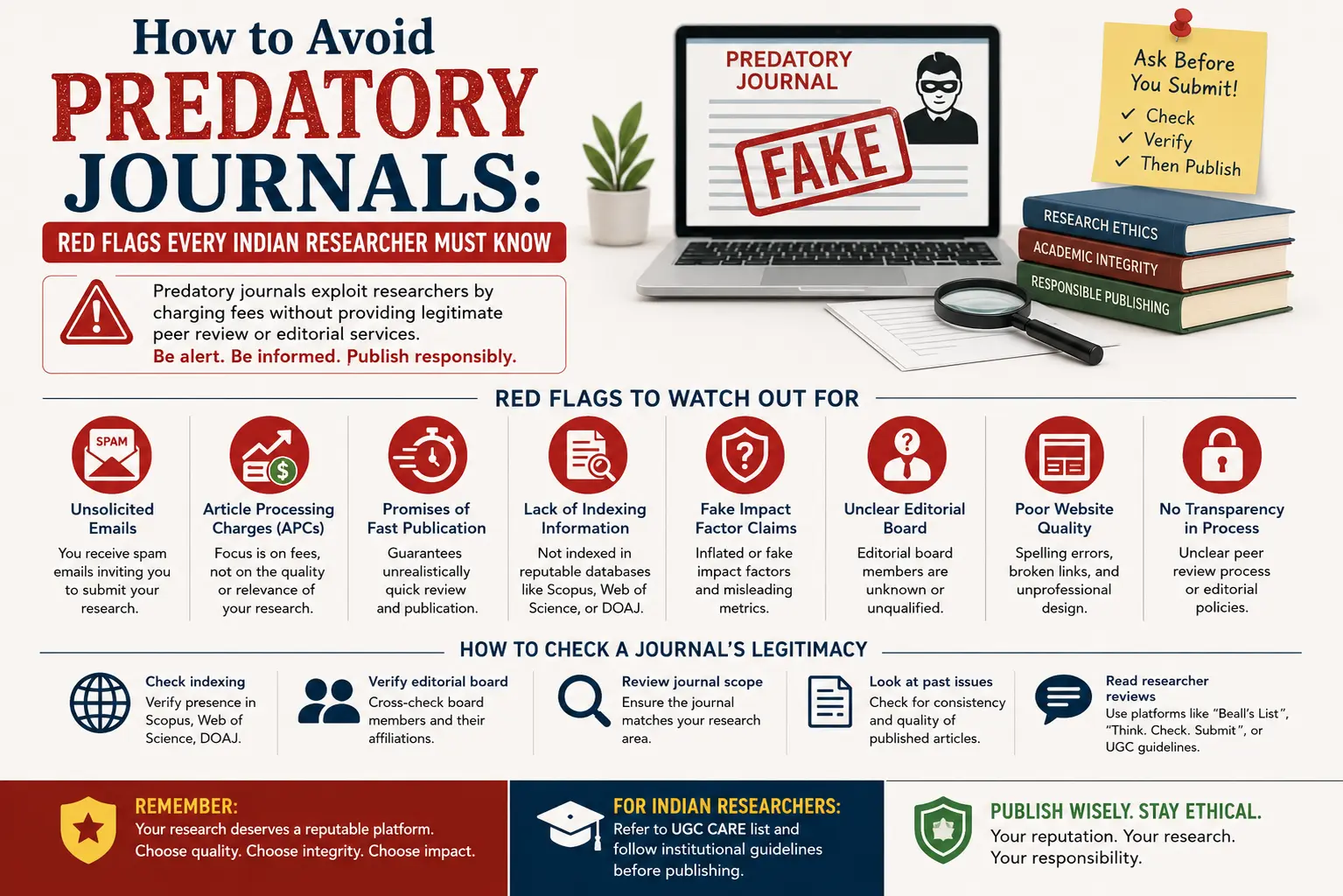
Publishing research is one of the most important aspects of a PhD, academic career, or research profession. However, with the rapid growth of academic publishing, researchers are increasingly facing a serious challenge: predatory journals.
Every year, thousands of Indian researchers unknowingly submit their papers to fake or low-quality journals that claim to be legitimate academic publications. These journals often charge publication fees, promise rapid acceptance, and advertise fake indexing metrics while providing little or no peer review.
For PhD scholars, faculty members, and postgraduate students, publishing in a predatory journal can damage academic credibility, waste research efforts, and even create problems during thesis submission, promotions, and grant applications.
In this comprehensive guide, we explain what predatory journals are, why they are dangerous, how to identify them, and the red flags every Indian researcher must know before submitting a manuscript in 2026.
What Is a Predatory Journal?
A predatory journal is a publication that prioritizes profit over academic quality.
These journals typically:
- Charge publication fees
- Conduct little or no peer review
- Accept papers regardless of quality
- Use misleading marketing practices
- Make false claims about indexing and impact factors
Their primary goal is often to collect publication fees rather than contribute to scholarly communication.
Simple Definition
A predatory journal is a fake or unethical academic journal that exploits researchers by charging publication fees without maintaining proper scholarly standards.
Why Predatory Journals Are a Growing Problem in India
India has one of the largest populations of research scholars in the world.
Factors contributing to the growth of predatory journals include:
- Pressure to publish
- PhD publication requirements
- Faculty promotion criteria
- Lack of awareness among new researchers
- Demand for quick publication
Many inexperienced researchers become easy targets for fraudulent publishers.
How Predatory Journals Operate
Most predatory journals follow a similar pattern.
Step 1: Attractive Invitation
Researchers receive an email saying:
- "Your research profile is impressive."
- "We invite you to publish."
- "Fast-track publication available."
Step 2: Easy Submission
The journal accepts submissions with minimal requirements.
Step 3: Quick Acceptance
Papers are often accepted within:
- 24 hours
- 3 days
- 1 week
without meaningful review.
Step 4: Publication Fee Request
Authors are asked to pay:
- Article Processing Charges (APCs)
- Submission fees
- Publication fees
before publication.
Step 5: Publication
The paper is published online with little editorial oversight.
Why Publishing in Predatory Journals Is Dangerous
Some researchers assume that any publication is better than no publication.
This is a costly mistake.
1. Loss of Academic Credibility
Publications in predatory journals may not be recognized by:
- Universities
- Funding agencies
- Academic committees
2. Thesis Submission Problems
Some universities reject publications appearing in suspicious journals.
3. Faculty Promotion Issues
Predatory publications may not count toward promotion requirements.
4. Reduced Research Visibility
Many predatory journals are not indexed in reputable databases.
As a result, papers receive little attention.
5. Financial Loss
Researchers may pay significant publication fees without receiving legitimate publishing services.
Red Flag 1: Unrealistically Fast Acceptance
One of the most obvious warning signs is immediate acceptance.
Legitimate peer review takes time.
Typical review periods range from:
- 4 weeks
- 8 weeks
- Several months
Be cautious if a journal promises:
- Acceptance within 48 hours
- Publication within 3 days
- Guaranteed acceptance
Quality peer review cannot happen this quickly.
Red Flag 2: Guaranteed Publication
No reputable journal guarantees acceptance.
Legitimate journals evaluate manuscripts based on:
- Originality
- Methodology
- Relevance
- Scientific quality
Statements such as:
"100% acceptance guaranteed"
should immediately raise concerns.
Red Flag 3: Fake Impact Factors
Many predatory journals advertise misleading metrics.
Examples include:
- Global Impact Factor
- Universal Impact Factor
- Scientific Journal Impact Factor
- Cosmos Impact Factor
These are often not recognized by the academic community.
What Researchers Should Verify
Look for legitimate metrics such as:
- Journal Impact Factor
- CiteScore
- SJR
- SNIP
Always verify metrics through official sources.
Red Flag 4: Fake Indexing Claims
Predatory journals frequently claim indexing in:
- Scopus
- Web of Science
- PubMed
without actually being indexed.
How to Verify
Always check:
Scopus
Use the official Scopus Sources database.
Web of Science
Check the Master Journal List.
PubMed
Search directly in PubMed.
Never rely solely on information displayed on a journal website.
Red Flag 5: Spam Email Invitations
Predatory journals aggressively send mass emails.
Common phrases include:
- "Dear Esteemed Researcher"
- "We read your excellent article"
- "Submit within 48 hours"
- "Special Issue Closing Soon"
These emails are often generic and sent to thousands of researchers.
Red Flag 6: Poor Website Quality
A journal's website often reveals its legitimacy.
Warning signs include:
Grammar Errors
Numerous spelling and language mistakes.
Broken Links
Non-functional pages.
Missing Information
No clear editorial policies.
Unprofessional Design
Poorly maintained websites.
Reputable journals invest in professional online platforms.
Red Flag 7: Suspicious Editorial Board
A credible journal should have a transparent editorial board.
Check:
- Editor names
- Institutional affiliations
- Academic credentials
Warning Signs
Missing Editors
No editor information available.
Fake Names
Unknown or unverifiable individuals.
Unauthorized Listings
Researchers listed without permission.
Red Flag 8: Extremely Broad Scope
Some predatory journals claim to publish research in:
- Engineering
- Medicine
- Law
- Education
- Literature
- Physics
- Management
all within a single journal.
Legitimate journals usually focus on specific disciplines.
Red Flag 9: Lack of Peer Review Information
Peer review is a cornerstone of academic publishing.
A trustworthy journal clearly explains:
- Review process
- Review timeline
- Reviewer policies
If this information is absent, proceed cautiously.
Red Flag 10: Hidden Publication Charges
Reputable journals openly disclose publication fees.
Predatory journals often:
- Hide charges initially
- Demand unexpected payments after acceptance
Always verify APCs before submission.
Red Flag 11: Fake ISSN Numbers
Every legitimate journal should have a valid ISSN.
Researchers should verify ISSN details independently.
Warning signs include:
- Invalid ISSN numbers
- Missing ISSN information
- Multiple inconsistent ISSNs
Red Flag 12: No Retraction Policy
Quality journals maintain policies regarding:
- Corrections
- Retractions
- Research misconduct
Predatory journals often lack such policies.
How to Verify a Journal Before Submission
Following a verification checklist can prevent costly mistakes.
Check Journal Indexing
Verify whether the journal appears in:
- Scopus
- Web of Science
- PubMed
- DOAJ (for Open Access journals)
Check Publisher Reputation
Well-established publishers generally maintain strong quality controls.
Examples include:
- Elsevier
- Springer Nature
- Wiley
- Taylor & Francis
- Sage
Review Recent Publications
Examine recently published papers.
Ask:
- Are they relevant?
- Are they professionally written?
- Do they appear peer-reviewed?
Evaluate Editorial Board Members
Check whether editors are affiliated with recognized institutions.
How Predatory Journals Affect PhD Scholars
Publishing in predatory journals can create serious problems during:
Thesis Submission
Universities may reject questionable publications.
Viva Voce Examination
Examiners often scrutinize publication quality.
Academic Recruitment
Employers increasingly verify journal credibility.
Research Funding Applications
Funding agencies prefer publications in reputable journals.
Difference Between Predatory and Low-Impact Journals
Many researchers confuse these concepts.
Low-Impact Journal
A legitimate journal with:
- Lower citation rates
- Smaller audience
- Proper peer review
Predatory Journal
An unethical publication that:
- Exploits researchers
- Lacks genuine peer review
- Prioritizes profit
A low-impact journal is not necessarily predatory.
What Should Indian Researchers Do If They Published in a Predatory Journal?
If you have already published in a predatory journal:
Do Not Panic
Many researchers make this mistake early in their careers.
Focus on Future Publications
Prioritize reputable journals moving forward.
Be Transparent
If asked about previous publications, explain the circumstances honestly.
Learn from the Experience
Use the incident to improve journal evaluation skills.
Best Practices for Safe Journal Selection
Before submission:
Verify indexing
Review journal scope
Check editorial board
Confirm peer review process
Evaluate publisher reputation
Read recent articles
Verify publication charges
Avoid unrealistic promises
Consult supervisors
Compare multiple journals
Future of Predatory Publishing in India
As research output increases, predatory journals are becoming more sophisticated.
However, several developments are helping researchers:
Improved Awareness
Universities increasingly educate scholars about publication ethics.
Better Indexing Verification
Researchers have easier access to indexing databases.
AI-Based Screening
Publishers and institutions increasingly use AI tools to detect publication fraud.
Stronger Research Regulations
Academic institutions continue to strengthen publication quality standards.
Conclusion
Predatory journals pose a significant threat to academic integrity and research quality. They exploit scholars by offering easy publication opportunities while failing to provide the peer review, editorial standards, and scholarly value expected in legitimate academic publishing.
For Indian researchers in 2026, avoiding predatory journals is essential for protecting academic credibility, ensuring thesis acceptance, supporting career growth, and maximizing research impact.
Before submitting any manuscript, scholars should carefully verify indexing status, editorial quality, publisher reputation, peer-review processes, and publication policies. A few hours spent evaluating a journal can save years of academic regret.
Remember: a publication in a reputable journal is far more valuable than multiple publications in predatory journals. Quality should always outweigh quantity.
Frequently Asked Questions (FAQs)
1. What is a predatory journal?
A predatory journal is an unethical publication that charges fees while providing little or no genuine peer review.
2. How can I identify a predatory journal?
Look for warning signs such as fake indexing claims, guaranteed acceptance, spam emails, poor websites, and hidden fees.
3. Are all Open Access journals predatory?
No. Many highly respected journals operate under Open Access models. Predatory publishing is different from Open Access publishing.
4. Can predatory journal publications affect my PhD?
Yes. Some universities may not recognize publications in predatory journals for thesis or promotion purposes.
5. How do I verify if a journal is Scopus indexed?
Use the official Scopus Sources database to confirm indexing status.
6. Is fast publication always a red flag?
Not always, but acceptance within a few days without peer review is highly suspicious.
7. What should I do if I already published in a predatory journal?
Focus on publishing future work in reputable journals and learn from the experience.
8. Why are predatory journals common in India?
Factors include publication pressure, lack of awareness, and the demand for quick academic credentials.
Contact ThesisLikho Today
Call / WhatsApp: +91 96438 02216
Visit: ThesisLikho.com