
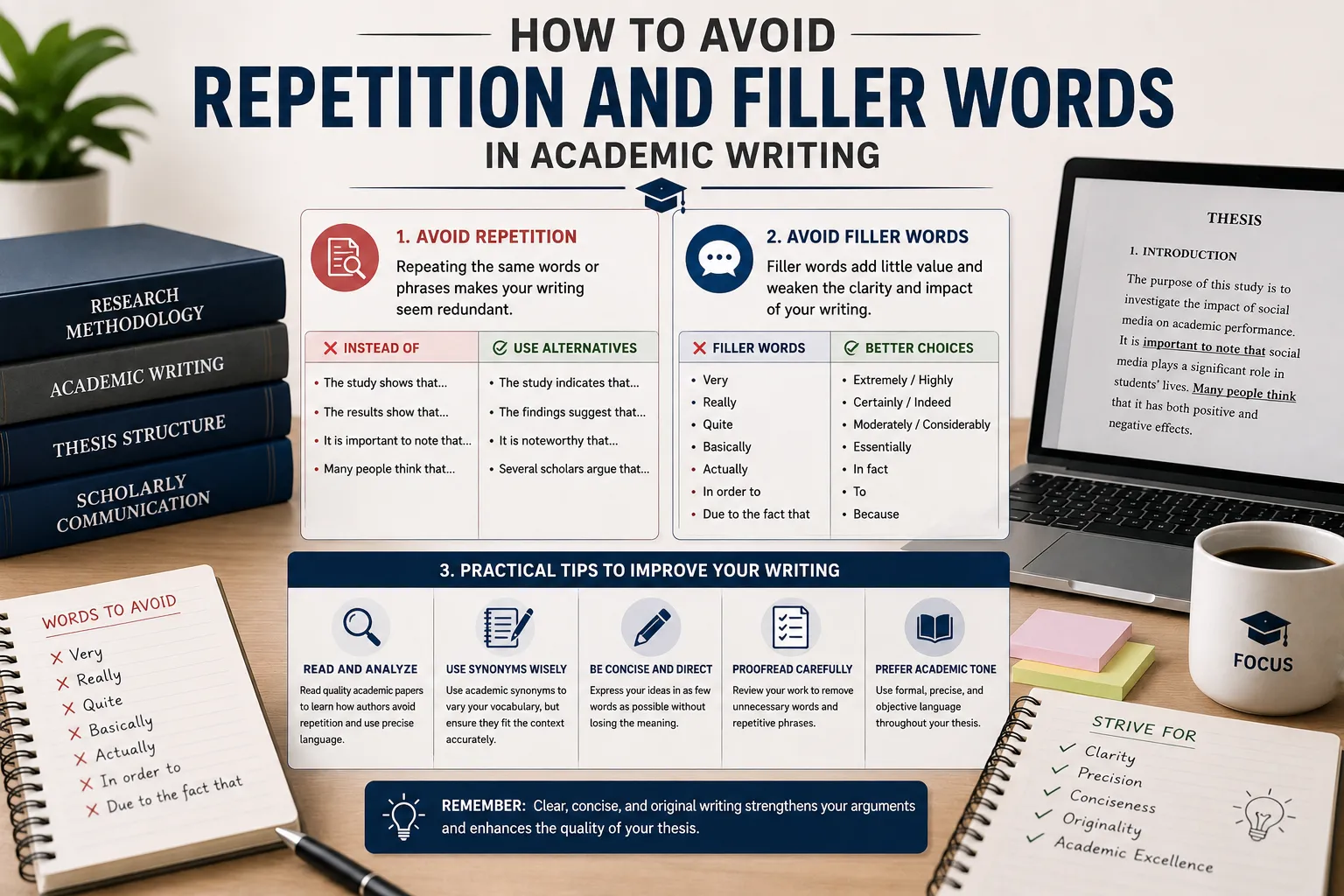
There's a persistent myth in academic writing that longer, more complex sentences sound more scholarly. They don't — they usually just sound padded. This guide walks through how to avoid repetition and filler words in academic writing, with specific phrases to cut, a practical editing process, and real before/after examples you can apply directly to your own thesis.
Why Wordiness Actually Undermines Your Writing
Wordiness refers to using more words than necessary to convey an idea. It's a genuinely common problem in research writing, where scholars sometimes believe complex, padded sentences sound more "academic." In reality, excessive length reduces impact and readability, obscures your main ideas, and can even create an impression of poor organization or overcompensation — the opposite of the authority you're trying to project.
Cut These Specific Empty Openers Entirely
Certain phrases add words without adding meaning. Specifically flagged, commonly overused openers include:
- "It is important to note that..."
- "The fact that..."
- "There are many studies that show..."
Removing these empty openers immediately makes your writing more confident and direct. Consider this representative example: "It is important to note that the results clearly indicate a positive correlation between the variables" becomes simply "The results indicate a positive correlation between the variables." Nothing about the meaning changes — the sentence just gets straight to the point instead of announcing that it's about to.
Three Specific Areas Where Wordiness Hides
Wordiness can be systematically avoided by paying attention to three specific areas: redundancy (saying the same thing twice in different words), purposeless words and phrases (words that don't add meaning), and excessive adjectives and adverbs (modifiers that weaken rather than strengthen a sentence). Reducing wordiness is a genuine challenge, particularly for non-native English-speaking researchers, since writing style is often influenced by patterns established in a different first language. The effort is genuinely worth it, though — it measurably improves readability and can increase how favorably a manuscript or thesis chapter is received.
Specific Filler Phrases to Eliminate
Certain filler phrases show up repeatedly across academic drafts and are worth actively hunting for during revision:
- "in order to" → replace with simply "to"
- "due to the fact that" → replace with "because"
- "the reason is because" → redundant; replace with simply "because"
- "at this point in time" → replace with "now" or "currently"
- "each and every" → redundant pairing; use just "each" or "every"
- "in the process of" → often removable entirely, or replaceable with the specific verb it's obscuring
None of these substitutions lose any meaning. They just remove words that were never doing any real work in the sentence.
Structural Repetition: Beyond Individual Phrases
Repetition isn't only a word-level or sentence-level problem — it can happen at the structural level of your entire thesis. A useful guiding principle: every section, example, and argument should serve your paper's main goal and relate clearly back to your thesis statement or research question. If the link between a specific piece of information and your broader purpose isn't clear, either make that connection explicit, or remove the information entirely. Content that doesn't clearly serve your argument isn't neutral filler — it's actively diluting your reader's attention from what does matter.
Watch for Introductory Clauses That Restate the Previous Sentence
A specific structural repetition pattern worth watching for: lengthy introductory clauses that restate the main point of the sentence before them. This structure can bury the actual new point you're trying to make. Keeping introductory clauses relatively short helps your reader stay genuinely focused by the time they reach the sentence's real content, rather than re-processing information they already absorbed one sentence earlier.
How Removing Passive Voice Also Reduces Wordiness
Unnecessary passive constructions often carry hidden wordiness along with them. A representative example: "The letter was taken to the mailbox by Sally" (10 words) becomes "Sally took the letter to the mailbox" (7 words) once you move the subject to the front and remove the "to be" verb construction. This is a genuinely useful double benefit — converting passive to active voice where appropriate (see our companion guide on active versus passive voice) often tightens your sentence length as a side effect, not just your grammatical style.
Recognize the Different Forms Redundancy Takes
Redundancy hides in several distinct, learnable forms:
- Redundant word pairs — using two words that mean essentially the same thing (e.g., "each and every," "basic fundamentals")
- Restated ideas — an idea expressed once, then expressed again in only slightly different words within the same paragraph
- Double negatives — constructions that make sentences both confusing and unnecessarily wordy simultaneously
Learning to spot these specific forms — rather than vaguely sensing that a paragraph "feels long" — makes your editing process considerably more efficient.
Editing, Not Drafting, Is Where This Actually Happens
Concise, tight writing rarely comes out that way in a first draft, and that's genuinely fine. Editing — not drafting — is where concise writing actually happens. After drafting, your specific revision tasks are: delete repeated ideas, merge similar sentences, and replace weak verbs with stronger, more precise ones. Treat your first draft as raw material, not a finished product you're expected to have gotten exactly right the first time.
A Practical Self-Editing Technique: Read Aloud
One of the most practical, repeatable techniques: read your work aloud specifically to check sentence flow. If you find yourself gasping for air mid-sentence, or stumbling over repetitive patterns, that's a direct, physical signal something needs adjusting. This technique also reveals related short, choppy sentences that might be better combined using semicolons, colons, or dashes — improving both clarity and flow at the same time, rather than just cutting length for its own sake.
Step-by-Step: Editing Your Thesis for Repetition and Filler Words
- Complete your full draft first, without worrying about concision during the initial writing pass
- Scan specifically for the flagged empty openers ("It is important to note that," "The fact that") and cut them
- Search your document for the specific filler phrases listed above ("in order to," "due to the fact that," "at this point in time") and replace each with its shorter equivalent
- Check each section against your thesis statement or research question — remove or clarify anything whose connection to your argument isn't explicit
- Scan for introductory clauses that restate the previous sentence's point, and shorten or remove them
- Identify unnecessary passive constructions and convert them to active voice where appropriate, noting the length reduction as a bonus
- Look specifically for redundant word pairs, restated ideas, and double negatives
- Read your work aloud, marking any sentence where you lose your breath or notice repetitive rhythm
- Merge related short sentences where doing so improves flow without sacrificing clarity
Practical Checklist: Is Your Writing Free of Repetition and Filler?
- Empty openers ("It is important to note that," "The fact that," "There are many studies that show") have been removed
- Specific filler phrases ("in order to," "due to the fact that," "at this point in time," "each and every") have been replaced with concise equivalents
- Every section and example connects explicitly back to the thesis statement or research question
- Introductory clauses that restate the previous sentence's point have been shortened or removed
- Unnecessary passive constructions have been converted to active voice where appropriate
- Redundant word pairs, restated ideas, and double negatives have been identified and removed
- The document has been read aloud at least once, specifically checking for breathless or repetitive sentences
- Related short, choppy sentences have been merged where it improves flow
Two Practical Scenarios
Scenario 1 — Cleaning Up a Wordy Results Paragraph
A scholar's draft included the sentence: "It is important to note that, due to the fact that the sample size was relatively small, the results should be interpreted with an appropriate degree of caution at this point in time." Applying the specific filler-phrase cuts, this became: "Because the sample size was small, the results should be interpreted with caution." The revised sentence preserved the exact meaning while cutting nearly half the original word count.
Scenario 2 — Removing Structural Repetition Across a Chapter
A scholar reviewing their literature review chapter noticed that a specific finding — that mentorship programs improve early-career retention — was stated in full three separate times across different subsections, each time in only slightly reworded language. Rather than leaving each restatement, the scholar consolidated the point into one clear statement in the most relevant subsection, then used brief, explicit callbacks ("as discussed above") in the other subsections where the point was genuinely relevant to a new argument — eliminating redundant explanation while preserving the connections between sections.
Common Mistakes Writers Make With Repetition and Filler Words
- Assuming longer, more complex sentences sound more academic, when concise, direct sentences are generally valued more highly in current academic writing.
- Leaving empty openers unedited, adding words without adding meaning.
- Restating the same point multiple times across a chapter in only slightly different language, rather than stating it once clearly and referencing it explicitly when relevant elsewhere.
- Editing only for grammar, not for concision, missing filler phrases and redundancy that a grammar checker alone won't flag.
- Skipping the read-aloud step, missing a fast, effective way to catch repetitive rhythm and overly long sentences.
Frequently Asked Questions
How do you avoid repetition and filler words in academic writing?
Cut specific empty openers ("It is important to note that"), replace common filler phrases ("in order to," "due to the fact that") with concise equivalents, ensure every section connects explicitly to your thesis statement, convert unnecessary passive constructions to active voice, and read your work aloud to catch repetitive or overly long sentences during revision.
Why does avoiding repetition and filler words matter for academic writing?
Wordy, repetitive writing reduces readability, obscures your main arguments, and can create an impression of poor organization — concise, direct writing is generally valued more highly in current academic and thesis writing standards.
How does removing filler words affect a thesis's overall quality?
Tighter, more direct writing makes your arguments easier for examiners to follow and signals confidence and clarity, while wordy, padded writing can bury genuinely strong points under unnecessary language.
When should you edit a thesis for repetition and filler words?
During the revision stage, after your full draft is complete — concise writing generally happens through deliberate editing, not in the first draft, so don't worry about wordiness while initially drafting.
Is professional help available for avoiding repetition and filler words in academic writing?
Yes. ThesisLikho's PhD-qualified mentors have guided 10,000+ scholars through academic writing style editing, concision review, and complete thesis writing assistance tailored to current academic writing standards.
Get Expert Guidance on Your Thesis Writing Style
Cutting filler words and repetition while preserving your argument's full meaning takes careful, deliberate editing — a skill that improves considerably with a second, experienced set of eyes. If you'd like expert input on tightening your thesis's writing style, ThesisLikho's PhD-qualified team offers concision editing, academic style review, and complete thesis writing assistance. If you need expert guidance with your academic writing, editing, or overall thesis structure, you can explore our Thesis Writing Assistance service.
Talk to a Thesis Expert → https://thesislikho.com/writing-services/thesis-writing
Email: support@thesislikho.com
Mobile No.: +91-9289068414 , +91-9643802216