
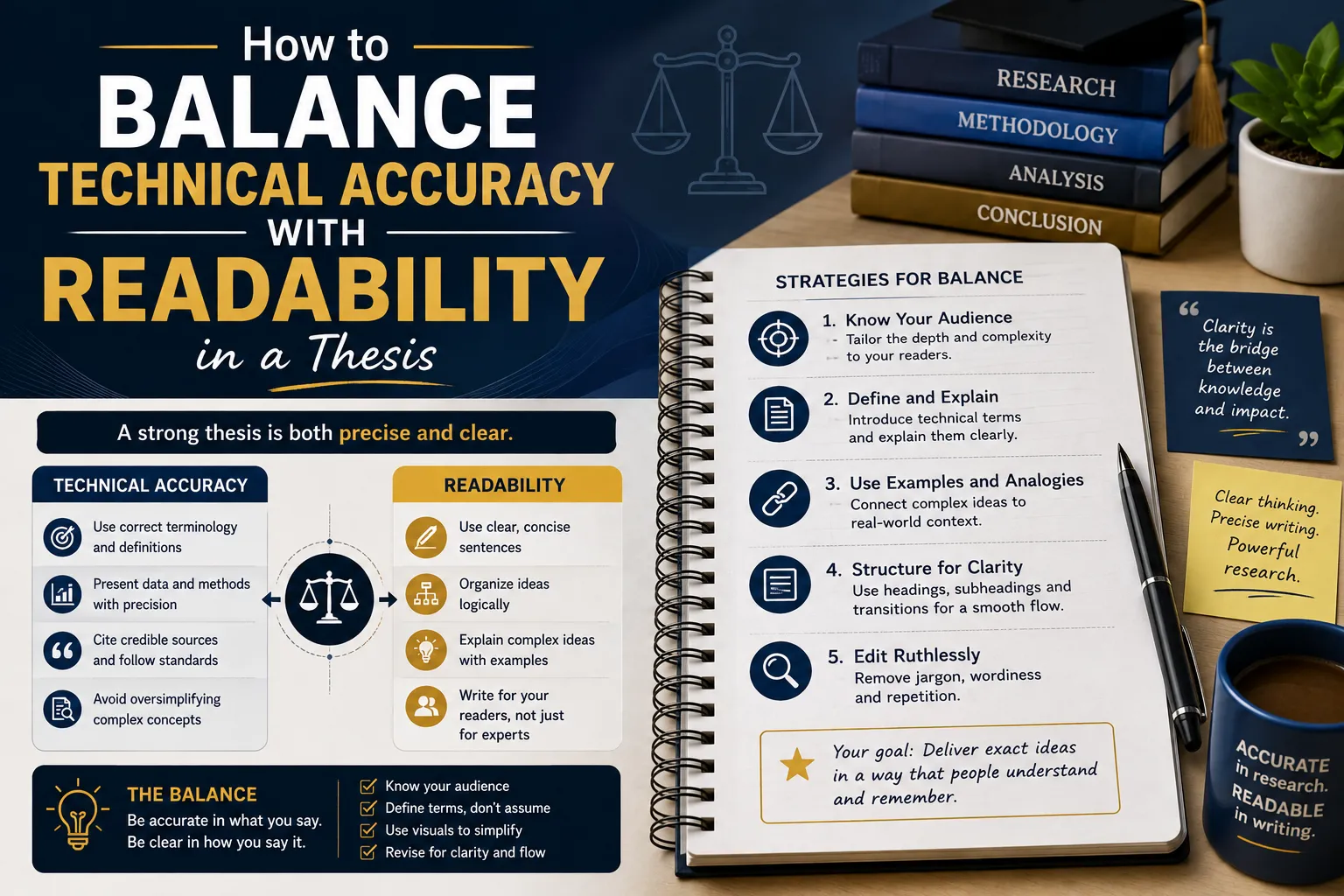
There's a persistent myth in academic writing that dense, jargon-heavy prose signals rigor, and that anything readable must be somehow less precise. Research on scientific writing consistently pushes back against this: good scientific writing is expected to be clear, precise, concise, and logically structured — with plain language and jargon avoidance treated as markers of skill, not a compromise on accuracy. Learning how to balance technical accuracy with readability in a thesis means understanding that these two goals aren't actually in tension the way they're often assumed to be; the real skill is precision expressed clearly, not precision buried under unnecessary complexity.
This guide walks through the specific techniques for keeping your thesis technically rigorous while genuinely readable, why "writing plainly" is harder than it sounds and doesn't happen automatically, and how to know when simplification has gone too far and cost you real precision. We've grounded this in current research on scientific readability and the patterns we see across scholars ThesisLikho supports through the writing and revision stage.
Why This Isn't Actually a Trade-Off
The assumption that technical accuracy and readability pull against each other is worth challenging directly, because it leads scholars to make bad choices in both directions — either producing dense, jargon-heavy prose in the name of rigor, or oversimplifying technical content to the point of genuine inaccuracy in the name of accessibility. Good scientific and academic writing treats clarity and precision as complementary goals: writing is expected to be clear, precise, concise, and to follow a logical progression of thought, with the explicit guidance to use plain language and avoid unnecessary jargon while still saying exactly what you mean.
The genuine tension isn't between accuracy and readability — it's between effort and readability. Dense, unrevised prose is often easier to produce than clear, precise prose; clarity generally requires more deliberate revision, not less rigor. Recognizing this reframes the whole task: you're not choosing between sounding rigorous and being understood, you're doing the harder work of achieving both.
The Surprising Truth: Plain Language Doesn't Happen Automatically
Here's a genuinely counterintuitive finding worth internalizing: research comparing plain-language summaries against their corresponding technical abstracts across six biomedical and life sciences journals found that the plain-language versions weren't consistently, meaningfully more readable than the technical originals — both versions, on average, exceeded recommended readability thresholds for their intended audiences. In other words, simply intending to write "plainly," or labeling something a simplified summary, doesn't automatically produce genuinely readable text without deliberate, technique-driven revision.
This matters for thesis writing specifically because it means readability isn't a mindset you adopt once and then naturally achieve — it's a set of concrete techniques (defining terms, managing sentence length, favoring active voice, restructuring for logical flow) that need to be deliberately applied and checked, not simply intended. A thesis chapter you believe you've "written clearly" may not actually be as readable as you assume unless you've specifically tested and revised for it.
Precision Versus Complexity: A Critical Distinction
The most useful mental shift for this balance is separating precision from complexity, since they're often conflated but genuinely aren't the same thing. Precision means saying exactly what you mean, with no ambiguity about what you're claiming or how confident you are in it. Complexity means using longer words, denser sentence structures, or more specialized vocabulary than the content actually requires. A sentence can be highly complex and still imprecise (vague despite its density), and a sentence can be genuinely simple and highly precise (clear and exact despite plain wording).
The practical implication: when revising for readability, your target isn't to reduce precision — it's to identify and remove complexity that isn't actually contributing to precision. Replacing "utilize" with "use," or breaking an overloaded 45-word sentence into two clearer ones, doesn't cost you accuracy; it removes complexity that was never adding precision in the first place.
Defining Technical Terms Without Interrupting Flow
Every discipline has genuinely necessary technical vocabulary that can't be simplified away without losing real meaning — the goal isn't eliminating these terms, it's making sure your reader can follow them. Define specialized or field-specific terms clearly the first time you use them, ideally in a brief parenthetical or a short defining clause rather than a lengthy digression that interrupts your argument's flow: "the study used discourse analysis (a method examining how language constructs meaning within social context) to..." keeps the sentence moving while still equipping an unfamiliar reader.
For terms you'll use repeatedly throughout your thesis, a glossary — either as a standalone section or integrated into your introduction — lets you define once and then use the term freely afterward without repeatedly re-explaining it, which keeps later chapters from feeling weighed down by recurring definitional interruptions.
Sentence Length and Structure for Technical Content
Long sentences aren't inherently more sophisticated or more precise — they're often simply harder to parse, particularly when they're carrying genuinely technical content that already demands real cognitive effort from the reader. A useful practical guideline: when a single sentence is doing more than one distinct job (stating a finding and qualifying it and connecting it to prior literature, all at once), consider whether splitting it into two or three sentences, each doing one job clearly, actually preserves more precision than cramming everything into one dense sentence a reader has to work to untangle.
This doesn't mean every sentence should be short — varied sentence length genuinely helps readability, and some ideas do need a longer, more complex sentence to express the relationship between their parts accurately. The goal is intentional length, not uniform brevity: choose sentence length based on what the specific idea requires, rather than defaulting to maximum density because it's the accepted convention in your field.
Active Voice and Its Role in Clarity
Active voice ("we tested three hypotheses") is generally more direct and easier to follow than passive voice ("three hypotheses were tested by us"), and favoring active voice where it doesn't compromise appropriate scientific convention is a consistently recommended technique for improving readability without sacrificing precision. This doesn't mean passive voice is wrong — it remains genuinely useful, particularly in methods sections where the action itself matters more than who performed it — but defaulting to active voice wherever it's a genuine choice, rather than passive voice as an unexamined habit, tends to make technical writing noticeably clearer.
The clarity benefit of active voice is particularly strong in your discussion and conclusion sections specifically, where being explicit about who is making a claim or interpretation — you, the researcher, versus prior literature, versus an established fact — genuinely matters for the reader's ability to follow your argument's structure.
When Jargon Is Genuinely Necessary
Not all specialized vocabulary is jargon in the pejorative sense — field-specific technical terms that carry precise, established meaning within your discipline are often the most accurate available language, and replacing them with a vaguer "plain" alternative can genuinely reduce precision rather than improve clarity. The distinction worth drawing: necessary technical terms are precise, established, and don't have an equally precise plain-language equivalent; unnecessary jargon is complexity for its own sake — inflated vocabulary, unnecessary Latin phrasing, or institutional habit-driven density that doesn't actually add meaning.
A practical test: for any specialized term or phrase, ask whether a simpler alternative would express exactly the same precise meaning. If yes, the simpler version is almost always the stronger choice. If no — if the technical term genuinely captures something a plain-language substitute would blur or lose — keep the technical term, but define it clearly on first use for readers outside your immediate sub-specialty.
Structuring Paragraphs for Readability Without Losing Rigor
Beyond sentence-level choices, paragraph-level structure matters considerably for readability in technical writing. Leading each paragraph with its main point, rather than building up to it through several sentences of context first, helps readers immediately understand what a paragraph is arguing before evaluating the supporting detail — a structure sometimes described as front-loading, and one that consistently improves comprehension in technical and scientific writing without requiring any simplification of the underlying content.
Explicit transitional signposting between paragraphs and sections — clearly indicating whether you're building on, contrasting with, or qualifying a previous point — helps a reader follow complex, technical argumentation without losing the thread, which matters more in dense technical content than in simpler prose, precisely because the reader already has more cognitive load to manage from the content itself.
Balancing Precision in Methods and Results Sections
Your methods and results sections carry a particular version of this balance: they need enough technical detail for genuine reproducibility, but excessive procedural minutiae can bury the genuinely important methodological choices under less critical detail. A useful practice: distinguish between details that are methodologically consequential (anything that could meaningfully affect how a reader interprets your results) and details that are procedurally necessary but less consequential (routine steps any competent researcher in your field would follow the same way) — give the first category full, precise attention in your main text, and consider moving extensive procedural detail that's necessary for reproducibility but less critical for interpretation into an appendix or supplementary material.
This keeps your main narrative readable and focused on what actually matters for understanding your findings, while still providing the full technical detail rigor and reproducibility require, just organized so it doesn't obscure your central argument.
Writing for Your Actual Reader, Not an Imagined Expert
A subtle but important shift: your actual thesis readers — your supervisor, your Research Advisory Committee, your examiners — are genuinely expert in your broad field, but they are not necessarily expert in the specific, narrow sub-area your thesis investigates in depth. Writing as though every reader shares your exact specialized knowledge, built up over years of focused work on this one narrow topic, tends to produce writing that's harder to follow even for genuinely qualified academic readers.
A useful frame: write for an intelligent, well-informed reader in your broad discipline who hasn't spent the last three years thinking specifically about your narrow research question the way you have. This standard keeps you appropriately technical — you don't need to explain foundational concepts in your field — while still requiring you to build the specific, narrower context your reader needs to follow your particular argument.
Testing Your Own Readability
Since intending to write plainly doesn't automatically produce readable prose, actively testing your draft is worth doing rather than relying purely on your own sense of clarity while writing. Reading a section aloud is a reliable, low-effort test — sentences that are hard to say smoothly are often hard to read smoothly too. Asking someone outside your specific sub-field (a labmate in a related but different area, for instance) to read a section and summarize what it's arguing is a genuinely revealing test of whether your writing actually communicates clearly, independent of your own familiarity with the content. And basic readability formulas, built into many word processors or available as standalone tools, can flag sections with unusually long average sentence length or unusually dense vocabulary — useful as a rough signal for where to focus a closer manual revision pass, though not a substitute for genuine human judgment about whether precision has been preserved.
Real Before-and-After Examples
Overly complex, jargon-heavy: "The utilization of a multifaceted methodological approach facilitated the elucidation of previously unexamined interrelationships between the variables under investigation." Clearer, equally precise: "Using a mixed-methods approach revealed previously unexamined relationships between the variables studied."
Overloaded single sentence: "The findings, which were derived from a sample of 250 respondents across three organizational contexts and analyzed using multiple regression while controlling for firm size and industry sector, suggest a significant positive relationship, although this relationship was notably weaker in the service sector subsample compared to manufacturing." Split for clarity, same precision: "The findings are based on a sample of 250 respondents across three organizational contexts, analyzed using multiple regression while controlling for firm size and industry sector. Results suggest a significant positive relationship overall, though this relationship was notably weaker in the service sector subsample than in manufacturing."
Necessary jargon, properly defined: "The study applied institutional isomorphism (the tendency of organizations within the same field to adopt similar structures and practices over time) as its guiding theoretical lens."
Common Mistakes When Balancing Accuracy and Readability
- Assuming dense, complex prose signals rigor, when it more often just signals unrevised writing.
- Oversimplifying to the point of genuine inaccuracy, stripping out technical terms that were actually carrying necessary precision rather than unnecessary complexity.
- Treating "writing plainly" as automatic once intended, rather than a deliberate, technique-driven revision process that needs active testing.
- Front-loading paragraphs with context instead of the main point, burying the key argument under supporting detail a reader has to wade through first.
- Overloading single sentences with multiple distinct claims, rather than splitting complex ideas into several clearer, individually precise sentences.
- Never testing readability externally, relying purely on your own sense of clarity despite genuinely being too close to your own writing to judge it accurately.
- Writing for an imagined super-expert reader, assuming a level of narrow familiarity even your actual, qualified examiners don't share.
- Cramming excessive procedural detail into main text, obscuring genuinely important methodological choices under routine, less consequential detail better suited to an appendix.
Readability and Accuracy Checklist
Before finalizing a thesis chapter, confirm you have:
- Checked that every technical term used is genuinely necessary, not complexity for its own sake
- Defined specialized or field-specific terms clearly on first use
- Reviewed sentences carrying multiple distinct claims for opportunities to split without losing precision
- Favored active voice where it doesn't compromise appropriate scientific convention, particularly in your discussion and conclusion
- Structured paragraphs to lead with the main point rather than building up to it
- Distinguished methodologically consequential detail (kept in main text) from routine procedural detail (candidate for an appendix)
- Written with an intelligent, broadly informed reader in mind, not an imagined narrow specialist
- Tested at least one section by reading aloud or having an outside reader summarize its argument
- Confirmed that any simplification made during revision preserved the original claim's precision
How Long Does It Take to Complete a Thesis Using This Approach?
A dedicated readability revision pass across a full thesis draft typically takes two to four weeks, best scheduled as a distinct stage after content and grammar revisions are largely settled, since readability editing works most effectively on text that's already structurally and factually close to final. Building in time specifically to test sections with an outside reader, rather than relying solely on self-assessment, is worth the additional week or so it typically adds, given how unreliable self-judgment of readability tends to be.
Is Professional Help Available to Balance Technical Accuracy With Readability in a Thesis?
Yes — many scholars work with academic mentors, professional editors, or research consultancies specifically to identify where dense or jargon-heavy writing is reducing clarity without adding genuine precision, and to revise technical content so it reads clearly without sacrificing rigor. ThesisLikho's PhD-qualified research experts have supported thesis writers through exactly this stage, helping ensure every chapter communicates complex, technically accurate research in a way examiners and readers can genuinely follow — all while keeping the underlying findings and arguments entirely your own. Explore ThesisLikho's thesis writing services for one-on-one guidance.
FAQs
How do you balance technical accuracy with readability in a thesis? S
eparate precision from unnecessary complexity, define technical terms clearly on first use, favor active voice and reasonably sized sentences carrying one clear idea at a time, structure paragraphs to lead with the main point, and actively test your writing's clarity with an outside reader rather than assuming plain intent automatically produces plain results.
How long does it take to complete a thesis using this approach?
A dedicated readability revision pass typically takes two to four weeks, best scheduled after content and grammar revisions are largely finalized, with additional time worth budgeting for outside-reader testing.
Is professional help available to balance technical accuracy with readability in a thesis?
Yes. Academic mentors, professional editors, and research consultancies, including ThesisLikho's PhD-qualified experts, help scholars revise technical content for clarity without sacrificing precision, while preserving full ownership of the underlying research.
Why should I balance technical accuracy with readability in a thesis carefully?
Because dense, hard-to-follow writing doesn't actually signal rigor — it can obscure genuinely strong research behind unnecessary complexity, while research shows that simply intending to write plainly doesn't automatically produce readable text without deliberate technique.
When should you balance technical accuracy with readability in a thesis for a thesis?
Treat readability as a distinct revision stage after your content and structure are largely settled, rather than trying to achieve both technical precision and clear prose simultaneously during initial drafting — this staged approach consistently produces stronger results than attempting both at once.
Ready to make your technically rigorous thesis genuinely readable?
Talk to a Thesis Expert → https://thesislikho.com/writing-services/thesis-writing