
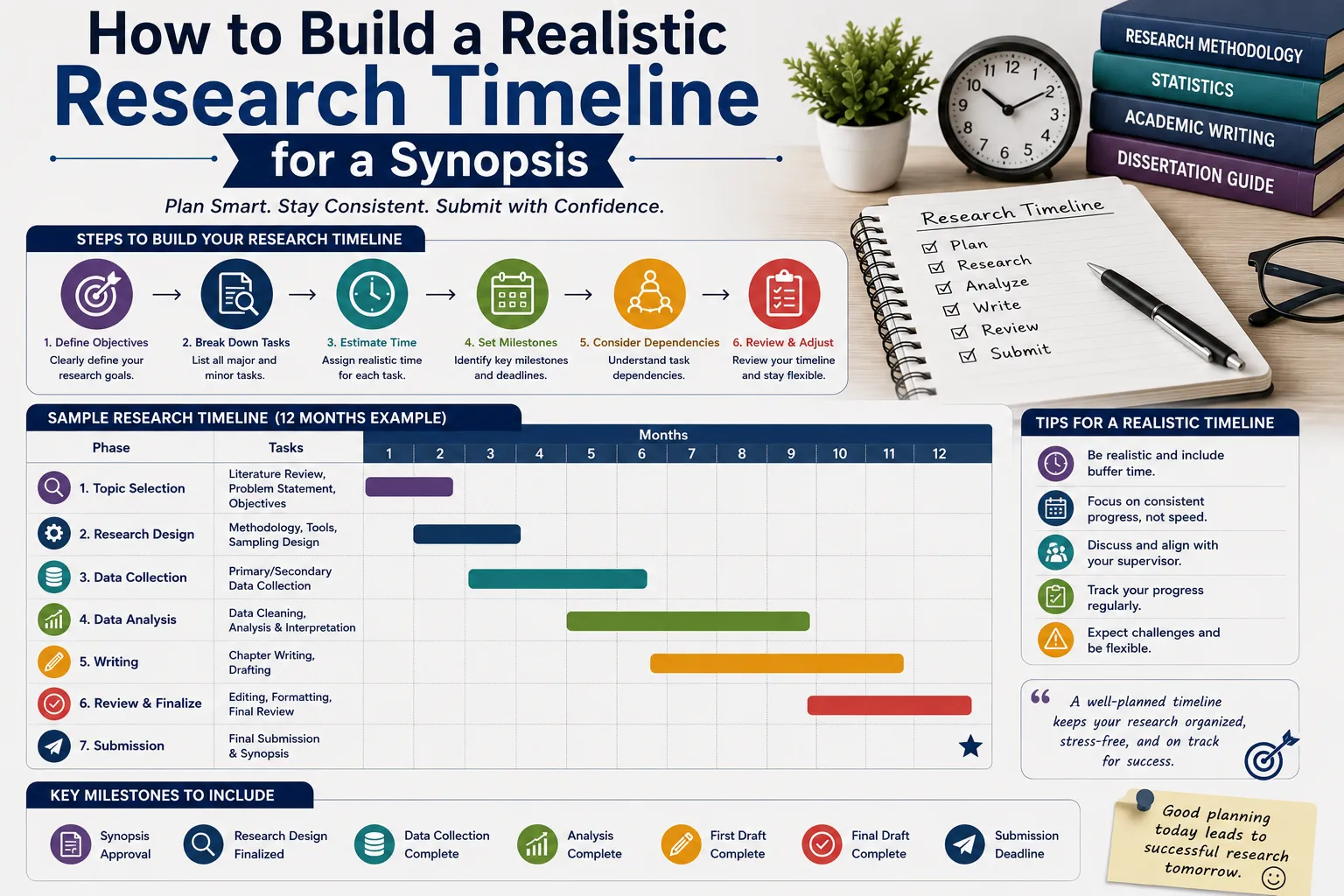
Every synopsis needs a timeline, and almost every first-time scholar gets the same thing wrong: they build one that looks tidy on paper and falls apart the moment real research begins. Learning how to build a realistic research timeline for a synopsis isn't about producing an impressive-looking schedule — it's about honestly estimating how long each phase of your research will actually take, building in buffer where things reliably go wrong, and giving your Doctoral Research Committee a plan they can actually believe.
This guide walks through the phases every research timeline needs, how much time to realistically allocate to each one, where timelines most commonly break down, and how to build a schedule that survives contact with real fieldwork. We've grounded this in current research timeline planning practice and the patterns we see across scholars ThesisLikho supports through the synopsis stage.
Why Your Timeline Matters Beyond Just Looking Organized
A research timeline in a synopsis does more than demonstrate that you've thought about scheduling — it's one of the concrete ways your Doctoral Research Committee evaluates whether your proposed research is actually feasible within a normal PhD duration. A synopsis with strong objectives and a well-designed methodology can still draw committee pushback if the accompanying timeline looks unrealistic, since an infeasible schedule raises doubts about whether the underlying research plan has been genuinely thought through.
Beyond committee approval, the timeline you build now becomes the working document you'll actually track your own progress against for the next several years — which is exactly why building an honest one matters more than building an impressive-looking one.
The Six Phases Every Research Timeline Needs
Most PhD research timelines, regardless of discipline, break down into six recognizable phases: research design and planning, where you finalize your topic, objectives, and methodology; literature review, where you build the scholarly foundation and identify your research gap; data collection, where you gather your primary or secondary data; data analysis, where you process and interpret what you've collected; writing up, where you draft your full thesis chapters; and viva preparation and defence, the final stage before completion.
Your synopsis timeline doesn't need to plan every phase in exhaustive detail — much of that detail will only become clear once you're actually in the middle of the research — but it does need to show a scholar has thought through how these six phases will unfold across a realistic multi-year period, with rough duration estimates for each.
How Much Time Each Phase Realistically Deserves
While exact proportions vary considerably by discipline, methodology, and individual project, a rough allocation across a typical three-to-five-year Indian PhD timeline looks something like this: research design and planning, including synopsis preparation itself, often takes the first three to six months. Literature review continues throughout the first year and often extends into later years as new sources emerge, though the bulk of the initial review is usually completed within the first twelve to eighteen months. Data collection is highly variable depending on methodology — a single-case qualitative study might take three to six months, while a large-scale multi-site quantitative study or a longitudinal design can take a year or more. Data analysis typically follows data collection by several months, sometimes overlapping with it for qualitative studies using iterative analysis approaches. Writing up is often allocated a full year or more in realistic plans, even though many first-time scholars badly underestimate this stage. Viva preparation typically needs a dedicated final few months after the full draft is complete.
These proportions are a starting point, not a formula — your specific methodology, data access, and institutional requirements should shape your actual allocation, but understanding roughly how PhD time typically distributes across these six phases helps you sanity-check whether your own plan is in a realistic range.
The Two Phases That Blow Every Timeline
If there's one lesson experienced supervisors repeat most often about research timelines, it's this: data collection and writing are the two phases most likely to run over schedule, consistently, across nearly every discipline and methodology. Data collection overruns for reasons that are often outside a scholar's direct control — participant recruitment takes longer than expected, organizational access gets delayed, ethics approval takes longer than the initial estimate, or a data source turns out to be less complete than assumed. Writing overruns because it's genuinely difficult, cognitively demanding work that scholars — like most people — tend to underestimate, particularly when a full draft needs multiple rounds of supervisor feedback and revision before it's submission-ready.
Knowing this in advance is exactly why realistic timeline-building means building deliberately generous buffers into these two specific phases, rather than treating your first estimate as accurate and hoping everything goes according to plan.
Building Buffer Into Your Plan
A timeline built with zero slack is a timeline that will fail the moment anything goes even slightly wrong — and in multi-year research, something always does. Practical buffer-building means adding roughly 20 to 30 percent extra time to your estimates for data collection and writing specifically, since these are the phases most consistently underestimated; explicitly accounting for institutional delays — ethics committee review, DRC feedback cycles, supervisor availability — which are rarely under your direct control but reliably take real time; and building in a dedicated revision period after each major chapter draft, rather than assuming your first draft of any chapter will be your last.
This isn't pessimism — it's the difference between a timeline that looks reassuring on paper and one that actually reflects how research unfolds in practice. A timeline is a planning tool, not a rigid contract, and most research projects experience some delay along the way; building buffer in from the start is what keeps normal, expected delays from becoming genuine crises.
Working Backward From Your Deadline
One reliable way to build a realistic timeline is working backward from your actual submission deadline rather than only working forward from today. Start with your final submission date, subtract a dedicated viva preparation period, then subtract realistic writing time (with buffer), then subtract data analysis time, then data collection time (with buffer), then literature review and design time — checking at each step whether the resulting start date for that phase is actually achievable given where you are right now.
This backward-planning approach often reveals timeline problems immediately and clearly — if working backward from your deadline puts your data collection start date in the past, that's an unambiguous sign your current plan doesn't fit your actual timeframe, and something needs to be either compressed, cut, or your overall timeline reconsidered before your synopsis is submitted, not discovered partway through the research itself.
Matching Your Timeline to Your Methodology
Your timeline needs to reflect the specific demands of your chosen methodology, not a generic template. A single-case qualitative study with an organization you already have strong access to can realistically move through data collection faster than a multi-site quantitative survey requiring cold outreach to unfamiliar organizations. A study depending on secondary government data may need very little dedicated data collection time at all, but should budget real time for locating, cleaning, and understanding that data's original collection methodology. A longitudinal design, tracking a phenomenon over multiple time points, needs a data collection phase that literally cannot be compressed below the minimum interval your design requires, regardless of how tight your overall timeline is.
If your timeline doesn't obviously reflect the specific methodological choices you've made elsewhere in your synopsis, that mismatch is exactly the kind of inconsistency a DRC is likely to flag.
Presenting Your Timeline in a Synopsis
Most synopses present the timeline as either a simple phase-by-phase written breakdown or, increasingly, as a visual Gantt chart — a horizontal bar chart showing each phase's start and end point across your overall research period. Many universities now expect or explicitly require a Gantt chart or equivalent visual timeline as part of the synopsis, since it communicates feasibility and plan structure more clearly, at a glance, than a written paragraph alone.
Whether you present your timeline as text or as a visual chart, keep it proportional to your synopsis's overall length — a single clear page is usually sufficient, showing your six major phases with rough durations, without needing to break every phase down into granular weekly detail your committee doesn't need to see at this stage. For guidance on whether and how to build the visual version specifically, see our related guide, Gantt charts in a synopsis: do you really need one.
Writing Early: The Single Best Timeline Habit
The single most effective way to protect your overall timeline from collapsing is writing throughout your research process rather than treating writing as something that only begins once every phase of data collection and analysis is complete. Scholars who draft literature review sections, methodology descriptions, and even early findings summaries as they go — rather than saving all writing for a dedicated final year — consistently report less painful, less compressed final writing stages, since much of the writing work is effectively already done by the time formal "writing up" begins.
Building this habit into your timeline explicitly — allocating small, regular writing blocks throughout the earlier phases rather than treating writing as a single, isolated final phase — is one of the most practical, high-leverage adjustments you can make to an otherwise standard six-phase plan.
Revisiting Your Timeline After Approval
A synopsis timeline isn't the last version of your schedule you'll ever produce — it's the first. Once your synopsis is approved and research actually begins, treating your original timeline as a living document rather than a fixed contract is what separates scholars who manage delays gracefully from those who feel blindsided by them. A practical habit worth building from the start: revisit your timeline at each major milestone (end of literature review, completion of data collection, first full chapter draft) and honestly compare actual progress against your original estimates.
When a phase runs longer than planned — and for data collection and writing specifically, it very often will — the useful response isn't panic or an attempt to silently make up the lost time by compressing a later phase unrealistically. It's an honest, updated timeline, ideally discussed with your supervisor, that reflects what's actually been learned about how your specific research is unfolding. Many DRCs expect and accommodate reasonable timeline adjustments during a PhD's progress review stages, provided the original synopsis timeline was built with genuine care and the adjustment is well-justified rather than a sign of poor initial planning.
Real Timeline Examples
Example 1 — A well-buffered quantitative timeline.
A scholar studying supply chain digitalization built her synopsis timeline with six months for design and literature review, four months for ethics approval and survey distribution (against an initial estimate of two months, deliberately doubled after her supervisor flagged how often ethics approval runs long), three months for data analysis, twelve months for writing with built-in revision cycles after each chapter, and a final three months for viva preparation — totaling a realistic four-year plan with clear buffer visible in the two historically riskiest phases.
Example 2 — A timeline exposed by working backward.
A scholar initially drafted a timeline allocating only four months total for data collection and analysis combined, on a qualitative study requiring interview access to a specific set of hard-to-reach senior executives. Working backward from her intended submission date revealed that her data collection phase, as planned, would need to begin before her literature review was even complete — an obvious inconsistency that led her to either extend her overall timeline or substantially compress her literature review phase. She chose to extend her overall proposed timeline by eight months, presenting the revised, more realistic plan to her DRC rather than submitting a synopsis with a schedule that didn't actually work.
Common Mistakes When Building a Research Timeline
- Copying a generic timeline template without adjusting phase durations to reflect your specific methodology and data access.
- Allocating equal time to every phase, rather than recognizing that data collection and writing typically need more time — and more buffer — than the other phases.
- Building a timeline with zero slack, leaving no room for the institutional delays and setbacks that are a normal, expected part of research.
- Treating writing as a single final phase rather than something that begins early and continues throughout the research process.
- Not working backward from the actual deadline to sanity-check whether the forward-planned phases genuinely fit within the available time.
- Presenting an overly granular, weekly-level timeline in a synopsis, when the DRC needs to see overall feasibility, not exhaustive scheduling detail better suited to your own personal tracking document.
- Ignoring methodology-specific constraints, such as a longitudinal design's minimum required time between data points, when estimating phase durations.
- Never revisiting the timeline after synopsis approval, treating the original plan as fixed rather than as a living document to be honestly updated as the research actually unfolds.
Research Timeline Checklist
Before finalizing your synopsis timeline, confirm you have:
- All six major research phases represented, even if described briefly
- Duration estimates that reflect your specific methodology, not a generic template
- Deliberate buffer built into your data collection and writing phase estimates
- A check that working backward from your submission deadline confirms the plan is actually feasible
- Explicit allowance for institutional delays such as ethics approval and DRC feedback cycles
- Early, regular writing built into the plan rather than concentrated entirely in a final phase
- A visual or written format proportional to your synopsis's overall length and your university's expectations
- Consistency between your timeline and the methodology described elsewhere in your synopsis
For guidance on how your overall research plan should be broken into thesis chapters — closely related to, but distinct from, your timeline — see our related guide, how to create a chapterization plan for a PhD synopsis.
How Long Does It Take to Complete a Synopsis Using This Approach?
Building a genuinely realistic timeline typically takes one to two weeks of focused work, mainly because it requires talking through phase estimates with your supervisor and, ideally, checking them against how similar studies in your specific sub-field have actually unfolded. This upfront investment is worth it: scholars who submit an honestly buffered timeline generally face fewer disruptive schedule crises later, compared to those who submit an optimistic, unbuffered plan that starts falling apart within the first year.
Is Professional Help Available to Build a Realistic Research Timeline for a Synopsis?
Yes — many scholars work with academic mentors or research consultancies to sanity-check their proposed timeline against realistic phase durations for their specific methodology, and to build appropriate buffer into the stages most likely to run long. ThesisLikho's PhD-qualified research experts have supported synopsis writers through exactly this stage, helping ensure every proposed timeline is both genuinely feasible and convincing to a Doctoral Research Committee — all while keeping the underlying research plan entirely your own. Explore ThesisLikho's synopsis writing services for one-on-one guidance.
FAQs
How do you build a realistic research timeline for a synopsis?
Break your research into six phases — design, literature review, data collection, data analysis, writing, and viva preparation — estimate each phase honestly based on your specific methodology, build deliberate buffer into data collection and writing since these phases most commonly overrun, and check your plan by working backward from your actual submission deadline.
How long does it take to complete a synopsis using this approach?
Building a genuinely realistic timeline typically takes one to two weeks, mainly involving discussion with your supervisor to validate phase estimates against how similar studies have actually unfolded in your field.
Is professional help available to build a realistic research timeline for a synopsis?
Yes. Research consultancies and academic mentors, including ThesisLikho's PhD-qualified experts, help scholars build feasible, appropriately buffered research timelines while preserving full ownership of the underlying research plan.
Why should I build a realistic research timeline for a synopsis carefully?
Because an unrealistic timeline can draw committee pushback even when the rest of your synopsis is strong, and because the timeline you submit becomes the actual working plan you'll be tracking your own progress against for years — a poorly built one sets up avoidable stress and delay well beyond the synopsis stage itself.
When should you build a realistic research timeline for a synopsis for a synopsis?
Build your timeline only after your research design and methodology are largely finalized, since a realistic timeline depends on knowing roughly what your data collection and analysis will actually involve — building it earlier usually means having to substantially revise it once your methodology is settled.
Ready to build a timeline your committee will actually believe?
Get Synopsis Help Now → https://thesislikho.com/writing-services/synopsis-writing