
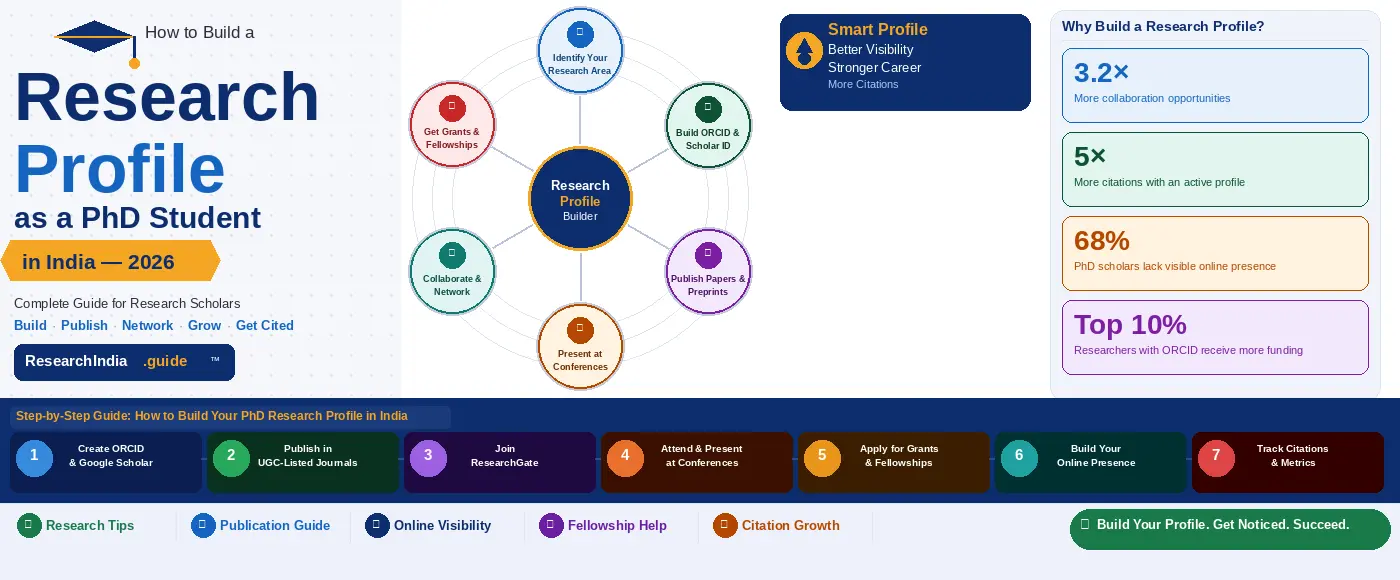
Introduction
PhDs in India are an exciting yet challenging time in your academic career. Learning how to build a strong research profile is paramount. As an early career researcher, a strong profile increases your reputation and expands your options for future career positions. These options include postdoc opportunities, faculty positions, positions in industry, and positions in government and private sector research.
The future is bright for Indian PhD students. By 2026, there will be more global opportunities to engage with digital platforms, publish in open access journals, and collaborate across the globe. This blog post (around 2000 words) describes how to build a research profile with a practical guide.
1. What is a Research Profile?
A research profile is an academic identity. It encompasses:
Your papers, research, and talks.
Collaborations.
Your academic networks.
Your teaching and mentoring.
Your outreach and academic service.
Use of academic networks.
Research profiles are professional brands of academic identity.
2. Research Publications
Your Papers Have to Go Somewhere
Research papers should go in UGC CARE journals.
Research papers published in Scopus Indexed and Web of Science journals are considered published internationally.
Be careful of predatory journals.
Research Papers should be Published Frequently
Research papers should be original and clear.
Focusing on exclusive research papers is imperative.
Ask your supervisor, mentor, and peers for critical feedback and suggestions.
Use Turnitin for your papers and for plagiarism.
Variety is Important
Research papers should be published in national and international journals.
Papers should be published as book chapters and as edited volumes.
Papers should be shared as preprints in arXiv and bioRxiv or in Open Science Framework (OSF).
3. Presenting at Conferences
National Conferences
Go to IITs, IISc, CSIR labs, and central universities organized events.
Visibility comes from presenting posters and papers.
International Conferences
Travel grants from UGC, DST, and ICSSR may be applied to.
Presenting internationally is a boost to the global aspect of your profile.
Networking Opportunities
Creating a network of peers, future collaborators, and potential employers is just as important as presenting.
4. Building an Online Academic Presence
ResearchGate & Academia.edu
Post publications and preprints online.
Participate in forums and respond to questions.
ORCID ID
Setting up your free and unique ORCID profile is a great way to establish your online presence as a researcher.
Add links to all your publications, grants, and/or affiliations.
Google Scholar Profile
H-index and citation counting profiles.
Keep your profile current with all your published works.
Online CV with an emphasis on your academic accomplishments.
Make connections with professionals and researchers to expand your network and develop interdisciplinary collaborations.
5. Collaborating with Other Researchers
Visibility and quality of your work is also strengthened through collaboration.
Join research groups at your own or other institutions.
Cross discipline collaboration is key to working on novel and exploratory projects.
Overleaf and GitHub are excellent tools to facilitate collaborative writing and coding.
6. Applying for Grants and Fellowships
Applying for grants and fellowships is an easy way to add funding to your profile.
Grants and fellowships that are prestigious and in demand are UGC JRF/SRF, CSIR fellowships, ICSSR grants, and projects from the DST.
Fulbright-Nehru, DAAD, and Commonwealth fellowships are great and prestigious international fellowships to apply for.
Even applying for small travel grants shows that you are active and engaged.
7. Teaching and Mentorship
Teaching others is a highly regarded method for building your academic credentials.
Teaching undergraduates by assisting other faculty members is one way to gain teaching experience.
Mentoring lab students is also a great way to gain experience.
Another way to gain experience is to teach a research methods course by holding a webinar or a workshop.
8. Using Digital Tools to Enhance Research
Zotero/Mendeley: Great for citation management.
Tableau/Power BI: Tools for data visualization.
Grammarly/QuillBot: Tools that support the writing process by improving writing.
Elicit/Connected Papers: Tools for literature reviews that integrate
These tools improve your research and help you acquire the skills you need to be digitally literate.
9. Open Science Initiatives
An Open Science movement is steadily building in India. You can be part of it.
Use Zenodo or the Open Science Framework (OSF) to host your datasets.
Start publishing in Open Access journals.
Join Citizen Science initiatives to see and be part of the science in action.
10. Finding the Right Balance
Publishing lots of papers is not what builds a strong profile. Impactful papers do.
Always choose the right journals and the right opportunities to build your profile and publish papers.
Establish yourself as a trustworthy researcher.
Research Profile Frequently Asked Questions
1. How many papers should a PhD student publish?
Aim for 2 or 3 high impact publications in quality journals to build a strong research profile.
2. Do I have to attend international conferences?
Not really, but it is highly encouraged. Other researchers attend and you get the opportunity to network and build your profile.
3. Is it appropriate to publish in Open Access journals?
You can, but only if they are reputable and indexed in Scopus and the Web of Science or the UGC CARE list.
4. Is an ORCID ID necessary?
Yes, it is important to get one to uniquely identify you, there will not be a mix up like with researchers of the same name.
5. Will collaborating with industry strengthen my research profile?
Yes, applied research makes your profile stronger.
6. Do citations really matter during my PhD?
Yes, they do and citations will be how you are evaluated as well.
7. How do I know if a journal is predatory?
You should use the UGC CARE list and also use research tools like Think. Check. Submit. to help determine if a journal is legitimate.
8. Do you need to have teaching experience to build your profile?
Teaching experience is expected for academic roles. It shows your ability to support students as well as to convey ideas.
9. Is building a research profile with the help of social media possible?
Yes. Research can be shared and updated in real time, creating additional peer connections on both Twitter and LinkedIn.
10. What is the biggest mistake in building a profile which PhD students commit?
It is solely relying on the number of publications and avoiding all other aspects such as networking, teaching, and grant writing.
Conclusion
Creating a research profile in India as a PhD student is an extensive process. Profile creation is not limited to research publications. It also includes the various professional networking and collaborative activities you have engaged in. A unique and extensive profile can be created through grant writing, teaching and student mentoring, validated research publications, conference presentations, an active social media presence for research, and participation in and support of the open research movement. It can be both a nationally and internationally recognized profile.
The year 2026 will be significant for many Indian PhD students, as it will create many new avenues for researchers to be actively engaged and to clearly present their research activities. If well planned, frequent networking and professional collaboration, active participation of an open researcher, validated publications, grant and research activities, conference presentations, an active social media presence for research, and participation in and support of the open research movement will create numerous opportunities for an extensive and innovative profile for newly minted PhD students in India.
ThesisLikho supports scholars throughout the dissertation process helping them turn research ideas into quality academic contributions that meet university and publication standards.
Contact ThesisLikho
Website: www.ThesisLikho.com
Call/WhatsApp: +91 96438 02216