
Introduction
Submitting a PhD thesis is one of the most important milestones in a research scholar's academic journey. Years of literature review, data collection, analysis, and writing culminate in a document that represents a scholar's original contribution to knowledge. However, before a thesis can be submitted for evaluation, it must pass an equally important requirement—plagiarism checking.
In India, universities are increasingly adopting strict academic integrity policies in line with the University Grants Commission (UGC) regulations. Most institutions now require scholars to submit a plagiarism report generated through professional plagiarism detection software, with Turnitin being the most widely used platform.
Many PhD scholars understand the importance of plagiarism checks but remain unsure about how Turnitin works, how similarity reports are interpreted, and what steps should be taken if the similarity score is too high.
This comprehensive guide explains everything Indian PhD scholars need to know about checking plagiarism in a thesis using Turnitin in 2026. Whether you are preparing for final submission, publication, or pre-submission review, this article will help you navigate the process confidently.
What Is Turnitin?
Turnitin is one of the world's most trusted plagiarism detection platforms used by universities, colleges, and research institutions.
The software compares submitted documents against a massive database that includes:
- Academic journals
- Books
- Research papers
- Conference proceedings
- Internet sources
- Institutional repositories
- Previously submitted student papers
After analyzing the document, Turnitin generates a Similarity Report that highlights matching text and identifies potential sources.
It is important to understand that Turnitin does not directly determine plagiarism. Instead, it identifies textual similarities that require human interpretation.
Why Indian Universities Use Turnitin for PhD Theses
Several reasons explain Turnitin's widespread adoption across Indian universities.
Maintaining Academic Integrity
Universities must ensure that research contributions are original and properly referenced.
Compliance with UGC Guidelines
Many institutions follow UGC regulations regarding plagiarism assessment before thesis submission.
Preventing Research Misconduct
Turnitin helps identify:
- Direct copying
- Improper paraphrasing
- Missing citations
- Self-plagiarism
Improving Research Quality
Scholars can use similarity reports to revise and improve their work before final submission.
Understanding Plagiarism in a PhD Thesis
Before learning how to use Turnitin, it is essential to understand what plagiarism actually means.
Plagiarism occurs when a researcher uses another person's:
- Words
- Ideas
- Data
- Images
- Graphs
- Findings
without proper acknowledgment.
Common forms include:
Direct Plagiarism
Copying text word-for-word.
Mosaic Plagiarism
Mixing copied content with minor changes.
Improper Paraphrasing
Changing a few words while retaining the original structure.
Self-Plagiarism
Reusing one's previously published work without citation.
Source-Based Plagiarism
Incorrectly citing or misrepresenting sources.
Can Individual Students Access Turnitin?
One of the most common questions among Indian scholars is whether they can create a Turnitin account independently.
The answer is generally no.
Turnitin primarily operates through institutional subscriptions.
Access is usually provided through:
- Universities
- Colleges
- Research institutions
- Libraries
- Academic departments
Most PhD scholars access Turnitin through their university credentials or supervisor's account.
Ways to Access Turnitin in India
Through Your University
The most common method.
Many universities provide access via:
- Research departments
- Central libraries
- Examination cells
- Academic portals
Through Supervisors
Some supervisors have access to departmental Turnitin accounts.
Through Research Centers
Research support centers may offer plagiarism checking services.
Through Institutional Partnerships
Many institutions subscribe to Turnitin under consortium agreements.
Preparing Your Thesis Before Running Turnitin
Proper preparation ensures more accurate results.
Finalize Major Revisions
Avoid running Turnitin on incomplete drafts whenever possible.
Check Citations
Ensure all references are included.
Organize Chapters
Keep chapter formatting consistent.
Verify Reference Lists
Incomplete references often increase similarity issues.
Remove Unnecessary Draft Material
Exclude notes and comments that are not part of the final thesis.
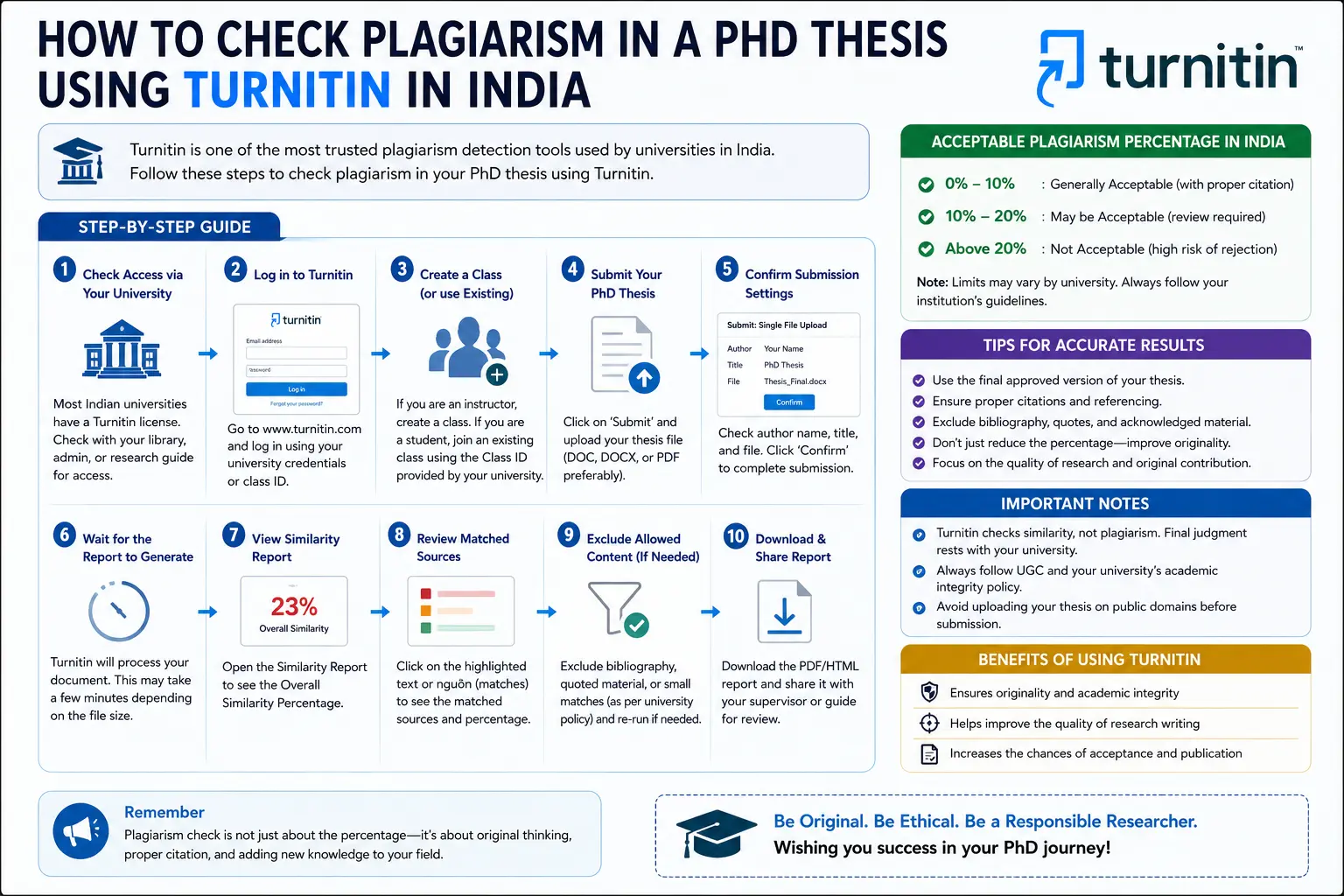
Step-by-Step Guide to Checking a PhD Thesis in Turnitin
Step 1: Log In to Turnitin
Access the institutional portal using credentials provided by your university.
Many institutions integrate Turnitin with learning management systems such as:
- Moodle
- Blackboard
- Canvas
Step 2: Create or Access an Assignment Folder
Depending on institutional settings, your supervisor or administrator may create a submission folder.
Select the appropriate thesis submission category.
Step 3: Upload Your Thesis
Turnitin accepts several formats including:
- DOC
- DOCX
Upload the complete thesis or individual chapters, depending on university requirements.
Step 4: Confirm Submission Settings
Some institutions customize settings such as:
- Excluding bibliographies
- Excluding quotations
- Excluding small matches
These settings affect similarity percentages.
Step 5: Submit the Document
After uploading, Turnitin begins processing the file.
Processing times vary based on:
- Document length
- Server load
- Institutional settings
Large PhD theses may require additional time.
Step 6: Generate Similarity Report
Once processing is complete, Turnitin generates a Similarity Report.
This report becomes the primary tool for evaluating originality.
Understanding the Turnitin Similarity Report
Many scholars panic when they see a percentage score.
However, similarity does not automatically mean plagiarism.
The report contains several key components.
Similarity Percentage
This indicates the amount of matching text identified.
For example:
- 8% similarity
- 15% similarity
- 25% similarity
The percentage alone does not determine whether plagiarism exists.
Source Matches
Turnitin highlights matching text and identifies sources.
Matches may come from:
- Published journals
- Websites
- Books
- Student papers
Color Indicators
Turnitin typically uses color coding:
Blue
Minimal similarity
Green
Low similarity
Yellow
Moderate similarity
Orange
High similarity
Red
Very high similarity
These indicators provide quick visual assessment.
What Is an Acceptable Similarity Score for a PhD Thesis?
There is no universal standard.
Different universities establish their own thresholds.
However, many Indian institutions prefer lower similarity percentages.
General guidance:
Below 10%
Excellent originality
10–15%
Usually acceptable
15–20%
May require review
Above 20%
Often requires revisions
Above 30%
Usually considered problematic
Context matters more than percentages.
A well-cited thesis with a 15% similarity score may be preferable to a poorly cited thesis with a 5% score.
UGC Regulations and Plagiarism
The UGC has established regulations aimed at maintaining academic integrity.
Universities often classify plagiarism based on similarity levels.
Penalties may vary depending on:
- Degree of overlap
- Intentionality
- Nature of copied material
Institutions may require scholars to reduce similarity before final submission.
Researchers should always consult their university's latest plagiarism policy.
Common Reasons for High Similarity Scores
Many legitimate factors contribute to similarity.
Literature Reviews
Frequently cited theories often generate unavoidable matches.
Technical Terminology
Scientific terms cannot always be paraphrased.
Standard Methodologies
Research procedures often use established descriptions.
Reference Lists
Bibliographies may contribute to similarity.
Previously Published Work
Self-plagiarism can increase scores.
How to Reduce Similarity Before Submission
Improve Paraphrasing
Rewrite ideas in your own words while preserving meaning.
Example
Instead of changing only a few words, restructure entire sentences.
Add Proper Citations
Ensure every borrowed idea has appropriate references.
Use Quotations Correctly
Directly copied text should appear within quotation marks.
Synthesize Multiple Sources
Rather than describing studies individually, integrate findings into broader discussions.
Review Self-Plagiarism
Cite your previously published work whenever reused.
Should You Exclude References and Quotations?
Most universities allow exclusion of:
Bibliography
Reference sections often contain unavoidable matches.
Quotations
Properly quoted material is generally excluded.
Small Matches
Minor overlaps may not be significant.
Exclusions help create a more meaningful similarity assessment.
Interpreting Turnitin Results Correctly
Many researchers focus exclusively on percentages.
This is a mistake.
Always examine:
Source Quality
Where are matches coming from?
Context
Are citations present?
Match Size
Is the overlap significant?
Nature of Content
Does it involve technical language or copied paragraphs?
A thoughtful review is far more valuable than chasing an arbitrary percentage.
Common Mistakes PhD Scholars Make
Submitting Without Checking
Always review your thesis before official submission.
Ignoring Self-Plagiarism
Published conference papers and journal articles must be cited.
Overusing Direct Quotations
Excessive quoting can inflate similarity.
Focusing Only on Percentage Scores
Quality of matches matters more than numbers.
Trusting Automated Reports Completely
Human judgment remains essential.
Can Turnitin Detect AI-Generated Content?
In 2026, many institutions are also concerned about AI-assisted writing.
Turnitin has introduced AI writing detection features aimed at identifying content generated by tools such as ChatGPT.
However:
- AI detection is not perfect.
- False positives occur.
- Human review remains necessary.
Researchers should use AI responsibly and ensure their work reflects genuine scholarly contributions.
Best Practices Before Final Thesis Submission
Run Multiple Checks
Review similarity reports after major revisions.
Keep Draft Records
Maintain writing histories and notes.
Consult Your Supervisor
Discuss problematic sections early.
Review Every Match
Do not rely solely on percentages.
Focus on Academic Integrity
Original thinking matters more than similarity scores.
Future of Plagiarism Detection in India
Academic integrity systems continue to evolve.
Emerging developments include:
AI-Assisted Similarity Analysis
Detection of conceptual similarities.
Citation Verification
Automated reference checking.
Research Integrity Platforms
Integrated tools combining:
- Plagiarism detection
- AI detection
- Citation analysis
- Publication verification
These technologies will make research evaluation even more comprehensive in the coming years.
Conclusion
Checking plagiarism in a PhD thesis using Turnitin is no longer merely a procedural requirement—it is an essential component of responsible research practice. As Indian universities strengthen academic integrity standards and adopt advanced plagiarism detection systems, scholars must understand how similarity reports work and how to interpret them correctly.
Turnitin provides valuable insights into textual overlap, but it is ultimately the researcher's responsibility to ensure originality, proper citation, and ethical writing. By preparing your thesis carefully, reviewing similarity reports thoughtfully, and addressing problematic sections before submission, you can significantly improve the quality and credibility of your research.
Remember, the objective is not to achieve a perfect zero similarity score. The true goal is to produce a thesis that reflects genuine scholarship, original thinking, and respect for academic ethics.
Frequently Asked Questions (FAQs)
Can I use Turnitin without a university account in India?
Generally, Turnitin access is provided through universities and institutions rather than individual subscriptions.
What similarity percentage is acceptable for a PhD thesis?
Requirements vary by institution, but many universities prefer similarity scores below 10–15%.
Does Turnitin detect self-plagiarism?
Yes. It can identify overlap with your previously submitted or published work.
Can Turnitin detect AI-generated content?
Turnitin offers AI writing detection features, although results should always be reviewed carefully.
Should references be excluded from Turnitin reports?
Many institutions allow exclusion of bibliographies and quotations for more accurate similarity assessment.
Is a high similarity score always plagiarism?
No. Similarity indicates matching text, but proper citations and context determine whether plagiarism exists.
Contact ThesisLikho Today
Call / WhatsApp: +91 96438 02216
Visit: ThesisLikho.com