
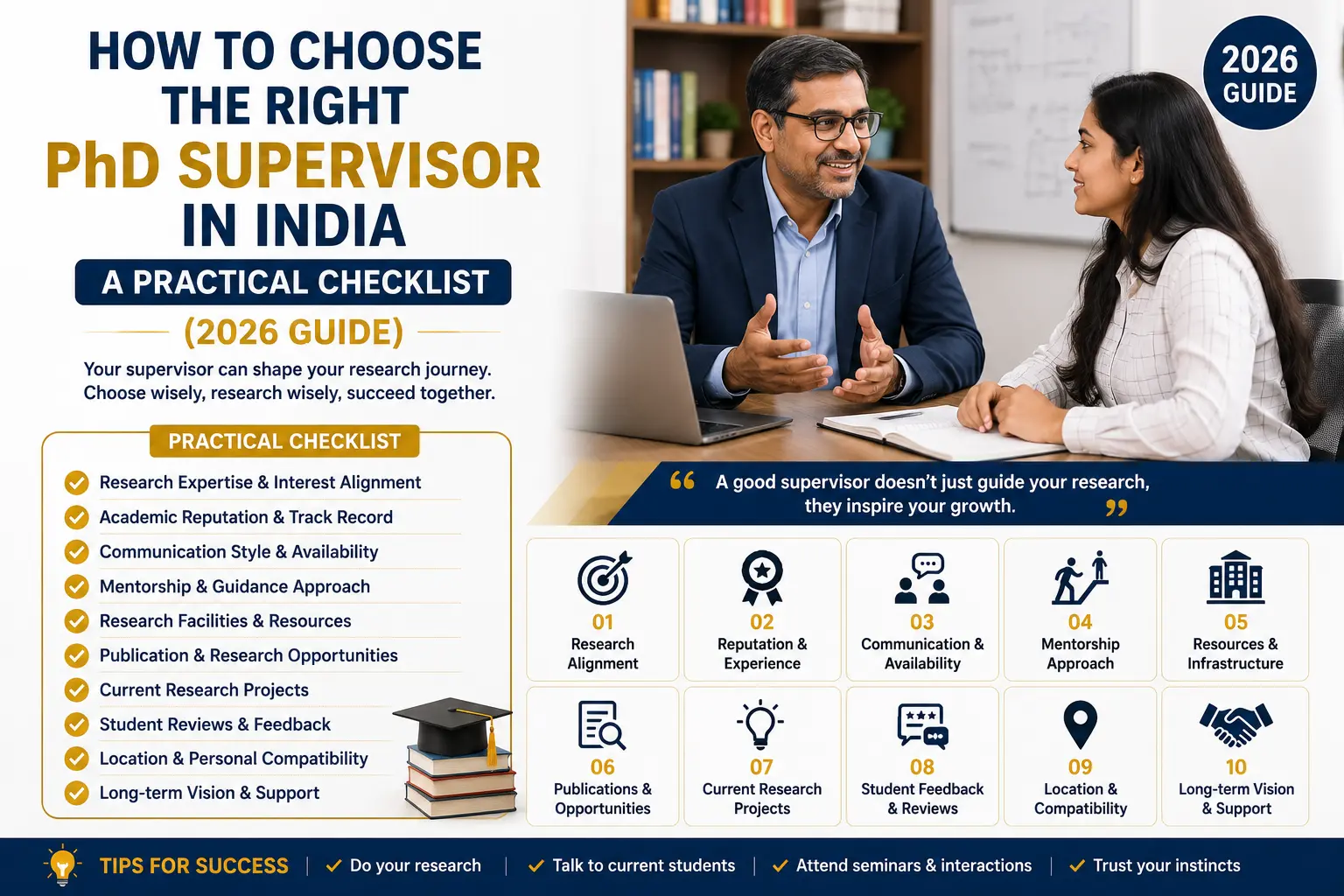
Choosing a PhD supervisor is one of the most important decisions in your doctoral journey. While many students focus heavily on selecting the right university, research topic, or funding opportunity, the reality is that your PhD supervisor can significantly influence your academic progress, research quality, publication record, and overall doctoral experience.
In India, thousands of PhD scholars face challenges such as delayed thesis submissions, communication gaps, lack of guidance, and research conflicts. In many cases, these problems arise because students choose a supervisor without thoroughly evaluating their research interests, mentoring style, availability, and academic track record.
A PhD typically takes three to six years to complete, making it essential to work with a supervisor who aligns with your research goals and career aspirations. Whether you are applying for a PhD in Engineering, Management, Science, Humanities, Education, Commerce, or Social Sciences, selecting the right guide can make your doctoral journey smoother and more rewarding.
This practical guide provides a detailed checklist to help Indian research scholars choose the best PhD supervisor in 2026.
Why Your PhD Supervisor Matters
A PhD supervisor is more than just an academic advisor. They serve as your:
- Research mentor
- Academic guide
- Publication advisor
- Career counselor
- Thesis reviewer
- Professional network facilitator
A supportive supervisor can help you:
- Complete your PhD on time
- Publish quality research papers
- Secure fellowships and grants
- Attend conferences
- Build academic credibility
- Improve career opportunities
On the other hand, a poor supervisor-student relationship can lead to:
- Research delays
- Low motivation
- Publication challenges
- Thesis rejection risks
- Increased stress and burnout
This is why selecting the right PhD supervisor should never be rushed.
Understanding the Role of a PhD Supervisor
Before choosing a guide, it is important to understand their responsibilities.
A supervisor generally helps with:
Research Planning
They assist in:
- Identifying research gaps
- Refining research questions
- Defining objectives
Methodology Guidance
They help scholars select:
- Research methods
- Data collection techniques
- Statistical tools
Publication Support
Good supervisors encourage students to publish papers in:
- Scopus-indexed journals
- Web of Science journals
- UGC CARE journals
Progress Monitoring
Regular meetings help ensure:
- Research milestones are met
- Challenges are addressed quickly
- Thesis timelines remain realistic
Career Development
Experienced supervisors often help scholars secure:
- Postdoctoral opportunities
- Academic positions
- Industry research roles
Practical Checklist for Choosing the Right PhD Supervisor
Use the following checklist before finalizing your doctoral guide.
1. Check Their Research Expertise
The first and most important factor is research alignment.
Ask yourself:
- Does the supervisor work in your area of interest?
- Have they published research related to your topic?
- Do they actively participate in current research projects?
For example:
If you want to research Artificial Intelligence in Healthcare, choosing a supervisor whose expertise is solely in Network Security may not be ideal.
What to Check
- Recent publications
- Research interests
- Ongoing projects
- Conference presentations
The closer their expertise matches your research goals, the better your guidance will be.
2. Review Their Publication Record
A strong publication profile often reflects active research involvement.
Look for:
- Scopus-indexed publications
- Web of Science papers
- High-quality journal articles
- Research citations
Questions to Ask
- How many papers have they published in the last five years?
- Are they publishing consistently?
- Do they collaborate internationally?
A supervisor actively engaged in research can provide better insights into publishing and academic writing.
3. Evaluate Their Experience as a Research Guide
Not every accomplished researcher is necessarily an effective mentor.
Check:
- Number of PhD students supervised
- Student completion rates
- Average completion time
- Student publications
Red Flags
- Multiple students leaving supervision
- Excessive delays in thesis completion
- Poor student feedback
Experience often translates into better guidance and problem-solving abilities.
4. Speak with Current and Former PhD Students
One of the most effective ways to assess a supervisor is by talking to their students.
Ask current scholars about:
- Meeting frequency
- Availability
- Feedback quality
- Research support
Former students can provide valuable insights into:
- Thesis completion experiences
- Career outcomes
- Publication opportunities
Student experiences often reveal details that university websites do not.
5. Assess Availability and Accessibility
Many professors handle:
- Teaching responsibilities
- Administrative duties
- Research projects
- Consultancy work
As a result, some supervisors may have limited time for students.
Ask These Questions
- How often do they meet students?
- Do they respond to emails promptly?
- Are they available for research discussions?
A supervisor who is difficult to reach may slow your progress significantly.
6. Understand Their Supervision Style
Different supervisors have different mentoring approaches.
Hands-On Supervisors
They:
- Provide detailed feedback
- Conduct frequent meetings
- Monitor progress closely
Independent Supervisors
They:
- Offer broad guidance
- Expect self-directed research
- Allow greater freedom
Choose a style that matches your personality and working preferences.
7. Check Their Research Funding and Projects
Supervisors involved in funded research projects often provide additional opportunities.
Benefits include:
- Access to research grants
- Advanced equipment
- Data resources
- Conference funding
Funding can significantly improve your research quality and exposure.
8. Evaluate Their Professional Network
A well-connected supervisor can open doors to:
- Research collaborations
- Industry partnerships
- International universities
- Academic conferences
Networking opportunities can be extremely valuable during and after your PhD.
9. Examine Student Publication Success
Research output is an important indicator of supervision quality.
Ask:
- How many papers do students publish before graduation?
- Do students publish in reputed journals?
- Are students encouraged to attend conferences?
Publication support can strengthen your academic profile considerably.
10. Consider Their Reputation and Ethics
Academic integrity should never be overlooked.
Look for supervisors who:
- Follow ethical research practices
- Credit student contributions fairly
- Encourage originality
Avoid supervisors associated with:
- Plagiarism controversies
- Publication misconduct
- Research disputes
Your academic reputation is closely linked to your supervisor's credibility.
11. Verify UGC and University Eligibility
Indian universities have specific regulations regarding PhD supervision.
Check whether the faculty member:
- Is approved as a PhD guide
- Meets UGC requirements
- Has available supervision slots
A professor may be academically qualified but temporarily unable to supervise new scholars.
12. Assess Communication Skills
Research often involves complex discussions.
Your supervisor should be able to:
- Explain concepts clearly
- Provide constructive criticism
- Guide academic writing effectively
Good communication reduces misunderstandings and improves productivity.
13. Evaluate Long-Term Compatibility
Remember that you may work with your supervisor for 4–6 years.
Consider:
- Professional compatibility
- Shared expectations
- Mutual respect
Even highly qualified supervisors may not be suitable if communication styles clash.
14. Review Their Academic and Industry Connections
For professional disciplines like:
- Management
- Engineering
- Data Science
- Healthcare
industry exposure can enhance research relevance.
Supervisors with strong industry connections may facilitate:
- Internships
- Collaborative projects
- Career opportunities
15. Check Research Infrastructure
A supervisor's effectiveness also depends on available resources.
Look for:
- Laboratory facilities
- Research software
- Databases
- Library access
Strong infrastructure enables smoother research progress.
Questions to Ask Before Choosing a PhD Supervisor
Consider asking:
Research Questions
- What research areas are you currently working on?
- Do you have ongoing funded projects?
Supervision Questions
- How frequently do you meet your scholars?
- What are your expectations regarding progress reports?
Publication Questions
- Do students publish before thesis submission?
- Which journals do you recommend?
Career Questions
- How do you support students' career development?
- Have your scholars secured academic positions?
Common Mistakes Students Make
Many scholars choose supervisors based solely on:
University Reputation
A famous university does not automatically guarantee excellent supervision.
Faculty Designation
Seniority alone does not indicate mentorship quality.
Easy Availability
Choosing a supervisor simply because they are accepting students can be risky.
Ignoring Student Feedback
Current scholars often provide the most accurate assessment.
Lack of Research Alignment
Research mismatch frequently leads to frustration and delays.
Warning Signs of a Poor Supervisor
Be cautious if a supervisor:
- Rarely responds to communication
- Has numerous unfinished student theses
- Provides minimal feedback
- Frequently changes research directions
- Has a history of student complaints
Identifying these warning signs early can save years of difficulty.
Checklist Summary: Choosing the Right PhD Supervisor
Before finalizing your guide, ensure:
✅ Research expertise matches your interests
✅ Strong publication record
✅ Positive student feedback
✅ Good communication skills
✅ Availability for regular meetings
✅ Ethical academic practices
✅ Research funding opportunities
✅ Strong professional network
✅ Adequate infrastructure support
✅ Compatible supervision style
Benefits of Choosing the Right PhD Supervisor
A suitable supervisor can help you:
- Complete your PhD faster
- Publish more research papers
- Secure scholarships and grants
- Build a strong academic network
- Improve career prospects
- Enhance research quality
The right mentor often becomes a lifelong professional connection.
Conclusion
Choosing the right PhD supervisor in India is one of the most critical decisions in your doctoral journey. A supervisor influences not only your research quality and thesis completion but also your academic growth, publication success, professional network, and future career opportunities.
Rather than selecting a guide solely based on reputation or designation, evaluate factors such as research expertise, publication record, student feedback, mentoring style, availability, funding opportunities, and ethical standards. Take time to interact with potential supervisors and their current scholars before making a final decision.
A well-matched supervisor-scholar relationship can transform your PhD experience from a stressful academic obligation into a productive and rewarding research journey. Investing effort in choosing the right mentor today can significantly shape your success as a researcher tomorrow.
Frequently Asked Questions (FAQs)
1. How important is a PhD supervisor in India?
A PhD supervisor plays a crucial role in guiding research, publications, thesis writing, and career development. The right supervisor can significantly improve your doctoral experience and outcomes.
2. Can I change my PhD supervisor after admission?
Yes, many universities allow supervisor changes under specific circumstances, subject to departmental approval and university regulations.
3. How do I know if a supervisor is good?
Review their publications, research projects, student completion rates, feedback from current scholars, and overall academic reputation.
4. Should I choose a famous professor as my PhD guide?
Not necessarily. Research compatibility, availability, and mentoring quality are often more important than fame or seniority.
5. How many PhD students should a supervisor ideally have?
A moderate number is preferable. Supervisors handling too many scholars may struggle to provide adequate attention and guidance.
6. What questions should I ask a potential PhD supervisor?
Ask about research interests, publication expectations, meeting frequency, available funding, supervision style, and career support opportunities.
7. Can a PhD supervisor help with journal publications?
Yes. Experienced supervisors often guide students in selecting journals, improving manuscripts, responding to reviewers, and publishing quality research.
8. What are the warning signs of a poor PhD supervisor?
Common signs include lack of communication, delayed feedback, poor student completion rates, limited research activity, and negative student reviews.
9. Is it better to choose a young or senior professor as a PhD guide?
Both can be effective. Senior professors bring experience and networks, while younger faculty may offer more availability and active research involvement.
10. How early should I contact potential PhD supervisors?
Ideally, contact potential supervisors several months before admission deadlines to discuss research interests and assess compatibility.
Contact ThesisLikho Today
Call / WhatsApp: +91 96438 02216
Visit: ThesisLikho.com