
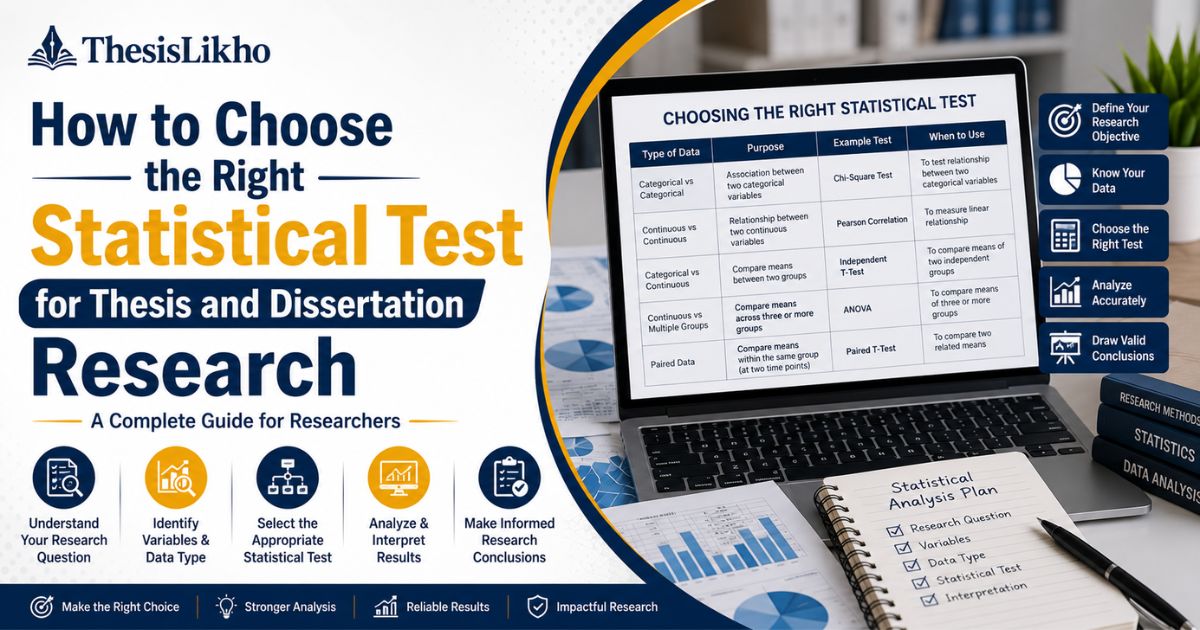
Introduction
Picking the statistical test is a big decision in academic research. Even if your research is well designed you can still get conclusions if you do not use the right statistical test. This is why it is so important to choose the test. ThesisLikho can help you with this.
Your research goals, variables, measurement scales, sample characteristics and study design are all important when choosing a test. ThesisLikho is here to help you learn about tests.
Researchers often wonder which statistical test to use. Do you use an Independent Sample t Test, Paired Sample t Test, ANOVA, Chi Square Test, Correlation Analysis, Regression Analysis, Logistic Regression, Factor Analysis or Structural Equation Modelling. The answer depends on your research problem and the data you have collected. ThesisLikho can help you with this.
This guide will show you how to pick the statistical test based on your research goals, hypotheses, variables, sample size, research design and measurement scales. ThesisLikho is here to help you with this.
We will also talk about mistakes, software recommendations and how to apply statistical tests in different fields. ThesisLikho is here to help you learn about tests.
Quick Definition
A test is a way to analyze research data, test hypotheses, compare groups identify relationships and determine if the findings are important. Choosing the statistical test is very important for producing good research. ThesisLikho can help you with this.
Statistical tests are used in research to get valid results. ThesisLikho is here to help you learn about tests.
Key Facts at a Glance
Topic
Details
Primary Focus
Selecting the statistical test
Suitable For
PhD Masters Thesis, Dissertation, M.Tech, MBA, Medical, Nursing, Engineering students
Major Software
SPSS, R Programming, Python, SmartPLS, AMOS are used for statistical tests
Research Types
Quantitative, Mixed Methods, Experimental, Survey Research are types of research
Outcome
Good statistical analysis and interpretation are the outcomes of using the right statistical test
Why Statistical Test Selection Matters
A test should answer your research question correctly and support your goals. If you pick the test your findings may not be valid and your interpretation may be weak. ThesisLikho can help you with this.
Picking the statistical test helps you:
Match your statistical methods with your research goals.
Test your hypotheses correctly.
Make your research more reliable and valid.
Get conclusions that are defensible.
Make your research ready for publication.
Make your examiners confident in your research.
Support your interpretation with evidence.
Every statistical procedure should be justified in your research methodology chapter. ThesisLikho is here to help you with this.
Step 1 Identify Your Research Objective
Your research objective is the starting point for picking a test.
Research Objective
Recommended Statistical Test
Compare two independent groups
Independent Sample t Test
Compare the group before and after intervention
Paired Sample t Test
Compare three or more groups
One Way ANOVA
Measure the relationship between variables
Pearson or Spearman Correlation
Predict the influence of variables
Linear or Multiple Regression
Analyze the association between categorical variables
Chi Square Test
Validate a measurement scale
Exploratory Factor Analysis (EFA) or Confirmatory Factor Analysis (CFA)
Evaluate a theoretical model
Structural Equation Modelling (SEM)
Starting with your ensures that your statistical analysis supports your research purpose. ThesisLikho is here to help you with this.
Step 2 Identify the Type of Variables
The type of variables determines which statistical techniques are appropriate.
You should classify variables as:
Independent Variables
These are variables that influence or predict another variable.
Dependent Variables
These are variables that represent the outcome being measured.
Categorical Variables
Examples include:
Gender.
Department.
Educational Qualification.
Employment Status.
Continuous Variables
Examples include:
Age.
Income.
Blood Pressure.
Examination Scores.
Customer Satisfaction Scores.
classifying variables helps eliminate inappropriate statistical tests during the planning stage. ThesisLikho is here to help you with this.
Step 3 Understand Measurement Scales
Measurement scales play a role in picking a statistical test.
Scale
Examples
Common Statistical Tests
Nominal
Gender, Religion
Chi Square
Ordinal
Satisfaction Levels
Mann Whitney U, Kruskal Wallis
Interval
Temperature
Correlation, Regression
Ratio
Height, Weight, Income
t Test, ANOVA Regression
Understanding measurement scales allows you to pick tests that satisfy the assumptions required for statistical analysis. ThesisLikho is here to help you with this.
Step 4 Develop the Research Hypothesis
After defining your research objectives and identifying the variables the next step is to formulate research hypotheses. The statistical test you select should directly evaluate these hypotheses.
The two common types are:
Null Hypothesis (H₀)
The null hypothesis assumes that there is no significant relationship, difference or effect between the variables being studied.
Examples include:
There is no difference in academic performance between male and female students.
Employee motivation has no effect on organisational performance.
Customer satisfaction is not associated with service quality.
Alternative Hypothesis (H₁)
The alternative hypothesis assumes that a significant relationship, difference or effect exists.
Examples include:
There is a difference in academic performance between male and female students.
Employee motivation significantly influences performance.
Customer satisfaction is significantly associated with service quality.
The statistical analysis should always be designed to evaluate these hypotheses. ThesisLikho is here to help you with this.
Step 5 Understand Parametric and Non Parametric Tests
One of the important decisions in statistical analysis is determining whether to use a parametric or non parametric statistical test.
Parametric Tests
Parametric tests generally require:
Normally distributed data.
Continuous variables.
Homogeneity of variance.
Independent observations.
Common parametric tests include:
Independent Sample t Test.
Paired Sample t Test.
One Way ANOVA.
Pearson Correlation.
Linear Regression.
Multiple Regression.
These methods generally provide statistical power when assumptions are satisfied. ThesisLikho is here to help you with this.
Non Parametric Tests
Non parametric tests are suitable when parametric assumptions are not met.
Common non parametric methods include:
Mann Whitney U Test.
Wilcoxon Signed Rank Test.
Kruskal Wallis Test.
Friedman Test.
Spearman Rank Correlation.
Chi Square Test.
You should justify why a non parametric method has been selected whenever data violate normality assumptions. ThesisLikho is here to help you with this.
Step 6 Consider Sample Size
Sample size plays a role in picking statistical tests and interpreting results.
General considerations include:
Small samples may require parametric techniques.
Larger samples generally provide stable estimates.
SEM techniques require observations relative to model complexity.
Regression models require observations for each predictor variable.
You should determine sample size during the research planning stage than after data collection. ThesisLikho is here to help you with this.
Statistical Assumptions That Should Be Verified
Before performing analysis you should examine important assumptions.
Typical assumptions include:
Normality.
Linearity.
Homogeneity of Variance.
Independence of Observations.
Absence of Multicollinearity.
Homoscedasticity.
Absence of Extreme Outliers.
Ignoring these assumptions may produce misleading conclusions even when sophisticated software is used. ThesisLikho is here to help you with this.
Statistical Test Selection by Research Design
research designs require different analytical approaches.
Research Design
Recommended Statistical Tests
Descriptive Research
Descriptive Statistics, Frequency Analysis
Comparative Research
t Test, ANOVA
Correlational Research
Pearson Correlation, Spearman Correlation
Predictive Research
Regression Analysis
Experimental Research
Paired t Test, ANOVA, ANCOVA
Survey Research
Chi Square, Regression, Factor Analysis
ThesisLikho is here to help you learn about tests and choose the right one for your research.
Structural Model Research uses tools like SmartPLS and AMOS for SEM.
When you are doing research it is very important to choose the tests. This helps to make sure that your research is good and reliable.
Statistical Tests Across Different Fields
Medical Sciences
Regression.
Survival Analysis.
ROC Analysis.
ANOVA.
Chi Square Test.
Engineering
Regression Analysis.
ANOVA.
Principal Component Analysis.
Machine Learning Evaluation Metrics.
Management
Exploratory Factor Analysis.
Confirmatory Factor Analysis.
PLS SEM.
Mediation Analysis.
Moderation Analysis.
Commerce and Economics
Regression Analysis.
Panel Data Regression.
Time Series Analysis.
ARIMA.
Cointegration Analysis.
Psychology and Education
t Test.
ANOVA.
Correlation.
Regression.
Structural Equation Modelling.
Choosing Statistical Software
It is also important to choose the software for your statistical tests.
The test you choose and the software you use should work together.
Here are some tests and the software that goes with them:
Descriptive Statistics. SPSS, R, Python.
Regression Analysis. SPSS, R, Python.
Factor Analysis. SPSS, AMOS.
Structural Equation Modelling. SmartPLS, AMOS.
Machine Learning. Python.
Econometrics. R, Python.
Time Series Analysis. R, Python, SPSS.
Choosing the test and software makes your research better and more reliable.
Common Mistakes When Choosing Statistical Tests
There are some mistakes that researchers make when choosing statistical tests.
You should avoid:
Choosing tests without thinking about what you want to achieve with your research.
Not considering the type of data you have.
Using tests that require conditions without checking if those conditions are met.
Choosing software just because you are used to it.
Not understanding what the results of your tests mean.
Thinking that just because two things are related one must cause the other.
Doing many tests when it is not necessary.
Reporting the results of your tests without explaining what they mean.
Avoiding these mistakes makes your research better and more credible.
Latest Research Trends from 2026 to 2030
Latest Research Trends from 2026 to 2030 show that statistical test selection is becoming smarter.
Researchers are using intelligence and automated analytics to help them choose the right tests.
Of just relying on their own decisions researchers are using software that recommends tests based on their research objectives and design.
Artificial Intelligence is helping researchers with:
Choosing the statistical tests.
Checking the quality of their data.
Finding outliers in their data.
Checking if the conditions for tests are met.
Interpreting the results of their tests.
Creating reports about their analysis.
Although these technologies make research more efficient researchers still need to explain why they made methodological decisions.
Advanced Statistical Models
Many researchers are now using statistical models like:
Structural Equation Modelling.
Multilevel Modelling.
Generalised Linear Models.
Bayesian Statistics.
Machine Learning Models.
Predictive Analytics.
These models help researchers understand relationships that cannot be understood using traditional statistical methods.
Reproducible Research
Reproducible research is becoming more important.
Universities and journals want researchers to be transparent about their methods.
Researchers now document:
How they prepared their data.
The assumptions they made for their tests.
The procedures they used for their analysis.
The software they used.
The scripts they wrote.
How they interpreted their results.
This makes it easier for other researchers to verify their findings.
Research Gap Opportunities
There are opportunities for future research, such as:
Using artificial intelligence to help choose statistical tests.
Creating frameworks for automated hypothesis testing.
Developing systems that can explain decisions.
Comparing statistical software.
Combining machine learning approaches.
Doing analysis on the cloud.
Developing methods for interdisciplinary research.
Creating systems to support research methodology.
These topics are great for masters and doctoral research.
Common Challenges
Many researchers face challenges when choosing tests.
They often focus much on the software and not enough on the research methodology.
Common challenges include:
Not identifying the variables for their research.
Not aligning their objectives with their tests.
Ignoring the assumptions for tests.
Not having an enough sample size.
Designing questionnaires.
Not understanding what the results of their tests mean.
Not distinguishing between association and causation.
Not explaining their choices clearly.
Relying much on default software outputs.
Not discussing their findings well.
Having a framework for decision making helps researchers avoid these problems and improves the quality of their research.
Future Technologies
In the future statistical analysis will use more:
Artificial Intelligence.
Machine Learning.
AI.
Automated Statistical Decision Systems.
Big Data Analytics.
Cloud Computing.
Interactive Dashboards.
Intelligent Research Assistants.
Computational Statistics.
Scientific Workflow Automation.
Researchers who understand these technologies will be better prepared for future research.
Skills Required
To be a researcher you need to have skills in:
Research Methodology.
Statistical Thinking.
Research Design.
Hypothesis Development.
Statistical Test Selection.
Data Cleaning.
SPSS.
R Programming.
Python.
SmartPLS.
AMOS.
Data Interpretation.
Academic Writing.
Thinking.
Research Ethics.
Having these skills makes you a better researcher and improves the quality of your research.
Career Opportunities
Knowing about test selection and analytical methods can help you in many careers, such as:
Academic Research.
Data Analytics.
Biostatistics.
Clinical Research.
Business Analytics.
Healthcare Analytics.
Government Research Organisations.
Policy Research.
Financial Analytics.
Artificial Intelligence Research.
Professionals with analytical skills are valued in many fields.
Future Scope
In the future choosing the statistical tests will remain an important part of research.
Sound statistical reasoning makes research more credible. Helps with decision making.
Future researchers will use a combination of knowledge and intelligent software to do better statistical analysis and make more meaningful conclusions.
Key Takeaways
Always start by thinking about what you want to achieve with your research.
Choose tests based on your variables, hypotheses, measurement scales and sample size.
Use non parametric tests based on the assumptions of your data.
Software is helpful. It does not replace good methodological reasoning.
Different software has purposes.
Choosing the tests improves the quality and credibility of your research.
Interpreting your results carefully is essential for making conclusions.
Frequently Asked Questions
1. What is the first step, in choosing a test?
The first step is to identify what you want to achieve with your research. What question you want to answer.
2. Why are research variables important when selecting tests?
The type of variables determines which statistical procedures are right for the job and make sense scientifically.
3. What is the difference between non parametric tests?
The main difference is that parametric tests require things to be true like the data being normally distributed, whereas non parametric tests are better when those things are not true.
4. Does the number of people in a study affect which test to use?
Yes the number of people in a study affects how powerful the test is and whether the assumptions are met and it also affects which techniques to use.
5. Which statistical test is used to compare two groups of people?
An Independent Sample t Test or Paired Sample t Test is often used, depending on how the study was designed.
6. Which test is used to compare three or more groups of people?
One Way ANOVA is commonly used to compare groups of people.
7. When should researchers use Structural Equation Modelling?
Researchers should use Structural Equation Modelling when they want to look at theories that involve many hidden variables and relationships.
8. Can statistical software automatically choose the test?
The software can give some guidance. The researchers have to justify why they chose that test based on their methodology and research goals.
9. Why is it important to interpret the results?
Interpreting the results connects the numbers to the research questions what other people have. What it means in real life.
10. How does choosing the statistical test make a thesis better?
It makes sure the conclusions are valid makes the methodology stronger and makes people more confident in the results.
Conclusion
Choosing the statistical test is one of the basics of doing good academic research. Every statistical procedure should be chosen based on the research goals, hypotheses, variables, measurement scales, number of people in the study and study design than just what is easy or what software is available.
Researchers who understand why they are choosing a statistical test are better, at justifying their methodological decisions analyzing the data correctly and interpreting the results in a meaningful way. Using the statistical tests not only makes the thesis better but also makes the research more credible and supports conclusions that are based on evidence.
As research keeps changing with intelligence computational statistics and advanced software scholars who combine methodological expertise with statistical reasoning will be well prepared to do high quality research in many different fields of study.
Final CTA
Need expert guidance in choosing the right statistical test for your thesis or dissertation?
Website: www.thesislikho.com
Call / WhatsApp: +91 96438 02216