
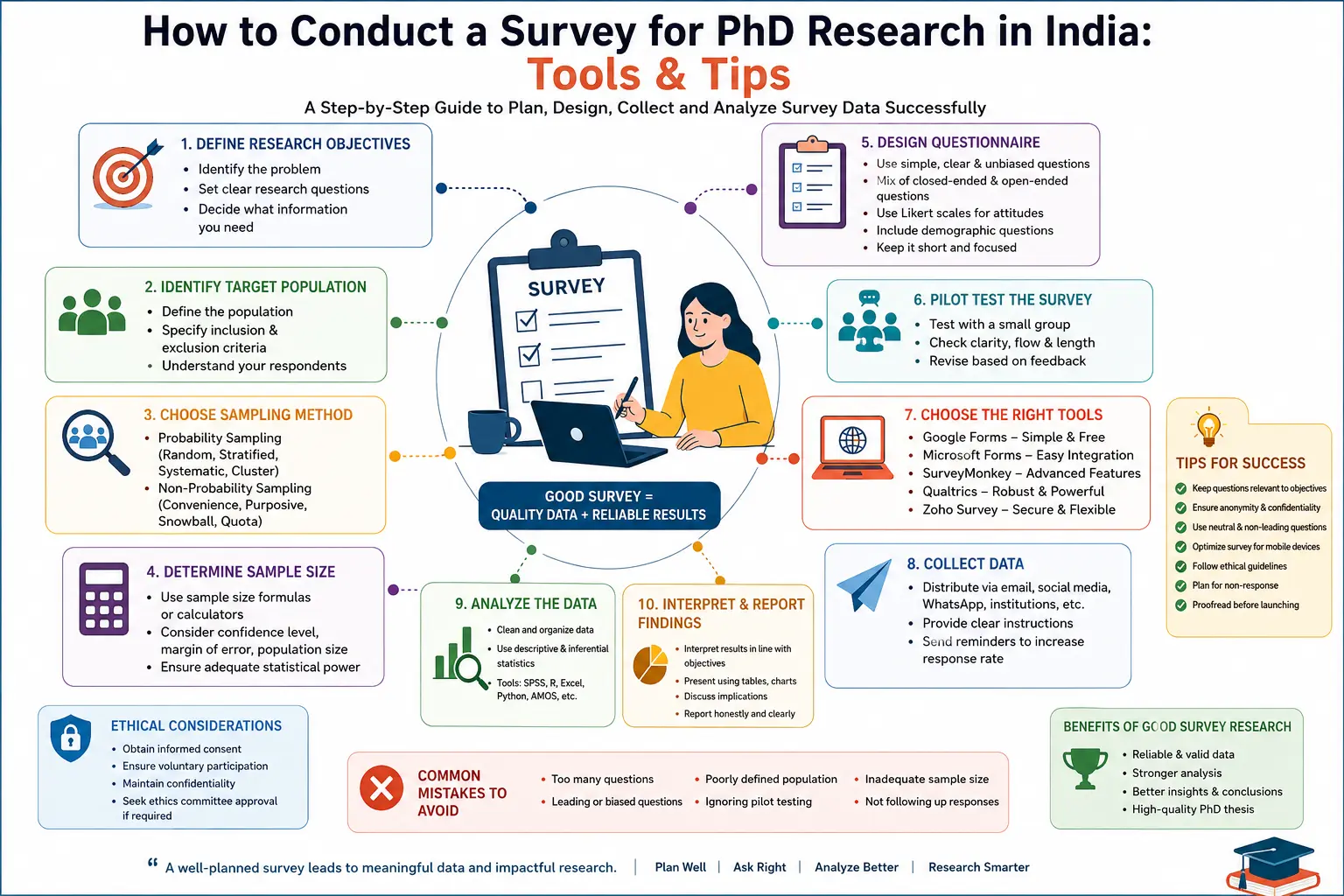
Survey research is one of the most widely used data collection methods in PhD studies across India. Whether you're pursuing a doctorate in management, education, healthcare, social sciences, psychology, economics, engineering, or public policy, surveys help researchers collect valuable information directly from participants. A well-designed survey can reveal opinions, attitudes, behaviors, experiences, and demographic characteristics, making it an essential tool for quantitative and mixed-methods research.
However, conducting a successful survey involves much more than creating a questionnaire and distributing it online. Every stage—from defining research objectives and selecting respondents to designing questions, collecting data, and analyzing results—requires careful planning and scientific rigor. Poorly designed surveys often result in low response rates, biased data, and unreliable conclusions, which can weaken the overall quality of a PhD thesis.
This comprehensive guide explains how to conduct a survey for PhD research in India. You'll learn how to plan your survey, choose the right sampling method, design effective questionnaires, select data collection tools, improve response rates, follow ethical guidelines, and avoid common mistakes.
What Is Survey Research?
Survey research is a systematic method of collecting information from a group of people using structured questionnaires or interviews. The primary purpose is to gather data that can be analyzed to answer specific research questions or test hypotheses.
Surveys are particularly useful when researchers want to understand:
- People's opinions
- Attitudes and perceptions
- Consumer behavior
- Employee satisfaction
- Educational outcomes
- Healthcare experiences
- Social trends
- Public awareness
Because surveys allow data to be collected from large numbers of participants efficiently, they are among the most popular research methods for doctoral studies.
Why Are Surveys Important in PhD Research?
Survey research offers several advantages that make it suitable for academic studies.
Some of the key benefits include:
- Collects data from large populations.
- Supports statistical analysis.
- Provides standardized responses.
- Saves time compared to face-to-face interviews.
- Enables comparisons across different groups.
- Produces measurable and reproducible findings.
- Supports evidence-based conclusions.
When designed correctly, surveys generate high-quality data that contribute to reliable and valid research outcomes.
Types of Surveys Used in PhD Research
The choice of survey depends on your research objectives, participants, and available resources.
1. Online Surveys
Online surveys have become the preferred option for many researchers because they are cost-effective and easy to distribute.
Common platforms include:
- Google Forms
- Microsoft Forms
- SurveyMonkey
- Qualtrics
- Zoho Survey
Online surveys are ideal for geographically dispersed participants and large sample sizes.
2. Paper-Based Surveys
Paper questionnaires remain useful in areas with limited internet access or when respondents are more comfortable with printed forms.
They are often used in:
- Schools
- Rural communities
- Hospitals
- Government offices
Although paper surveys require manual data entry, they may achieve higher participation in certain settings.
3. Telephone Surveys
Telephone interviews allow researchers to reach participants remotely while clarifying questions during the conversation.
These surveys can improve response quality but may require more time and trained interviewers.
4. Face-to-Face Surveys
In-person surveys are commonly used when detailed explanations or observations are required.
They are particularly valuable for:
- Community studies
- Healthcare research
- Rural fieldwork
- Social science investigations
However, they are generally more expensive and time-intensive.
Step 1: Define Your Research Objectives
Every successful survey begins with clear research objectives.
Ask yourself:
- What problem am I investigating?
- What information do I need?
- What variables should be measured?
- Which research questions or hypotheses will the survey address?
Clear objectives ensure that every survey question serves a meaningful purpose.
Example
Research Topic:
Factors Influencing Employee Job Satisfaction in Indian IT Companies
Possible objectives:
- Measure employee satisfaction levels.
- Identify factors affecting satisfaction.
- Examine relationships between leadership and satisfaction.
- Assess the impact of work-life balance.
Well-defined objectives guide questionnaire design and data analysis.
Step 2: Identify Your Target Population
The target population refers to the entire group about which you want to draw conclusions.
Examples include:
- College students
- School teachers
- Hospital patients
- IT professionals
- Small business owners
- Farmers
- Consumers
Clearly defining the population improves sampling accuracy and the relevance of your findings.
Step 3: Choose the Right Sampling Method
Since surveying an entire population is rarely feasible, researchers select a representative sample.
Probability Sampling
Probability sampling gives every member of the population a known chance of selection.
Common methods include:
Simple Random Sampling
Every participant has an equal chance of being selected.
Stratified Sampling
The population is divided into meaningful groups (strata), and participants are selected from each group.
Cluster Sampling
Entire groups or clusters are selected instead of individual participants.
Systematic Sampling
Participants are selected at regular intervals from a sampling frame.
Probability sampling generally enhances the representativeness of survey findings.
Non-Probability Sampling
These methods are often used when probability sampling is impractical.
Examples include:
- Convenience sampling
- Purposive sampling
- Snowball sampling
- Quota sampling
While easier to implement, these approaches may limit the generalizability of results.
Step 4: Determine the Sample Size
An appropriate sample size strengthens the reliability and validity of your study.
Sample size depends on factors such as:
- Population size
- Confidence level
- Margin of error
- Expected effect size
- Statistical power
- Planned analytical methods
For many survey-based PhD studies, researchers use sample size calculators or power analysis software to justify the number of participants.
Step 5: Design an Effective Questionnaire
The questionnaire is the heart of your survey.
A well-designed questionnaire collects accurate, relevant, and unbiased information.
Types of Questions
Closed-Ended Questions
Respondents select from predefined answers.
Examples:
- Yes/No
- Multiple choice
- Rating scales
- Likert scales
These questions are easy to analyze statistically.
Open-Ended Questions
Participants provide answers in their own words.
These questions generate richer insights but require more time to analyze.
Demographic Questions
Collect background information such as:
- Age
- Gender
- Education
- Occupation
- Income
- Location
These variables often support subgroup analyses.
Writing Good Survey Questions
Effective survey questions should be:
- Clear
- Concise
- Neutral
- Relevant
- Easy to understand
Avoid:
- Leading questions
- Double-barreled questions
- Technical jargon
- Ambiguous wording
- Double negatives
Poor Example
"Do you think your manager is friendly and supportive?"
This asks about two different qualities at once.
Better Example
- "My manager is friendly."
- "My manager is supportive."
Separating concepts improves measurement accuracy.
Using Likert Scales
Likert scales are widely used in PhD research to measure attitudes and perceptions.
A common five-point scale is:
- Strongly Disagree
- Disagree
- Neutral
- Agree
- Strongly Agree
Ensure that the scale remains consistent throughout the questionnaire.
Step 6: Conduct a Pilot Study
Before launching the full survey, test it with a small group similar to your target population.
A pilot study helps identify:
- Confusing questions
- Technical issues
- Missing response options
- Completion time
- Reliability problems
Based on feedback, revise the questionnaire before collecting the main dataset.
Step 7: Select the Right Survey Tool
Several online platforms simplify survey creation and data collection.
Google Forms
Advantages:
- Free to use
- Easy to share
- Automatic spreadsheet integration
- Suitable for students
Microsoft Forms
Offers seamless integration with Microsoft 365 and is particularly useful for institutions already using the Microsoft ecosystem.
SurveyMonkey
Provides advanced survey logic, analytics, and reporting features.
Qualtrics
Widely used by universities for large-scale academic research due to its extensive customization and analytical capabilities.
Zoho Survey
A good option for researchers who need multilingual surveys or integration with other Zoho applications.
Choose a platform that aligns with your budget, technical requirements, and institutional support.
Step 8: Collect Data
After finalizing the questionnaire, distribute it through appropriate channels.
Common methods include:
- Email invitations
- University mailing lists
- Professional associations
- Social media groups
- WhatsApp (where appropriate and ethically acceptable)
- Institutional websites
- In-person distribution
Always ensure that participants meet the study's eligibility criteria.
Improving Survey Response Rates
Low response rates can reduce data quality and introduce bias.
Strategies to improve participation include:
- Writing a clear invitation message.
- Explaining the purpose of the research.
- Keeping the questionnaire concise.
- Ensuring mobile-friendly survey design.
- Sending polite reminders.
- Highlighting confidentiality.
- Thanking participants for their time.
Avoid excessive reminders that may inconvenience potential respondents.
Ethical Considerations in Survey Research
Ethical conduct is fundamental to academic research.
Researchers should:
- Obtain informed consent.
- Explain the study's purpose.
- Ensure voluntary participation.
- Protect participant anonymity where promised.
- Maintain confidentiality.
- Store data securely.
- Seek approval from an Institutional Ethics Committee (IEC) or Institutional Review Board (IRB) when required.
Participants should be free to withdraw from the study at any stage without penalty.
Step 9: Organize and Clean the Data
Before analysis:
- Check for incomplete responses.
- Remove duplicate submissions where appropriate.
- Verify coding accuracy.
- Handle missing data using suitable methods.
- Identify potential outliers if relevant.
Clean data improve the reliability of statistical analyses.
Step 10: Analyze Survey Data
The analytical approach depends on your research questions and data type.
Common analyses include:
Descriptive Statistics
- Frequencies
- Percentages
- Means
- Standard deviations
Inferential Statistics
- t-tests
- ANOVA
- Chi-square tests
- Correlation analysis
- Regression analysis
- Factor analysis
- Structural Equation Modeling (SEM)
Qualitative responses from open-ended questions may be analyzed using thematic or content analysis.
Reporting Survey Findings
Present findings logically and clearly.
Include:
- Response rate.
- Participant demographics.
- Descriptive statistics.
- Reliability measures (if applicable).
- Inferential analyses.
- Tables and figures.
- Interpretation of key findings.
Do not simply reproduce software output; explain what the results mean in relation to your research objectives.
Common Challenges in Survey Research
Researchers often encounter obstacles such as:
- Low response rates.
- Sampling bias.
- Social desirability bias.
- Incomplete questionnaires.
- Technical issues with online platforms.
- Language barriers.
- Respondent fatigue.
Anticipating these challenges allows you to plan effective solutions.
Best Practices for Conducting a Successful Survey
To maximize the quality of your survey research:
- Define clear objectives before designing questions.
- Use a representative sampling strategy whenever possible.
- Keep the questionnaire focused and concise.
- Pilot test the survey before full deployment.
- Use reliable and valid measurement scales.
- Follow ethical guidelines throughout the study.
- Monitor response rates and send appropriate reminders.
- Clean the data thoroughly before analysis.
- Interpret results objectively.
- Document every step of the survey process in your thesis.
Common Mistakes to Avoid
Many PhD scholars reduce the quality of their surveys by making avoidable mistakes.
Some of the most common include:
- Asking too many questions.
- Using confusing or leading wording.
- Ignoring pilot testing.
- Choosing an inappropriate sampling method.
- Collecting data without ethical approval where required.
- Failing to justify sample size.
- Not checking for missing or duplicate responses.
- Drawing conclusions beyond what the data support.
Avoiding these errors will strengthen the credibility of your research.
Frequently Asked Questions (FAQs)
Which survey tool is best for PhD research in India?
The best tool depends on your research needs. Google Forms is an excellent free option for many students, while Qualtrics and SurveyMonkey offer more advanced features for complex studies. Microsoft Forms is also a strong choice for institutions using Microsoft 365.
How many questions should a PhD survey include?
There is no fixed number. Include only questions that directly support your research objectives. Keeping the survey concise helps improve completion rates and data quality.
Should I conduct a pilot study?
Yes. A pilot study helps identify unclear questions, technical issues, and potential reliability problems before launching the main survey.
How can I improve my survey response rate?
Use clear invitations, keep the questionnaire brief, ensure confidentiality, optimize the survey for mobile devices, and send polite follow-up reminders when appropriate.
Is ethical approval necessary for survey research?
Many universities require ethical approval for research involving human participants. Always follow your institution's guidelines and obtain approval when required before collecting data.
Conclusion
Survey research remains one of the most effective methods for collecting primary data in PhD studies across India. When carefully planned and executed, surveys provide valuable insights into attitudes, behaviors, experiences, and opinions that can answer complex research questions and support evidence-based conclusions.
Conducting a successful survey involves much more than distributing a questionnaire. It requires clearly defined research objectives, an appropriate sampling strategy, thoughtfully designed questions, reliable data collection tools, ethical research practices, and rigorous data analysis. By investing time in each stage of the survey process—from planning and pilot testing to data cleaning and interpretation—you can significantly improve the quality and credibility of your research.
Whether you are studying management, education, healthcare, engineering, social sciences, or any other discipline, following these best practices will help you design surveys that generate accurate, reliable, and meaningful data. A well-executed survey not only strengthens your PhD thesis but also enhances the potential for publishing your findings in respected academic journals and contributing valuable knowledge to your field.
Website: www.thesislikho.com
Call/WhatsApp: +91 96438 02216