
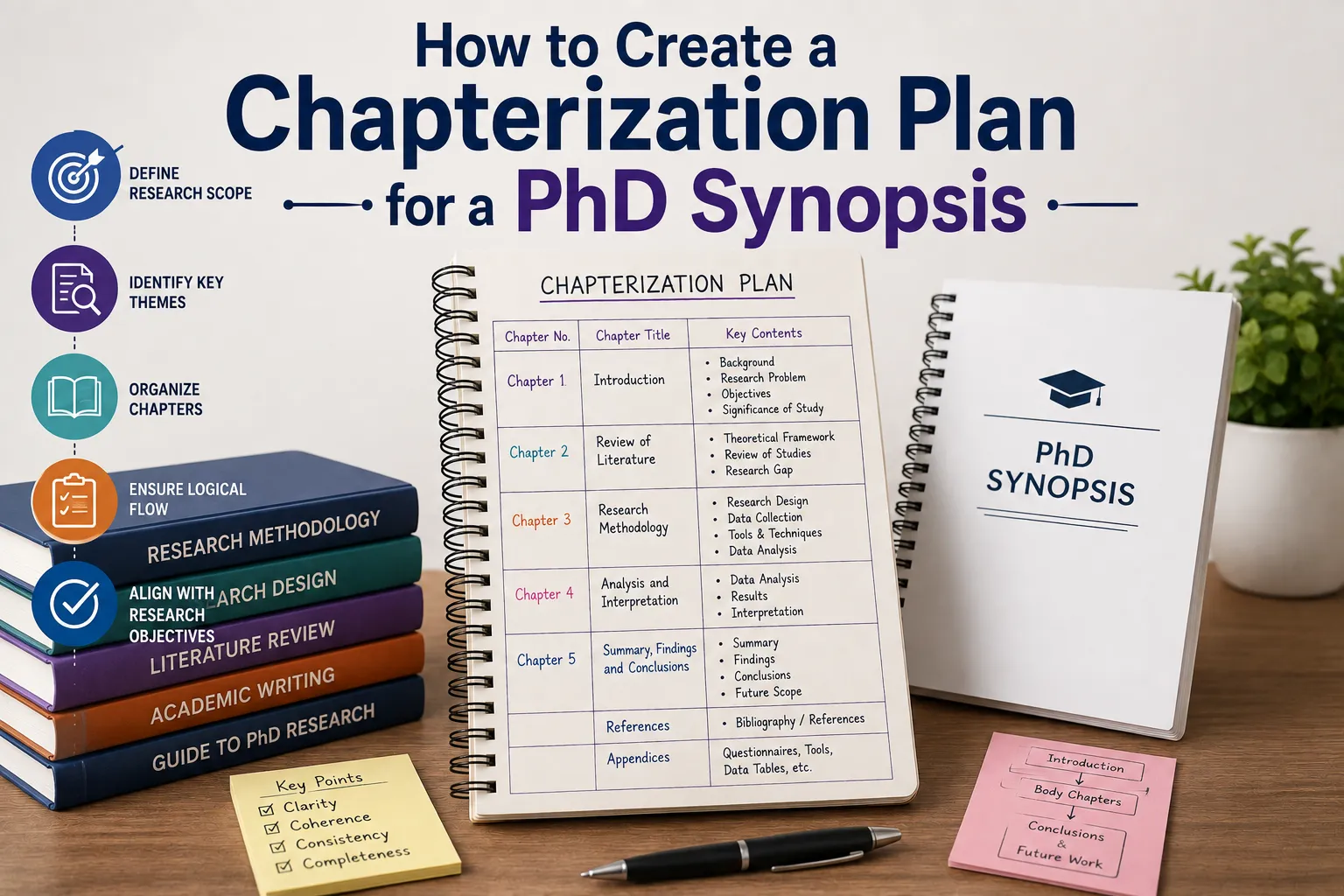
Somewhere near the end of writing a PhD synopsis, most scholars hit a section they weren't quite prepared for: the chapterization plan. It's easy to underestimate — a page, maybe two, sketching out what each thesis chapter will eventually contain. But it's also one of the sections a Doctoral Research Committee reads most carefully, because it's the clearest signal of whether you actually understand the shape of the work you're proposing, or whether you're still figuring that out as you go.
This guide walks through how to create a chapterization plan for a PhD synopsis the way an experienced research supervisor would — practically, without assuming you already know what a "chapter scheme" is supposed to look like. If you're a first-time PhD thesis writer without a strong research background, this is written specifically for you.
At ThesisLikho, our PhD-qualified mentors have guided more than 10,000 scholars through synopsis writing, chapterization planning, and Doctoral Research Committee presentations across disciplines. What follows draws on that mentoring experience, checked against current guidance on PhD synopsis and thesis structure used across Indian universities.
1. What a Chapterization Plan Actually Is (and Why It Matters)
A chapterization plan — sometimes called a chapter scheme — is a structured outline of how your eventual thesis will be organized into chapters, with a short description of what each chapter will cover. In your synopsis, it's a compact preview: not the actual content of each chapter, but a clear map showing the Doctoral Research Committee that you've thought through the full shape of your research before beginning it.
Most Indian university Doctoral Research Committees expect a chapter scheme within the synopsis specifically because it demonstrates something a literature review or methodology section can't on its own: that you can see your entire project end-to-end, not just its starting point. A strong chapter scheme reassures a committee that your major research components are all accounted for, logically sequenced, and proportionate to the scope of a PhD — which is exactly why it draws close scrutiny even though it's often one of the shorter sections in the document.
There's also a practical, self-interested reason to take this section seriously beyond satisfying the Committee: the chapterization plan you submit at synopsis stage often becomes the working skeleton you'll actually write against for the next several years. A vague or poorly reasoned scheme doesn't just risk Committee pushback — it tends to resurface as genuine confusion eighteen months later, when you're staring at a results chapter that doesn't quite match what you originally planned to put in it.
2. Where the Chapterization Plan Sits in Your Synopsis
A typical PhD synopsis format in India includes, roughly in this order: a title page, introduction and background, statement of the problem, review of literature, objectives of the study, hypotheses or research questions, research methodology, and — usually appearing near the end, just before references — the proposed chapter scheme or chapterization plan.
This placement isn't arbitrary. By the time a reader reaches your chapterization plan, they've already read your problem statement, your literature-based gap, your objectives, and your methodology — so your chapter scheme should read as the natural, inevitable structure that falls out of everything preceding it, not as a separate, disconnected addition tacked on at the end.
3. The Standard Chapter Scheme Most Indian PhD Theses Follow
While exact structures vary meaningfully by discipline and university, a commonly used baseline chapter scheme for an Indian PhD thesis includes:
Chapter 1: Introduction — establishes the broad research area, its significance, the specific problem being addressed, and the aim and scope of the work, often closing with a brief outline of the thesis structure itself.
Chapter 2: Review of Literature — synthesizes existing research relevant to your topic, organized thematically rather than as a simple chronological list, building toward a clearly stated research gap.
Chapter 3: Research Methodology — details your research design, data collection methods, sampling strategy (where applicable), and analytical approach, justified against your specific research questions.
Chapter 4 (and often 5): Data Analysis / Results — presents your findings, often split across one or more chapters if your thesis has multiple distinct studies, experiments, or objectives.
Chapter 5 or 6: Discussion — interprets your results in light of existing literature, addressing what your findings mean, how they relate to your original research gap, and what their broader implications are. In some disciplines, particularly in the sciences, results and discussion are merged into a single chapter rather than kept separate.
Final Chapter: Conclusion and Future Scope — summarizes your key findings, states your original contribution clearly, acknowledges limitations, and identifies directions for future research.
References and Appendices — your full reference list, followed by supplementary material such as questionnaires, data collection instruments, ethical approval letters, or additional detailed data tables referenced in the main text.
This is a flexible foundation, not a rigid template — what matters most is that your specific structure supports your specific research argument and satisfies your university's and discipline's expectations, not that it matches this scheme exactly.
4. When and Why Your Chapter Scheme Should Deviate From the Standard
The standard scheme above is a reasonable default, but real theses frequently — and legitimately — deviate from it, and knowing when that deviation is warranted (versus when it signals a poorly planned structure) matters.
Legitimate reasons to deviate include: your topic requires substantial standalone background coverage that doesn't fit naturally within either the introduction or literature review (for instance, a scholar researching a specific historical policy initiative might need a dedicated chapter covering that initiative's emergence and context before reviewing academic literature about it); your thesis involves multiple distinct studies or objectives that genuinely need separate results chapters rather than being combined; your discipline's norms differ from the standard scheme (sciences often merge results and discussion, while humanities theses may be structured more thematically than by the standard method-then-results progression); or your literature base is thin enough that a separate, full literature review chapter isn't warranted, and reviewing related work is instead woven into your introduction or discussion instead.
What's not a legitimate reason to deviate: simply not having thought through how your specific research fits the standard structure. If your proposed chapter scheme differs meaningfully from convention, be ready to explain why in one clear sentence — a Committee member is far more likely to raise an eyebrow at an unconventional structure with no stated rationale than at one with a brief, sensible justification attached.
It's worth noting that this same flexibility exists at the level of individual chapters, not just the overall scheme. An investigator who doesn't find sufficient prior research directly related to their specific problem may reasonably combine what would otherwise be a standalone literature review chapter with their introduction, rather than stretching thin material across an artificially separate chapter. Similarly, a scholar constructing a new measurement tool or instrument as part of their research may need a dedicated chapter for that construction and validation process — something the standard scheme above doesn't explicitly account for. The underlying principle stays the same throughout: structure follows the actual shape of the research, not the other way around.
5. How to Actually Build Your Chapter Scheme, Step by Step
- Start from your objectives, not from a template. List your research objectives exactly as stated in your synopsis, and ask which chapter(s) each one will actually be addressed in — this single exercise often reveals whether your objectives and structure are genuinely aligned or only loosely connected.
- Draft your chapter list at the title level first. Write just the chapter titles in sequence before adding any description — this lets you see the overall shape and catch structural problems (too many thin chapters, one enormous chapter trying to do too much) before investing time in detail.
- Write a 3–5 sentence description for each chapter. Cover what the chapter will contain, and, where relevant, briefly note the method or approach used within it — enough for a reader to understand the chapter's purpose without needing the full content.
- Check for logical flow between chapters. Each chapter should visibly build on the one before it — your methodology chapter should follow directly from the gap established in your literature review, and your results chapters should map clearly onto the methodology just described.
- Sanity-check chapter count and balance against your discipline and university norms. A thesis with one 15-page chapter and one 3-page chapter signals uneven planning; check what chapter count and rough balance your department typically expects before finalizing.
- Have your supervisor review the scheme before finalizing it for submission — this is a section supervisors often have strong, specific opinions about, given how directly it shapes years of subsequent writing.
6. How Much Detail Each Chapter Description Needs
This is where many first-time scholars either under- or over-write. The chapter scheme within a synopsis is meant to be a compact overview — commonly recommended to stay in the range of roughly 200–400 words total when presented as a standalone summary (some universities allow this as a short diagram or table-free outline instead of prose) — not a detailed table of contents with subsections spelled out.
For each chapter, aim to answer three questions in just a few sentences: what will this chapter cover, what method or approach will it use (if applicable), and how does it connect to the chapter before and after it. Resist the temptation to preview your actual findings or go deep into subsection-level detail — at the synopsis stage, you often don't have results yet, and a chapter scheme that reads like you've already written the thesis can actually raise questions about whether your research is still genuinely open-ended and exploratory, or whether the conclusion is predetermined.
A useful test of whether your chapter description has the right level of detail: read it aloud to someone outside your specific research area. If they come away understanding roughly what the chapter will do and why it matters to the overall thesis, you've pitched it correctly. If they're either lost in jargon or left with no real sense of the chapter's purpose beyond a generic label, the description needs adjusting — usually by cutting overly technical detail in the first case, or adding one more concrete sentence in the second.
7. Aligning Your Chapterization With Your Objectives and Methodology
A chapter scheme that doesn't map cleanly onto your stated objectives and methodology is one of the fastest ways to undermine an otherwise strong synopsis, because it suggests the different sections of your proposal weren't written with each other in mind.
A practical check: create a simple two-column mapping — your objectives in one column, the specific chapter(s) that will address each one in the other — before finalizing your scheme. If an objective doesn't map to any chapter, either your chapter scheme is missing something or that objective doesn't actually belong in your proposal. Similarly, if your methodology chapter describes a mixed-methods design but your chapter scheme only allows for a single results chapter, that mismatch needs resolving before submission — either your chapter scheme needs a second chapter to accommodate both strands of data, or your methodology description needs revisiting.
This alignment check takes very little time but catches a surprising number of internal inconsistencies that a Committee member reading closely and carefully will otherwise catch for you — at a considerably less convenient moment.
8. Presenting the Chapterization Plan: Format and Length
A few practical formatting points worth getting right:
- Position it correctly — typically placed after your methodology section and before your references, functioning as a natural closing summary of the full proposal.
- Use a consistent format across chapters — if you describe Chapter 1's purpose in a certain style (a short paragraph, a specific sentence structure), maintain that same style through every subsequent chapter description, since inconsistent formatting here reads as rushed.
- Consider a simple diagram as a supplement, not a replacement, for the written description — some universities are receptive to a visual chapter-flow diagram alongside the text; check your department's convention before assuming this is expected or acceptable.
- Follow your university's specific formatting requirements exactly — margins, chapter heading style, numbering conventions, and page limits for the synopsis as a whole are often specified in granular detail in departmental guidelines, and small deviations here are easy, avoidable reasons for a synopsis to be returned for formatting corrections before content is even properly reviewed.
- Keep numbering consistent with how you'll eventually number chapters in the full thesis — inconsistency between your synopsis chapter numbering and your eventual thesis numbering, while not a major issue, is a small polish detail examiners sometimes notice.
9. Common Mistakes First-Time Scholars Make
- Copying a generic chapter scheme without checking it fits your actual research — a scheme borrowed from a template or a friend's thesis rarely aligns cleanly with your specific objectives and methodology.
- Writing chapter descriptions that are too vague to be useful ("This chapter will discuss the results" tells a reader almost nothing) or too detailed for a synopsis (previewing specific findings you don't actually have yet).
- Letting the chapter scheme drift from the objectives and methodology already stated earlier in the same synopsis, creating an internal inconsistency a careful reader will catch.
- Uneven chapter balance — cramming most of the actual research into one enormous chapter while padding others, which signals unclear planning of how the work will actually be distributed.
- Ignoring discipline-specific norms — applying a rigid results-then-discussion split in a field where merging them is standard, or vice versa, without checking what your department actually expects.
- Treating the chapter scheme as a formality to finish quickly rather than as a genuine planning exercise — scholars who skip this step often discover mid-thesis that their actual research doesn't fit the loosely sketched structure they submitted, requiring a formal revision request later.
- Not having your supervisor review it before submission, missing an easy opportunity to catch structural issues early, when they're cheap to fix.
10. Two Realistic Case Studies
Case Study 1 — Fixing a Chapter Scheme That Didn't Match the Objectives
A scholar preparing a management PhD synopsis submitted a first draft chapter scheme with a single combined "Analysis and Discussion" chapter, despite their methodology section describing two distinct studies — a quantitative survey and a set of qualitative interviews. On review, the supervisor pointed out that combining both strands into one chapter would make the eventual thesis unwieldy and structurally unclear. Revising the scheme to include separate chapters for each study's analysis, followed by a unified discussion chapter integrating both, resolved the mismatch and gave the synopsis a scheme that genuinely reflected the proposed mixed-methods design.
Case Study 2 — Justifying a Deliberate Deviation From the Standard Scheme
A first-time scholar researching a specific historical education policy initiative in India found that the standard four-to-six chapter scheme didn't comfortably accommodate the substantial background needed to explain the policy's emergence and evolution before reviewing academic literature about its effects. Rather than forcing this material awkwardly into either the introduction or literature review, the scholar added a dedicated background chapter between the two, with a brief explanatory note in the chapterization section stating why this additional chapter was necessary given the topic's specific historical complexity. The Committee approved the deviation without objection, precisely because the reasoning was stated clearly rather than left for the reader to guess at.
If you'd like a second set of eyes on whether your chapterization plan is well-structured and genuinely aligned with your objectives and methodology before submission, our Synopsis Writing service works through exactly this stage with scholars.
FAQs
How do I create a chapterization plan for a PhD synopsis?
Start from your stated research objectives, draft your chapter titles at a high level first, then write a short (3–5 sentence) description for each chapter covering its content, method, and connection to adjacent chapters — checking throughout that the scheme aligns cleanly with your objectives and methodology already described earlier in the synopsis.
Why should I create a chapterization plan for a PhD synopsis carefully?
Because it's one of the clearest signals to your Doctoral Research Committee of whether you've genuinely thought through the full shape of your research — a well-aligned, logically sequenced chapter scheme builds confidence in your proposal, while a generic or mismatched one raises exactly the kind of structural questions a Committee is trained to look for.
When should you create a chapterization plan for a PhD synopsis, relative to the rest of the document?
Draft it after your objectives and methodology sections are finalized, since your chapter scheme should logically follow from both — treating it as a genuine planning step rather than an afterthought tacked on right before submission produces a considerably stronger, more internally consistent synopsis.
How long does it take to complete a synopsis using this approach?
Timelines vary by university and topic complexity, but building your chapterization plan deliberately — with an explicit check against your objectives and methodology — typically takes no more than a few focused hours, and it meaningfully reduces the risk of structural revision requests from your Committee later.
Is professional help available to create a chapterization plan for a PhD synopsis?
Yes — support with structuring a chapter scheme that genuinely aligns with your research objectives and methodology, formatted to your specific university's requirements, is available through services such as Synopsis Writing.
Ready to get your synopsis chapterization plan Committee-ready? Get Synopsis Help Now from ThesisLikho's PhD-qualified mentors.