
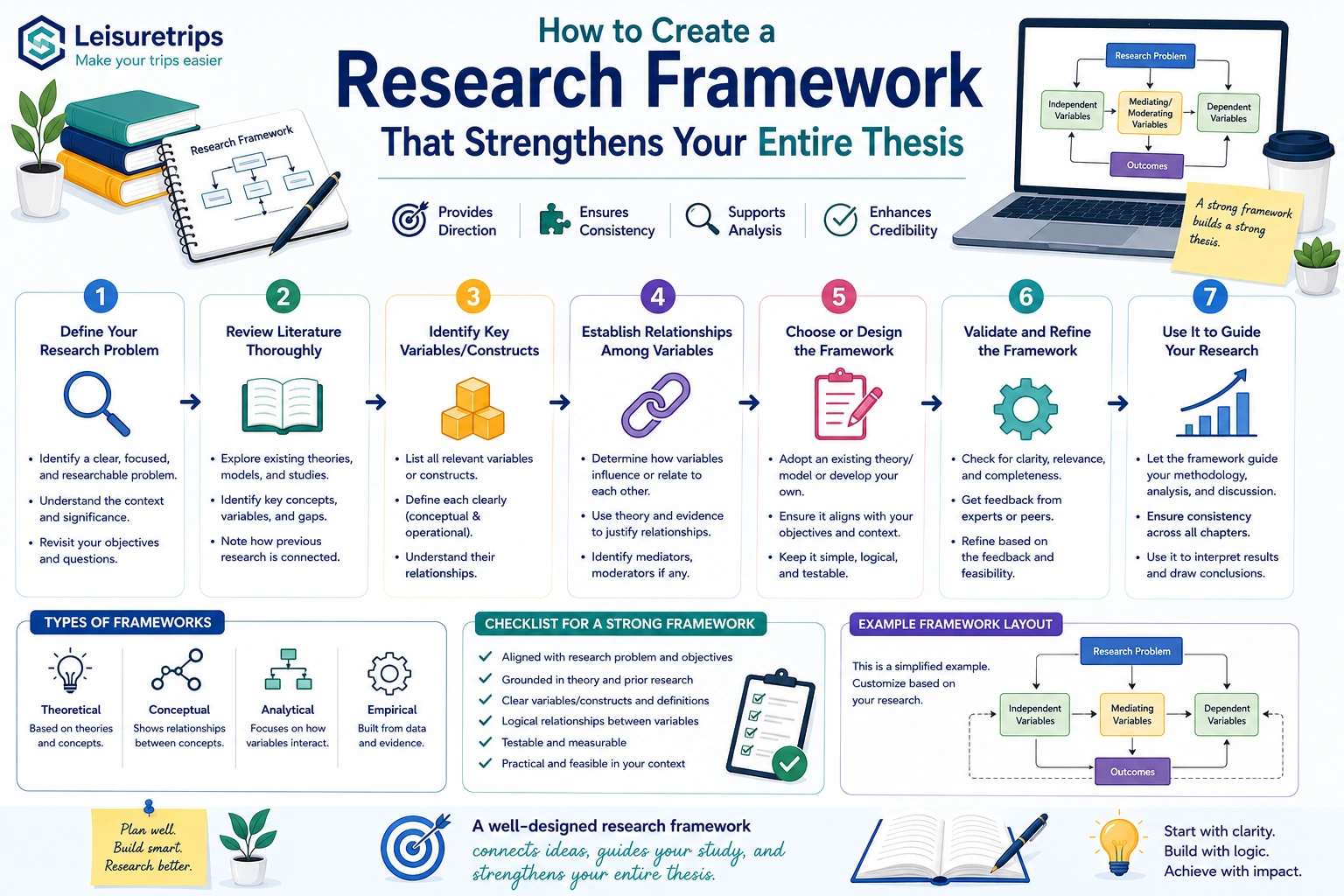
A research framework is one of the most important yet often misunderstood parts of a thesis. Many PhD scholars spend months collecting data and reviewing literature without first establishing a solid framework that connects every part of their research. The result is often a thesis that feels disconnected, lacks logical flow, and becomes difficult for supervisors and examiners to follow.
A well-developed research framework acts as the backbone of your study. It links your research problem, objectives, literature review, methodology, data analysis, and conclusions into one coherent structure. Whether you are pursuing a PhD in Management, Education, Engineering, Social Sciences, Commerce, Healthcare, or any other discipline in India, creating a strong research framework significantly improves the quality of your thesis.
In this comprehensive guide, you'll learn what a research framework is, why it matters, the different types of frameworks, and a step-by-step process to create one that strengthens your entire thesis.
What Is a Research Framework?
A research framework is a structured representation of the key concepts, theories, variables, and relationships that guide your research study.
It serves as the blueprint for your research by explaining:
- What you are studying
- Why you are studying it
- How different variables are connected
- Which theories support your research
- How you plan to investigate your research questions
Instead of conducting research randomly, the framework provides direction throughout the entire research process.
Why Is a Research Framework Important?
A strong research framework offers several benefits.
1. Provides Clear Direction
The framework keeps every chapter focused on the same research objectives.
2. Strengthens Research Quality
It ensures that your research questions, hypotheses, methodology, and findings are logically connected.
3. Improves Literature Review
A framework helps organize previous studies according to concepts instead of simply summarizing articles.
4. Supports Methodology
Your research design becomes easier to justify because it aligns with the framework.
5. Makes Data Interpretation Easier
The framework acts as a guide while interpreting findings and explaining relationships between variables.
Components of a Strong Research Framework
An effective framework usually includes the following elements.
Research Problem
The issue or gap your study aims to solve.
Example:
"Limited understanding of AI adoption among Indian MSMEs."
Research Objectives
These define what the study intends to achieve.
Example:
- To identify factors affecting AI adoption.
- To measure business performance after AI implementation.
- To examine organizational readiness.
Research Questions
These guide the investigation.
Examples:
- What factors influence AI adoption?
- Does AI improve operational efficiency?
- What barriers exist?
Literature Support
Include key theories and previous research that justify your framework.
Examples:
- Technology Acceptance Model (TAM)
- Diffusion of Innovation Theory
- Resource-Based View
Variables
Clearly identify variables.
Independent Variables
- Technology readiness
- Organizational support
- Employee skills
Dependent Variable
- AI adoption
Mediating Variable
- Employee attitude
Moderating Variable
- Firm size
Proposed Relationships
Explain how variables influence one another.
Example:
Technology readiness positively influences AI adoption.
Employee attitude mediates this relationship.
Firm size moderates adoption success.
Types of Research Frameworks
1. Theoretical Framework
Uses one or more established theories.
Example:
A study on online learning using Constructivism Theory.
2. Conceptual Framework
Creates a new model based on literature findings.
Common in:
- Management
- Education
- Marketing
- Healthcare
3. Analytical Framework
Focuses on analyzing data systematically.
Used in:
- Economics
- Policy Research
- Finance
4. Operational Framework
Describes practical implementation of research methods.
Often used in applied sciences.
Step-by-Step Guide to Creating a Research Framework
Step 1: Define the Research Problem
Everything begins with identifying a genuine research problem.
Ask yourself:
- What issue exists?
- Why is it important?
- Who is affected?
A clearly defined problem creates the foundation of your framework.
Step 2: Conduct an Extensive Literature Review
Read:
- Journal articles
- Books
- Conference papers
- Government reports
- Doctoral theses
Look for:
- Research gaps
- Common findings
- Contradictory results
- Frequently used theories
Step 3: Identify Relevant Theories
Choose theories that best explain your research.
Examples include:
- Theory of Planned Behavior
- Technology Acceptance Model
- Expectancy Theory
- Social Exchange Theory
- Institutional Theory
Avoid selecting theories simply because they are popular.
Step 4: Identify Key Variables
List every important variable discussed in previous studies.
Example:
Independent Variables:
- Leadership
- Innovation
- Technology
Dependent Variable:
- Organizational performance
Mediator:
- Employee engagement
Moderator:
- Organizational culture
Step 5: Establish Relationships
Explain why variables are connected.
For example:
Leadership improves innovation.
Innovation enhances organizational performance.
Employee engagement strengthens innovation outcomes.
Step 6: Draw the Framework
Create a visual diagram showing relationships.
Example:
Leadership
↓
Innovation
↓
Employee Engagement
↓
Organizational Performance
Many universities encourage including diagrams because they simplify complex relationships.
Step 7: Validate with Literature
Each relationship in your framework should be supported by previous research.
Never include unsupported assumptions.
Example Research Framework
Research Topic
"Factors Influencing Digital Banking Adoption Among Rural Consumers in India."
Research Framework:
Independent Variables
- Trust
- Security
- Ease of Use
- Awareness
↓
Mediator
- Customer Satisfaction
↓
Dependent Variable
- Digital Banking Adoption
↓
Outcome
- Financial Inclusion
This framework clearly demonstrates the logical flow of the study.
How Different Disciplines Use Research Frameworks
Management
Focuses on organizational behavior, leadership, innovation, marketing, and performance.
Education
May examine:
- Teaching methods
- Student engagement
- Academic performance
Engineering
Frameworks often include:
- Design models
- Performance evaluation
- Experimental variables
Healthcare
Common variables include:
- Patient satisfaction
- Treatment outcomes
- Healthcare accessibility
Social Sciences
Usually investigate:
- Human behavior
- Social structures
- Public policy
- Community development
Common Mistakes to Avoid
1. Creating a Framework Without Literature
Every relationship should be supported by published research.
2. Including Too Many Variables
More variables do not necessarily improve your research.
Focus only on those relevant to your objectives.
3. Ignoring Research Objectives
Your framework should directly address your objectives and research questions.
4. Copying Another Researcher's Framework
Develop your own framework based on your literature review and research problem.
5. Using Unclear Variable Names
Avoid vague terms such as:
- Better performance
- Good management
- High quality
Use measurable constructs instead.
Tips for Building a Strong Research Framework
Start Early
Develop your framework before writing the methodology chapter.
Stay Focused
Every variable should contribute to answering your research questions.
Use Visual Models
Flowcharts improve understanding.
Discuss with Your Supervisor
Early feedback prevents major revisions later.
Update Regularly
As your literature review expands, refine your framework.
Useful Software for Designing Research Frameworks
Several tools can help create professional framework diagrams.
- Microsoft PowerPoint
- Microsoft Visio
- Lucidchart
- Canva
- Draw.io
- SmartDraw
- Miro
These tools make it easier to present relationships between variables clearly.
How a Research Framework Strengthens Every Chapter of Your Thesis
Introduction
Defines the scope and direction of the research.
Literature Review
Organizes theories, concepts, and previous studies around the framework.
Research Methodology
Justifies the selection of research design, variables, instruments, and analytical methods.
Data Analysis
Guides hypothesis testing and interpretation of relationships.
Discussion
Compares findings with the framework and existing literature.
Conclusion
Demonstrates whether the proposed framework successfully addressed the research objectives.
Frequently Asked Questions (FAQs)
Is a research framework mandatory in every PhD thesis?
Most universities expect a clear research framework, particularly in empirical studies. While the exact format may vary, presenting a logical framework strengthens the academic quality of your thesis.
Can I create my own research framework?
Yes. A conceptual research framework is often developed by the researcher based on a critical review of existing literature and identified research gaps.
What is the difference between a conceptual and theoretical framework?
A theoretical framework is grounded in established theories, whereas a conceptual framework illustrates the relationships among concepts or variables specific to your study.
Where should the research framework be included in a thesis?
It is typically presented in the Literature Review chapter, usually after discussing relevant theories and before introducing hypotheses or research propositions.
How many variables should a research framework include?
There is no fixed number. Include only the variables that are directly relevant to your research objectives, questions, and the evidence from the literature.
Conclusion
A research framework is far more than a simple diagram—it is the foundation that connects every chapter of your thesis into a coherent and academically rigorous study. By defining the relationships among theories, concepts, variables, and research objectives, it provides a clear roadmap from the introduction to the conclusion.
For Indian PhD scholars, investing time in developing a well-structured research framework can significantly improve the clarity, credibility, and impact of their work. Begin with a well-defined research problem, conduct a thorough literature review, identify appropriate theories and variables, and build a framework supported by evidence. As your research evolves, refine the framework with guidance from your supervisor to ensure it remains aligned with your objectives.
A thoughtfully designed research framework not only strengthens your thesis but also demonstrates the originality, logical reasoning, and scholarly contribution expected of high-quality doctoral research.
Call / WhatsApp: +91 96438 02216
Website:www.ThesisLikho.com