
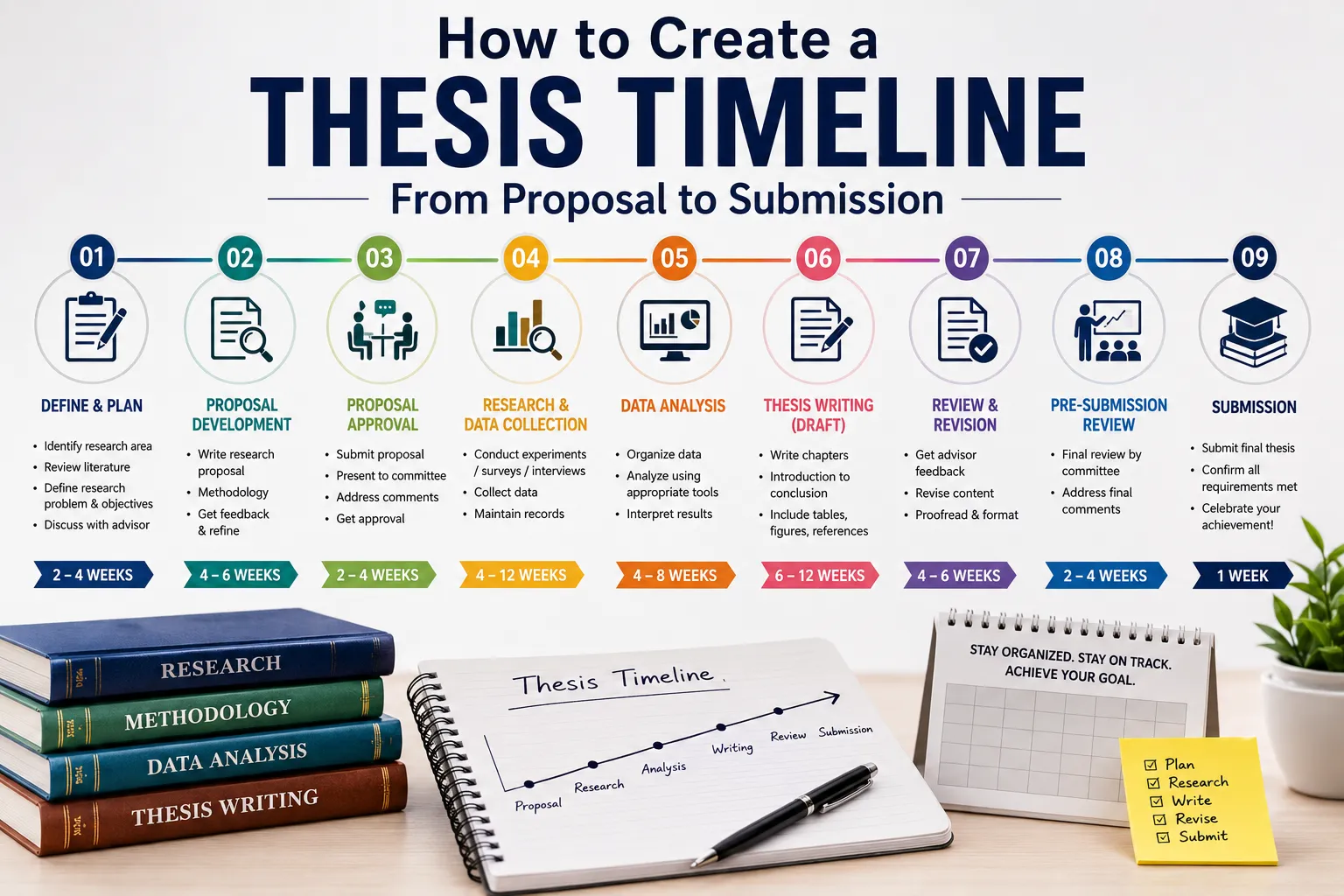
"I'll figure out the timeline as I go" is one of the most common and most costly assumptions in thesis writing. Without a structured plan, months disappear into an overlong literature review, ethics approval delays quietly eat your data collection window, and suddenly you're three months from deadline with a first draft that isn't close to finished. This guide walks through how to create a thesis timeline from proposal to submission that actually holds up under real-world delays.
What a Thesis Timeline Actually Needs to Track
A thesis timeline usually covers the period from topic approval through your final defense and submission. It's built around two related concepts: milestones, the fixed points marking the end of one phase and the start of the next (proposal defense, ethics approval, first full draft), and deadlines, the specific dates assigned to those milestones — ideally set with input from your supervisor or committee, not just chosen unilaterally.
Each milestone should be broken into smaller tasks. Your literature review milestone, for example, isn't one undifferentiated block of time — it includes database searches, source screening, note-taking, and drafting, each with its own realistic estimated duration. This level of granularity is what turns a vague intention ("finish the lit review by March") into an actual, trackable plan.
Use the Backcasting Method
The most reliable planning approach is backcasting: start with your final deadline — your defense or submission date — and work backwards to identify every step needed to reach that goal. This is meaningfully different from planning forward from your start date and hoping everything fits before the deadline. Backcasting forces you to confront early whether your timeline is actually realistic, rather than discovering the mismatch only when it's too late to adjust.
Build In Buffer Time Deliberately — Not Just Optimistically
Buffer time is unscheduled time deliberately added after each phase specifically to absorb delays. Without it, a single late committee response can push back every subsequent date in your entire timeline. Build buffer in two places: at the task level (if you estimate eight weeks for your literature review, plan for ten), and at the end of your overall project, to absorb whatever unexpected problems accumulate across the whole timeline.
Specific buffer benchmarks worth building in directly:
- 2–3 weeks per chapter for supervisor feedback cycles — committees typically need two to four weeks to review a submitted chapter or proposal, and this waiting period needs to be scheduled, not treated as a surprise
- 4–8 weeks for ethics or IRB approval delays, since this process is notoriously variable and often slower than expected
- Extra time for data collection setbacks — participant recruitment consistently takes longer than initially expected, almost universally across disciplines
Take the Planning Fallacy Seriously
A well-documented phenomenon is worth knowing about before you finalize your own timeline: studies show only about 30% of students complete their thesis in the time they originally expected. This isn't a reflection of poor discipline — it's a well-established cognitive bias called the planning fallacy, where people systematically underestimate how long tasks will take, even when they've experienced similar delays before. Build your timeline assuming you're subject to this same bias, not assuming your project will be the exception.
Representative Timeline Structures by Program Length
A Full PhD Timeline (3–5 Years)
A representative structure: Years 1–2 generally cover coursework, proposal development, and data collection. Years 2–4 focus on writing. The final year covers revisions, submission, and defense preparation. Confirm your specific program's typical pacing with your supervisor, since PhD timelines vary considerably by discipline and by how much of your research depends on external data collection versus existing sources.
A Shorter Thesis Timeline (8 Months)
A representative breakdown for a shorter (roughly 8-month) thesis: topic selection and proposal (3–6 weeks), literature review (6–8 weeks), methodology and data collection (8–12 weeks), analysis and writing (8–12 weeks), and revision (3–4 weeks).
A Master's Thesis Timeline (18–24 Months)
For a master's thesis specifically, these same phase categories typically expand to fill 18–24 months, giving considerably more breathing room per phase than the compressed 8-month structure above, while following the same underlying sequence.
Find Genuine Time Savings Through Parallel Work
Literature review work can often run in parallel with ethics or IRB submission review time. This overlap is one of the most common, genuinely effective ways students save time in shorter programs — the waiting period for ethics approval doesn't need to be idle time on your part, since your literature review doesn't depend on that approval to proceed.
Step-by-Step: Building Your Own Thesis Timeline
- List every stage your thesis involves — topic selection, reading, proposal, research/data collection, writing, editing, revision, and submission — without filtering yet, just capturing everything
- Estimate the time each stage will honestly take, specifically resisting the common trap of underestimating your literature review and data analysis phases
- Identify which tasks can run in parallel (such as literature review alongside ethics approval waiting time) versus which must happen sequentially
- Work backwards from your final deadline using the backcasting method, placing each milestone at the latest point it could occur while still leaving room for everything after it
- Add buffer time at both the task level and the end of the overall project
- Schedule regular supervisor check-ins as fixed points in your timeline, not optional extras
- Choose a visible planning tool — spreadsheet, checklist, or Gantt chart — that you'll actually maintain
- Review and update your timeline regularly, ideally weekly, adjusting as your actual progress reveals which original estimates were accurate and which weren't
Practical Checklist: Is Your Thesis Timeline Ready?
- Every stage of the thesis is listed, from topic selection through submission
- Each milestone is broken into smaller, individually estimated tasks
- Timeline was built using the backcasting method, starting from the final deadline
- Buffer time is included both within individual tasks and at the end of the overall project
- Specific buffer benchmarks (2–3 weeks per chapter for feedback, 4–8 weeks for ethics approval) are reflected in the schedule
- Opportunities for parallel work (literature review alongside ethics approval waiting time) are identified
- Regular supervisor check-ins are scheduled as fixed points, not left informal
- A visible, trackable planning tool is chosen and actually used
- Timeline is reviewed and updated on a regular (ideally weekly) basis, not created once and forgotten
Two Practical Scenarios
Scenario 1 — Recovering From an Underestimated Literature Review
A scholar initially budgeted six weeks for their literature review, based on optimism rather than a careful task breakdown. By week five, they'd completed database searching and source screening but hadn't yet begun substantive drafting — a clear sign the original estimate was too tight. Because the scholar had built in task-level buffer (planning eight weeks against the six-week estimate), the overrun was absorbed without disrupting the rest of the timeline, and subsequent phases proceeded on schedule.
Scenario 2 — Using Parallel Work to Recover Lost Time
A scholar's ethics approval took six weeks instead of the anticipated four, eating into time originally reserved for data collection. However, because the scholar had scheduled literature review work to run in parallel with the ethics waiting period rather than sequentially after it, the literature review was already substantially complete by the time approval came through — meaning the overall timeline absorbed the ethics delay without a corresponding delay to the final submission date.
Common Mistakes Students Make Building Thesis Timelines
- Planning forward optimistically from the start date instead of working backwards from the final deadline using backcasting.
- Underestimating literature review and data analysis time specifically, two phases repeatedly flagged as commonly under-planned.
- Failing to build in buffer time, leaving no cushion when a single delay (a late committee response, a slow ethics approval) pushes back the entire remaining schedule.
- Treating supervisor feedback turnaround as instant, rather than the realistic two-to-four-week window committees typically need.
- Creating a timeline once and never revisiting it, missing the chance to adjust as real progress reveals which original estimates were accurate.
Frequently Asked Questions
How do you create a thesis timeline from proposal to submission?
List every stage from topic selection through submission, estimate each task's duration honestly, use the backcasting method to work backwards from your final deadline, build in buffer time at both the task and project level, and review your timeline regularly rather than treating it as a one-time plan.
Why does creating a thesis timeline matter?
Without a structured, buffer-inclusive timeline, delays in one phase (ethics approval, supervisor feedback, data collection) tend to cascade unpredictably through the rest of the project — a well-built timeline absorbs these delays without derailing your final submission date.
How does a thesis timeline affect a student's overall success?
Studies show only about 30% of students complete their thesis in their originally expected timeframe, largely due to the planning fallacy — a realistic, buffer-inclusive timeline built with this bias in mind significantly improves the odds of staying on track.
When should you create your thesis timeline?
As early as possible, ideally as soon as your proposal is approved or even during the proposal stage itself, so your research, writing, and revision phases can be planned realistically from the very start rather than reactively adjusted later.
Is professional help available to create a thesis timeline from proposal to submission?
Yes. ThesisLikho's PhD-qualified mentors have guided 10,000+ scholars through timeline planning, milestone structuring, and complete thesis writing assistance tailored to individual programs and deadlines.
Get Expert Guidance on Your Thesis Timeline
Building a realistic timeline that accounts for supervisor feedback cycles, ethics approval delays, and the planning fallacy takes more than optimism — it takes deliberate, buffer-inclusive planning from the very start. If you'd like expert input on structuring your thesis timeline or managing your research schedule, ThesisLikho's PhD-qualified team offers timeline planning support, milestone structuring guidance, and complete thesis writing assistance. If you need expert guidance with your thesis timeline, research planning, or overall writing process, you can explore our Thesis Writing Assistance service.
Talk to a Thesis Expert → https://thesislikho.com/writing-services/thesis-writing