
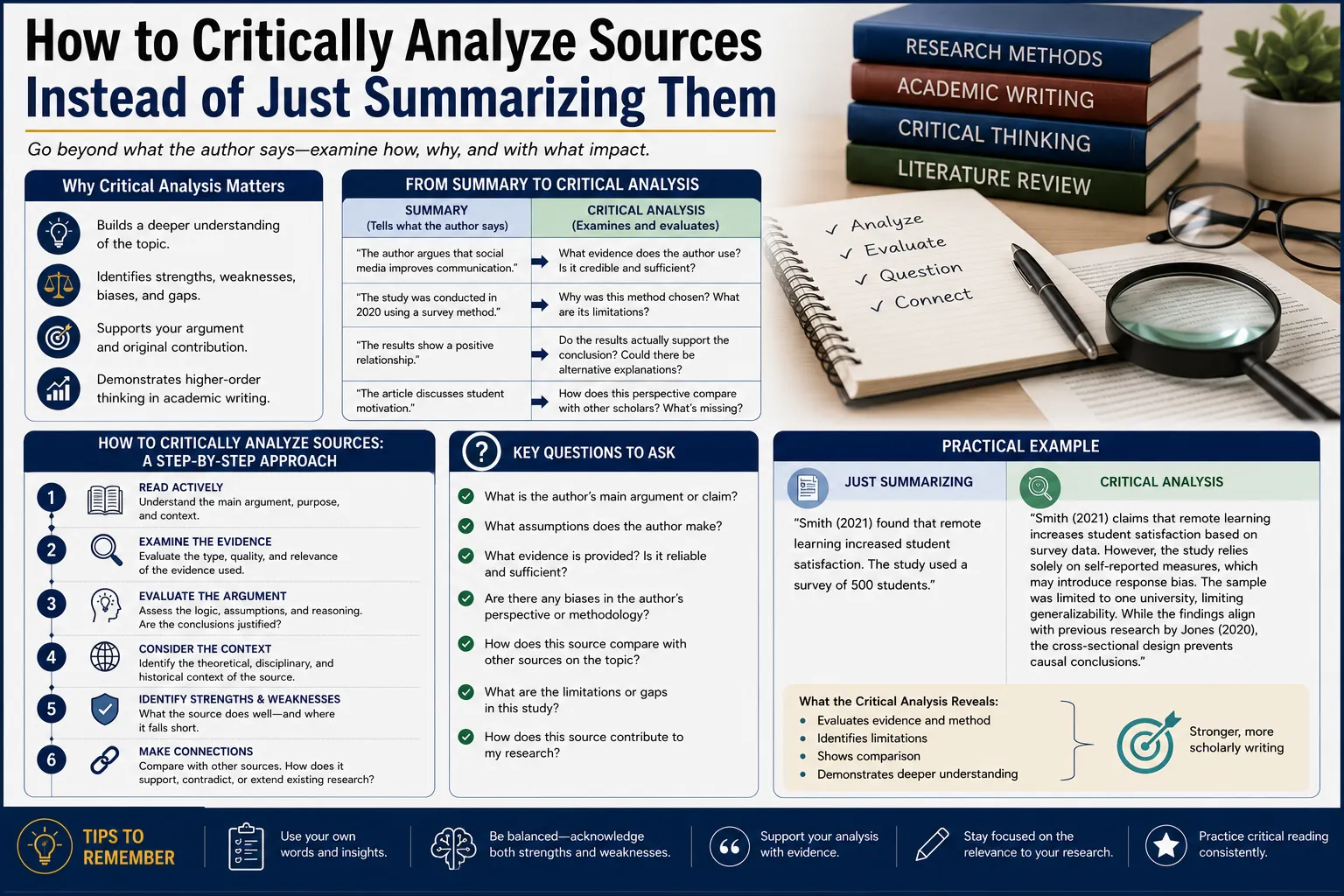
If a supervisor has ever handed back your literature review with "too descriptive" or "where's your voice in this?" scrawled in the margins, you've run into the single most common weakness in thesis writing. Learning how to critically analyze sources instead of just summarizing them is what separates a literature review that simply lists what other people found from one that builds an actual argument — and it's usually the difference between a chapter that sails through committee review and one that gets sent back for revision.
This guide breaks down exactly what critical analysis means in practice, how it differs from summary, the frameworks and sentence-level techniques that make analytical writing concrete rather than vague, and the mistakes that keep scholars stuck in summary mode. We've grounded this in current UGC research integrity expectations and the patterns we see across scholars ThesisLikho supports through the literature review stage.
What Does It Mean to Critically Analyze a Source?
Critical analysis means evaluating and interpreting a source's strengths, weaknesses, assumptions, and implications, rather than simply restating what the source says. It requires you to ask questions the original author didn't necessarily answer: Is this methodology strong enough to support the claims made? Does this finding hold up against other studies in the field? What's missing from this argument, and why does that gap matter for your own research?
Critical thinking here doesn't mean being negative or dismissive — a strong critical analysis can conclude that a study is rigorous and convincing, as long as that conclusion is reasoned rather than assumed. The word "critical" refers to critical thinking, not criticism for its own sake.
Summary vs Critical Analysis: The Core Difference
A summary is a concise restatement of a source's main points, findings, and conclusions — it tells the reader what the source said. Critical analysis goes further: it evaluates how well the source supports its claims, why its findings matter, and how it relates to other work in the field. Summarization sets the stage and provides context; critical analysis is where the actual scholarly contribution of your literature review happens.
Both have a place in a thesis. You need enough summary to orient your reader — describing a study sufficiently that they understand its core findings without needing to read the original in full. But summary alone answers the question "what has been done?" while analysis answers the much more important question "what does it mean, and what does it tell me about the gap my research will fill?" A literature review built entirely from summary reads like an annotated list of papers; a literature review built around analysis reads like a scholarly argument.
Why This Matters More Than Ever in 2026
Two current developments make this distinction more consequential than it used to be. First, UGC now requires universities to deliver a 30-hour research and publication integrity training course to PhD students before they begin their research, covering scientific misconduct, plagiarism, and research ethics — a clear signal that regulators expect genuine, original scholarly engagement, not restated literature.
Second, UGC has taken visible enforcement action against theses containing excessive AI-generated or copied content submitted without critical interpretation or proper attribution, including cases where similarity checks flagged theses at well above the permitted threshold. Under the UGC 2018 plagiarism regulations, similarity must stay below 10% nationally, and many universities apply stricter, chapter-specific thresholds for literature reviews specifically — precisely because literature review chapters are where unoriginal, purely descriptive writing tends to concentrate. A literature review built on critical analysis rather than paraphrased summary is not just academically stronger; it's also structurally less likely to trip a similarity check, since analysis requires your own reasoning rather than restated source material.
The CRAAP Test: Evaluating Sources Before You Analyze Them
Before you can meaningfully analyze a source, you need to judge whether it's worth analytical weight in the first place. The CRAAP test is a widely used framework for this initial evaluation:
- Currency — how recent is the source, and does that matter for your topic? A five-year-old paper on a fast-moving area like AI adoption carries different weight than one on a stable, long-established theory.
- Relevance — how directly does this source connect to your specific research question, not just your broad topic area?
- Authority — who wrote it, and what's their standing in the field? Peer-reviewed journal articles generally carry more authority than unreviewed working papers or non-academic sources.
- Accuracy — is the source well-supported by evidence, and can its claims be verified against other literature?
- Purpose — was the source written to inform, to persuade, or to sell something? Academic sources aim to contribute knowledge; industry white papers or commercial content may have other motives worth noting.
Running sources through CRAAP isn't itself critical analysis — it's the filtering step that helps you decide which sources deserve deep analytical engagement and which can be cited more briefly for context.
Five Dimensions of Critical Analysis
When you sit down to analyze rather than summarize a source, these five dimensions give you concrete angles to work through:
- Methodological rigor — Was the sample size adequate? Was the research design appropriate for the research question? Are there validity or reliability concerns that limit how far the findings can be trusted?
- Theoretical grounding — Is the study well-anchored in existing theory, or does it apply a framework loosely or inconsistently? Does it extend theory in a meaningful way, or just reference it superficially?
- Contextual applicability — Does the finding hold in contexts beyond where it was originally studied? A result from a Western corporate setting may or may not transfer cleanly to an Indian SME context, and that gap is often exactly the kind of observation that becomes your research justification.
- Consistency with the wider literature — Does this source agree with, contradict, or complicate other studies you've reviewed? Contradictions between sources are some of the most valuable material in a literature review, since they often point directly to a research gap.
- Limitations acknowledged (and unacknowledged) — What does the author say the study can't do? And just as importantly, what limitations does the author not mention that you can identify yourself?
Working through even two or three of these dimensions for your more central sources will transform a passage from description into genuine analysis.
Sentence-Level Techniques That Signal Analysis
Critical analysis often comes down to specific sentence structures and word choices that summary-heavy writing lacks. A few reliable patterns:
- Evaluative framing: "While the study's sample of 300 respondents is robust, its convenience sampling method introduces a bias that limits generalizability" — note how this pairs a strength with a specific, reasoned limitation, rather than stating either in isolation.
- Comparative framing: "Unlike Sharma et al. (2023), who found no significant relationship between X and Y, this study's larger sample and longitudinal design suggest a more reliable basis for concluding otherwise."
- Gap-identifying framing: "Although several studies have examined X in manufacturing contexts, none have tested whether the same relationship holds in service-sector organizations — a gap this thesis addresses directly."
- Position-taking framing: "This thesis aligns more closely with the resource-based view articulated by [source] than with the competing institutional theory perspective, because the former better explains the variation observed in emerging-market firms."
Notice that none of these examples simply restate a finding — each one evaluates, compares, or positions the source in relation to something else. That relational move is what analysis actually is.
How Much of Your Literature Review Should Be Analysis?
Academic writing guides commonly suggest that the evaluative, analytical portion of a literature review or critical review should make up the clear majority of the text — description exists mainly to orient the reader briefly before the real analytical work begins. In practice, this means every paragraph built around a single source or cluster of sources should spend only a sentence or two establishing what the study found, then dedicate the remainder to evaluating, comparing, or positioning that finding.
A useful gut check: if you could delete a paragraph from your literature review and lose nothing except a restated fact the reader could get from the abstract itself, that paragraph is running too heavy on summary. If the paragraph contains a judgment, comparison, or connection that only you could have made after reading multiple sources together, it's doing the job a literature review is supposed to do.
Building a Synthesis Matrix
A synthesis matrix is one of the most effective practical tools for moving from summary to analysis, especially once you're working with more than fifteen or twenty sources. Rather than organizing your notes source by source, you organize them theme by theme or variable by variable — with each source appearing across multiple rows depending on which themes it touches. Reading down a column that spans ten different sources, all addressing the same variable or theme, naturally surfaces agreements, contradictions, and gaps that are far harder to spot when your notes are structured one source at a time.
Building this matrix before you start drafting is often what makes analytical writing feel achievable rather than abstract — the comparisons and contradictions are already visible on the page; you're just narrating what the matrix already shows you.
Step-by-Step: Moving From Summary to Analysis
- Read with a question in mind, not just to absorb content — ask what this source contributes to your specific research question before you start taking notes.
- Run each source through the CRAAP test to decide how much analytical weight it deserves.
- Take notes in your own words from the start, capturing your reactions and questions alongside the source's findings, not just the findings themselves.
- Group sources thematically, ideally using a synthesis matrix, rather than working through them one at a time in isolation.
- Identify agreements, contradictions, and gaps across each theme before you write a single sentence of the chapter itself.
- Draft paragraph by paragraph around themes, not around individual sources — a paragraph that's really "here's what source A said, then source B, then source C" is a summary in disguise.
- Revise for evaluative language, replacing purely descriptive sentences with sentences that compare, judge, or connect.
- Check every paragraph for your own analytical voice — could a reader tell, from the writing itself, what you think about the strength of this body of evidence?
Real Thesis Example
A scholar writing a literature review on employee engagement and remote work initially drafted the chapter source by source: a paragraph summarizing Study A's findings, followed by a paragraph summarizing Study B's findings, and so on through roughly thirty papers. Her supervisor flagged the chapter as "descriptive" and asked her to rebuild it around themes instead. She built a synthesis matrix organized by four themes — communication frequency, autonomy, technology fatigue, and managerial trust — with each of her thirty sources mapped across the relevant themes. Rewriting the chapter around these four themes rather than around individual studies immediately surfaced a contradiction she'd missed: several studies found autonomy positively predicted engagement, while two recent papers focused specifically on hybrid (not fully remote) settings found the opposite. That contradiction became the explicit research gap justifying her own study, and the resulting chapter shifted from a list of findings to an argument about what the field still didn't understand.
Common Mistakes That Keep Writers Stuck in Summary Mode
- Organizing by source instead of by theme. A chapter structured as "Author A said X, Author B said Y" almost always reads as summary, regardless of how well each individual sentence is written.
- Treating every source as equally important. Not every paper deserves the same depth of engagement — spend your analytical effort on the sources most central to your argument, and describe peripheral ones more briefly.
- Restating findings without evaluating methodology. Reporting a result without commenting on whether the study design was strong enough to support it is a missed analytical opportunity.
- Avoiding disagreement between sources. Some scholars smooth over contradictions in the literature rather than highlighting them, when contradictions are often the most valuable material for justifying a research gap.
- Writing without a clear thematic through-line. If your chapter doesn't build toward an argument about what's known, unknown, and contested, it's functioning as an inventory rather than a review.
- Over-relying on paraphrased AI-generated summaries. Beyond the academic integrity risk this now carries under current UGC enforcement, paraphrased AI summary is, by definition, restated content — it can't produce the comparative, evaluative judgments that only come from your own critical reading.
- Confusing length with depth. A longer paragraph isn't automatically more analytical — three carefully reasoned sentences that compare two studies do more analytical work than a full page describing each study separately.
Critical Analysis Checklist
Before finalizing a literature review section, check it against this list:
- Every paragraph is organized around a theme or argument, not a single source
- Each major source has been run through a CRAAP-style evaluation before being cited
- At least one of the five analytical dimensions (methodology, theory, context, consistency, limitations) is addressed for your most central sources
- Contradictions and disagreements between sources are named explicitly, not smoothed over
- Every paragraph contains at least one sentence of genuine evaluation, comparison, or positioning
- The chapter builds toward a clearly stated research gap, not just a list of findings
- Sentence-level analytical language (comparative, evaluative, gap-identifying framing) appears throughout
- No paragraph could be deleted without losing an argument, only a restated fact
- Notes and drafting were done in your own words from the start, not paraphrased from AI or source text
- The chapter reads as an argument about the field, not an inventory of papers
For the systematic search process that often feeds into this kind of thematic synthesis, our related guide, [PRISMA guidelines explained for systematic literature reviews], walks through building a defensible, comprehensive source base before you begin the analytical work described here.
How Long Does It Take to Complete a Thesis Using This Approach?
Rebuilding a literature review chapter around genuine critical analysis — including building a synthesis matrix and reorganizing by theme — typically adds two to six weeks to the literature review stage compared to a purely descriptive draft, depending on how many sources are involved. Scholars who build analytically from the start, rather than drafting descriptively and revising later, generally find this faster overall, since restructuring an already-written descriptive chapter takes longer than writing analytically the first time.
Is Professional Help Available to Critically Analyze Sources Instead of Just Summarizing Them?
Yes — many scholars work with academic mentors or research consultancies to build synthesis matrices, identify contradictions across their source base, and strengthen the analytical voice of a literature review chapter, particularly when English isn't their first language for academic writing or when they're new to research altogether. ThesisLikho's PhD-qualified research experts have supported thesis writers through exactly this transition from descriptive to analytical writing, helping ensure every chapter demonstrates genuine scholarly engagement rather than restated summary — all while keeping the underlying thinking and argument entirely your own. Explore ThesisLikho's thesis writing services for one-on-one guidance.
FAQs
How do you critically analyze sources instead of just summarizing them?
Organize your literature review around themes rather than individual sources, evaluate each source's methodology and contribution rather than just restating its findings, and explicitly highlight agreements, contradictions, and gaps across the literature to build toward your own research justification.
How long does it take to complete a thesis using this approach?
Building genuinely analytical literature review chapters typically adds two to six weeks to the review stage compared to purely descriptive drafting, though writing analytically from the start is usually faster overall than restructuring a descriptive draft later.
Is professional help available to critically analyze sources instead of just summarizing them?
Yes. Research consultancies and academic mentors, including ThesisLikho's PhD-qualified experts, help scholars build synthesis matrices and strengthen analytical writing while preserving full originality and academic integrity.
Why should I critically analyze sources instead of just summarizing them?
Because a literature review's scholarly value comes from evaluation and synthesis, not restated findings — committees and examiners specifically look for evidence that you can judge the strength of existing research, not just describe it, and current UGC integrity enforcement makes genuine analytical engagement more important than ever.
When should you critically analyze sources instead of just summarizing them for a thesis?
From the very first notes you take on a source, not just during the final drafting stage — capturing your evaluative reactions alongside a source's findings while reading makes analytical writing dramatically easier than trying to add analysis into an already-summarized draft later.
Related reading: PRISMA Guidelines Explained for Systematic Literature Reviews
Ready to turn a descriptive draft into an analytical literature review?
Talk to a Thesis Expert → https://thesislikho.com/writing-services/thesis-writing