
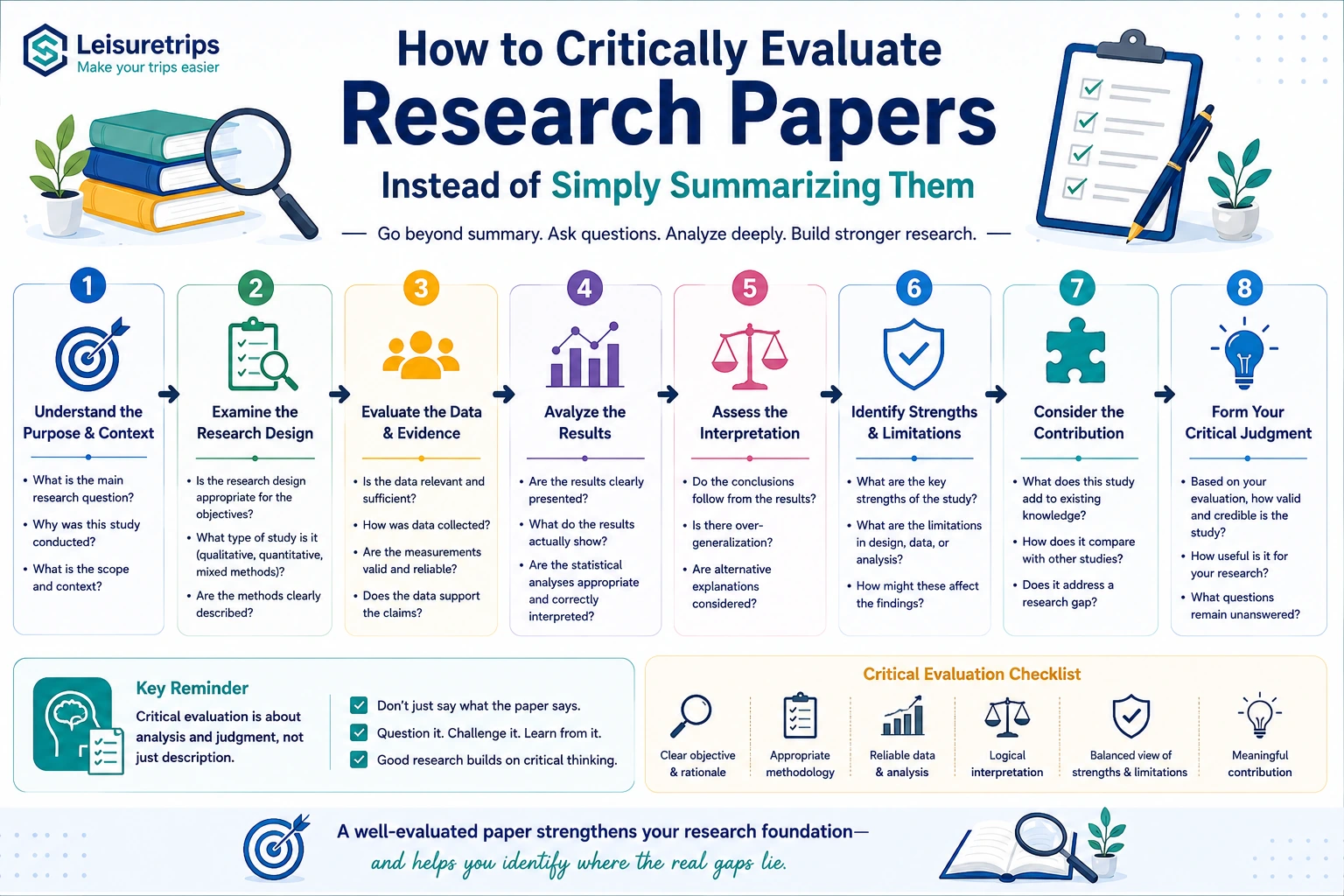
One of the biggest differences between an average PhD thesis and an outstanding one lies in the quality of its literature review. Many research scholars spend months reading journal articles but make one common mistake—they simply summarize what each author has written. While summarization demonstrates that you have read the literature, it does not prove that you understand it or can engage with it critically.
Universities in India and around the world expect PhD scholars to move beyond description. A literature review should critically evaluate existing research by identifying strengths, weaknesses, contradictions, methodological limitations, theoretical gaps, and opportunities for future investigation. Examiners are not interested in reading a chapter that repeats published studies—they want to see your ability to analyze, compare, interpret, and synthesize academic knowledge.
Critical evaluation is what transforms a collection of article summaries into a scholarly discussion. It enables you to justify your research problem, establish a clear research gap, and demonstrate how your study contributes to the existing body of knowledge.
This comprehensive guide explains how to critically evaluate research papers instead of merely summarizing them. Whether you are writing a PhD thesis, MPhil dissertation, MBA project, or research article, these techniques will help you produce a stronger and more persuasive literature review.
What Does Critical Evaluation Mean?
Critical evaluation is the process of examining a research paper objectively to determine:
- How reliable the study is.
- Whether the methodology is appropriate.
- If the conclusions are supported by evidence.
- How the findings compare with previous studies.
- What limitations exist.
- Whether the research contributes meaningful knowledge.
Critical evaluation does not mean criticizing the author personally. Instead, it involves assessing the quality, credibility, and significance of the research using evidence and logical reasoning.
Why Is Critical Evaluation Important?
Developing critical evaluation skills benefits every stage of academic research.
1. Produces a Stronger Literature Review
Rather than listing studies one after another, you build a meaningful discussion that identifies patterns, debates, and research gaps.
2. Identifies Research Gaps
By evaluating previous studies, you can determine what remains unexplored and justify your own research.
3. Improves Research Design
Understanding the strengths and weaknesses of earlier methodologies helps you design a more robust study.
4. Demonstrates Academic Maturity
Critical thinking is a key expectation at the doctoral level and shows that you can engage with scholarly work independently.
5. Supports Original Contributions
Your thesis should contribute new knowledge, and critical evaluation helps explain why your research is needed.
The Key Elements of Critical Evaluation
Every research paper can be evaluated by examining several core elements.
Research Problem
Ask:
- Is the problem clearly stated?
- Is it relevant?
- Does the study explain why the problem matters?
- Is the research gap well defined?
A poorly defined problem often weakens the entire study.
Research Objectives
Evaluate whether:
- Objectives are specific.
- Objectives align with the research problem.
- Objectives are measurable and achievable.
Vague objectives often lead to unclear conclusions.
Literature Review
Consider:
- Are recent studies included?
- Are foundational theories discussed?
- Does the review identify contradictions?
- Is there a clear research gap?
A literature review that merely summarizes previous work without analysis is less convincing.
Theoretical Framework
Assess whether:
- The chosen theory is appropriate.
- The theory aligns with the research objectives.
- Alternative theories should have been considered.
A strong theoretical foundation strengthens the credibility of the study.
Research Methodology
The methodology is one of the most important areas for critical evaluation.
Examine:
- Research design
- Sampling method
- Sample size
- Data collection tools
- Validity
- Reliability
- Ethical considerations
Ask yourself:
- Is the chosen method suitable?
- Could another method produce better results?
- Are there potential sources of bias?
Sample Selection
Evaluate:
- Sample size
- Representativeness
- Sampling technique
- Geographic coverage
- Inclusion and exclusion criteria
Example:
A study involving only one university may not represent all Indian higher education institutions.
Data Collection
Consider:
- Were questionnaires validated?
- Were interviews well structured?
- Were data collection procedures explained clearly?
Poor data collection methods reduce the reliability of findings.
Data Analysis
Evaluate whether the statistical or qualitative analysis was appropriate.
Questions include:
- Were suitable statistical tests used?
- Were assumptions checked?
- Were qualitative themes explained systematically?
- Were findings interpreted correctly?
The quality of analysis directly affects the credibility of the conclusions.
Results
Ask:
- Do the results answer the research questions?
- Are tables and figures clear?
- Are findings presented objectively?
- Are unexpected results discussed?
Strong results are transparent and directly linked to the study's objectives.
Discussion
A good discussion should:
- Compare findings with previous studies.
- Explain similarities and differences.
- Interpret results rather than simply repeating them.
- Discuss practical and theoretical implications.
Conclusion
Assess whether:
- Conclusions are supported by evidence.
- Recommendations are realistic.
- Limitations are acknowledged.
- Future research directions are identified.
Avoid studies that make broad claims unsupported by their data.
Questions to Ask While Reading Research Papers
Reading actively improves critical thinking.
Ask yourself:
- What problem is being investigated?
- Why is this research important?
- Which theory supports the study?
- Is the methodology appropriate?
- What assumptions have been made?
- Are the findings convincing?
- What limitations exist?
- How does this paper compare with others?
- What research gap remains?
These questions encourage deeper engagement with the literature.
Evaluate Methodological Quality
Many research papers reach different conclusions because they use different methods.
Compare:
- Quantitative vs. qualitative approaches.
- Cross-sectional vs. longitudinal studies.
- Experimental vs. observational designs.
- Random sampling vs. convenience sampling.
For example, two studies may investigate employee engagement, but differences in sampling or measurement tools can explain conflicting results.
Assess the Credibility of the Evidence
Not all evidence carries the same weight.
Generally, stronger evidence comes from:
- Peer-reviewed journals.
- Large, representative samples.
- Validated research instruments.
- Transparent methodologies.
- Reproducible analyses.
Be cautious with studies that lack methodological detail or make sweeping claims without sufficient evidence.
Identify Biases and Limitations
Every study has limitations. Recognizing them is an important part of critical evaluation.
Common limitations include:
- Small sample sizes.
- Limited geographic scope.
- Self-reported data.
- Short study duration.
- Low response rates.
- Measurement errors.
- Researcher bias.
Identifying these limitations helps explain why further research is needed.
Synthesize the Literature
Instead of discussing each paper separately, group studies by themes.
For example:
Theme 1: Technology Adoption
Several studies report that perceived usefulness and ease of use significantly influence technology adoption. However, researchers disagree on the role of organizational culture, suggesting the need for further investigation.
Theme 2: Employee Engagement
Most studies identify leadership as a major predictor of engagement, but few examine the influence of hybrid work environments in developing economies.
This thematic approach demonstrates synthesis rather than description.
Build an Argument Throughout Your Literature Review
A literature review should develop a logical argument.
For example:
- Explain the research topic.
- Discuss foundational theories.
- Compare previous findings.
- Highlight contradictions.
- Identify methodological limitations.
- Demonstrate the research gap.
- Justify your study.
Each section should naturally lead to the next.
Practical Framework for Critically Evaluating a Research Paper
Use the following checklist when reading any article.
Background
- Is the topic relevant?
- Is the problem clearly defined?
Literature Review
- Are recent studies included?
- Is the research gap identified?
Methodology
- Is the design appropriate?
- Is the sample adequate?
- Are ethical considerations discussed?
Analysis
- Are suitable analytical techniques used?
- Are results interpreted correctly?
Findings
- Do findings answer the research questions?
- Are conclusions supported by evidence?
Contribution
- Does the study add new knowledge?
- What opportunities remain for future research?
Completing this checklist consistently will improve your critical reading skills.
Common Mistakes to Avoid
Many researchers unintentionally weaken their literature reviews.
Avoid:
- Describing studies without analysis.
- Ignoring methodological weaknesses.
- Accepting conclusions uncritically.
- Focusing only on findings.
- Overlooking contradictory evidence.
- Copying article summaries.
- Discussing papers in isolation.
- Failing to connect the literature to your own research.
Tips for Indian PhD Scholars
If you are conducting doctoral research in India, these practices can strengthen your literature review:
- Include both international and Indian studies to provide broader context.
- Examine completed theses from Shodhganga to understand how critical evaluation is applied in your discipline.
- Focus on high-quality peer-reviewed journals rather than relying solely on freely available online sources.
- Discuss conflicting findings instead of presenting only studies that support your perspective.
- Keep a literature matrix with sections for strengths, limitations, and research gaps—not just summaries.
- Regularly review your notes to identify emerging themes and opportunities for original research.
Best Tools for Literature Analysis
Several digital tools can help organize and evaluate research papers more effectively.
Zotero
Excellent for reference management, PDF annotation, and note-taking.
Mendeley
Useful for organizing research libraries and highlighting important sections of articles.
EndNote
Suitable for managing extensive reference collections and multiple citation styles.
Notion
Ideal for building literature matrices, thematic databases, and research dashboards.
Microsoft Excel
A simple but effective option for comparing methodologies, findings, and limitations across studies.
ChatGPT
Can help explain complex concepts, compare theories, generate literature comparison tables, and brainstorm thematic structures. However, critical evaluation should always be based on your own reading of the original paper rather than AI-generated summaries.
Frequently Asked Questions (FAQs)
What is the difference between summarizing and critically evaluating a research paper?
Summarizing explains what the author studied and found, while critical evaluation assesses the quality of the research by examining its methodology, evidence, strengths, weaknesses, limitations, and overall contribution.
How do I critically evaluate a research methodology?
Assess whether the research design, sampling technique, data collection methods, and analytical procedures are appropriate for answering the research questions. Consider possible sources of bias and whether alternative methods might have produced stronger evidence.
Should I criticize every research paper?
No. The goal is not to find faults but to evaluate studies objectively. A balanced review acknowledges both strengths and limitations.
How can I identify a research gap?
Compare findings across multiple studies, look for contradictory results, methodological limitations, under-researched populations, and emerging issues that have not yet been fully explored.
Why is critical evaluation important in a PhD thesis?
Critical evaluation demonstrates advanced research skills, supports the identification of research gaps, strengthens the justification for your study, and produces a more analytical and persuasive literature review.
Conclusion
Critically evaluating research papers is one of the most valuable skills a PhD scholar can develop. While summarizing helps you understand what previous researchers have done, critical evaluation enables you to determine how well those studies were conducted, how reliable their findings are, and where opportunities for new research exist.
A high-quality literature review is built on analysis rather than description. By examining research problems, theoretical frameworks, methodologies, data analysis, strengths, limitations, and contributions across multiple studies, you can create a coherent narrative that justifies your own research and demonstrates scholarly expertise.
For Indian PhD scholars, adopting a systematic approach to critical evaluation will not only improve the quality of your thesis but also enhance your academic writing, research design, and publication potential. As you review each paper, remember that your goal is not to repeat what others have written—it is to engage with the literature thoughtfully, question assumptions, identify gaps, and build a strong foundation for original research that advances your field.
Call / WhatsApp: +91 96438 02216
Website:www.ThesisLikho.com