
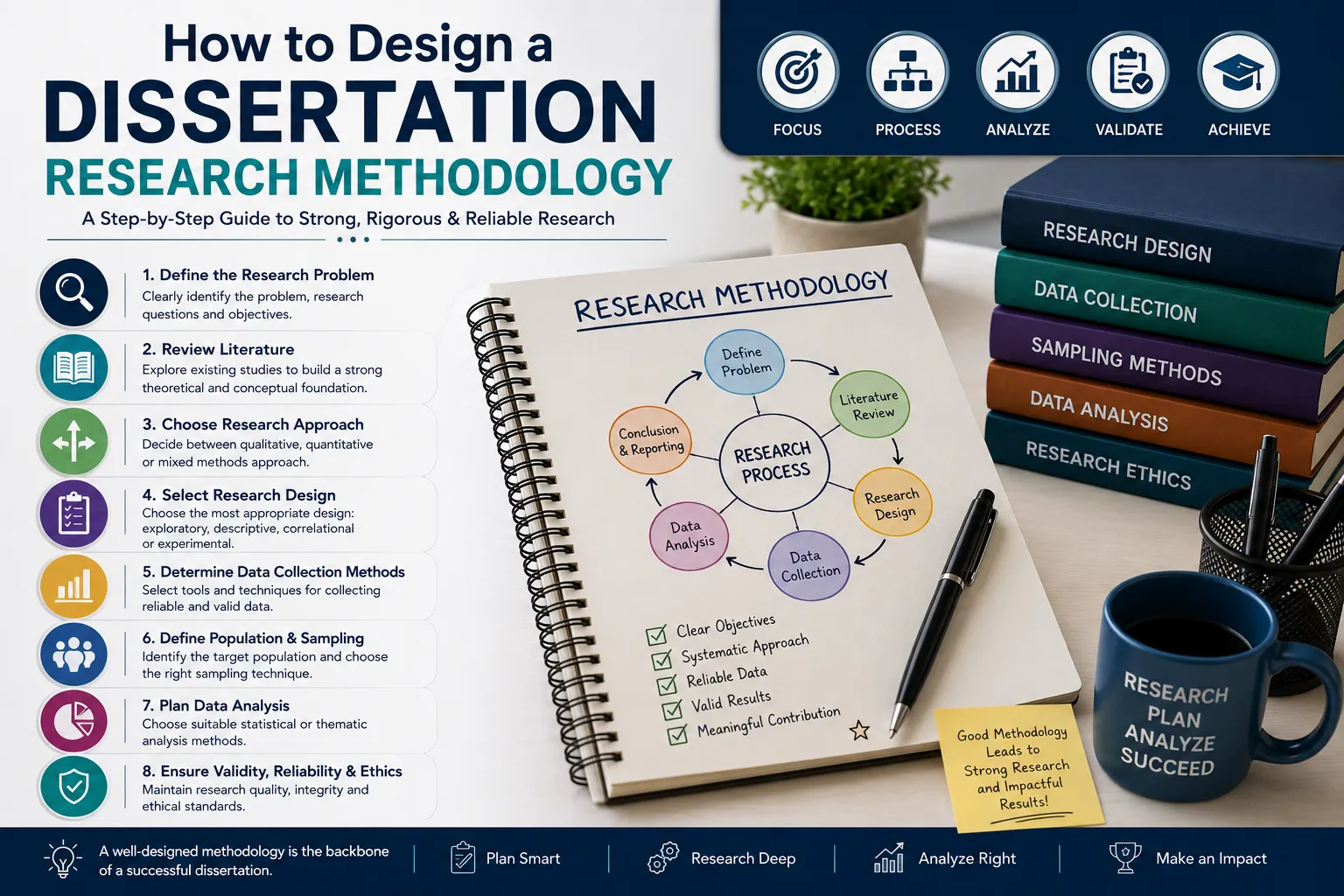
There's a specific moment in most dissertation journeys where the excitement of a good research idea meets a much harder question: okay, but how are you actually going to study this? Designing a research methodology is where that question gets answered — not in the abstract, but as a concrete, defensible plan covering exactly who you'll study, how you'll collect data, and how you'll analyze it.
This guide covers how to design a dissertation research methodology from the ground up — the difference between methodology and research design, the main design types available to you, and how to work through the decisions in a logical order rather than getting stuck picking pieces in isolation. We've written it the way an experienced dissertation mentor would talk you through your own planning process, because that's genuinely the kind of guidance ThesisLikho's PhD-qualified team provides to the thousands of scholars we've supported through exactly this stage.
Methodology vs. Research Design: Clearing Up the Confusion
These two terms get used almost interchangeably in casual conversation, but they refer to slightly different things, and understanding the distinction actually helps clarify your own thinking as you plan. Methodology refers to the overall philosophy or general principle guiding your research — your broader stance on how knowledge should be generated and what counts as valid evidence. Research design is the more concrete, practical translation of that philosophy into an actual executable project: your specific methods, sampling approach, participant recruitment, ethical considerations, and data analysis plan, all working together to turn your research question into something you can actually go and do.
Thinking of it this way helps: your methodology is your "why this approach," and your research design is your "here's exactly how." Both need to appear in your dissertation, but design work is where most of the concrete planning decisions actually happen.
Where Design Decisions Fit in Your Dissertation Timeline
A detail worth knowing upfront: your research design doesn't just appear once. It typically shows up twice across your dissertation's lifecycle. First, in compressed form, within your research proposal — a sketch detailed enough for your supervisor to approve the overall plan before you invest significant time executing it. Second, in expanded, fully justified form within the methodology chapter of your final dissertation, where you defend every component with citations to methodological literature and explain precisely how your variables and data map onto your research question.
Getting your design genuinely right at proposal stage — rather than treating it as a rough placeholder to sort out properly later — saves considerable rework, since a fundamentally flawed design discovered mid-data-collection is far more expensive to fix than one caught on paper before you've started.
Step 1: Let Your Research Question Drive Everything
Every methodology design decision that follows should trace back to a single source: your specific research question. This sounds obvious, but it's the single most common place where design work goes wrong — students choose a method they're comfortable with, or one that sounds more rigorous, before their research question is specific enough to actually demand it.
Before moving to any other design decision, write your research question down in its most current, refined form, and check: does it ask about a relationship between variables (pointing toward quantitative, correlational, or experimental design)? Does it ask about lived experience or meaning (pointing toward qualitative design)? Does it ask about the current state of something without testing a relationship (pointing toward descriptive design)? Your answer here should shape every subsequent decision, not the other way around.
Step 2: Choose Your Design Type
Beyond the qualitative/quantitative split covered in Step 3, your dissertation needs a specific research design type. Five main categories are commonly used: descriptive design, which characterizes a phenomenon or population without testing cause-and-effect; experimental design, which manipulates a variable under controlled conditions to test a causal hypothesis; correlational design, which measures the strength and direction of a relationship between variables without establishing causation; diagnostic design, which investigates the underlying cause of a specific problem or issue; and explanatory (or causal) design, which aims to explain why and how a particular outcome occurs.
Choosing the right one depends entirely on what your research question is actually trying to do. A question asking "what is the current state of X" calls for descriptive design. A question asking "does X cause Y" calls for experimental or explanatory design. A question asking "how strongly are X and Y related" calls for correlational design. Getting this categorization right early gives you vocabulary and structure that makes every subsequent design decision more straightforward.
Step 3: Decide on Qualitative, Quantitative, or Mixed Methods
This decision should follow directly from your research question and chosen design type. Quantitative research is expressed in numbers and used to test hypotheses and measure relationships with statistical precision. Qualitative research is expressed in words and used to gain deeper understanding of experiences, meanings, and context that numbers alone can't capture. Mixed methods deliberately combines both, typically to either explain unexpected quantitative patterns with qualitative follow-up, or to build quantitative measurement on top of qualitative exploratory groundwork.
Step 4: Fixed vs. Flexible Design
A distinction worth understanding alongside the qualitative/quantitative choice: how fixed or flexible your overall design should be. If you're testing a clear, specific hypothesis, a fixed design — where your variables, sample, and analysis plan are locked in before data collection begins — protects the reliability and validity of your findings. If you're exploring a poorly understood phenomenon, a more flexible design lets your understanding, and sometimes your specific research questions, evolve as data collection progresses.
Many dissertation projects genuinely sit somewhere between these two poles — starting with a looser framework that tightens as your literature review deepens and your understanding of the topic matures. Being explicit about where your own project sits on this spectrum, rather than leaving it ambiguous, strengthens your methodology chapter's internal logic.
Step 5: Work Out Sampling and Participants
Once your overall design and method are set, you need to specify exactly who your research involves and how you'll select them. This means naming your target population, your sampling technique (random, stratified, purposive, convenience, or another approach matched to your specific design), and a justified sample size or, for qualitative designs, a plan guided by thematic saturation rather than a fixed number.
This step also means being concrete about where and when your research will take place — a detail that's easy to leave vague but genuinely matters for a reader assessing whether your findings can reasonably be interpreted in the context you're claiming.
Step 6: Choose Your Data Collection Methods
Your data collection method should be the natural consequence of every decision made so far, not a separate choice made in isolation. Quantitative designs commonly rely on structured surveys, experiments, or existing numerical datasets. Qualitative designs commonly rely on interviews, focus groups, or observation. Whichever you choose, specify the actual instrument — the exact survey scale, the interview guide structure, the observation protocol — in enough detail that a reader can picture precisely how your data collection unfolded.
Step 7: Plan Your Analysis Approach
Your analysis plan needs to match your data type precisely. Numerical data calls for a named statistical technique — descriptive statistics, regression, ANOVA, or structural equation modeling, depending on your specific research question and variables. Word-based qualitative data calls for a named analytical approach — thematic analysis, content analysis, or discourse analysis are common choices, each with a different emphasis and suited to slightly different kinds of research questions.
Vague statements like "the data will be analyzed appropriately" tell a reader nothing useful. Naming your specific technique, and briefly explaining why it fits your data and research question, is what turns this section from a placeholder into genuine methodological justification.
Step 8: Build in Reliability and Validity
Reliability and validity are both fundamentally about how well your method measures what it claims to measure — reliability addresses consistency (would your results reproduce under similar conditions), while validity addresses accuracy (are you actually capturing the concept you intend to). These concerns apply differently across paradigms: quantitative research typically reports statistical reliability measures like Cronbach's Alpha and formal validity checks, while qualitative research relies on different, equally rigorous standards — credibility, transferability, and dependability — reflecting a different but no less serious approach to trustworthy findings.
Whichever paradigm you're working in, build your reliability and validity plan into your design from the start, rather than treating it as an afterthought to address only once data collection is already underway.
Step 9: Address Ethical Considerations
Every dissertation methodology needs to address informed consent, confidentiality or anonymity of participant data, and how collected data will be stored and eventually handled. If your research involves vulnerable populations, sensitive topics, or data obtained through an organizational or industry relationship, this section needs proportionally more detail, including how any necessary permissions were secured.
Most universities require a formal ethics review or approval process before data collection can begin — confirm your specific institution's process and timeline early, since ethics approval can take longer than students initially expect, and factoring this into your overall project timeline avoids an avoidable late-stage delay.
Justifying Your Design Choices
A genuinely useful self-check, drawn from methodology guidance broadly applicable across disciplines: for every major design decision, ask yourself whether this is a standard, well-established methodology in your specific field, or whether it requires additional justification because it's less conventional. A standard approach still needs to be named and cited, but an unconventional choice needs a more developed argument for why it fits your specific research question better than the field's usual default.
This same self-check applies to ethical considerations — ask explicitly whether there are ethical implications specific to your chosen design that a more conventional approach wouldn't raise, and address them directly rather than leaving them implicit.
Common Mistakes When Designing a Methodology
A frequent early mistake is choosing a method before the research question is specific enough to actually demand it — leading to a mismatch that surfaces later, once data collection has already begun around the wrong approach. Another common gap is treating research design type (descriptive, experimental, correlational) as an afterthought, jumping straight to qualitative versus quantitative without ever naming the more specific design category, which leaves the methodology chapter missing an important layer of precision. Vague sampling and analysis descriptions — naming a technique without justifying why it fits — are a recurring weakness examiners are quick to flag. And underestimating ethics approval timelines is a practical planning mistake that can quietly derail an otherwise well-designed project's schedule.
A Realistic Example Walkthrough
Scenario — Kabir, a first-time dissertation writer in a public policy program
Kabir's initial research question — "how does government digital service adoption affect citizen satisfaction" — sounded reasonably specific, but when he began designing his methodology, he realized it could support at least three different design approaches: a descriptive study measuring current adoption and satisfaction levels, a correlational study measuring the relationship between the two, or a qualitative study exploring citizens' lived experience of digital services. Rather than picking one arbitrarily, he worked backward from what he genuinely wanted to know — not just whether a relationship existed, but why citizens felt satisfied or dissatisfied — and settled on a correlational quantitative core study, supplemented by a smaller qualitative follow-up with a subset of survey respondents to explain the "why" behind the numbers. This mixed-methods design took more planning upfront than a single-method study would have, but it directly matched the full scope of what his research question was actually asking.
This is a pattern we see constantly in mentoring work: the strongest methodology designs come from working backward from a genuinely specific research question, not from picking a comfortable or impressive-sounding method first and reverse-engineering a question to fit it.
Scenario — Farah, a dissertation writer redesigning her methodology after supervisor feedback
Farah's initial methodology design proposed a purely experimental study testing whether a specific training intervention improved employee performance, complete with a control group and pre/post measurement. Her supervisor raised a practical concern: her access to participants — a single mid-sized organization willing to cooperate — couldn't realistically support a properly randomized control group without disrupting normal operations enough that the organization would likely withdraw cooperation entirely. Rather than abandoning her research question, Farah redesigned around a correlational design instead, measuring the relationship between training participation (which was happening anyway, for organizational reasons unrelated to her study) and subsequent performance metrics, without needing to construct an artificial control condition. The redesign meant she could no longer claim causation as strongly as an experimental design would have allowed, and she stated this limitation explicitly in her methodology chapter — but it meant her study was actually executable given her real-world access constraints, rather than an elegant design that would have collapsed the moment she tried to implement it.
If you'd like a second opinion on your own methodology design before you finalize your proposal, our Dissertation Writing Service offers exactly this kind of structural review from PhD-qualified mentors. Once your design is settled, our companion guide — How to Write the Methodology Chapter of a Thesis— covers how to turn it into a properly structured, examiner-ready chapter.
How Design Priorities Shift Across Disciplines
While the core design process covered above applies broadly, different fields tend to weight certain steps more heavily, and knowing your discipline's typical emphasis helps you calibrate where to invest extra planning time. In management and social science dissertations, sampling strategy and instrument validation (particularly for survey-based quantitative work) tend to draw the most scrutiny, since these fields have well-established conventions for what counts as a defensible sample and a properly validated measurement scale. In health and clinical research, ethical considerations and formal ethics board approval typically dominate the design timeline, often requiring significantly more lead time than other design steps combined. In education and organizational research, access negotiation — securing genuine cooperation from schools, companies, or institutions — often becomes the practical constraint that shapes every other design decision, much as it did in Farah's scenario above. In humanities and interpretive social science, theoretical framework and epistemological positioning typically receive more explicit attention than in more purely empirical fields, since the researcher's interpretive stance is treated as a core part of the methodology itself rather than a brief preliminary note.
Understanding which of these pressure points is most likely to shape your own design allows you to front-load planning time where it's genuinely needed, rather than distributing your early planning effort evenly across every step when your specific field's conventions call for more weight on one or two of them.
Pre-Submission Checklist
Before finalizing your research design, confirm that every design decision traces back clearly to your specific research question rather than being chosen in isolation. Confirm you've named a specific design type (descriptive, experimental, correlational, diagnostic, or explanatory), not just a broad qualitative or quantitative label. Confirm your sampling technique, sample size, and data collection instrument are all specified in enough detail to be replicable. Confirm your analysis approach names a specific technique rather than a vague general description. Confirm your reliability and validity plan is built in from the start, using criteria appropriate to your specific research paradigm. And confirm your ethics considerations are addressed explicitly, with your institution's approval process and timeline factored into your overall project schedule.
Getting Expert Support
Even experienced researchers benefit from a second, structured read on their methodology design before committing significant time to execution — a mismatch between research question and design, or a vague sampling and analysis plan, is far easier to fix on paper than after data collection has already begun.
ThesisLikho's mentoring team — PhD-qualified experts who've guided over 10,000 scholars through this exact planning stage — offers structured methodology design review as part of our Dissertation Writing Service, helping you build a design that genuinely fits your research question before you commit to executing it.
Frequently Asked Questions
How do you design a dissertation research methodology?
Start from your specific research question, choose a design type that matches what the question is trying to do (descriptive, experimental, correlational, diagnostic, or explanatory), decide between qualitative, quantitative, or mixed methods, and then work through sampling, data collection, analysis, reliability and validity, and ethics in a logical sequence that follows from those earlier choices.
How long does it take to complete a dissertation using this approach?
Designing a methodology, as distinct from executing it, typically takes several weeks of focused planning at proposal stage, though this process is genuinely iterative — your design often tightens further as your literature review deepens and your understanding of the topic matures.
Is professional help available to design a dissertation research methodology?
Yes — structured mentoring on research design selection, sampling strategy, and methodology justification is a standard, legitimate form of academic support. ThesisLikho's PhD-qualified mentors offer this kind of guided review for dissertation scholars.
Why should I design a dissertation research methodology carefully?
Your research design is the single biggest factor in whether examiners trust your conclusions — every result and discussion chapter that follows depends entirely on whether your design genuinely matches your research question and was executed with appropriate rigor.
When should you design a dissertation research methodology?
Design work belongs at proposal stage, before data collection begins — sketching it in compressed form for supervisor approval first, then expanding and fully justifying it in your final methodology chapter, since a design flaw caught early is far cheaper to fix than one discovered mid-data-collection.
Get Dissertation Help Now
If you'd like a mentor to review your research design before you finalize your proposal, ThesisLikho's team is ready to help.