
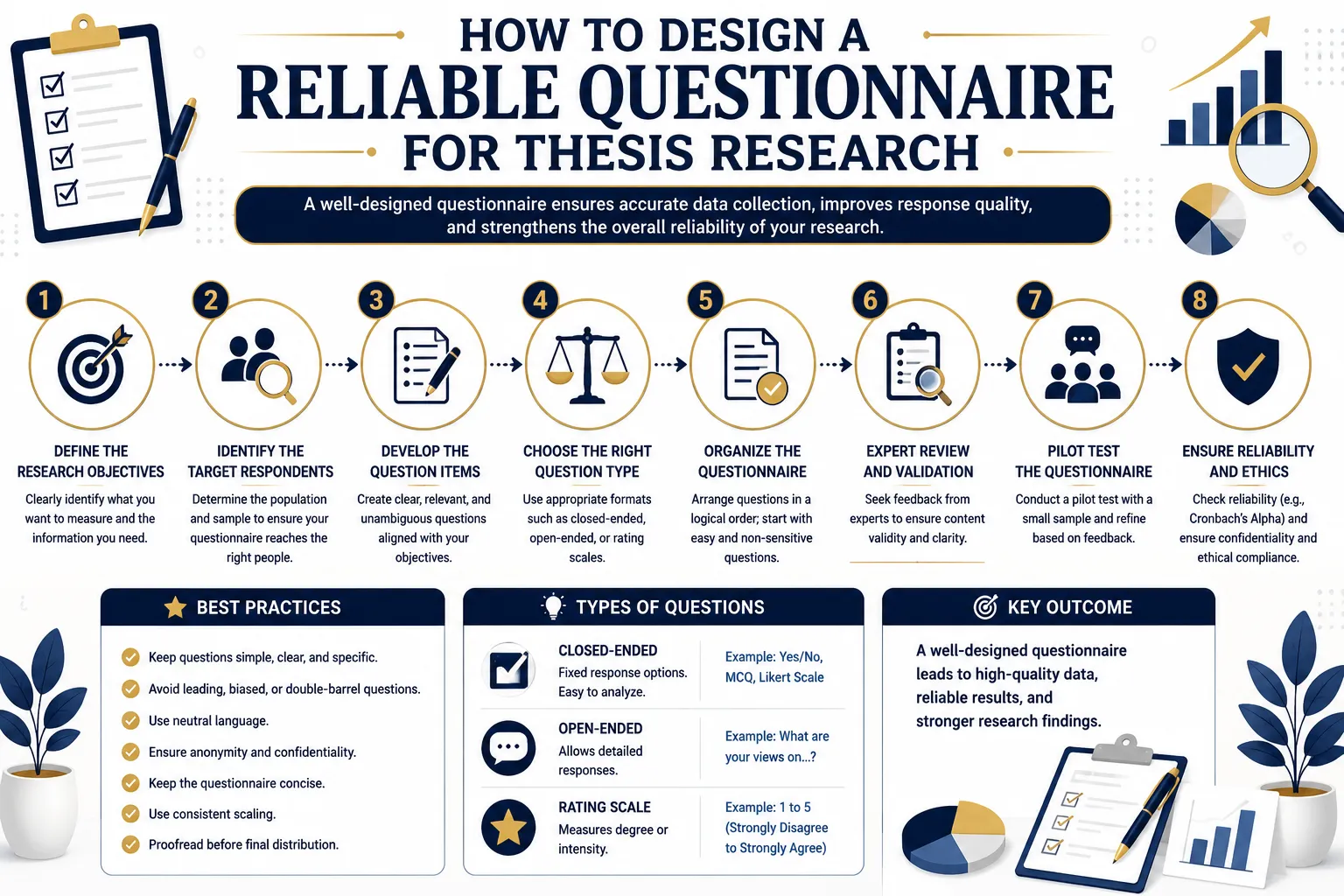
A questionnaire that looks fine on paper can still quietly undermine your entire thesis if it isn't actually reliable and valid. Ambiguous wording, an untested scale, or a sample size too small to trust your Cronbach's Alpha — any of these can weaken findings that otherwise took months to collect. This guide walks through how to design a reliable questionnaire for thesis research, step by step, so your instrument holds up under committee and examiner scrutiny.
Developing a genuinely valid and reliable questionnaire requires systematic progression through defined stages: clearly defining your construct with specified theoretical boundaries, generating an initial item pool typically three to five times larger than your final intended scale, conducting expert review for content validity, and then running cognitive interviews and pilot testing with a small sample. Skipping or shortchanging any of these stages weakens the instrument's overall psychometric quality — and that weakness shows up later, when your data doesn't hold together the way you expected.
Step 1: Start With Clear Research Objectives, Not Questions
Before drafting a single item, define your research objectives precisely. Every question in your final questionnaire must directly serve one of these objectives — if it doesn't, remove it. This single discipline prevents the most common structural flaw in student-designed questionnaires: a long instrument padded with interesting-but-irrelevant items that dilute focus and increase respondent fatigue without adding analytical value.
Step 2: Define Your Construct With Precision
If you're measuring something abstract — job satisfaction, brand loyalty, academic self-efficacy — define exactly what that construct means within your study and specify its theoretical boundaries. A vaguely defined construct leads to items that measure several overlapping ideas at once, which undermines both validity and your later factor analysis.
Step 3: Identify Your Target Respondents and Tailor Accordingly
Know precisely who will be answering your questionnaire, and tailor your language, length, and complexity to that specific audience. A questionnaire designed for senior executives can use different vocabulary and assume different context than one designed for undergraduate students or rural survey respondents.
Step 4: Generate a Larger Item Pool Than You'll Need
Generate an initial item pool roughly three to five times larger than your intended final scale. This gives you room to remove weak, redundant, or poorly performing items during expert review and pilot testing, without being left with too few items to adequately measure your construct.
Step 5: Choose the Right Mix of Question Types
A strong questionnaire typically combines several question formats for both measurability and depth:
- Likert scales — ordered agreement responses (e.g., 1 = Strongly Disagree to 5 = Strongly Agree), the most common format in thesis-level survey research
- Closed-ended questions — multiple choice or yes/no questions for clean, quantifiable data
- Open-ended questions — for qualitative insight and unanticipated responses
- Visual analogue scales — respondents mark a position on a continuous line between two anchor points
- Semantic differential scales — respondents rate a concept between pairs of bipolar adjectives (e.g., "Weak" to "Strong")
Mixing these formats supports both quantitative and mixed-methods analysis, depending on your overall research design.
Step 6: Watch Your Likert Scale Design Decisions Closely
Likert scale design involves several specific decisions that directly affect reliability and validity: how many response categories or scale points to use, whether to include a midpoint (neutral option), how each response category is labeled, and whether the format runs horizontally or vertically. Making these choices inconsistently — or without considering their effect on measurement — can introduce response bias into your data. Decide on your scale format early and apply it consistently across all Likert-based items in your questionnaire.
Step 7: Write Clear, Unbiased, Single-Idea Questions
The most common questionnaire design mistakes are avoidable with careful drafting:
- Leading or biased questions that nudge respondents toward a particular answer
- Questionnaires that are simply too long, increasing fatigue and drop-off
- Double-barrelled questions that combine two separate ideas into one item (e.g., "Do you find the app fast and easy to use?" — what if it's fast but not easy?)
- Overly complex language that respondents outside academia may struggle to parse
- Questions that don't clearly link back to any specific research objective
Reviewing every draft item against these five pitfalls before moving forward catches most structural problems early.
Step 8: Structure the Questionnaire Professionally
Organize your questionnaire into logical sections — typically demographics first, then core measurement items grouped by construct, and open feedback questions last. A clear, logical flow reduces respondent confusion and makes your later data cleaning and analysis considerably easier.
Step 9: Establish Content and Face Validity Through Expert Review
Before pilot testing with actual respondents, expose your draft questionnaire to expert referees in your field. Provide them with your research aims and questions so they can assess whether your items genuinely capture the construct you intend to measure. This expert review step for content and face validity should happen before, not after, pilot testing — it's far cheaper to revise items based on expert feedback than after a full pilot round.
Step 10: Pilot Test Before Full Distribution
Pilot testing is essential, not optional. Test your questionnaire with 5–10 participants first to check clarity, measure completion time, and gather initial feedback. For a more formal reliability check using an established scale, pilot testing with a minimum sample of 30 respondents is commonly used to calculate Cronbach's Alpha. If your scale is newly developed rather than adapted from existing literature, running an exploratory factor analysis alongside reliability testing is recommended.
Step 11: Check Your Reliability Score Against Accepted Benchmarks
Once you've calculated Cronbach's Alpha from your pilot data, compare it against widely used benchmarks: excellent reliability sits at 0.90 and above, high reliability falls between 0.70 and 0.90, moderate reliability between 0.50 and 0.70, and low reliability below 0.50. Most researchers agree on a minimum acceptable internal consistency coefficient of 0.70 for a main study, though a lower threshold of 0.60 is generally considered acceptable specifically for exploratory or pilot-stage work. If your pilot results fall below these thresholds, revisit and revise the weaker items before moving to full data collection.
Step 12: Revise Based on Pilot Feedback
Use pilot results to identify which items to keep, revise, or remove. Items that respondents found confusing, that loaded poorly on their intended factor, or that reduced your overall reliability score should be reworded or dropped before the main study begins.
A Note on Tools
Google Forms is widely used and accepted for dissertation and thesis-level questionnaires at undergraduate and master's level. It's free, straightforward to use, and exports data directly into formats compatible with Excel and SPSS — a practical option for scholars without access to specialized survey software.
Practical Checklist: Is Your Questionnaire Reliable and Ready?
- Every question links directly to a specific research objective
- Core construct(s) are clearly defined with specified boundaries
- Initial item pool was generated at 3–5x the intended final scale size
- Question types are appropriately mixed (Likert, closed-ended, open-ended)
- Likert scale format (points, midpoint, labeling) is applied consistently throughout
- No leading, double-barrelled, or overly complex questions remain
- Questionnaire is structured into logical sections
- Expert review for content/face validity has been completed
- Pilot test (minimum 5–10 for initial clarity check, 30+ for reliability testing) has been conducted
- Cronbach's Alpha meets or exceeds 0.70 for main study use
- Weak or poorly performing items have been revised or removed based on pilot feedback
Two Practical Scenarios
Scenario 1 — Fixing a Double-Barrelled Item After Expert Review A scholar studying employee satisfaction included the item "I find my workplace communication clear and my workload manageable." An expert reviewer flagged this as double-barrelled — respondents disagreeing with one half but agreeing with the other would have no way to answer accurately. Splitting it into two separate items ("I find my workplace communication clear" and "I find my workload manageable") resolved the ambiguity and improved the clarity of the resulting data.
Scenario 2 — Reliability Score Below Threshold, Item Revision Needed
A scholar piloting a newly developed 15-item scale with 35 respondents calculated a Cronbach's Alpha of 0.61 — below the 0.70 threshold typically expected for main study use. Reviewing item-level statistics revealed that three items had poor correlation with the rest of the scale. After removing two of these items and rewording the third for clarity, a second pilot round with a fresh sample raised the reliability score to 0.79, well within the "high reliability" range before full-scale data collection began.
Common Mistakes Thesis Writers Make When Designing Questionnaires
- Skipping expert review and going straight to pilot testing, missing an inexpensive early opportunity to catch construct-level problems.
- Writing leading or double-barrelled questions, which quietly compromise data quality without being obvious at first glance.
- Treating pilot testing as optional to save time, then discovering reliability issues only after full data collection.
- Using inconsistent Likert scale formats across different sections of the same questionnaire.
- Including items that don't map to a specific research objective, resulting in a longer, less focused instrument than necessary.
Frequently Asked Questions
How do you design a reliable questionnaire for thesis research?
Start with clear research objectives, define your constructs precisely, generate a larger item pool than needed, choose an appropriate mix of question types, write clear and unbiased items, validate through expert review, pilot test with a meaningful sample size, and check your reliability score against accepted Cronbach's Alpha benchmarks before full data collection.
Why does questionnaire reliability matter for thesis research?
An unreliable or invalid questionnaire produces data that doesn't accurately reflect what you intended to measure, which undermines the credibility of every finding built on top of it — regardless of how sophisticated your later statistical analysis is.
How does questionnaire design affect a thesis's overall quality?
Since findings and conclusions are only as strong as the instrument that generated the underlying data, a poorly designed questionnaire is one of the most common reasons examiners raise concerns about a thesis's methodological rigor.
How long does it take to complete a thesis using this approach?
Building in expert review and proper pilot testing adds time upfront, but typically saves time overall by avoiding the need to re-collect data after discovering reliability problems in a rushed, unpiloted instrument.
Is professional help available to design a reliable questionnaire for thesis research?
Yes. ThesisLikho's PhD-qualified experts have guided 10,000+ scholars through questionnaire design, validity and reliability testing, and complete thesis writing assistance tailored to individual research designs.
Get Expert Guidance on Your Thesis Questionnaire
Designing a questionnaire that's both examiner-ready and statistically sound takes careful attention to construct definition, item wording, and proper validation — skipping any step can compromise your data later. If you'd like expert input on your questionnaire design, pilot testing approach, or reliability analysis, ThesisLikho's PhD-qualified team offers questionnaire design support, research methodology guidance, and complete thesis writing assistance. If you need expert guidance with your questionnaire, sampling plan, or overall research design, you can explore our Thesis Writing Assistance service.
Talk to a Thesis Expert → https://thesislikho.com/writing-services/thesis-writing