
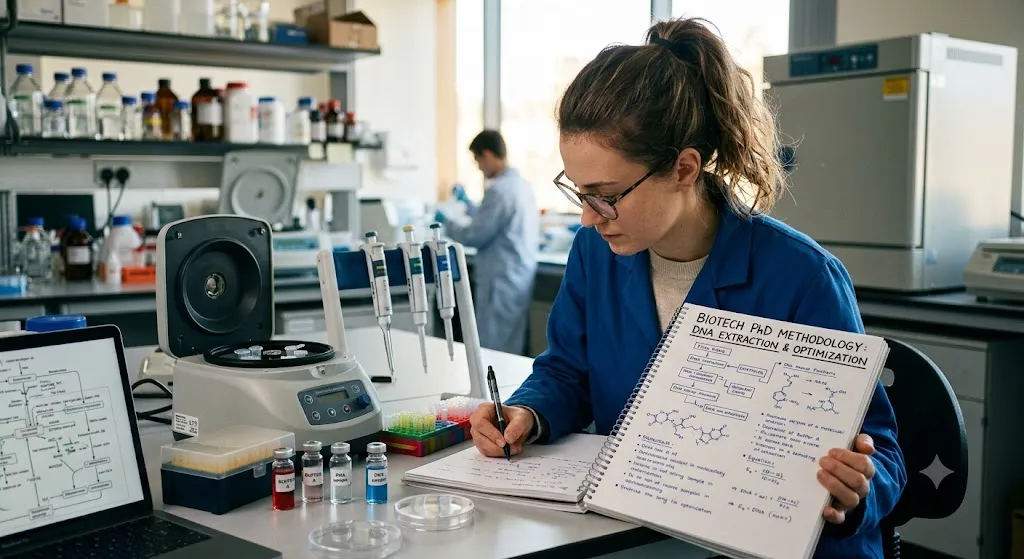
Biotechnology PhD research comes with a methodology-design challenge most other disciplines don't face quite the same way: your experimental protocol isn't just a plan you defend to a committee — it's something regulatory bodies need to formally approve before you're even allowed to start pipetting. Add in the statistical subtleties of biological versus technical replicates, and it's easy to see why so many first-year biotechnology scholars find methodology design more daunting than the actual bench work that follows.
This guide covers how to design a research methodology for a PhD in biotechnology — from framing a testable hypothesis, through the specific replicate and control logic wet-lab research demands, to navigating India's biosafety and ethics approval pathway before your experiments can formally begin. We've written it the way an experienced PhD research mentor would talk you through your own protocol design, because that's genuinely the kind of guidance ThesisLikho's PhD-qualified team provides to the thousands of scholars we've supported through exactly this stage.
Why Biotechnology Methodology Design Is Different
Most PhD methodology guides talk about survey design, sampling, and interview protocols. Biotechnology methodology design involves a genuinely different set of concerns: experimental models, biological replication logic, laboratory controls, and — critically for Indian scholars — a formal regulatory approval process that has to be cleared before experiments can legally begin. Get this design wrong, and the consequences aren't just a weaker thesis argument; they can mean months of delay waiting for approvals you didn't anticipate, or statistical results that can't actually support the conclusions you want to draw from them.
Understanding these field-specific requirements early, rather than treating your methodology chapter as a generic template to fill in, is what separates biotechnology research that moves smoothly from bench to thesis defense from research that stalls at each regulatory or statistical checkpoint.
Step 1: Frame a Specific, Testable Hypothesis
Every biotechnology methodology should trace back to a clearly stated, testable hypothesis — not a broad area of interest, but a specific, falsifiable statement your experiments are designed to test. "Investigating the role of a specific gene in stress tolerance" is a research area; "silencing gene X reduces drought stress tolerance in [organism] by at least a measurable margin under controlled water-deficit conditions" is a testable hypothesis.
This specificity matters because everything that follows — your experimental model, your controls, your sample size, your statistical test — needs to logically flow from what your hypothesis actually requires you to measure and compare.
Step 2: Choose Your Experimental Model
Your choice of experimental model — a specific cell line, a model organism, a particular tissue type, or an in silico computational approach — needs to be justified against your hypothesis, not chosen simply because it's what your lab already has established protocols for. A model that's convenient but doesn't genuinely represent the biological system your hypothesis is about weakens your entire study's validity, however smoothly your subsequent experiments run.
Justify your model choice explicitly in your methodology chapter: why this specific cell line, this particular model organism, or this computational approach is appropriate for testing your specific hypothesis, and what its known limitations are relative to the biological phenomenon you're actually trying to understand.
Step 3: Understand Biological vs. Technical Replicates
This is one of the most consequential, and most frequently misunderstood, design decisions in biotechnology research. Technical replicates are repeated measurements of the same biological sample — running the same PCR reaction three times from one extraction, for instance — and they capture measurement noise from your protocol or instrumentation. Biological replicates come from genuinely independent biological sources — different animals, different cell culture batches, different individual plants — and capture true biological variation, which is what most research questions actually need to draw valid conclusions about.
A well-documented and specifically flagged error in biomedical research, sometimes called pseudoreplication, treats technical replicates as if they were biological replicates — inflating your apparent sample size and invalidating the statistical inference that follows. If you ran one cell culture and measured it five times, your biological n is one, not five, regardless of how many technical measurements you took. Current statistical reporting standards followed by major journals specifically require researchers to report sample size at the biologically independent unit level, distinguishing it clearly from any technical replicate measurements used to reduce noise.
Getting this distinction right from the design stage — before you've collected a single data point — prevents a genuinely painful problem: discovering during analysis that your apparent sample size doesn't actually support the statistical test you planned to run.
Step 4: Plan Your Controls
Every biotechnology experiment needs appropriate controls, and planning these at the design stage — not improvising them once experiments are underway — is essential for a defensible thesis. Negative controls confirm that an observed effect isn't due to an artifact of your experimental procedure itself. Positive controls confirm your experimental system is actually capable of detecting the effect you're looking for, ruling out a null result that's really just a failed assay. Vehicle or sham controls, where relevant, isolate the specific effect of your treatment or intervention from any effect of the delivery method itself.
Explicitly naming and justifying each control in your methodology chapter — not just running them because it's standard lab practice, but explaining what specific confound each control rules out — strengthens your chapter's rigor considerably compared to a chapter that simply lists controls without explaining their purpose.
Step 5: Determine Sample Size and Statistical Power
Once your biological versus technical replicate logic is clear, determine how many biological replicates you actually need. Wherever feasible, a formal power analysis — calculating the minimum sample size needed to detect an effect of a meaningful size, given your expected variability and desired statistical confidence — is stronger than an informal "this many samples felt sufficient" justification, and increasingly expected by journals and thesis committees alike.
Where resource, ethical, or practical constraints limit your achievable sample size (common with animal models or scarce clinical samples), state this limitation honestly in your methodology chapter rather than implying a larger sample was used than actually was, and discuss how this constraint affects the strength of the conclusions you can draw.
Step 6: Choose Your Analytical and Statistical Methods
Your statistical approach should be determined by your specific data type and hypothesis, not selected for familiarity or convenience. Comparing two groups typically calls for a t-test; comparing more than two groups typically calls for ANOVA with appropriate post-hoc tests; testing a dose-response or time-course relationship typically calls for regression-based approaches; and complex, high-dimensional data (genomic, transcriptomic, or proteomic datasets) typically requires specialized bioinformatics pipelines and appropriate multiple-testing correction, since running many simultaneous statistical tests on large datasets without correction inflates the risk of false-positive findings.
Name your specific planned statistical test explicitly in your methodology chapter, along with the software or package you'll use to run it, rather than describing your analysis plan in vague, generic terms.
Step 7: Secure Biosafety Approval (IBSC and RCGM)
For Indian biotechnology PhD scholars, this step is not optional and needs to be built into your project timeline from the very beginning, not treated as a late-stage formality. Any research involving recombinant DNA technology, genetic manipulation, or potentially hazardous biological materials — explicitly including PhD and dissertation-level work — requires prior approval from your institution's Institutional Biosafety Committee (IBSC) before experiments can begin, under guidelines set by India's Department of Biotechnology (DBT).
As the researcher, you (working with your supervisor as Principal Investigator) are responsible for determining the appropriate containment level for your specific work, based on DBT's Recombinant DNA Safety Guidelines, and submitting this information to IBSC for formal review. Depending on the risk category of your work, higher-risk projects may be escalated further to the Review Committee on Genetic Manipulation (RCGM), which operates directly under DBT. Building realistic time into your project schedule for this review — IBSC meetings and decisions typically take at least a few weeks from submission, sometimes longer depending on your institution's meeting frequency — prevents an entirely avoidable delay to your entire research timeline.
Step 8: Secure Animal Ethics Approval Where Applicable
If your biotechnology research involves animal models, a separate approval pathway applies alongside (not instead of) biosafety review: Institutional Animal Ethics Committee (IAEC) approval, operating under the national Committee for the Purpose of Control and Supervision of Experiments on Animals (CPCSEA) framework. This ethical review process evaluates your experimental design specifically for animal welfare considerations — justification for the species and number of animals used, methods for minimizing pain or distress, and humane endpoints for your experiments.
Since IAEC and IBSC review processes are distinct committees with separate submission and meeting schedules, factor both into your timeline separately if your research requires both — assuming one approval covers the other is a genuine, avoidable source of project delay.
Step 9: Plan for Reproducibility From the Start
Beyond formal approvals, build reproducibility into your methodology design from day one — detailed, dated lab notebooks, clear protocol version documentation (noting exactly when and why a protocol changed partway through your research), and consistent reporting of both biological and technical replicate numbers throughout your data collection. This isn't just good scientific practice; it's directly protective for your own thesis defense, since a viva panel or journal reviewer questioning your methodology will expect you to explain exactly how and why any protocol adjustments were made during your research.
Common Mistakes in Biotechnology Methodology Design
A frequent and consequential mistake is confusing technical replicates for biological replicates when planning sample size, only discovering the problem during statistical analysis when a reviewer or supervisor points out the apparent n doesn't reflect genuine biological independence. Underestimating regulatory approval timelines — assuming IBSC or IAEC review will be quick, then discovering these processes take meaningfully longer than expected — is a common, avoidable planning gap. Choosing an experimental model for convenience rather than genuine fit to the research hypothesis weakens a study's validity in ways that are hard to fix after data collection has already begun. Skipping a formal power analysis and instead using a sample size based purely on lab tradition or what previous students in the group used, without justifying it against your own specific hypothesis and expected effect size, is a frequently flagged weakness. And failing to document protocol changes as they happen, relying instead on memory to reconstruct methodology details months later while writing the thesis, creates unnecessary difficulty at write-up stage.
A Realistic Example Walkthrough
Scenario — Ananya, a PhD scholar studying gene expression under stress conditions
Ananya's initial experimental plan involved culturing plant cells from a single source, then taking multiple gene expression measurements from that same culture across different time points, planning to treat each measurement as an independent data point in her statistical analysis. During a methodology review with her supervisor, this was flagged as a pseudoreplication problem — her measurements, while numerous, all traced back to a single biological source, meaning her true biological n was one, not the multiple measurements she'd planned to analyze as separate data points. She redesigned her experiment to include genuinely independent biological replicates — separate plant cultures grown and treated independently — while still taking multiple technical measurements within each biological replicate to reduce measurement noise. This meant significantly more upfront lab work than her original design, but it meant her eventual statistical conclusions would actually hold up to scrutiny, both from her thesis committee and from any journal reviewer evaluating a resulting publication.
This is a pattern we see constantly in mentoring work: the biological-versus-technical-replicate distinction is one of the highest-value things to get right at the design stage, since a mistake here can undermine months of subsequent data collection.
Scenario — Kabir, a PhD scholar navigating IBSC approval for a recombinant protein project
Kabir assumed, based on how his lab had operated informally for years, that IBSC approval was a quick formality he could submit alongside his initial thesis proposal and expect near-immediate sign-off. When he formally submitted his application involving a recombinant expression construct, he discovered his university's IBSC met only once every two months, and his submission needed additional documentation about containment procedures he hadn't originally prepared. The approval process ultimately took nearly ten weeks from submission to sign-off — a delay that would have pushed his entire first-year experimental timeline back significantly had he not built in a buffer once he understood the actual process. For his second major protocol change later in his PhD (introducing a new construct requiring updated biosafety documentation), he submitted his IBSC application nearly three months before he actually needed to begin the corresponding experiments, treating the committee's schedule as a fixed constraint to plan around rather than something to react to after the fact.
If you'd like a second opinion on your own experimental design before you begin data collection, our PhD Thesis Assistance service offers exactly this kind of structural review from PhD-qualified mentors. Once your data is collected, our companion guide — PhD in Biotechnology: Publication and Viva Preparation Tips — covers the next stage of your research journey.
Choosing Analytical Instruments and Platforms
Beyond the statistical methods covered earlier, biotechnology methodology chapters often need to justify specific analytical instrumentation and platform choices — which sequencing platform, which chromatography or spectrometry setup, which imaging system — and this justification deserves the same rigor as any other design decision. Beyond simply naming the instrument used, a strong methodology chapter briefly explains why that specific platform suits the research question (sensitivity requirements, resolution needs, throughput constraints) and notes any relevant calibration or validation steps taken to ensure data quality.
This matters particularly for shared institutional facility equipment, where access scheduling can itself become a practical project-timeline constraint worth planning around early, much like biosafety and ethics committee review timelines. Confirming realistic access windows for any shared core facility equipment your methodology depends on — rather than assuming availability whenever your experiments happen to be ready — is a small planning step that prevents a genuinely common source of late-stage delay.
Pre-Submission Checklist
Before finalizing your methodology design, confirm your hypothesis is specific and testable, not a broad area of interest. Confirm your experimental model is justified against your specific hypothesis, with its limitations acknowledged. Confirm you've clearly distinguished biological from technical replicates in your sample size planning, and that your reported n reflects biologically independent units. Confirm your controls are explicitly named and justified, not just listed as standard practice. Confirm your sample size is backed by a formal power analysis where feasible, or an honestly stated resource limitation where it isn't. Confirm your specific statistical tests are named, not described generically. And confirm your biosafety (IBSC/RCGM) and, where applicable, animal ethics (IAEC/CPCSEA) approvals are factored into your project timeline with realistic lead time, not assumed to be a quick formality.
Getting Expert Support
Even experienced researchers benefit from a second, structured read on their experimental design before committing significant lab time and resources to execution — a replicate-logic error or an underestimated regulatory approval timeline is far cheaper to catch on paper than after months of bench work.
ThesisLikho's mentoring team — PhD-qualified experts who've guided over 10,000 scholars through this exact planning stage — offers structured methodology design review as part of our PhD Thesis Assistance services, helping you build an experimentally sound, regulation-ready methodology before you begin your research.
Frequently Asked Questions
How do you design a research methodology for a PhD in biotechnology?
Start with a specific, testable hypothesis, choose an experimental model genuinely suited to it, clearly distinguish biological from technical replicates in your sample size planning, build in appropriate controls, determine sample size ideally through formal power analysis, name your specific statistical methods, and secure required biosafety and, where applicable, animal ethics approvals before beginning experiments.
How long does it take to complete a PhD thesis using this approach?
Designing a biotechnology methodology — including protocol development and regulatory approval — typically takes several months before full-scale data collection can begin, given India's multi-committee approval process for biosafety and animal ethics review, with the full PhD research and thesis-writing process generally extending across three to five years overall.
Is professional help available to design a research methodology for a PhD in biotechnology?
Yes — structured mentoring on experimental design, replicate and sample size planning, and regulatory approval navigation is a standard, legitimate form of academic support. ThesisLikho's PhD-qualified mentors offer this kind of guided review for biotechnology research scholars.
Why should I design a research methodology for a PhD in biotechnology so carefully?
A flawed experimental design — particularly around replicate logic or inadequate controls — can undermine months of subsequent lab work, since statistical conclusions built on pseudoreplicated or poorly controlled data may not hold up under committee or journal reviewer scrutiny.
When should you design a research methodology for a PhD in biotechnology?
Design work belongs at the very start of your research, before any experiments begin, since biosafety and ethics approvals must be secured in advance, and correcting a replicate-logic or sample-size flaw is dramatically cheaper before data collection starts than after months of experiments have already been run around a flawed design.
Book a PhD Research Consultation
If you'd like a mentor to review your experimental design before you begin data collection, ThesisLikho's team is ready to help.