
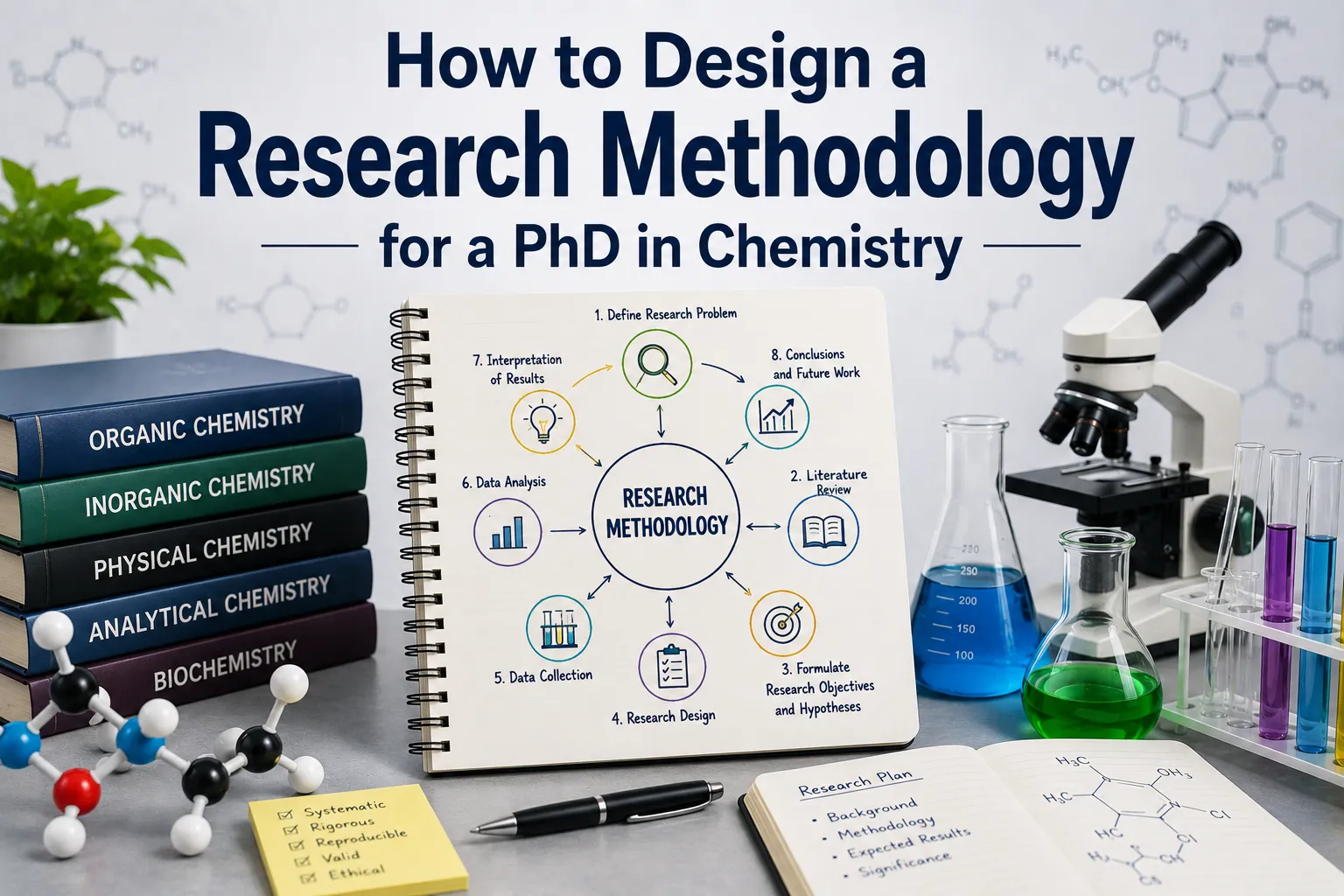
Ask any chemistry scholar where their proposal got the toughest questions, and the answer is almost always the methodology section. It's one thing to identify an interesting gap — a novel catalyst combination, an unexplored synthesis route, a material property worth characterizing. It's another to lay out, convincingly, exactly how you'll get from "interesting idea" to "defensible, reproducible result."
This guide walks through how to design a research methodology for a PhD in chemistry the way an experienced research supervisor would — practically, without assuming you already know the vocabulary of experimental design. If you're a first-time PhD thesis writer without a strong research background, this is written specifically for you.
At ThesisLikho, our PhD-qualified mentors have guided more than 10,000 scholars through methodology design, experimental planning, and thesis writing across disciplines, including chemistry. What follows draws on that mentoring experience, grounded in established methodology guidance from Purdue OWL, current chemistry-specific experimental design literature, and Google Scholar-indexed research on reproducibility in chemical research.
1. Why Methodology Is Where Chemistry Proposals Succeed or Fail
A chemistry dissertation isn't defined solely by its topic — it's defined by the rigor of the methodology underpinning it. In chemical research specifically, your methods determine whether your findings are credible, reproducible, and actually useful to anyone reading your work afterward, which is exactly why this chapter draws the sharpest scrutiny from a Doctoral Committee.
A mismatch between your stated objectives and your chosen methods is one of the most common weaknesses in student theses. Studying reaction kinetics requires time-resolved measurements; studying structural properties requires spectroscopic or crystallographic techniques. Choosing tools that don't actually match your research question is one of the fastest ways to have a proposal sent back — and it's also one of the easiest problems to catch early, if you build your methodology deliberately rather than defaulting to whatever technique your lab happens to use most often.
This matters more in chemistry than in many disciplines because your methodology chapter is doing double duty: it needs to convince your committee the work is scientifically sound, and it needs to function as an actual procedural record precise enough for someone else to repeat. Those two goals reinforce each other more than scholars often expect — the same level of detail that makes a protocol replicable is usually what makes it defensible under questioning.
2. What a Chemistry Research Methodology Chapter Needs to Contain
A standard chemistry PhD methodology chapter, following widely used guidance for structuring a research methods section, typically covers: your overall research approach (experimental, computational, or hybrid) and why it fits your research question; your experimental design, including which variables you're controlling and which you're varying; your synthesis or data collection procedure in enough detail for another researcher to replicate it; your characterization and analytical techniques; your data analysis and statistical treatment plan; and a section addressing reproducibility, validation, and safety considerations (Source: Purdue OWL; chemistry-specific methodology guidance).
This last point deserves emphasis because it's chemistry-specific: your methodology chapter needs to provide sufficient procedural detail for another researcher to actually replicate your work under similar conditions — vague descriptions of synthesis conditions or characterization procedures are a well-documented, ongoing problem in published chemistry research, and it's exactly the kind of gap an examiner is trained to notice (Source: reproducibility-in-chemistry literature, ScienceDirect).
3. Experimental vs. Computational vs. Hybrid Approaches
Your first major methodological fork is deciding how much of your thesis will be wet-lab experimental work, computational work, or some combination of both.
Purely experimental approaches suit most synthesis, characterization, and applied chemistry topics — green synthesis studies, catalyst development, materials characterization, analytical method development. The core requirement is that your lab has the equipment, reagents, and characterization access your topic depends on.
Purely computational approaches — DFT calculations, molecular dynamics, machine learning-based property prediction — suit theoretical and mechanistic questions, and are increasingly viable even without extensive wet-lab infrastructure, provided you have access to computational resources and the relevant software licenses.
Hybrid approaches, combining computational prediction with experimental validation, are increasingly common and often strengthen a thesis considerably — for instance, using DFT to predict a reaction mechanism, then validating key predictions experimentally, or using machine learning to narrow a large candidate pool before synthesizing and testing the most promising options. This combination lets simulations complement or partially substitute for exhaustive lab work, provided the assumptions and limitations of your computational model are clearly addressed rather than glossed over.
Whichever you choose, state your reasoning explicitly in your methodology chapter — a committee wants to see that you deliberately chose this balance because it fits your research question, not because it's simply what your lab defaults to.
4. Matching Your Method to Your Research Question
Before designing your specific experimental protocol, get precise about what kind of question you're actually asking, since different question types demand fundamentally different methodological structures:
- "Can this be synthesized, and what does it look like?" — points toward synthesis followed by structural characterization (NMR, XRD, mass spectrometry, IR).
- "How fast does this reaction proceed, and what's the mechanism?" — points toward kinetic studies, often requiring time-resolved measurement techniques and, frequently, computational mechanism modeling to support the experimental kinetics.
- "How does this material perform under specific conditions?" — points toward application-specific performance testing (electrochemical cycling for battery materials, catalytic turnover studies for catalysts, degradation testing for photocatalysts).
- "Can we detect or quantify this substance reliably?" — points toward analytical method development and validation, typically following established validation guidelines (linearity, precision, accuracy, detection limits).
- "What's the optimal combination of conditions for this outcome?" — points toward a structured Design of Experiments (DoE) approach rather than ad hoc trial-and-error, which is covered in the next section.
Get this mapping right before you plan your actual experimental protocol — it's the single decision that shapes everything downstream.
5. Design of Experiments (DoE): Moving Beyond One-Factor-at-a-Time
One of the most common, quietly costly mistakes in chemistry research methodology is relying on the one-factor-at-a-time (OFAT) approach — varying a single variable while holding everything else constant, then moving to the next variable. It's intuitive, which is exactly why so many first-time researchers default to it, but it provides only a limited view of how your system actually behaves, fails to capture interactions between variables, and often leads to suboptimal, poorly reproducible results.
Design of Experiments (DoE) offers a structured, statistically grounded alternative: rather than testing variables one at a time, you systematically vary multiple factors together according to a planned design, which reduces the influence of experimental noise, reveals interactions between variables that OFAT would miss entirely, and typically requires fewer total experiments to reach a reliable optimum. A commonly used approach, response surface methodology (RSM), lets you generate a large amount of usable information from a comparatively small number of experiments — genuinely valuable when reagents, instrument time, or synthesis time are limited, as they usually are in a PhD timeline.
The typical DoE workflow involves: selecting your input factors (temperature, concentration, reaction time, catalyst loading, and so on), defining the experimental domain and response variable you're measuring (yield, purity, particle size, and similar), conducting the experiments according to the statistical design, analyzing the results, and validating the accuracy of your model's predictions with confirmation experiments.
You don't need to be a statistician to use DoE effectively — open-access tools and web applications now exist specifically to make structured experimental design accessible without requiring expensive statistical software or a steep learning curve, and using one of these (rather than defaulting to OFAT purely out of familiarity) is worth raising directly with your supervisor at the proposal stage.
6. Choosing the Right Characterization Techniques
Your characterization plan should follow directly from what you actually need to demonstrate, not from what's simply available or familiar. A few grounding questions:
- What structural information do you need? NMR and mass spectrometry for molecular structure confirmation; XRD for crystal structure and phase identification; SEM/TEM for morphology and particle size.
- What compositional information do you need? Elemental analysis, XPS for surface composition, or ICP-based techniques for trace element quantification.
- What thermal or mechanical properties matter to your research question? DSC and TGA for thermal behavior; mechanical testing where relevant to polymer or materials work.
- What performance metric are you actually measuring? Electrochemical testing for battery/energy storage materials; catalytic activity measurements (conversion, selectivity, turnover number) for catalysis work; spectroscopic monitoring for photocatalytic degradation studies.
Resist the temptation to run every available characterization technique "just to be thorough" — a tightly justified set of techniques that directly answers your research question reads as more rigorous than an exhaustive list run without clear purpose, and it also saves considerable instrument time and cost across a multi-year PhD.
7. Building In Reproducibility From the Start
Reproducibility is a cornerstone of scientific credibility, and it needs to be designed into your methodology from the outset rather than addressed only when writing up results. A documented, ongoing issue in published chemistry research is that incomplete descriptions of experimental methodology make it genuinely difficult for other researchers to compare or replicate results — particularly in reactions sensitive to seemingly minor variations like mixing duration, vessel shape, or reagent addition order.
A few concrete habits that build reproducibility into your work from day one:
- Record every parameter, not just the ones you think matter. Reaction yield can be highly sensitive to variables that seem incidental — stirring speed, vessel geometry, addition rate — and omitting these from your records is a common reason results can't later be explained or replicated.
- Run and document replicate experiments, not just single runs, especially for any result you intend to report as a key finding — this is what lets you (and later, your examiner) distinguish a genuine effect from experimental noise.
- Keep a detailed, dated lab notebook with enough procedural specificity that you — or someone else — could repeat any given experiment exactly a year later without guessing at unstated details.
- State your uncertainty and variability explicitly in your results, rather than reporting single values without any indication of run-to-run consistency.
Building these habits early doesn't just protect your results scientifically — it directly strengthens your methodology chapter and gives you concrete, defensible answers when your viva committee asks how you know your results are reliable.
8. Data Recording, Analysis, and Statistical Treatment
Your methodology chapter should specify not just how you'll collect data, but how you'll analyze it once collected:
- For quantitative yield/performance data: state your statistical approach clearly — mean and standard deviation across replicates, appropriate significance testing where you're comparing conditions, and, where you've used DoE, the statistical model (often a regression-based response surface model) used to interpret your results.
- For spectroscopic/characterization data: specify your peak assignment approach, reference standards used, and how you'll handle instrument calibration and baseline correction.
- For computational data: specify your software, basis sets or force fields, convergence criteria, and how you validated your computational results against experimental data or established literature values where possible.
- For method development/validation work: specify the statistical parameters you'll report — linearity (R² value), precision (relative standard deviation), accuracy (recovery percentage), and limits of detection/quantification.
Whatever your analysis plan, decide it before you start collecting data, not after — a methodology chapter that specifies exactly how ambiguous or borderline results will be handled reads as considerably more rigorous than one that leaves this to be figured out during writing.
9. Method Validation for Analytical Chemistry Work
If your thesis involves developing a new analytical method — an HPLC method for a pharmaceutical impurity, a sensor for an environmental contaminant, a spectroscopic technique for a specific analyte — validation isn't optional, and it follows an established structure widely referenced across analytical chemistry research: linearity across your intended concentration range, precision (both intra-day and inter-day), accuracy (often via recovery studies), specificity (confirming the method measures your target analyte without interference), and detection/quantification limits.
Combining a validated analytical method with a structured experimental design approach — rather than treating optimization and validation as separate, sequential steps — is itself an increasingly recognized good practice, since it can both improve reproducibility and reduce the number of experiments (and associated reagent/solvent use) needed to reach a validated, optimized method (Source: green analytical chemistry and experimental design literature).
10. Step-by-Step Guide to Writing Your Methodology Chapter
- Restate your research question and objectives at the top, so the methodology reads as a direct, deliberate response to them.
- State your overall approach (experimental, computational, or hybrid) with a one-paragraph justification tied to your specific research question.
- Detail your experimental design — including whether you're using a structured DoE approach or a simpler, justified alternative, and why.
- Describe your synthesis, data collection, or computational procedure in enough detail for genuine replication — this is the section examiners scrutinize most closely for reproducibility gaps.
- Specify your characterization and analytical techniques, with a brief justification for why each one is necessary to answer your specific question.
- Explain your data analysis and statistical treatment plan, matched explicitly to your data type.
- Address reproducibility practices, method validation (where relevant), and safety considerations in a dedicated closing section.
- Cross-check every method against your actual lab's equipment, reagent, and computational access — this step catches over-ambitious designs before they become a Year-2 problem.
11. Common Mistakes First-Time Writers Make
- Defaulting to one-factor-at-a-time experimentation purely out of familiarity, without considering whether a structured DoE approach would give more reliable results with fewer total experiments.
- Choosing characterization techniques because they're available, not because they directly answer the research question — padding a methods section with unnecessary techniques rather than a tightly justified set.
- Under-specifying procedural detail, leaving out variables (mixing speed, addition order, exact timing) that later turn out to matter for reproducibility.
- Treating computational and experimental work as disconnected in a hybrid thesis, rather than explicitly explaining how one informs or validates the other.
- Skipping replicate experiments to save time, then having no way to distinguish a genuine result from experimental noise when writing up findings.
- Deciding on statistical analysis after collecting data rather than planning it upfront, which often leads to analysis that doesn't quite fit the data actually collected.
- Forgetting to justify method validation parameters for analytical work — simply stating "the method was validated" without specifying linearity, precision, and accuracy results is a common, easily flagged gap.
12. Two Realistic Case Studies
Case Study 1 — Replacing OFAT With DoE for a Synthesis Optimization Problem
A chemistry scholar optimizing a catalytic synthesis route initially planned a one-factor-at-a-time approach — testing temperature, then catalyst loading, then reaction time, sequentially. After discussing the plan with a co-guide familiar with process chemistry, the scholar redesigned the study using a response surface DoE approach, varying all three factors together according to a structured design. The redesign not only revealed an interaction between temperature and catalyst loading that the OFAT approach would have completely missed, but also required fewer total experiments than the original sequential plan — directly strengthening both the scientific finding and the thesis's methodological rigor.
Case Study 2 — Building Reproducibility Into a Sensitive Reaction System
A first-time PhD scholar working on a yield-sensitive organic synthesis reaction found their results varying meaningfully between what should have been identical repeat runs. Rather than reporting an average and moving on, the scholar traced the variability to under-documented factors — stirring speed and reagent addition rate — that hadn't originally been recorded as controlled variables. Rebuilding the protocol to explicitly control and document these factors, alongside running proper replicates, both resolved the inconsistency and gave the scholar a much stronger, more defensible methodology section addressing exactly the kind of reproducibility question a viva examiner would likely raise.
If you're navigating either of these situations, our PhD Thesis Assistance service can help you design a methodology that's both scientifically rigorous and feasible within your lab's actual resources.
FAQs
How do I design a research methodology for a PhD in chemistry?
Start by matching your method type — experimental, computational, or hybrid — to your specific research question, then build a structured experimental design (ideally using DoE rather than one-factor-at-a-time testing), a clearly justified characterization plan, and an explicit data analysis approach, with reproducibility and validation built in from the outset rather than addressed afterward.
Why should I design a research methodology for a PhD in chemistry carefully?
Because methodology is what determines whether your findings are credible and reproducible — a mismatch between your research question and your chosen methods is one of the most common reasons chemistry proposals get sent back for revision, and reproducibility gaps are a well-documented, ongoing weakness in published chemistry research more broadly.
When should you design a research methodology for a PhD in chemistry, relative to your topic selection?
Methodology design should happen immediately after you've narrowed your topic and confirmed feasibility — not as an afterthought once you've already started lab work. Designing your experimental structure (including whether DoE is appropriate) before your first experiment saves considerable reagent, time, and instrument-access cost.
How long does it take to complete a PhD thesis using this approach?
Most Indian PhD programmes run three to six years, and a well-designed methodology — particularly one using structured experimental design rather than trial-and-error — can meaningfully reduce the time spent on inefficient, poorly reproducible experimentation during the research phase.
Is professional help available to design a research methodology for a PhD in chemistry?
Yes — methodology design support, including matching your research question to a feasible experimental or computational approach and building in reproducibility and validation planning, is available through services such as PhD Thesis Assistance.
Ready to design a methodology your Doctoral Committee will approve with confidence? Book a PhD Research Consultation with ThesisLikho's PhD-qualified mentors.