
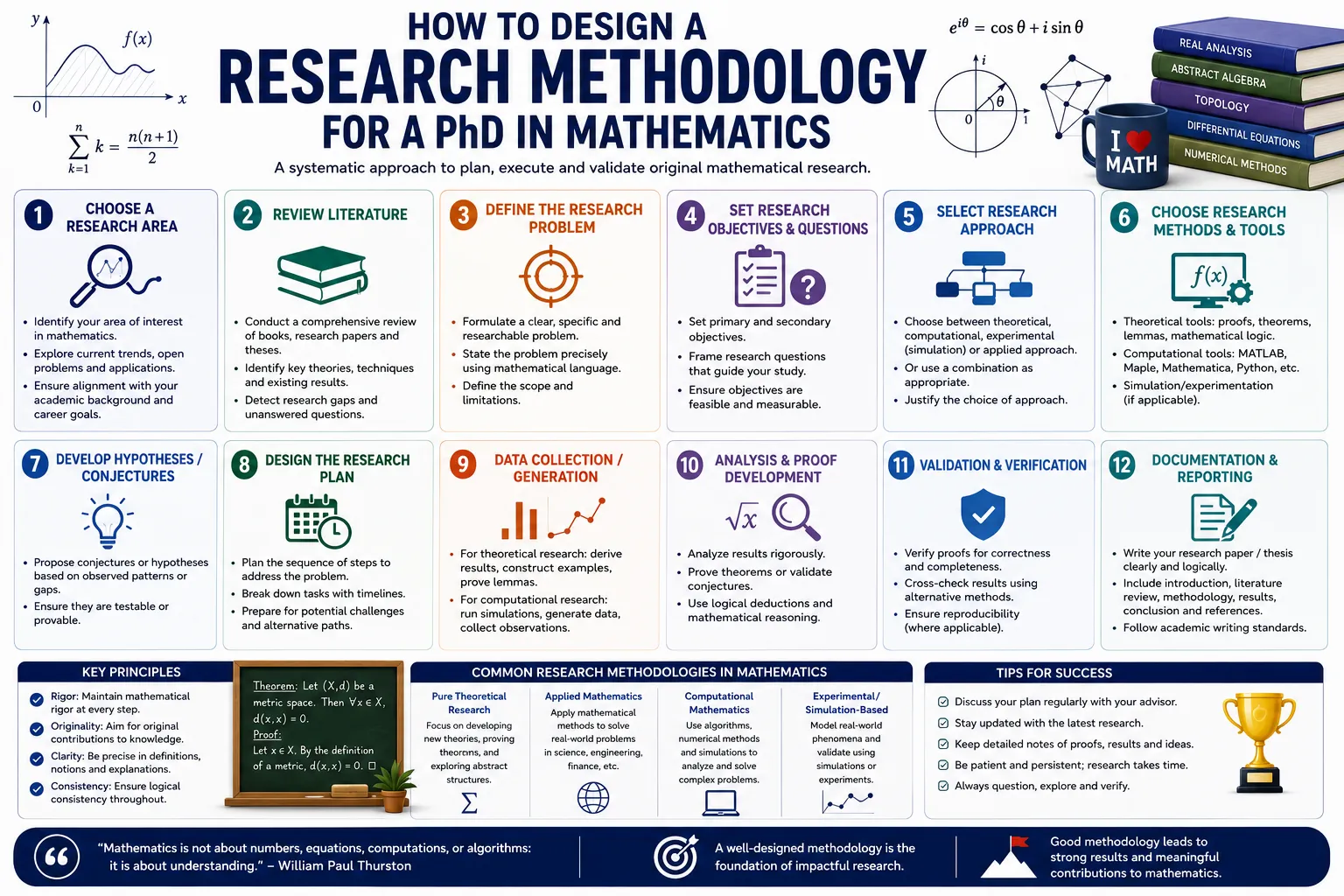
If you've been searching for "mathematics PhD research methodology" and feeling like the standard advice — surveys, sampling, data collection — simply doesn't apply to you, that's because it genuinely doesn't. Mathematics research methodology means something fundamentally different from what the term means in empirical disciplines. This guide walks through what "methodology" actually looks like for a PhD in mathematics, and how to structure your research process accordingly.
Why Mathematics Methodology Looks So Different
Mathematics dissertations are unusual in several respects compared to most other disciplines. The contribution is typically not empirical — there are no experiments, surveys, or datasets in most pure mathematics dissertations. The contribution is instead a set of new theorems, proved rigorously from axioms and prior results. This means your "methodology chapter," if your program even requires one in the conventional sense, isn't describing a sampling strategy or a data collection instrument — it's describing your mathematical approach, your proof strategy, and how you situate your work within existing results.
Step 1: Decide Between Pure, Applied, and Foundational Mathematics
Mathematics research topics span three broad categories: pure mathematics (analysis, algebra, geometry, topology, number theory), applied mathematics (differential equations, mathematical biology, financial mathematics, optimization), and foundational areas (logic, probability, combinatorics). This is a genuinely foundational early decision — pure mathematics tends to appeal to those drawn to abstraction for its own sake, while applied mathematics suits those motivated by practical, real-world impact. This choice shapes everything downstream: your prerequisite skill development, the kind of results your dissertation will produce, and even your eventual career trajectory in academia versus industry.
Step 2: Understand That Topic Selection Is a Genuine Multi-Year Process
Choosing a dissertation topic in mathematics is a multi-year process, not a single decision made at the start of your program. Most doctoral students in US mathematics programs spend their first two years completing coursework and qualifying examinations before seriously engaging with research problems. During this period, the best preparation for eventually choosing a topic is genuine breadth — taking graduate courses across several mathematical subfields and reading widely, rather than narrowing prematurely. If you feel behind because you don't yet have a specific research topic in your first year, this is completely normal, not a sign you're falling behind your peers.
Step 3: Apply Specific Selection Filters to Candidate Topics
Once you're ready to move from breadth toward a specific research direction, apply deliberate selection filters to candidate topics:
- Feasible scope — is this a clear question attackable with current techniques, given your prerequisite skills and available time?
- Genuine novelty — is this something beyond a well-known open problem, and beyond simply extending a known method from one case to a similar case using your advisor's prior technique?
- Learning value — does pursuing this topic involve learning new mathematics or creating new tools, expanding your capability as a researcher, not just applying what you already know?
Advisor expertise and availability, your realistic time horizon, and your prerequisite skills (analysis, algebra, computation, numerics, depending on your specific subfield) are the practical constraints that should filter your candidate topics alongside these criteria.
Step 4: Survey the Literature to Find Where the Genuine Gaps Are
Designing a solid mathematics thesis requires a structured research process, and the first concrete step is surveying current literature to understand your research area and identify where genuine gaps exist. Commenting critically on existing trends in the literature — not just summarizing them — is what actually paves the way to identifying these gaps. Working closely with faculty and academic advisors throughout this process helps clarify raw ideas and strengthen your eventual research direction considerably.
Step 5: Balance Precision Against Viability
A specific, practical warning about topic scope is worth taking seriously: topics that are too general make it difficult to achieve the necessary depth of research, while topics that are too narrowly defined may limit the available prior literature, results, or techniques you'll have to build on. Selecting a topic requires careful balance between preciseness and genuine research viability — weighing depth against comprehensibility. If you can't find enough existing work to build on, your topic may be too narrow; if you can't identify a specific, provable contribution within it, your topic may be too broad.
Step 6: Draft a Milestone-Based Research Plan
A genuinely practical planning approach: draft a 6–12 month plan with clear milestones — literature review, preliminary experiments or proofs, and write-up — and ensure your advisor and at least one external reader find the scope appropriate before you commit fully to the direction. Aim for at least one clear, deliverable contribution within this plan: a toy theorem with a complete proof, an algorithm with formal analysis, or a numerical study with rigorous error control — even if your larger, more ambitious conjecture ultimately isn't fully resolved by the end of your PhD.
Step 7: Consider Combining Theory With Computation
A genuinely useful strategic principle for many mathematics PhD projects: start with a modest, provable goal that yields something publishable even if your larger conjecture ultimately fails. Combining theory with computation, where feasible for your specific research area, often leads to publishable partial results — numerical evidence and computational exploration can generate genuine contributions even when a complete theoretical proof remains elusive. This is particularly relevant if your topic sits closer to applied or computational mathematics, where numerical methods can meaningfully complement pure theoretical derivation.
Step 8: Understand and Follow Your Program's Formal Milestones
Most mathematics PhD programs formalize the topic-selection and validation process through specific institutional milestones, rather than leaving it entirely informal between you and your advisor. A representative structure: choose a thesis advisor by the end of your first year, make an oral topic presentation together with a brief written report (often by the end of your second year), and then formally constitute your thesis committee. Beyond initial topic approval, annual performance reviews are typically conducted from the third year onward specifically to formally evaluate your ongoing research progress. Confirm your specific department's exact milestone structure and deadlines early, since these vary meaningfully between institutions.
Practical Checklist: Is Your Mathematics PhD Methodology Ready?
- Pure, applied, or foundational mathematics category is identified as your primary research direction
- Sufficient breadth (coursework across subfields, wide reading) has been built before narrowing to a specific topic
- Candidate topic passes the feasibility, novelty, and learning-value filters
- Advisor expertise and availability genuinely align with your chosen direction
- Literature has been surveyed critically, not just summarized, to identify a genuine gap
- Topic scope is balanced — neither too broad to achieve depth, nor too narrow to have enough prior work to build on
- A 6–12 month milestone-based research plan has been drafted and reviewed by your advisor and at least one external reader
- At least one modest, deliverable contribution is planned even if the larger research goal isn't fully achieved
- Theory-computation combination has been considered, where relevant to your specific subfield
- Your program's specific formal milestones (advisor selection deadline, topic presentation, committee formation, annual reviews) are understood and tracked
Two Practical Scenarios
Scenario 1 — Rescoping an Overly Ambitious Topic
A student initially proposed resolving a well-known, decades-old open conjecture in their subfield as their primary thesis goal. After discussing feasibility with their advisor, they recognized this exceeded what could realistically be achieved within a PhD timeline. Rather than abandoning the direction entirely, they rescoped the project to prove a specific, more modest result — a partial case of the conjecture with a complete, rigorous proof — while explicitly framing the full conjecture as a longer-term research direction beyond the thesis itself. This gave the thesis a genuine, deliverable contribution rather than an open-ended, potentially unfinishable ambition.
Scenario 2 — Combining Theory and Computation for a Publishable Partial Result
A student working on a problem in applied mathematics found that a full theoretical proof of their central conjecture remained elusive after considerable effort. Rather than treating this as a dead end, they pursued a computational approach in parallel, generating rigorous numerical evidence with quantified error bounds supporting the conjecture across a wide range of tested cases. This combined theory-computation approach produced a genuinely publishable partial result — the numerical evidence with rigorous error control — even though the complete theoretical proof remained an open direction for future work.
Common Mistakes Mathematics PhD Students Make in Methodology and Topic Design
- Narrowing to a specific topic too early, before building the breadth needed to genuinely evaluate which direction fits their interests and skills.
- Choosing a topic that simply extends an advisor's prior technique from one case to a similar case, without genuine novelty or new learning.
- Underestimating scope, choosing a topic requiring the resolution of a decades-old open problem within a standard PhD timeline.
- Overestimating scope in the opposite direction, choosing a topic so narrow that insufficient prior literature exists to build on.
- Treating computation and theory as separate, unrelated tracks, missing opportunities to combine them for genuinely publishable partial results.
Frequently Asked Questions
How do you design a research methodology for a PhD in mathematics?
Choose your broad category (pure, applied, or foundational), build sufficient breadth before narrowing to a specific topic, apply feasibility and novelty filters to candidate topics, survey the literature critically to identify a genuine gap, draft a milestone-based research plan with your advisor, and aim for at least one modest, deliverable contribution even if the larger research goal remains unresolved.
Why does research methodology design matter for a PhD in mathematics?
Since mathematics contributions are proof-based rather than empirical, a well-designed research approach — balancing scope, novelty, and feasibility — directly determines whether a student produces a genuine, defensible contribution within a realistic timeline, rather than pursuing an unfinishable ambition or an insufficiently novel extension.
How does research methodology affect a PhD thesis in mathematics overall?
A mathematics thesis's success depends heavily on whether the chosen problem was appropriately scoped from the outset — a topic too ambitious risks an incomplete thesis, while a topic too narrow or derivative risks insufficient contribution, making early methodological planning genuinely consequential.
How long does it take to complete a PhD thesis using this approach?
US mathematics doctoral programs typically span five to six years, with the first two years generally devoted to coursework and qualifying examinations before research begins in earnest — a realistic timeline expectation worth planning around from the start.
Is professional help available to design a research methodology for a PhD in mathematics?
Yes. ThesisLikho's PhD-qualified experts have guided 10,000+ scholars through research topic scoping, literature review support, and complete thesis writing assistance across mathematics and other research disciplines.
Get Expert Guidance on Your Mathematics PhD Methodology
Designing a mathematics research approach that balances genuine novelty, realistic scope, and a deliverable contribution takes careful, ongoing planning alongside your advisor. If you'd like expert input on scoping your topic, structuring your research plan, or reviewing your literature survey, ThesisLikho's PhD-qualified team offers research planning support, literature review guidance, and complete PhD thesis writing assistance. If you need expert guidance with your research direction, thesis structure, or overall academic writing, you can explore our PhD Thesis Assistance service.
Book a PhD Research Consultation → https://thesislikho.com/writing-services/thesis-assistance-phd