
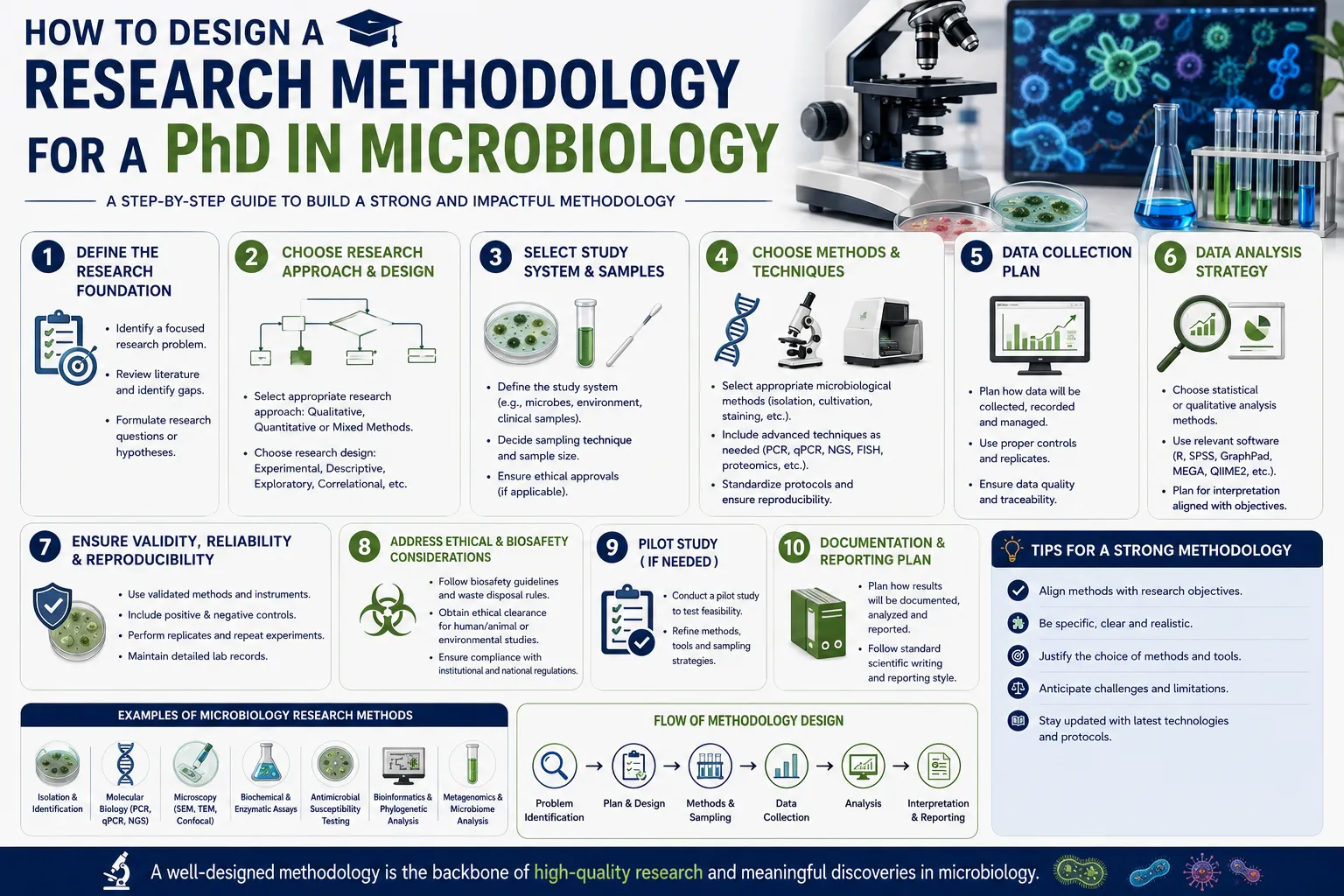
Microbiology has a methodological fork in the road that trips up a lot of first-time scholars: the organisms you're studying often can't simply be grown on a plate and counted the way classical microbiology once assumed. Somewhere between 90 and 99% of environmental and host-associated microorganisms resist standard laboratory culturing entirely, which means your methodology chapter has to make a real, defensible decision about how you'll actually detect and study what you're interested in — long before you touch a pipette.
This guide walks through how to design a research methodology for a PhD in microbiology the way an experienced research supervisor would — practically, without assuming you already know the difference between culture-dependent and culture-independent approaches, or why a biosafety committee might need to sign off on your protocol before you can start. If you're a first-time PhD thesis writer without a strong research background, this is written specifically for you.
At ThesisLikho, our PhD-qualified mentors have guided more than 10,000 scholars through methodology design, experimental planning, and thesis writing across disciplines, including microbiology. What follows draws on that mentoring experience, grounded in current culture-independent technique literature and established biosafety guidance for microbiological research.
1. Why Microbiology Methodology Starts With a Detection Problem
Before you can ask an interesting research question in microbiology, you have to solve a more basic problem: how will you actually detect, identify, and quantify the microorganisms your question depends on? This isn't a trivial preliminary step — it's the single decision that shapes almost everything downstream in your methodology, because the vast majority of microorganisms in most environments, including the human body, simply won't grow using traditional culturing techniques.
This "great plate count anomaly," as it's often called in the field, means a scholar who defaults to classical culture-based methods purely out of familiarity may be systematically missing most of the microbial community relevant to their research question. Getting this decision right early — deliberately, rather than by default — is the foundation everything else in this guide builds on.
2. Culture-Dependent vs. Culture-Independent Approaches
Culture-dependent methods involve isolating and growing microorganisms on selective or general media, allowing you to study individual strains in detail — their growth characteristics, metabolic capabilities, antibiotic susceptibility, and biotechnological potential. This remains genuinely essential when your research question requires a pure, viable isolate: studying a specific strain's antibiotic resistance mechanism, characterizing a novel compound it produces, or developing a probiotic application all require an actual living culture in hand, not just genetic evidence that the organism exists.
Culture-independent methods bypass the need to grow organisms at all, instead analyzing microbial DNA or RNA extracted directly from your sample. These methods reveal the vast majority of microbial diversity that culture-based approaches miss entirely, and they're essential when your research question is about community composition, diversity, or the presence of specific taxa or functional genes across a complex sample, rather than about the detailed biology of one particular organism.
Many strong microbiology theses use both, strategically: culture-independent sequencing to survey the full community and identify organisms or functions of interest, followed by targeted culture-dependent work to isolate and characterize the specific strains that survey reveals as important. Deciding this balance deliberately, and stating your reasoning explicitly in your methodology chapter, is exactly the kind of decision an examiner wants to see justified rather than assumed.
3. Matching Your Method to Your Research Question
Before designing your specific protocol, get precise about what kind of question you're actually asking, since different question types point toward fundamentally different methodological structures:
- "What organism is causing this specific effect, and can I study it in detail?" — points toward culture-dependent isolation, followed by biochemical or genomic characterization of the isolate.
- "What's the overall microbial community composition of this sample, and how does it compare across conditions?" — points toward culture-independent community profiling, most commonly via 16S rRNA gene sequencing for bacteria and archaea, or ITS sequencing for fungi.
- "What functional genes or metabolic capabilities exist within this microbial community?" — points toward shotgun metagenomic sequencing, which captures the full genetic content of a sample rather than just a targeted marker gene, revealing functional potential that a targeted approach like 16S sequencing can't.
- "Where, spatially, are specific organisms located within a tissue or biofilm?" — points toward fluorescence in situ hybridization (FISH), which allows spatial visualization and enumeration of specific taxa within intact samples.
- "How does gene expression change under specific conditions?" — points toward metatranscriptomics (community-level RNA sequencing) or RT-PCR for more targeted gene expression questions.
- "Can I detect and quantify a specific known pathogen or taxon?" — points toward targeted quantitative PCR (qPCR), which is faster and more cost-effective than full sequencing when you already know what you're looking for.
Get this mapping right before finalizing your protocol — it's the decision that shapes your entire budget, timeline, and required expertise.
4. Molecular and Sequencing-Based Techniques Explained
Since culture-independent, sequencing-based methods have become central to modern microbiology research, it's worth understanding the core techniques in enough depth to justify your specific choice in your methodology chapter:
16S rRNA gene sequencing targets a specific gene present in all bacteria and archaea, containing both highly conserved regions (allowing universal primer design) and variable regions (allowing taxonomic discrimination between different organisms). It's the workhorse technique for bacterial community profiling — cost-effective, well-established, with extensive reference databases for taxonomic assignment — but it has real limitations worth acknowledging in your chapter: taxonomic resolution often doesn't reach species level, your choice of hypervariable region and primer set can introduce real bias into which organisms you detect, and it tells you who's present, not what they're functionally doing.
Shotgun metagenomic sequencing sequences all DNA present in a sample rather than a single targeted gene, providing much richer taxonomic resolution and direct insight into functional gene content. It's considerably more expensive and computationally demanding than 16S sequencing, and requires more substantial bioinformatics expertise to analyze — a genuine consideration for your feasibility planning, not just your budget.
Metatranscriptomics sequences community RNA rather than DNA, revealing which genes are actively being expressed rather than simply present — a meaningfully different and more expensive question than metagenomics, since RNA is considerably less stable than DNA and requires more careful sample handling and preservation protocols.
qPCR and targeted PCR-based methods remain highly relevant when your question is narrower — detecting or quantifying a specific known pathogen, functional gene, or antibiotic resistance marker — and are considerably faster and more affordable than a full sequencing approach when full community profiling isn't actually what your research question needs.
Whichever combination you choose, justify it explicitly against your specific research question rather than defaulting to whatever technique is most fashionable or most available in your department's core facility — a well-justified qPCR-based study answering a narrow, well-defined question is methodologically stronger than an unfocused metagenomic study that doesn't actually need that level of resolution.
5. Biosafety Levels and Why They Shape Your Entire Methodology
Microbiology carries a methodological constraint most other disciplines don't have to build into their research design from day one: your proposed organisms and procedures need to be matched to an appropriate biosafety level, and this determines what equipment, facility access, training, and institutional approval you'll need before you can even begin.
Biosafety levels range from BSL-1 through BSL-4, with each level building on the requirements of the one below it. BSL-1 covers well-characterized agents not known to cause disease in healthy adults, requiring only standard microbiological practices and basic protective equipment, typically conducted on open bench tops without special containment. BSL-2 applies to agents posing moderate hazard — most common human pathogens studied in academic microbiology labs fall here — requiring restricted lab access during work, specific staff training in handling pathogenic agents, and procedures likely to generate aerosols or splashes conducted within biological safety cabinets rather than the open bench. Higher levels (BSL-3 and BSL-4) apply to more serious or exotic pathogens and involve considerably more stringent facility and procedural requirements that are rarely relevant to typical PhD-level academic microbiology research, but worth knowing about if your specific organism of interest falls into that category.
Critically, the appropriate biosafety level isn't something you self-assign — it's determined through a formal risk assessment process involving your principal investigator, your institution's biosafety officer, and an Institutional Biosafety Committee (IBC), which reviews proposed research activities and approves containment requirements before work begins. Build this approval timeline into your proposal planning from the outset, since scholars commonly underestimate how long institutional biosafety review can take, particularly for any protocol involving pathogenic organisms, and a delayed approval can meaningfully push back your entire research timeline if it's discovered only after your topic is already registered.
6. Designing Your Sampling and Experimental Protocol
A few practical considerations specific to microbiology sampling and experimental design:
- Sample collection and preservation protocols matter enormously, since microbial community composition can shift rapidly after collection if samples aren't properly stabilized — state your specific preservation method (immediate freezing, a preservation buffer, or another stabilization approach) and the time elapsed between collection and stabilization explicitly in your methodology.
- Contamination control is a first-order concern, not an afterthought — negative controls at every stage (extraction blanks, PCR no-template controls, sequencing run controls) are essential for distinguishing genuine signal from contamination, particularly given how sensitive modern sequencing methods are to even trace contaminating DNA.
- Primer and method choice introduces its own bias, as noted above for 16S sequencing specifically — acknowledging this explicitly, and where possible validating your chosen primers against your specific sample type or organism group using existing literature, strengthens your methodology's credibility.
- Replication matters as much here as in any other experimental science — biological replicates (independent samples) and, where relevant, technical replicates (repeated processing of the same sample) both need to be planned and justified, since microbial community data can show considerable variability between individually collected samples even under nominally identical conditions.
7. Building In Reproducibility and Controls
Reproducibility is a well-documented challenge specifically within sequencing-based microbiology research — different sequencing protocols, even applied to identical samples, can produce measurably different community profiles, which is exactly why methodological transparency and consistency matter so much in this field.
A few concrete habits worth building in from the start: use standardized, well-documented protocols for DNA/RNA extraction, library preparation, and sequencing rather than improvising steps, and cite the specific protocol or kit used explicitly; run technical and biological replicates sufficient to distinguish genuine biological variation from methodological noise; and document every parameter of your bioinformatics pipeline (software versions, quality filtering thresholds, reference database version) with the same rigor you'd document a wet-lab protocol, since a pipeline run with different software versions or filtering parameters can produce meaningfully different results from identical raw sequencing data.
8. Data Analysis for Microbiology Research
Your methodology chapter should specify not just how you'll collect microbiological data, but how you'll analyze it once collected:
- For sequencing-based community data: specify your bioinformatics pipeline explicitly — quality filtering and trimming approach, chimera removal, taxonomic classification method and reference database, and your chosen diversity metrics (alpha diversity within samples, beta diversity for comparing between samples).
- For culture-based quantitative data: specify your statistical approach for comparing colony counts or growth measurements across conditions, including whether your data requires transformation (colony count data often needs log transformation before standard statistical tests are appropriate).
- For qPCR-based quantification: specify your standard curve approach, efficiency calculations, and how you're handling technical replicate variability.
- For functional/metagenomic data: specify your gene annotation and pathway analysis approach, including which functional database (KEGG, COG, or another) you're using for annotation.
Decide your analysis plan before you start generating data, not after — this is worth restating specifically for microbiology, since sequencing runs are expensive and slow to repeat, and discovering your planned analysis doesn't quite fit your actual data structure after the sequencing run is complete is a costly, avoidable problem.
If you'd like structured support translating a microbiology research idea into a fully planned, feasibility-checked methodology, our PhD Thesis Assistance service works through exactly this stage with scholars.
9. Step-by-Step Guide to Writing Your Methodology Chapter
- Restate your research question and objectives, so the methodology reads as a direct response to them.
- State your overall detection approach (culture-dependent, culture-independent, or a deliberate combination) with explicit justification tied to your research question.
- Specify your sampling protocol, including collection, preservation, and contamination control measures.
- Detail your specific technique (culturing method, 16S/ITS sequencing, metagenomics, qPCR, or another) with enough procedural specificity for genuine replication.
- Address your biosafety level determination and institutional approval pathway explicitly.
- Specify your data analysis plan, including your bioinformatics pipeline where relevant, matched explicitly to your data type.
- Address reproducibility practices — replication strategy, control design, protocol documentation — in a dedicated section.
- Cross-check every method against your actual lab's equipment, biosafety clearance, and sequencing/computational resource access — this step catches over-ambitious designs before they become a Year-2 problem.
10. Common Mistakes First-Time Writers Make
- Defaulting to culture-based methods out of familiarity, without considering whether the research question actually requires or is better served by a culture-independent approach given how much microbial diversity culturing alone misses.
- Underestimating biosafety approval timelines, discovering only after topic registration that institutional biosafety committee review adds months to the research schedule.
- Choosing a sequencing technique that doesn't match the research question — running expensive shotgun metagenomics when a targeted qPCR would have directly answered a narrower, well-defined question, or vice versa, using 16S sequencing when the research question genuinely requires functional gene information only metagenomics provides.
- Skipping negative controls, leaving no way to distinguish genuine signal from contamination in a field where contamination is a well-documented, persistent risk.
- Under-specifying the bioinformatics pipeline, leaving out software versions, parameter choices, or reference database versions that materially affect reproducibility.
- Treating biosafety documentation as a formality rather than building it into the proposal from the outset.
- Deciding on data analysis after data collection rather than planning it upfront, discovering the mismatch only after an expensive, difficult-to-repeat sequencing run is already complete.
11. Two Realistic Case Studies
Case Study 1 — Combining Culture-Independent Survey With Targeted Isolation
A microbiology scholar studying antimicrobial resistance in a specific environmental setting initially planned a purely culture-dependent approach — isolating and testing individual bacterial strains. After recognizing that this approach would systematically miss the majority of the resistant organisms present (since most environmental bacteria resist standard culturing), the scholar redesigned the methodology as a two-phase study: 16S rRNA sequencing first, to survey the full bacterial community and identify which taxa carried resistance genes of interest, followed by targeted culture-dependent isolation and detailed characterization of the specific strains the survey flagged as significant. This sequencing-then-culturing sequence produced a considerably more complete picture than either approach alone would have, while keeping the resource-intensive culturing phase tightly focused rather than attempting to isolate everything present.
Case Study 2 — Planning Around Biosafety Approval Timelines
A first-time PhD scholar proposing to study a specific human pathogen requiring BSL-2 containment initially planned to begin sample processing within weeks of topic approval, unaware that institutional biosafety committee review for a new protocol involving pathogenic organisms could take considerably longer. After confirming the realistic approval timeline with the department's biosafety officer early, the scholar restructured the project's first several months around literature review and bioinformatics pipeline development — work that didn't require lab access — while the biosafety approval proceeded in parallel, avoiding what would otherwise have been a significant, unplanned delay to the overall research timeline.
If your topic idea resembles either of these scenarios, our PhD Thesis Assistance service can help you pressure-test scope, confirm feasibility, and prepare your proposal for Doctoral Committee presentation.
FAQs
How do I design a research methodology for a PhD in microbiology?
Start by deciding, deliberately and explicitly, whether your research question requires culture-dependent methods, culture-independent methods, or a combination, then match your specific technique (targeted sequencing, metagenomics, qPCR, or classical culturing) to what that question actually needs, while building in biosafety approval, contamination controls, and a clearly specified data analysis plan from the outset.
Why should I design a research methodology for a PhD in microbiology carefully?
Because the vast majority of microorganisms resist standard laboratory culturing, meaning a methodology defaulting to culture-based methods without deliberate justification risks systematically missing most of the relevant microbial community — and because biosafety and reproducibility concerns specific to this field, if not planned for early, can cause serious, costly delays later in the research timeline.
When should you design a research methodology for a PhD in microbiology, relative to your topic selection?
Methodology design should happen immediately after narrowing your topic and confirming feasibility — including checking your institution's biosafety review timeline — not as an afterthought once lab work has already begun.
How long does it take to complete a PhD thesis using this approach?
Most Indian PhD programmes run three to six years, and a well-designed methodology — particularly one that accounts realistically for biosafety approval timelines and sequencing turnaround times — can meaningfully reduce the time lost to unplanned delays during the research phase.
Is professional help available to design a research methodology for a PhD in microbiology?
Yes — methodology design support, including matching your research question to a feasible culture-dependent or culture-independent approach and planning around biosafety and reproducibility requirements, is available through services such as PhD Thesis Assistance.
Ready to design a methodology your Doctoral Committee will approve with confidence? Book a PhD Research Consultation with ThesisLikho's PhD-qualified mentors.
Email: support@thesislikho.com
Mobile No.: +91-9289068414 , +91-9643802216