
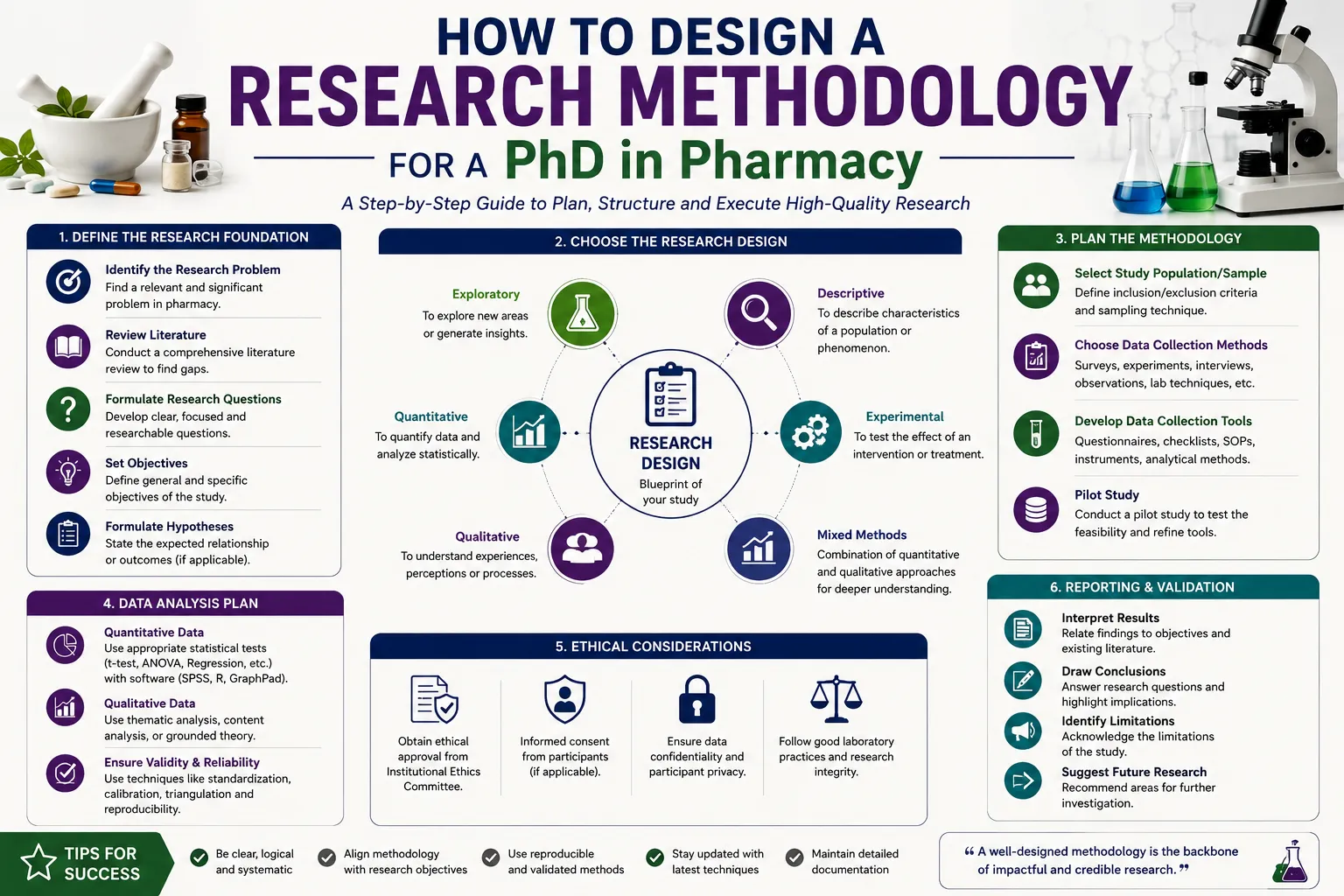
Pharmacy PhD research carries a unique burden that most other disciplines don't face in the same way: your methodology isn't just judged on rigor, it's judged on regulatory compliance. Whether you're screening a novel compound in vitro, running preclinical animal studies, or designing a clinical evaluation, your research design has to satisfy scientific committees and ethics bodies simultaneously. This guide walks through how to design a research methodology for a PhD in pharmacy that holds up on both fronts.
Good Clinical Practice is the international ethical and scientific quality standard for the design, conduct, recording, and reporting of trials involving human subjects, resting on two core principles: protecting participant rights, safety, and well-being, and ensuring the reliability and integrity of trial data. Even if your PhD research never reaches human trials, this same logic — rigor plus ethical defensibility — runs through every stage of pharmacy research design, from cell culture work to animal models.
Step 1: Match Your Study Type to Your Research Question
Pharmacy PhD research typically falls somewhere along a spectrum: in vitro (cell or tissue-based), in vivo (animal model-based), or clinical (human subject-based) — and increasingly, hybrid designs that combine more than one. There is a recognized recent trend toward replacing redundant animal experiments with simulation-based or cell-culture alternatives wherever scientifically feasible, reflecting both ethical priorities and methodological innovation. Before designing anything further, be explicit about which category your question belongs to and why.
Common Pharmacy PhD Study Types
Different types of studies are used in Pharmacy PhD research depending on the stage of drug development and the research objectives. Each study type also requires compliance with specific regulatory and ethical guidelines.
In Vitro Studies: These studies evaluate cellular or tissue-level mechanisms and initial drug efficacy under controlled laboratory conditions. In India, they generally require approval from the Institutional Biosafety Committee (IBC) or Institutional Ethics Committee, depending on the nature of the research.
In Vivo (Preclinical) Studies: These studies assess drug efficacy, toxicity, and pharmacokinetics in animal models before human testing. Researchers must obtain approval from the Committee for the Purpose of Control and Supervision of Experiments on Animals (CPCSEA) and the Institutional Animal Ethics Committee (IAEC).
Clinical Studies: Clinical research investigates the safety and efficacy of drugs in human participants. Such studies must comply with ICH-GCP (International Council for Harmonisation – Good Clinical Practice) guidelines and receive approval from an Independent Ethics Committee (IEC) before they begin.
Step 2: Identify the Specific Method Within Your Study Type
Common pharmacy PhD research methods include preclinical screening for pharmacological activity, toxicity studies (acute, sub-acute, and chronic, including LD50 determination following OECD guidelines), pharmacokinetic studies, and clinical evaluation of new drug candidates across defined trial phases. Your methodology chapter should name the specific method precisely — "toxicity screening" alone is not sufficient; state whether it's acute, sub-acute, or chronic, and which guideline framework you're following.
Step 3: Secure the Correct Ethical Approvals Before Designing Further
This is where pharmacy research design differs sharply from many other disciplines — ethical approval isn't a formality appended at the end, it shapes what's methodologically possible from the outset.
- For animal studies in India: Research is governed by the Committee for the Purpose of Control and Supervision of Experiments on Animals (CPCSEA) under the Prevention of Cruelty to Animals Act, 1960. Every laboratory must have a constituted Institutional Animal Ethics Committee (IAEC), and studies involving canines, ovines, bovines, or non-human primates require additional approval from a separate expert panel.
- For clinical/human-subject studies: ICH-GCP requires trials to receive a favorable opinion from an Independent Ethics Committee (IEC) before any study activity begins — a checks-and-balances mechanism ensuring a neutral third party agrees the trial's risks are outweighed by potential benefits .
- Under the current ICH E6(R3) framework (adopted June 2026, effective January 2027), quality should be proactively designed into trials from the planning stage using a proportionate, risk-based approach, rather than applying uniform requirements regardless of study scale.
Step 4: Apply the 3Rs Framework for Any Animal-Based Design
If your research involves animal models, CPCSEA Standard Operating Procedures require designing studies that use the smallest number of animals necessary to achieve statistically valid results — including formal statistical planning to justify sample size and avoid unnecessary duplication of experiments. This reflects the international 3Rs framework — Replacement, Reduction, Refinement — which modern pharmacy researchers are expected to actively apply, not merely acknowledge. Training in animal welfare, ethics, and non-animal alternative techniques is now considered part of a competent in vivo pharmacologist's broader skill set, beyond pure technical proficiency.
Step 5: Define Your Study Population, Model, and Sample Size With Precision
Whether your subjects are cell lines, laboratory animals, or human participants, your methodology needs to specify the exact model and justify its selection. A representative example from a preclinical pharmacokinetic study illustrates the level of procedural detail expected: IAEC approval referenced by specific protocol number, defined animal species, strain, age, and weight range, a quarantine period before dosing, controlled housing conditions, and body-weight-based stratification prior to intervention. This level of specificity — not vague statements like "rats were used" — is what committees expect to see.
Step 6: Choose and Justify Your Analytical Approach
Quantitative methods dominate most pharmacy PhD research, since the goal is typically to test a specific hypothesis (e.g., does Compound X reduce inflammatory markers significantly compared to control?) through systematic, measurable data collection. Your methodology chapter should describe your overall approach and rationale, your data collection tools and procedures, your sampling or group-allocation method, and your statistical analysis technique in enough detail that another researcher could replicate your study.
Step-by-Step: Building Your Pharmacy PhD Methodology Section
- State your research question and hypothesis precisely
- Identify your study type (in vitro, in vivo, clinical, or hybrid) and specific method
- Secure and document the relevant ethical approval (IAEC, IEC, or institutional biosafety committee) with reference numbers
- Define your model/population — species, strain, cell line, or patient population — with exact parameters
- Justify your sample size using statistical planning, applying the 3Rs where animals are involved
- Specify your intervention, dosing, or exposure protocol precisely
- Name your outcome measures and the statistical tests you'll use to analyze them
- State your data recording and quality-assurance procedures, reflecting GCP's emphasis on data reliability
Practical Checklist: Is Your Pharmacy PhD Methodology Ready?
- Study type (in vitro/in vivo/clinical) matches your research question
- Specific method (e.g., acute vs. chronic toxicity) is precisely named
- Relevant ethical approval (IAEC/IEC/biosafety) is secured and documented with reference numbers
- Animal-based designs apply and justify the 3Rs framework explicitly
- Model/population parameters (species, strain, age, weight, or patient criteria) are exactly specified
- Sample size is statistically justified, not arbitrarily chosen
- Intervention/dosing/exposure protocol is described in replicable detail
- Outcome measures and statistical tests are clearly stated
- Data recording procedures reflect GCP-aligned reliability standards
- Methodology chapter would allow another researcher to replicate the study
Two Practical Scenarios
Scenario 1 — Preclinical Toxicity Study Design A scholar investigating the safety profile of a novel anti-inflammatory compound designed an acute toxicity study following OECD guidelines, using the minimum statistically justified number of Wistar rats stratified by body weight, with IAEC approval secured and referenced by protocol number before any dosing began. By explicitly stating the 3Rs justification for group sizes and detailing the quarantine and housing conditions, the scholar's methodology chapter satisfied both the doctoral committee and the institutional ethics review on first submission.
Scenario 2 — Transitioning From In Vivo to In Vitro Screening A scholar originally planning extensive animal-based efficacy screening for a new formulation redesigned the study after committee feedback to prioritize cell-culture-based assays for initial mechanism screening, reserving a smaller, statistically justified animal study only for confirmatory in vivo validation. This hybrid design reduced the animal component substantially while still producing publishable, ethically defensible findings — illustrating how the "redundant animal experiments should be replaced with feasible alternatives" principle is applied in practice.
Common Mistakes First-Time Pharmacy PhD Researchers Make
- Designing the full study before securing ethical approval, risking a redesign after the IAEC or IEC raises objections.
- Choosing sample sizes without formal statistical justification, which conflicts directly with CPCSEA's reduction principle.
- Describing animal models vaguely ("rats were used") instead of specifying species, strain, age, weight, and housing conditions precisely.
- Treating GCP/ethics compliance as a bureaucratic afterthought rather than a factor that should shape the study design from the outset.
- Failing to justify why in vivo work is necessary when a cell-culture or simulation-based alternative could answer the same question.
Frequently Asked Questions
How do you design a research methodology for a PhD in pharmacy?
Start by matching your study type (in vitro, in vivo, or clinical) to your specific research question, secure the relevant ethical approval (IAEC for animal studies, IEC for clinical studies) before finalizing your design, define your model and sample size with statistical justification, and specify your intervention, outcome measures, and analysis technique in replicable detail.
Why does research methodology design matter so much for a PhD in pharmacy?
Beyond academic rigor, pharmacy research methodology must satisfy regulatory and ethical bodies (CPCSEA, IAEC, IEC) whose approval is required before data collection can even begin — a poorly designed methodology can stall a PhD at the ethics review stage, independent of scientific merit.
How does research methodology affect a PhD thesis in pharmacy overall?
A methodology that fails to justify its ethical approvals, sample size, or model selection precisely is one of the most common reasons pharmacy PhD proposals are returned for revision by doctoral and ethics committees alike.
How long does it take to complete a PhD thesis using this approach?
Timelines vary significantly by study type — in vitro work often proceeds faster than in vivo or clinical studies, which require ethics committee approval cycles that can add months before data collection begins; planning for these approval timelines early helps avoid unexpected delays.
Is professional help available to design a research methodology for a PhD in pharmacy?
Yes. ThesisLikho's PhD-qualified experts have guided 10,000+ scholars through pharmacy research methodology design, ethics documentation support, and complete thesis writing assistance tailored to preclinical and clinical research requirements.
Get Expert Guidance on Your Pharmacy PhD Methodology
Designing a pharmacy PhD methodology that satisfies both your doctoral committee and the relevant ethics bodies takes careful early planning — from choosing the right study type to justifying sample size and securing approvals in the correct order. If you'd like expert input on structuring your methodology chapter or navigating ethical approval requirements, ThesisLikho's PhD-qualified team offers research methodology support, ethics documentation guidance, and complete PhD thesis writing assistance. If you need expert guidance with your research design, ethics approval process, or overall thesis structure, you can explore our PhD Thesis Assistance service.
Book a PhD Research Consultation → https://thesislikho.com/writing-services/thesis-assistance-phd