
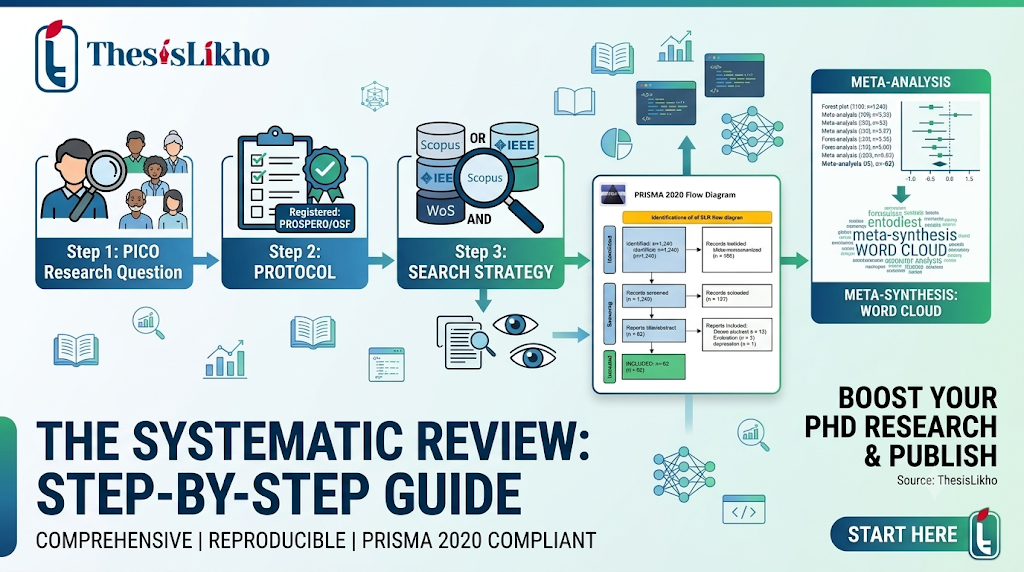
A systematic literature review (SLR) is one of the most respected forms of research. It answers a clearly defined question by finding, screening, evaluating and synthesising all relevant studies using a transparent and reproducible method. Scopus indexed journals publish SLRs widely, and many PhD committees now expect at least one review paper from a scholar's work.
But an SLR is not just a long literature review. It follows a strict methodology and must be reported according to PRISMA 2020. This guide explains every step — from forming your research question to drawing the PRISMA flow diagram — with figures you can follow. If you are still choosing between review types, first read our guide on types of literature review on the Thesislikho blog.
Systematic Review vs. Traditional Literature Review
| Aspect | Traditional (Narrative) Review | Systematic Literature Review |
|---|---|---|
| Research question | Broad, often general | Focused and pre-defined (PICO) |
| Protocol | Not required | Written and often registered |
| Search | Selective, not documented | Comprehensive, multiple databases, fully documented |
| Study selection | Author's judgement | Explicit inclusion/exclusion criteria, two reviewers |
| Quality appraisal | Rarely done | Mandatory (risk of bias tools) |
| Synthesis | Descriptive | Structured narrative or meta-analysis |
| Reporting | Free format | PRISMA 2020 checklist and flow diagram |
The SLR Process at a Glance
The figure below shows the eight stages of a systematic literature review. Each stage produces an output that feeds the next, and every decision must be documented so another researcher can repeat your review.
Step 1: Define a Focused Research Question
Everything in an SLR depends on the research question. A vague question produces thousands of irrelevant results; a focused question produces a manageable, meaningful set of studies. Use a structured framework:
- PICO — Population, Intervention, Comparison, Outcome (clinical, experimental and technical studies).
- PEO — Population, Exposure, Outcome (observational studies).
- SPIDER — Sample, Phenomenon of Interest, Design, Evaluation, Research type (qualitative research).
- PCC — Population, Concept, Context (scoping reviews).
Example (Computer Science): "In patients screened for depression (P), how accurate are multimodal deep learning models (I) compared with unimodal models (C) in detection accuracy and F1-score (O)?"
In software engineering, it is also common to frame two to four research questions (RQ1–RQ4), such as which techniques are used, which datasets are used, how performance is evaluated and what challenges remain.
Step 2: Develop and Register a Review Protocol
A protocol is your plan written before you start searching. It prevents bias, because you cannot change criteria later to suit the results. A protocol normally includes:
- Background and rationale, research questions and objectives
- Eligibility (inclusion and exclusion) criteria
- Databases, search strings and date limits
- Screening process and number of reviewers
- Quality assessment tool, data extraction items and synthesis method
Register health-related reviews on PROSPERO; other disciplines can use OSF Registries. Write your protocol using the PRISMA-P checklist. Need help designing it? Our Methodology Assist mentors can review your protocol.
Step 3: Build a Comprehensive Search Strategy
a) Identify keywords and synonyms
For each PICO element, list keywords, synonyms, abbreviations and spelling variations. Use controlled vocabulary such as MeSH terms in PubMed where available.
b) Combine with Boolean operators
Use OR between synonyms, AND between concepts, NOT to exclude, quotation marks for phrases and an asterisk (*) for truncation:
c) Select databases
Search at least three relevant databases: Scopus, Web of Science, PubMed/MEDLINE, IEEE Xplore, ACM Digital Library, ScienceDirect, PsycINFO or ERIC, depending on your field. Google Scholar and grey literature can be used as supplementary sources. Also perform backward and forward snowballing (checking references and citations of included papers).
d) Document everything
Record the date of search, database, exact search string and number of results. Follow PRISMA-S for search reporting.
Step 4: Screening and Study Selection
Export all records into a reference manager (Zotero, Mendeley or EndNote) and remove duplicates. Then screen in two stages:
- Title and abstract screening — remove clearly irrelevant records.
- Full-text screening — read remaining papers fully and apply eligibility criteria, recording the reason for each exclusion.
Ideally, two reviewers screen independently, resolve disagreements through discussion or a third reviewer, and report agreement using Cohen's kappa. Free and paid tools such as Rayyan and Covidence make this process faster.
| Inclusion Criteria (example) | Exclusion Criteria (example) |
|---|---|
| Peer-reviewed journal and conference papers | Editorials, letters, posters, abstracts only |
| Published 2019–2026 | Published before 2019 |
| English language | Non-English without translation |
| Uses multimodal data (text, audio, video) | Uses only a single modality |
| Reports quantitative performance metrics | No empirical evaluation |
The PRISMA 2020 Flow Diagram
The PRISMA 2020 flow diagram visually reports how many records passed through each stage of your review. Journals require it in every SLR. The figure below shows its structure with example numbers.
Note that the numbers must add up at every stage: 1,240 − 420 removed = 820 screened; 820 − 640 = 180 sought; 180 − 12 = 168 assessed; 168 − 106 = 62 included. Download official Word and PDF templates, or use the online diagram generator, from the PRISMA 2020 flow diagram page.
Step 5: Quality Assessment and Risk of Bias
Not all included studies are equally reliable. Quality assessment tells readers how much confidence they can place in the evidence. Choose a tool that matches the study design:
| Study Design | Recommended Tool |
|---|---|
| Randomised controlled trials | Cochrane RoB 2 |
| Non-randomised studies | ROBINS-I, Newcastle–Ottawa Scale |
| Qualitative studies | CASP Qualitative Checklist |
| Diagnostic accuracy studies | QUADAS-2 |
| Mixed methods | MMAT (Mixed Methods Appraisal Tool) |
| Software engineering / CS studies | Kitchenham quality checklist (custom scored questions) |
Report scores in a table, and consider sensitivity analysis excluding low-quality studies.
Step 6: Data Extraction
Design a standardised data extraction form (in Excel or Google Sheets) and pilot it on three to five papers. Typical fields include:
- Author, year, country, journal or conference
- Study objective, design and sample/dataset
- Methods, models or interventions used
- Outcomes, metrics and key results
- Limitations and future work stated by the authors
- Quality score
Two reviewers should extract data independently, or one should extract and another verify.
Step 7: Data Synthesis
Synthesis is where you transform extracted data into new knowledge. Choose the approach that suits your data:
- Narrative synthesis — structured textual comparison grouped by themes, methods or outcomes, supported by summary tables. Follow SWiM guidelines when meta-analysis is not possible.
- Thematic synthesis — coding findings and developing descriptive and analytical themes (for qualitative studies).
- Meta-analysis — statistical pooling of effect sizes using fixed- or random-effects models, heterogeneity (I²), forest plots and funnel plots, guided by the Cochrane Handbook.
- Bibliometric visualisation — publication trends, keyword co-occurrence maps and country networks using VOSviewer or Bibliometrix.
Present results with figures: publications per year, distribution by database or country, method taxonomy diagrams and comparison tables. For statistical guidance on meta-analysis, see our PhD Data Analysis support.
Step 8: Report the SLR Using PRISMA 2020
Structure your manuscript using the 27-item PRISMA 2020 checklist (full explanation in Page et al., BMJ 2021). A typical SLR paper contains:
- Title — identify the report as a systematic review.
- Structured abstract — following PRISMA for Abstracts.
- Introduction — rationale, existing reviews and research questions.
- Methods — protocol, eligibility criteria, sources, search, selection, extraction, risk of bias and synthesis methods.
- Results — PRISMA flow diagram, study characteristics, quality assessment and synthesis answering each RQ.
- Discussion — interpretation, research gaps, limitations of evidence and of the review, and future directions.
- Other information — registration, funding, conflicts of interest and data availability.
Attach the completed PRISMA checklist as supplementary material when submitting to journals. Once drafted, polish language and referencing through Proofreading & Formatting and verify originality with a plagiarism check.
Realistic Timeline for an SLR
| Stage | Approximate Time |
|---|---|
| Research question and protocol | 2–4 weeks |
| Searching and de-duplication | 1–2 weeks |
| Screening (title/abstract and full text) | 3–6 weeks |
| Quality assessment and data extraction | 3–6 weeks |
| Synthesis and writing | 4–8 weeks |
| Total | 3–6 months (longer with meta-analysis) |
Useful Software Tools for Each SLR Stage
The right software saves weeks of manual work and improves accuracy. The table below lists commonly used tools; many are free for students and researchers.
| Stage | Tools | Purpose |
|---|---|---|
| Reference management | Zotero, Mendeley, EndNote | Storing records, removing duplicates |
| Screening | Rayyan, Covidence, ASReview | Title/abstract and full-text screening with two reviewers |
| Data extraction | Excel, Google Sheets, Covidence | Standardised extraction forms |
| Meta-analysis | RevMan, R (metafor, meta), Stata, JASP | Effect sizes, forest and funnel plots |
| Bibliometrics | VOSviewer, Bibliometrix, CiteSpace | Citation, keyword and co-authorship networks |
| PRISMA diagram | PRISMA 2020 Shiny app, draw.io, Word template | Drawing the flow diagram |
Common Mistakes to Avoid
- Starting the search without a written protocol.
- Searching only one database or only Google Scholar.
- Not reporting exact search strings and search dates.
- PRISMA numbers that do not add up.
- Skipping quality assessment.
- Summarising papers one by one instead of synthesising by research question.
- Ignoring recently published reviews on the same topic.
Frequently Asked Questions about Systematic Literature Reviews
How many papers are needed for a systematic literature review?
There is no fixed number. The number of included studies depends on your research question and eligibility criteria. Most published SLRs include between 20 and 100 studies, but a well-justified review with fewer studies is acceptable if the search was comprehensive.
Can one person do a systematic review alone?
It is possible, especially for a PhD thesis chapter, but journals prefer at least two reviewers for screening and data extraction to reduce bias. If you work alone, ask your supervisor or a colleague to verify a random sample of decisions and report this in your methods.
Is registering on PROSPERO compulsory?
PROSPERO accepts reviews with a health-related outcome. Registration is not always compulsory, but many medical journals expect it. For engineering, computer science or management, registering a protocol on OSF is good practice and strengthens credibility.
What is the difference between an SLR and a meta-analysis?
An SLR is the full systematic process of finding and synthesising studies. A meta-analysis is a statistical technique that may be used within an SLR when studies report comparable quantitative outcomes. Every meta-analysis should be part of a systematic review, but not every systematic review includes a meta-analysis.
How Thesislikho Helps You Complete a High-Quality SLR
Thesislikho mentors guide scholars through each stage while the research remains the scholar's own:
- Framing research questions, protocol and search strategy — Literature Review & Analysis
- Choosing quality tools and synthesis methods — Methodology Assist
- Meta-analysis and bibliometric analysis guidance — PhD Data Analysis
- Preparing a journal-ready SLR manuscript — Research Article support
- Integrating your SLR into your thesis — Thesis support
Explore all services, see pricing, read testimonials, check our FAQs, or join the Research Community. More guides are available on the Thesislikho blog.
Conclusion
A systematic literature review is demanding, but its structure is also its strength. Define a focused question, write a protocol, search comprehensively, screen transparently, appraise quality, extract data carefully, synthesise meaningfully and report with PRISMA 2020. Follow these eight steps and your SLR will be reproducible, credible and well positioned for publication in a Scopus indexed journal.
Planning your Systematic Literature Review?
Get expert mentoring on protocol design, PRISMA reporting, quality assessment and meta-analysis.
Get SLR Guidance Contact Us