
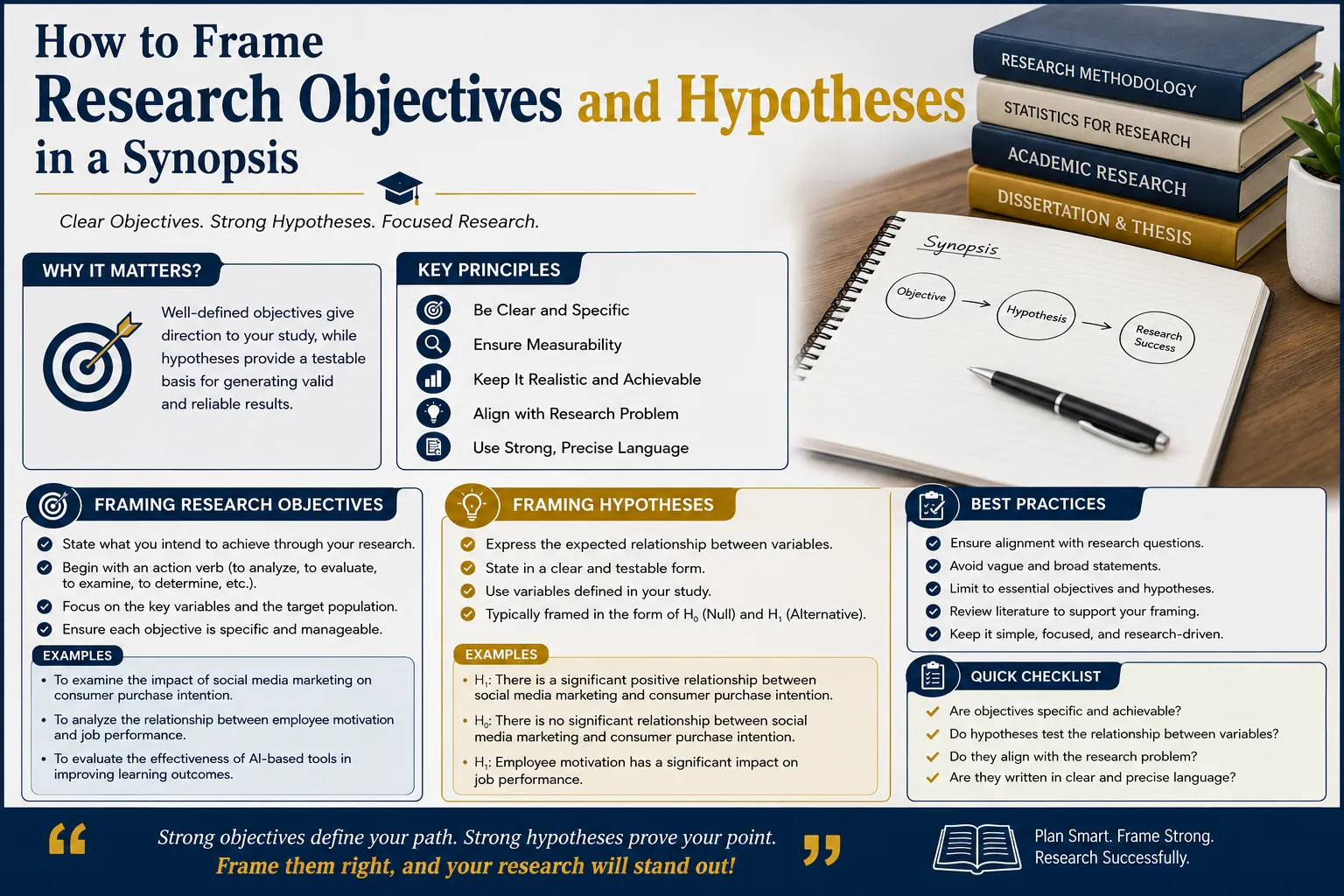
If your Doctoral Research Committee has sent your synopsis back with a comment like "objectives too broad" or "hypothesis not testable," you're not alone — this is, by a wide margin, the section of a PhD synopsis that gets flagged most often. Learning how to frame research objectives and hypotheses in a synopsis properly is what turns a vague research idea into a proposal a committee can actually evaluate, approve, and hold you accountable to for the next three to five years.
This guide walks through exactly that: what objectives and hypotheses are (and aren't), how to write them using a framework committees recognize, real examples from Indian doctoral research, and the mistakes that get synopses rejected or sent back for revision. We've grounded this in current DRC evaluation norms and the patterns we see across the scholars ThesisLikho supports through synopsis preparation.
What Are Research Objectives and Hypotheses in a Synopsis?
Research objectives are the specific, action-oriented statements that break your broader research aim into concrete, achievable steps — each one describing exactly what you intend to investigate, examine, or assess. Hypotheses, by contrast, are testable predictions about the relationship between variables, stated in a form that can be confirmed or rejected through your data. Together, they form the operational core of your synopsis: the section your Doctoral Research Committee (DRC) reads most carefully, because it's where they judge whether your research idea is actually researchable within a PhD timeframe.
Scholars often use "objectives" and "hypotheses" interchangeably, but they serve different functions. An objective tells the committee what you will do ("to examine the relationship between X and Y"). A hypothesis tells the committee what you expect to find ("X is positively associated with Y"). A well-framed synopsis needs both to work together, not as two separate lists but as a connected logical chain.
Why This Section Matters So Much
Your objectives and hypotheses are what your entire thesis will eventually be measured against — at the pre-submission seminar, at the viva, and in every progress review in between. A DRC evaluates a synopsis primarily on whether the research problem is clearly defined, whether the proposed objectives are achievable within a three-to-five-year PhD timeframe, and whether the methodology that follows genuinely matches those objectives. Weak framing here doesn't just risk synopsis rejection — it creates downstream problems that surface years later, when your data collection or literature review no longer maps cleanly to what you originally proposed.
Getting this section right the first time also protects you from a specific, painful problem: significant deviation from your approved synopsis in the final thesis can create serious complications at the viva stage, since your approved objectives are effectively a contract with your committee.
Where Objectives and Hypotheses Sit in Your Synopsis
A standard Indian PhD synopsis — typically running 2,000 to 5,000 words depending on your university's ordinance — follows a fairly consistent structure across institutions:
- Title page
- Introduction and background
- Statement of the research problem
- Review of literature
- Objectives of the study
- Hypotheses (or research questions)
- Research methodology
- Proposed chapter scheme
- Significance of the study
- References
Objectives and hypotheses sit right after your literature review and before your methodology — which is not accidental. They're the hinge point: everything before them (your problem statement, your literature review) builds the case for why this research matters, and everything after them (your methodology) explains how you'll actually achieve them. If this section is weak, both halves of your synopsis lose their connective tissue.
Research Aim vs Research Objectives vs Hypotheses
These three terms are frequently confused, and DRCs notice when scholars use them inconsistently.
- Research Aim — one broad statement of overall purpose. Example: "To investigate the impact of digital HR practices on employee engagement in Indian IT firms."
- Research Objectives — 3–5 specific, actionable steps that operationalize the aim. Example: "To assess the relationship between digital performance-tracking tools and employee engagement scores."
- Hypotheses — testable predictions derived from specific objectives. Example: "H1: Digital performance-tracking tool usage is positively associated with employee engagement."
Think of it as a funnel: one aim narrows into several objectives, and quantitative objectives narrow further into specific, testable hypotheses. For a deeper breakdown of exactly how aim and objectives differ in practice, see our related guide: [difference between research aim and research objectives in a synopsis].
How to Write Strong Research Objectives
- Start every objective with an action verb. "To examine," "to assess," "to compare," "to evaluate," "to identify," and "to determine" are standard, committee-recognized openers. Avoid vague verbs like "to study" or "to look at," which don't commit you to a specific analytical action.
- Keep each objective narrow enough to map to one clear method. If you can't picture the specific data or analysis technique an objective would require, it's still too broad.
- Sequence objectives logically, typically moving from descriptive/foundational objectives toward more analytical or evaluative ones — for example, first mapping the current state of a phenomenon, then testing relationships within it, then proposing recommendations.
- Make sure every objective is genuinely achievable within your PhD timeline. An objective requiring five years of longitudinal data collection doesn't fit a program with a three-to-five-year overall timeline that also needs to leave room for writing and revision.
- Objectives should appear at the end of your problem statement or literature review section, immediately signalling to the reader exactly what the study will accomplish before you move into methodology.
The SMART Framework for Objectives
The SMART framework remains the most widely referenced structure for writing research objectives, and DRCs are increasingly familiar with it even when they don't name it explicitly:
- Specific — names a precise variable, population, or relationship, not a general topic area.
- Measurable — can be assessed with a defined method, scale, or dataset.
- Achievable — realistic given your access, timeline, and resources.
- Relevant — directly connects to your stated research problem and gap.
- Time-bound — fits within your PhD's realistic completion window.
A quick before-and-after example:
- Weak (not SMART): "To study leadership in Indian organizations."
- SMART: "To assess the relationship between servant leadership behaviour and employee innovative work behaviour among mid-level managers in Indian manufacturing firms."
The SMART version names the specific leadership style, the specific outcome variable, the specific population, and the specific sector — everything a DRC needs to judge feasibility at a glance.
How Many Objectives Should a Synopsis Have?
Most Indian PhD synopsis formats call for somewhere between three and five specific objectives — few enough to remain manageable within a doctoral timeline, but enough to demonstrate a genuinely multi-dimensional investigation rather than a single narrow question. Fewer than three objectives often signals a thesis that's too thin for a full PhD; more than five tends to raise feasibility concerns and risks producing a thesis that reads as unfocused. Some university formats explicitly request four objectives as a working default, though this varies and should always be checked against your specific institution's synopsis guidelines.
How to Write Testable Hypotheses
A hypothesis is only useful if it's testable — meaning your proposed methodology can actually confirm or reject it using data you can realistically collect. Strong hypotheses in a management-related synopsis typically follow this structure:
- Identify the specific variables involved (independent, dependent, and any mediating or moderating variables).
- State the predicted direction of the relationship where your literature review supports one — "positively associated," "negatively associated," or simply "associated with" if direction isn't yet clear from prior research.
- Ground the prediction in your literature review, not intuition — a hypothesis with no supporting rationale is a guess, not a hypothesis.
- Write it as a single, unambiguous, declarative statement — avoid hedging language like "might," "could possibly," or "may potentially," since a hypothesis needs to commit to a specific, testable claim.
Example: "H1: Perceived organizational support is positively associated with employee organizational citizenship behaviour among private-sector bank employees in North India."
Null vs Alternative Hypotheses
For quantitative, hypothesis-testing research, each hypothesis is conventionally stated in two complementary forms:
- Null hypothesis (H0) — states there is no relationship, effect, or difference between the variables. This is the default, "status quo" assumption your statistical test works to reject. Example: "There is no significant relationship between perceived organizational support and organizational citizenship behaviour."
- Alternative hypothesis (H1 or Ha) — states that a relationship, effect, or difference does exist. This is usually the prediction the researcher actually expects to support, based on the literature review. Example: "Perceived organizational support has a significant positive relationship with organizational citizenship behaviour."
You don't need to write out both forms explicitly in every synopsis format — some universities only expect the alternative/research hypothesis to be stated, with the null implied — but you should understand both, since statistical testing during your actual data analysis will formally test the null against the alternative.
When You Don't Need a Formal Hypothesis
Not every synopsis requires a hypothesis, and forcing one where it doesn't fit is a common mistake. If your study is exploratory or qualitative in nature — for instance, investigating how family-run businesses navigate succession planning, or why gig workers construct a sense of job security — a hypothesis implies a level of predictive certainty that doesn't match an inductive, discovery-oriented design. In these cases, research questions replace hypotheses: open-ended, "how" or "why" framed questions that guide data collection without predicting a specific outcome. Many synopsis formats explicitly allow this, noting that a hypothesis should only be included where relevant to the field and design.
Linking Objectives to Hypotheses to Methodology
The single most important structural principle in this section of your synopsis is traceability: every hypothesis should map back to a specific objective, and every objective should map forward to a specific method in your methodology section. A DRC reviewing your synopsis should be able to draw a straight line from Objective 2, to Hypothesis 2, to the exact statistical test or qualitative technique that will address it.
A simple way to check this before submission — list each objective alongside its paired hypothesis and planned method:
- Objective: "To assess the relationship between remote work flexibility and employee productivity." Hypothesis: "H1: Remote work flexibility is positively associated with employee productivity." Planned method: Survey plus regression analysis.
- Objective: "To examine how managers perceive trust in hybrid teams." Hypothesis: none — this is exploratory, so a research question is used instead. Planned method: Semi-structured interviews plus thematic analysis.
If any objective has no corresponding method, or any hypothesis doesn't trace back to an objective, that's exactly the kind of inconsistency a DRC will catch. For a full walkthrough of building the methodology section that follows this logic, see [how to design a research methodology for a PhD in management].
Real Synopsis Examples
Example 1 — Quantitative synopsis (Management). A scholar proposing research on AI adoption and employee productivity initially framed a single broad objective: "to study the impact of AI on employees." After DRC feedback, this was reframed into four SMART objectives — for example, "to assess the relationship between AI-tool adoption intensity and self-reported task efficiency among customer service employees in Indian BPO firms" — each paired with a corresponding hypothesis (e.g., "H2: AI-tool adoption intensity is positively associated with self-reported task efficiency") and a named statistical technique (multiple regression). The revised version was approved without further changes because every objective, hypothesis, and method traced cleanly to the next.
Example 2 — Qualitative synopsis (Organizational Behaviour). A scholar studying how first-generation entrepreneurs in Tier-2 Indian cities experience decision-making under uncertainty initially attempted to force a formal hypothesis onto an exploratory question. On revision, the synopsis replaced the hypothesis with three research questions instead — for example, "How do first-generation entrepreneurs describe their decision-making process during periods of financial uncertainty?" — paired with a semi-structured interview methodology and thematic analysis. This shift from hypothesis to research question, properly justified in the synopsis, resolved the DRC's original concern about forcing a predictive claim onto genuinely exploratory research.
Common Mistakes While Framing Objectives and Hypotheses
- Writing objectives that are really just topics. "To study employee engagement" is a topic, not an objective — it doesn't specify what you'll actually do or measure.
- Mismatching objectives and methodology. Proposing a qualitative interview study while writing objectives phrased as if you're testing hypotheses statistically (or vice versa).
- Forcing a hypothesis onto exploratory research rather than using research questions where they genuinely fit better.
- Vague or hedged hypothesis language — "might be related to," "could potentially affect" — that isn't actually testable in a formal statistical sense.
- Too many objectives. Beyond five or six, DRCs frequently question whether the scope is realistic for a single PhD.
- No literature grounding for the predicted direction of a hypothesis — stating "positively associated" without a rationale for why you expect that direction.
- Inconsistent terminology across the synopsis — referring to the same construct by different names in the objectives, hypotheses, and methodology sections, which creates confusion for reviewers trying to trace the logic.
- Ignoring feasibility. An ambitious, well-written objective that simply can't be achieved with realistic data access within a PhD timeframe will still draw committee pushback.
DRC/RDC Evaluation Checklist
Before submitting your synopsis, check your objectives and hypotheses section against this list:
- Each objective starts with a clear action verb
- Each objective is Specific, Measurable, Achievable, Relevant, and Time-bound
- You have 3–5 objectives (check your specific university's expected range)
- Every objective maps to exactly one planned method in your methodology section
- Hypotheses (where used) are stated as clear, testable, declarative predictions
- Each hypothesis's predicted direction is grounded in your literature review
- Research questions are used instead of hypotheses for exploratory/qualitative objectives
- Terminology (construct names, population, context) is consistent throughout
- The full set of objectives is realistically achievable within a 3–5 year PhD timeline
- You've checked your specific university's synopsis ordinance for format requirements
If you're earlier in the process and still working on the problem statement that precedes this section, our related guide, [how to write a research problem statement for a synopsis], covers that groundwork in detail.
How Long Does It Take to Complete a Synopsis Using This Approach?
Framing objectives and hypotheses properly — including literature-grounding each prediction and cross-checking against your planned methodology — typically takes two to four weeks within an overall synopsis preparation timeline of one to three months. Scholars who skip careful framing at this stage often lose more time later through DRC revision cycles, so the upfront investment tends to pay off.
Is Professional Help Available to Frame Research Objectives and Hypotheses in a Synopsis?
Yes — many first-time scholars work with academic mentors or research consultancies to pressure-test their objectives against SMART criteria, refine hypothesis wording, and check the logical fit between objectives, hypotheses, and methodology before DRC submission. ThesisLikho's PhD-qualified research experts have supported 10,000+ scholars through exactly this stage of synopsis preparation, helping ensure every objective is both academically rigorous and realistically achievable — all while keeping the work entirely your own. Explore ThesisLikho's synopsis writing services for one-on-one guidance.
FAQs
How do you frame research objectives and hypotheses in a synopsis?
Start with one broad research aim, break it into 3–5 SMART objectives using action verbs like "to examine" or "to assess," then derive testable hypotheses (or research questions, for exploratory studies) from each objective, grounded in your literature review.
How long does it take to complete a synopsis using this approach?
Most scholars need two to four weeks specifically for the objectives and hypotheses section, within a broader synopsis preparation timeline of one to three months, depending on how much revision your DRC requests.
Is professional help available to frame research objectives and hypotheses in a synopsis?
Yes. Research consultancies and academic mentors, including ThesisLikho's PhD-qualified experts, help scholars refine objectives and hypotheses for DRC approval while preserving full originality and academic integrity.
Why should I frame research objectives and hypotheses in a synopsis carefully?
Because this section is what your DRC evaluates most closely, and it's the section your entire thesis will later be measured against — weak or mismatched objectives create problems that resurface at the pre-submission seminar and viva.
When should you frame research objectives and hypotheses in a synopsis?
Immediately after completing your problem statement and literature review, and before drafting your methodology section — objectives and hypotheses should be finalized first, since your methodology needs to be designed specifically to address them.
Related reading: [How to Write a Research Problem Statement for a Synopsis] and [Difference Between Research Aim and Research Objectives in a Synopsis].
Ready to turn your research idea into a DRC-ready synopsis?
Get Synopsis Help Now → https://thesislikho.com/writing-services/synopsis-writing