
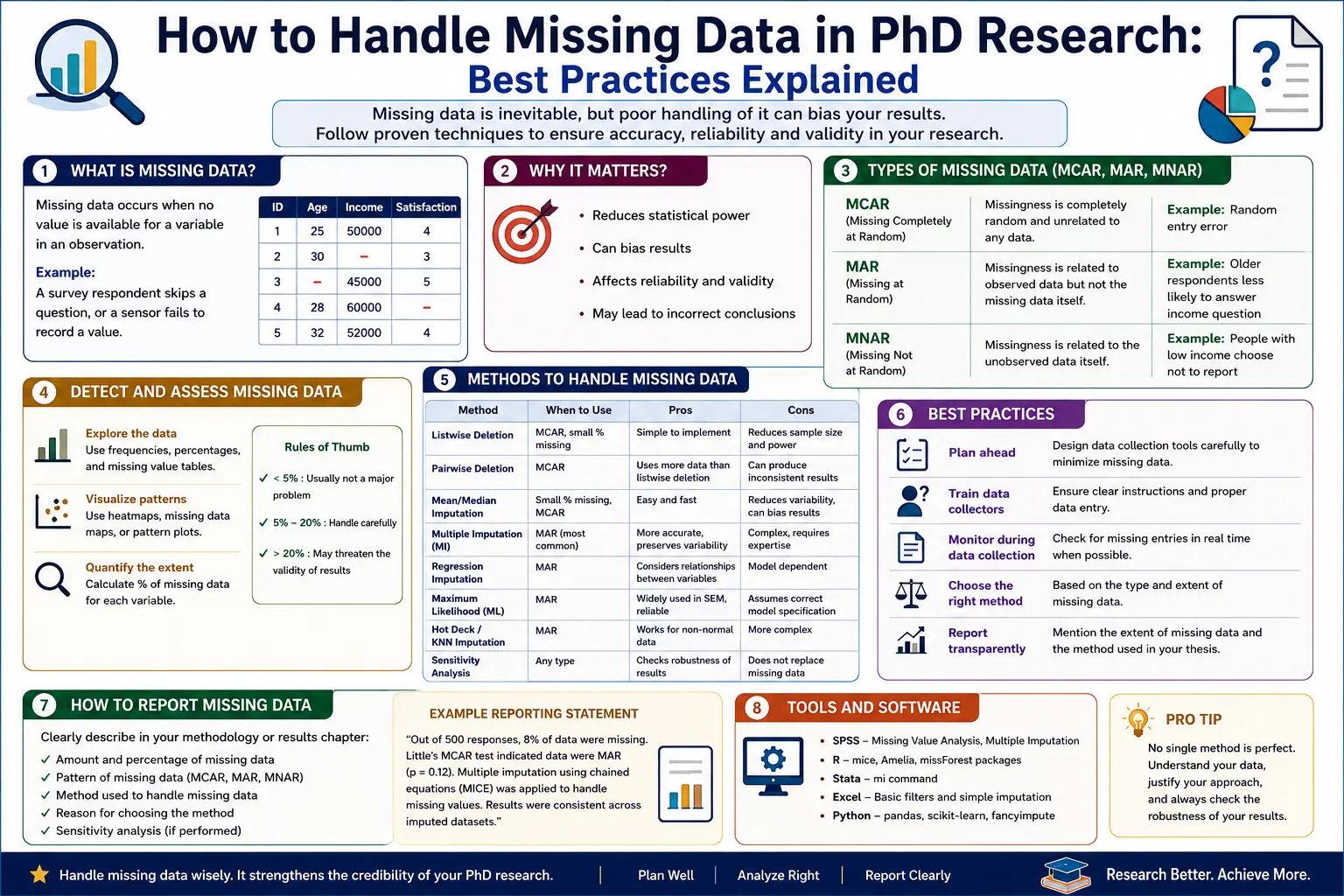
Missing data is one of the most common challenges faced by PhD scholars during research. Whether you are conducting surveys, experiments, interviews, or secondary data analysis, chances are that some data points will be incomplete or unavailable. Ignoring missing data or handling it incorrectly can lead to biased results, inaccurate conclusions, and even rejection of research papers by journals.
For doctoral researchers, understanding how to manage missing data is not just a statistical requirement—it is an essential part of producing credible and reliable research.
In this comprehensive guide, you'll learn what missing data is, why it occurs, different types of missing data, and the best practices for handling missing values in your PhD research.
What Is Missing Data in Research?
Missing data refers to observations or values that are unavailable for one or more variables in a dataset. Instead of having complete information for every participant or observation, researchers end up with blank or unknown entries.
For example:
- A participant skips a question in an online survey.
- Laboratory equipment fails during an experiment.
- Historical records contain incomplete information.
- Respondents withdraw before completing a study.
Even a small amount of missing data can significantly affect statistical analysis if not handled appropriately.
Why Missing Data Matters in a PhD Thesis
Many PhD scholars underestimate the impact of missing data. However, it can influence nearly every stage of research.
Improper handling of missing data may lead to:
- Biased parameter estimates
- Reduced statistical power
- Incorrect hypothesis testing
- Invalid conclusions
- Lower credibility of your thesis
- Rejection during journal peer review
A transparent and scientifically justified approach to missing data strengthens the overall quality of your dissertation.
Common Causes of Missing Data
Understanding why data is missing helps determine the most appropriate treatment method.
Some common causes include:
1. Participant Non-Response
Participants may intentionally skip sensitive questions such as income, health status, or personal experiences.
Example:
A respondent leaves the salary question unanswered.
2. Survey Fatigue
Long questionnaires often result in participants abandoning the survey midway.
3. Equipment Failure
Scientific instruments may malfunction, leading to missing laboratory measurements.
4. Data Entry Errors
Human errors during data entry can accidentally remove or overwrite observations.
5. Lost Records
Paper questionnaires, medical files, or interview notes may be misplaced.
6. Attrition in Longitudinal Studies
Participants may leave studies before completion, creating incomplete datasets over time.
Types of Missing Data
Statisticians classify missing data into three primary categories.
Understanding these categories is essential because the correct statistical method depends on the type of missingness.
1. Missing Completely at Random (MCAR)
The probability of missing data is entirely random and unrelated to any observed or unobserved variables.
Example:
A researcher accidentally loses five questionnaires during transportation.
Characteristics:
- No systematic pattern
- Least problematic
- Easier to analyze
2. Missing at Random (MAR)
The missingness depends on observed variables but not on the missing values themselves.
Example:
Older participants are less likely to answer questions about technology use.
Since age is already recorded, researchers can statistically adjust for the missing responses.
MAR is the assumption used by many advanced statistical methods.
3. Missing Not at Random (MNAR)
The missingness depends on the missing value itself.
Example:
Participants with higher income refuse to disclose their income.
This is the most difficult type of missing data because the missing values are systematically different.
Step 1: Identify Missing Data Patterns
Before applying any statistical technique, inspect your dataset carefully.
Look for:
- Which variables have missing values?
- How many values are missing?
- Are missing values concentrated in specific groups?
- Is there a recognizable pattern?
Most statistical software can generate missing data reports.
Popular software includes:
- SPSS
- R
- Python
- Stata
- SAS
Step 2: Understand Why the Data Is Missing
Do not immediately delete missing observations.
Instead, ask:
- Was the question optional?
- Did respondents skip sensitive questions?
- Was there equipment failure?
- Did participants drop out?
Knowing the reason helps determine whether the missingness is MCAR, MAR, or MNAR.
Step 3: Choose the Right Method
There is no single best technique for every study.
The choice depends on:
- Percentage of missing data
- Research objectives
- Statistical analysis
- Type of missingness
- Sample size
Below are the most commonly used methods.
Method 1: Listwise Deletion
Listwise deletion removes any participant with at least one missing value.
Example:
If a participant skips one survey question, the entire response is excluded.
Advantages
- Simple
- Easy to implement
- Default in many statistical software packages
Disadvantages
- Reduces sample size
- May introduce bias
- Decreases statistical power
Best used when:
- Missing data is less than 5%
- Data is MCAR
Method 2: Pairwise Deletion
Instead of removing entire cases, pairwise deletion uses all available data for each analysis.
Advantages:
- Retains more information
- Larger effective sample size
Disadvantages:
- Different analyses use different sample sizes
- Interpretation can become complicated
Method 3: Mean Substitution
Replace missing values with the average value of that variable.
Example:
Average age = 30 years
Missing age → Replace with 30.
Advantages:
- Very simple
Disadvantages:
- Underestimates variability
- Produces biased estimates
- Not recommended for serious research
Method 4: Median or Mode Imputation
Median works well for skewed numerical data.
Mode is appropriate for categorical variables.
These methods are more robust than simple mean substitution but still have limitations.
Method 5: Regression Imputation
Predict missing values using regression models based on other variables.
Example:
Predict income using education, age, and occupation.
Advantages:
- More accurate
- Uses relationships among variables
Disadvantages:
- Can overestimate precision
- Requires statistical expertise
Method 6: Multiple Imputation (Recommended)
Multiple imputation is considered one of the best methods for handling missing data.
Instead of filling one value, it creates several plausible values and combines results across multiple datasets.
Advantages:
- Produces less biased estimates
- Preserves uncertainty
- Suitable for MAR data
- Accepted by leading journals
Most modern researchers prefer multiple imputation whenever feasible.
Method 7: Maximum Likelihood Estimation
Maximum Likelihood Estimation (MLE) estimates model parameters directly using available data without filling in missing values.
Advantages:
- Highly accurate
- Efficient
- Frequently used in structural equation modeling
Disadvantages:
- Computationally intensive
- Requires advanced statistical software
Software for Handling Missing Data
Several software packages offer robust tools for managing missing values.
SPSS
Features include:
- Missing Value Analysis
- Multiple Imputation
- Expectation Maximization (EM)
Suitable for beginners and social science researchers.
R
Popular packages:
- mice
- Amelia
- missForest
- VIM
R provides flexibility and advanced options for complex datasets.
Python
Useful libraries include:
- pandas
- scikit-learn
- fancyimpute
Python is ideal for researchers working with large datasets and machine learning applications.
Stata
Provides built-in commands for:
- Multiple imputation
- Missing data diagnostics
- Regression analysis
Widely used in economics and public health research.
Reporting Missing Data in Your Thesis
Transparency is essential when documenting missing data.
Your methodology chapter should include:
- Percentage of missing values
- Variables affected
- Type of missingness
- Statistical tests performed
- Method chosen for handling missing data
- Justification for the chosen method
Example:
"Approximately 4.8% of observations were missing. Little's MCAR test indicated that data were missing completely at random (p > 0.05). Multiple imputation with five datasets was applied to minimize potential bias."
This level of detail demonstrates methodological rigor and improves the credibility of your research.
Common Mistakes to Avoid
Many doctoral researchers unintentionally make errors when handling missing data.
Avoid these common pitfalls:
- Ignoring missing values entirely
- Deleting large portions of data without justification
- Using mean substitution for all variables
- Failing to identify the type of missingness
- Not reporting missing data methods in the thesis
- Assuming statistical software automatically handles missing data correctly
- Applying advanced techniques without understanding their assumptions
Being aware of these mistakes can save time and improve the quality of your findings.
Best Practices for Handling Missing Data
To ensure your research remains reliable and reproducible, follow these best practices:
- Plan for missing data during the research design stage.
- Minimize missing responses by creating clear and concise questionnaires.
- Pilot test surveys to identify confusing questions.
- Monitor data collection regularly to detect missing values early.
- Explore missing data patterns before selecting a treatment method.
- Match the handling technique to the type of missingness (MCAR, MAR, or MNAR).
- Prefer advanced methods such as Multiple Imputation or Maximum Likelihood Estimation for moderate to high levels of missing data.
- Document every decision related to missing data in your methodology.
- Perform sensitivity analyses when appropriate to assess the impact of different approaches.
- Consult a statistician if your dataset contains substantial or complex missingness.
Frequently Asked Questions (FAQs)
Is it acceptable to delete missing data?
Yes, but only when the amount of missing data is very small and the missingness is completely at random (MCAR). Otherwise, deletion can introduce bias and reduce statistical power.
Which method is considered the best for handling missing data?
There is no universal solution, but Multiple Imputation and Maximum Likelihood Estimation are widely regarded as the most reliable methods for many research scenarios because they make better use of available information and reduce bias.
Can missing data invalidate a PhD thesis?
Missing data alone does not invalidate a thesis. However, failing to address it appropriately or neglecting to report how it was handled can undermine the validity of your findings and invite criticism during examination or peer review.
Should I report missing data in my research paper?
Absolutely. Clearly reporting the extent of missing data, its likely cause, and the method used to address it is considered a hallmark of transparent and high-quality research.
Conclusion
Missing data is an unavoidable aspect of many PhD research projects, but it does not have to compromise the integrity of your work. By identifying the type of missingness, evaluating its extent, and selecting an appropriate statistical method, you can minimize bias and produce more accurate, trustworthy results.
Rather than relying on simplistic techniques such as mean substitution or indiscriminate deletion, modern research favors robust approaches like Multiple Imputation and Maximum Likelihood Estimation. Equally important is documenting your methodology clearly, enabling reviewers and readers to understand and evaluate your decisions.
Ultimately, careful planning, transparent reporting, and adherence to statistical best practices will strengthen the quality of your thesis, increase confidence in your conclusions, and improve your chances of successful publication in reputable academic journals. A well-managed dataset is the foundation of credible research, making effective handling of missing data an essential skill for every PhD scholar.
Website: www.thesislikho.com
Call/WhatsApp: +91 96438 02216