
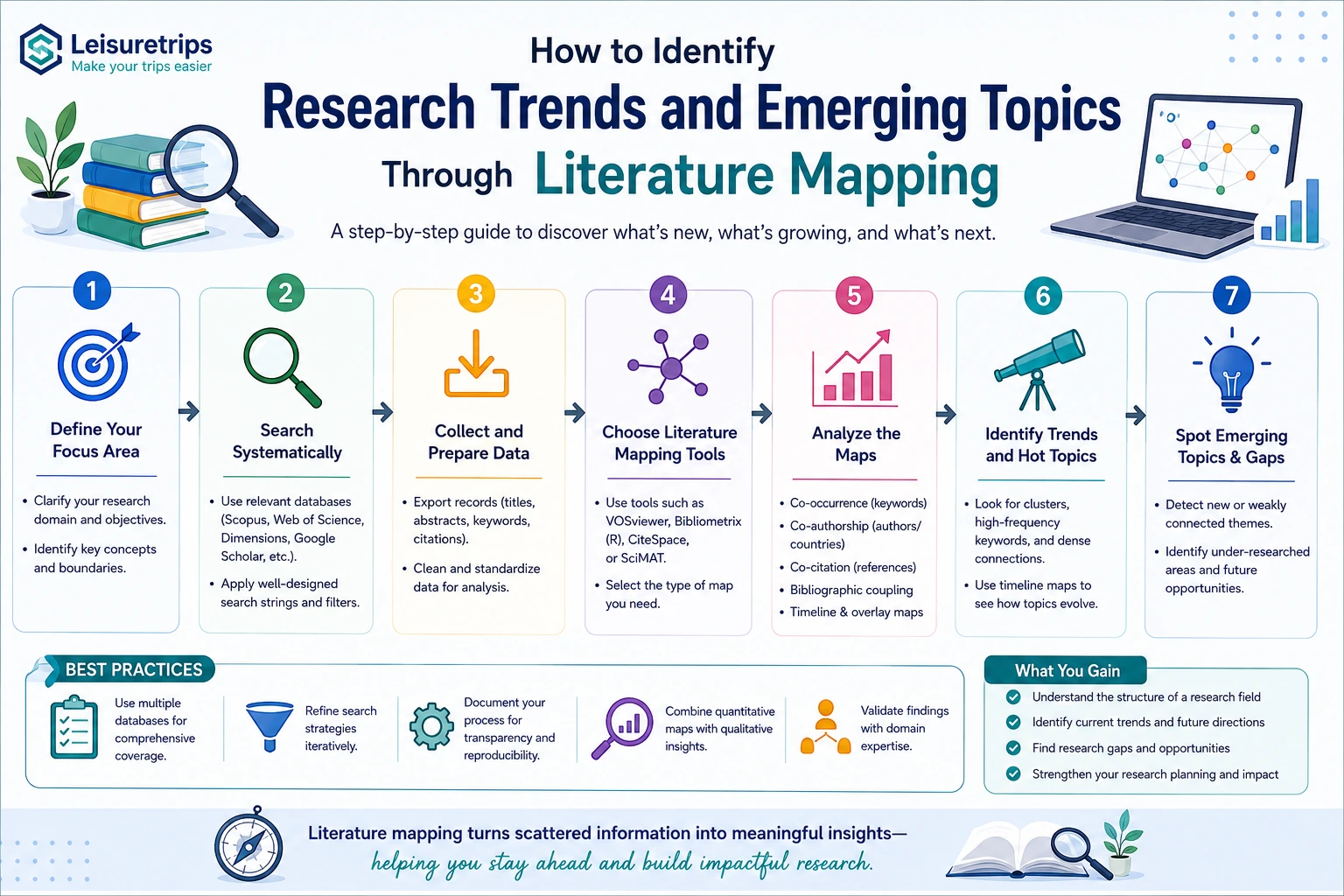
One of the biggest challenges faced by PhD scholars is selecting a research topic that is both original and relevant. Many researchers spend months reading journal articles but still struggle to identify genuine research gaps or emerging trends in their field. As academic literature continues to grow rapidly across every discipline, manually reviewing hundreds of papers has become increasingly difficult.
This is where literature mapping becomes an invaluable research strategy. Instead of reading articles one by one without a clear direction, literature mapping enables researchers to visualize relationships between studies, identify influential authors, discover frequently researched themes, and detect emerging topics that have the potential to shape future research.
Universities across India and worldwide increasingly encourage PhD scholars to incorporate literature mapping and bibliometric analysis into their research because these techniques provide a systematic and evidence-based understanding of existing knowledge. Whether you are pursuing a PhD in Management, Engineering, Healthcare, Education, Social Sciences, Commerce, or Computer Science, literature mapping can help you build a stronger literature review and identify meaningful research opportunities.
This comprehensive guide explains what literature mapping is, why it matters, the different techniques involved, the best software tools available, and a step-by-step process to identify research trends and emerging topics efficiently.
What Is Literature Mapping?
Literature mapping is a systematic process of organizing, analyzing, and visually representing academic literature to understand the structure of a research field.
Rather than reviewing studies individually, literature mapping helps researchers identify:
- Major research themes
- Frequently studied topics
- Relationships between concepts
- Influential authors
- Leading institutions
- Collaboration networks
- Keyword clusters
- Emerging research areas
- Knowledge gaps
It transforms a large collection of research articles into a visual roadmap that is easier to understand and interpret.
Why Is Literature Mapping Important?
A literature review should do more than summarize previous studies—it should explain how research in the field has evolved.
Literature mapping helps you:
- Identify current research trends.
- Discover underexplored topics.
- Avoid selecting over-researched problems.
- Understand the evolution of theories.
- Recognize influential journals and authors.
- Improve the quality of your literature review.
- Justify your research gap.
- Increase the originality of your thesis.
Instead of relying on intuition, literature mapping provides evidence-based insights into your research domain.
What Are Research Trends?
Research trends are topics, theories, methods, or technologies that receive increasing attention from researchers over time.
Examples include:
- Artificial Intelligence in Healthcare
- Sustainable Supply Chain Management
- FinTech and Digital Banking
- Climate Change Adaptation
- Machine Learning Applications
- Circular Economy
- Green Marketing
- Blockchain Technology
- Industry 5.0
- Generative AI in Education
Identifying these trends helps researchers choose timely and impactful topics.
What Are Emerging Research Topics?
Emerging topics are new areas of research that have recently gained academic attention but remain relatively underexplored.
Characteristics include:
- Growing publication numbers.
- Limited existing literature.
- High future research potential.
- Increasing citation rates.
- New theoretical developments.
- Rapid technological advancements.
Studying emerging topics increases the originality and relevance of your research.
What Is Bibliometric Analysis?
Bibliometric analysis is a quantitative method used to analyze academic publications using publication and citation data.
It examines:
- Publication trends.
- Citation counts.
- Author productivity.
- Journal performance.
- Institutional contributions.
- Country collaborations.
- Keyword frequency.
- Co-authorship networks.
- Co-citation relationships.
Bibliometric analysis provides objective evidence about how a research field is developing.
Types of Literature Mapping
Different techniques answer different research questions.
1. Citation Mapping
Shows how studies cite one another.
Useful for identifying:
- Landmark papers.
- Influential researchers.
- Highly cited publications.
2. Co-Citation Analysis
Two papers are linked if they are cited together by later studies.
This reveals:
- Research schools.
- Foundational theories.
- Knowledge structures.
3. Bibliographic Coupling
Connects studies that share similar references.
Useful for identifying current research communities.
4. Keyword Co-Occurrence Analysis
Analyzes keywords appearing together in research articles.
Helps identify:
- Major themes.
- Emerging topics.
- Relationships between concepts.
5. Co-Authorship Analysis
Examines collaboration between researchers.
Useful for finding:
- Research networks.
- Leading experts.
- Collaborative institutions.
6. Country Collaboration Mapping
Shows international research partnerships.
Useful for understanding global research activity.
Step-by-Step Guide to Literature Mapping
Step 1: Define Your Research Topic
Start with a clear research question.
Example:
"Artificial Intelligence Adoption in Indian Manufacturing SMEs."
Identify related keywords such as:
- Artificial Intelligence
- Machine Learning
- SMEs
- Industry 4.0
- Digital Transformation
- Manufacturing
A focused topic improves search accuracy.
Step 2: Collect Research Articles
Search multiple academic databases, including:
- Google Scholar
- Scopus
- Web of Science
- ScienceDirect
- SpringerLink
- IEEE Xplore
- PubMed (for medical sciences)
- Shodhganga (for Indian doctoral theses)
Export citation data in formats such as RIS, BibTeX, or CSV for use in literature mapping software.
Step 3: Clean Your Data
Before analysis:
- Remove duplicate records.
- Standardize author names.
- Merge similar keywords (e.g., "AI" and "Artificial Intelligence").
- Exclude irrelevant articles.
- Check publication years and metadata.
Clean data produces more reliable visualizations.
Step 4: Analyze Publication Trends
Examine:
- Number of publications per year.
- Growth rate of the research area.
- Most active journals.
- Leading institutions.
- Top contributing countries.
A steady increase in publications often indicates a growing research field.
Step 5: Analyze Keywords
Keywords reveal the dominant themes in a research area.
For example, a study on digital banking may show frequent keywords such as:
- Financial Inclusion
- Mobile Banking
- Trust
- Security
- FinTech
- Customer Satisfaction
Keywords that begin appearing more frequently in recent years often indicate emerging research topics.
Step 6: Identify Influential Authors
Look for:
- Highly cited researchers.
- Frequently published authors.
- Collaboration networks.
- Foundational studies.
Reading influential papers helps you understand the development of the field.
Step 7: Create Visualization Maps
Visualization simplifies complex research landscapes.
Common maps include:
- Network maps
- Cluster maps
- Overlay maps
- Density maps
- Timeline maps
These diagrams highlight relationships that are difficult to identify through manual reading alone.
Step 8: Interpret the Results
Ask questions such as:
- Which topics dominate the field?
- Which areas are growing rapidly?
- Which themes have received limited attention?
- What methodologies are commonly used?
- Where do research gaps exist?
Interpretation is the most important stage because visualizations alone do not explain the significance of the findings.
Best Software for Literature Mapping
Several tools make literature mapping easier.
VOSviewer
One of the most widely used tools for bibliometric analysis.
Features:
- Keyword mapping
- Citation analysis
- Co-authorship networks
- Cluster visualization
- Easy-to-use interface
Ideal for beginners.
CiteSpace
Designed for identifying emerging trends and research frontiers.
Useful for:
- Citation bursts.
- Timeline analysis.
- Research evolution.
- Knowledge domain visualization.
Bibliometrix (R Package)
A powerful open-source tool for advanced bibliometric analysis.
Suitable for researchers familiar with R programming.
Biblioshiny
A web interface built on Bibliometrix.
Provides advanced analysis without requiring coding skills.
Gephi
Useful for complex network visualization and large collaboration datasets.
Connected Papers
Generates visual graphs showing how academic papers are related through shared references and citations.
Helpful for discovering relevant literature around a key paper.
ResearchRabbit
An AI-powered literature discovery tool that helps researchers explore citation networks, monitor new publications, and identify related authors and papers through interactive visualizations.
How Literature Mapping Helps Identify Research Gaps
Literature mapping reveals research gaps by highlighting:
- Topics with limited publications.
- Weak collaboration between disciplines.
- Geographic regions with little research.
- Understudied populations.
- Contradictory findings.
- Emerging technologies with limited evidence.
For example, if most studies on digital banking focus on urban consumers, a literature map may reveal a lack of research on rural communities or older adults.
Integrating Literature Mapping into Your Literature Review
A literature map should support—not replace—your written review.
A practical structure is:
- Introduce the research field.
- Present major themes identified through mapping.
- Discuss influential theories and authors.
- Compare findings across clusters.
- Explain emerging topics.
- Highlight research gaps.
- Justify your own study.
This approach combines quantitative evidence with qualitative analysis.
Common Mistakes to Avoid
Many researchers reduce the value of literature mapping by making avoidable mistakes.
Avoid:
- Using only one database for data collection.
- Ignoring duplicate records.
- Failing to standardize keywords.
- Interpreting visualizations without reading the underlying studies.
- Assuming highly cited papers are always the most relevant.
- Choosing software without understanding the purpose of the analysis.
- Treating literature mapping as a substitute for critical reading.
Remember that visual maps guide your exploration—they do not replace scholarly judgment.
Practical Tips for Indian PhD Scholars
If you are pursuing doctoral research in India, consider these recommendations:
- Combine international literature with Indian research to provide a balanced perspective.
- Explore Shodhganga to understand existing doctoral work and avoid duplication.
- Use literature mapping early in your research to refine your topic before finalizing your proposal.
- Consult your supervisor when interpreting bibliometric findings.
- Update your literature map periodically as new studies are published.
- Include both seminal works and recent publications to capture the evolution of your field.
Example Workflow for Literature Mapping
A systematic workflow can make the process more manageable.
Step 1: Define your research topic and keywords.
Step 2: Search Google Scholar and academic databases.
Step 3: Export citation data.
Step 4: Clean and organize the dataset.
Step 5: Import the data into literature mapping software.
Step 6: Generate keyword, citation, and collaboration maps.
Step 7: Analyze trends, clusters, and emerging themes.
Step 8: Integrate the findings into your literature review and research gap discussion.
Following this structured process saves time and improves the quality of your review.
Frequently Asked Questions (FAQs)
What is literature mapping?
Literature mapping is a systematic technique for organizing and visualizing academic research to identify themes, relationships, influential studies, and emerging research trends.
Is literature mapping mandatory for a PhD thesis?
It is not mandatory in every discipline, but it is increasingly used in doctoral research because it strengthens literature reviews, supports research gap identification, and provides a more systematic overview of the field.
What is the difference between bibliometric analysis and literature mapping?
Bibliometric analysis uses publication and citation data to measure research performance and relationships. Literature mapping often uses bibliometric results to create visual representations of themes, authors, citations, and research networks.
Which software is best for beginners?
VOSviewer is generally considered one of the easiest tools for beginners due to its intuitive interface and strong visualization capabilities. Biblioshiny is another good option for users who prefer a graphical interface.
Can literature mapping replace a traditional literature review?
No. Literature mapping complements a traditional literature review by providing visual and quantitative insights. Critical reading, synthesis, and interpretation of individual studies are still essential.
Conclusion
Literature mapping has become an essential skill for modern researchers seeking to navigate the rapidly expanding world of academic publications. By combining systematic literature searches with bibliometric analysis and visualization techniques, researchers can identify influential authors, major research themes, collaboration networks, and emerging topics more efficiently than through manual reading alone.
For Indian PhD scholars, literature mapping offers a powerful way to strengthen literature reviews, justify research gaps, and select topics with greater originality and academic relevance. Tools such as VOSviewer, CiteSpace, Bibliometrix, ResearchRabbit, and Connected Papers make it possible to transform large collections of research articles into meaningful visual insights that support better research decisions.
However, literature mapping should always be paired with critical evaluation and thoughtful interpretation. Visualizations can reveal patterns, but only careful reading and scholarly analysis can explain why those patterns matter. By integrating literature mapping into your research workflow, you can build a more comprehensive literature review, identify future research opportunities with confidence, and develop a thesis that contributes meaningful new knowledge to your field.
Call / WhatsApp: +91 96438 02216
Website:www.ThesisLikho.com