
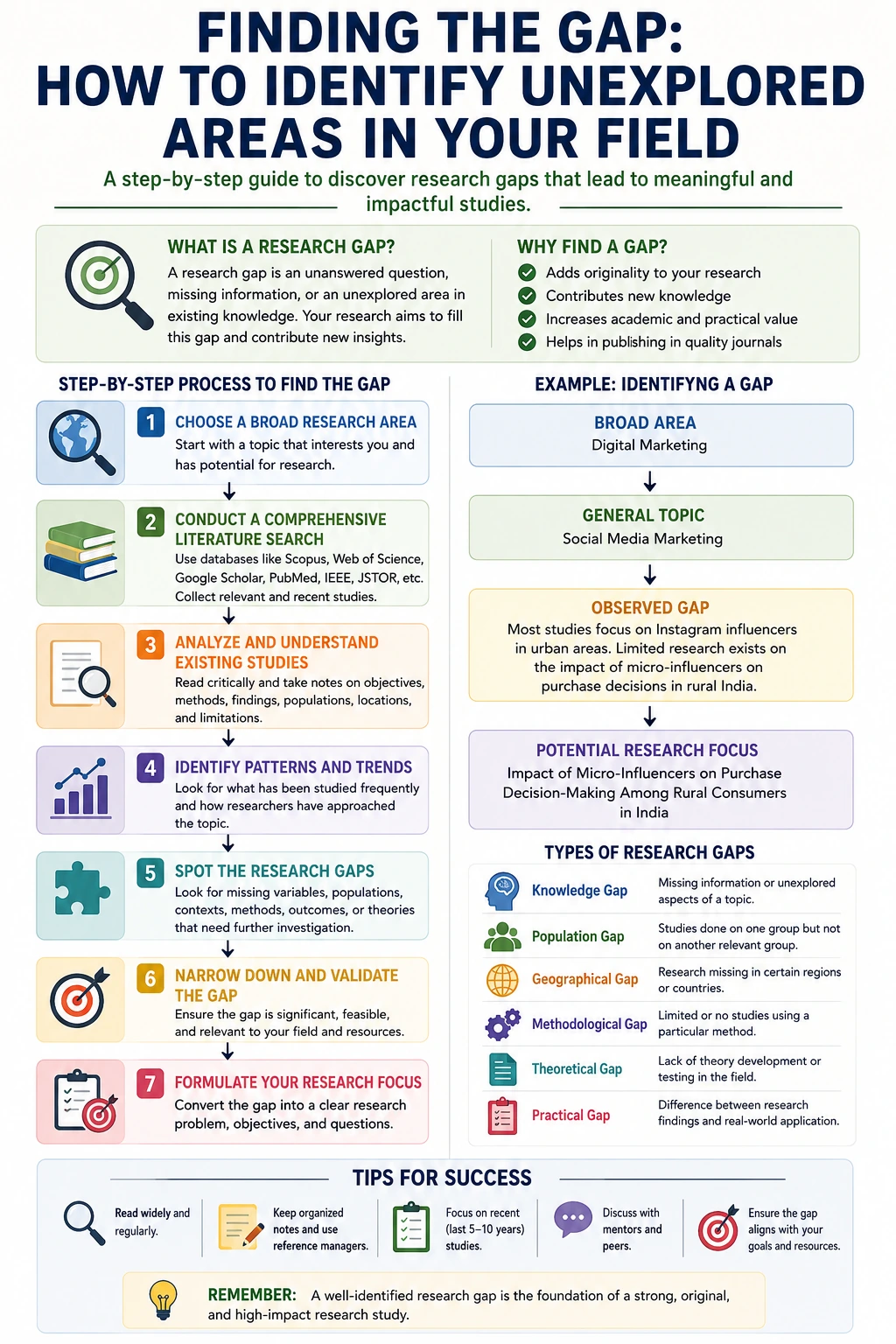
One of the biggest challenges faced by PhD scholars, Master's students, and academic researchers is finding a research topic that is both original and meaningful. Many students spend weeks—or even months—reading journal articles without knowing exactly what they are looking for. They often ask the same questions: Has this topic already been studied? Is my idea unique enough? How do I identify a genuine research gap?
The answer lies in understanding the concept of a research gap. A research gap is an unanswered question, an underexplored issue, or a limitation in existing studies that presents an opportunity for further investigation. Identifying a research gap is one of the most important steps in academic research because it ensures your work contributes new knowledge rather than repeating what is already known.
Universities, research supervisors, journal editors, and funding agencies all expect research to address a gap in existing literature. Without a clearly defined gap, your thesis or dissertation may lack originality and struggle to demonstrate its academic value.
In this comprehensive guide, you'll learn what a research gap is, why it matters, proven strategies for identifying unexplored areas in your field, practical examples, common mistakes to avoid, and the best tools to help you discover meaningful research opportunities.
What Is a Research Gap?
A research gap is an area where existing knowledge is incomplete, inconsistent, outdated, or entirely absent. It represents an opportunity to investigate a question that previous researchers have not adequately answered.
A research gap does not necessarily mean that no one has studied the topic before. Instead, it often means that:
- Certain populations have been overlooked.
- Existing findings are contradictory.
- New technologies have changed the research context.
- Previous studies have methodological limitations.
- Emerging trends have created new questions.
- Geographic regions remain underrepresented.
In simple terms, a research gap is the space between what is currently known and what still needs to be discovered.
Why Is Identifying a Research Gap Important?
Every successful thesis begins with a meaningful research problem. That problem should address a genuine gap in existing knowledge.
Identifying a research gap helps you:
- Demonstrate originality.
- Justify the importance of your study.
- Develop focused research questions.
- Gain supervisor approval more easily.
- Increase publication potential.
- Contribute to academic and practical knowledge.
- Avoid duplicating previous studies.
A well-defined research gap strengthens every section of your thesis, from the literature review to the conclusion.
Types of Research Gaps
Understanding the different types of research gaps makes it easier to recognise opportunities within the literature.
1. Knowledge Gap
A knowledge gap exists when little or no research has been conducted on a particular topic.
Example
The impact of generative AI tools on thesis-writing practices among postgraduate students in rural Indian universities.
Since generative AI is relatively new, many related questions remain unexplored.
2. Methodological Gap
Sometimes researchers have studied a problem using similar methods but have ignored alternative approaches.
Example
Most studies on employee engagement use surveys, while very few employ qualitative interviews to understand employees' lived experiences.
Using a different methodology can reveal new insights.
3. Population Gap
Many studies focus on one group while neglecting others.
Example
Research on digital banking often examines urban consumers but rarely investigates adoption among senior citizens in rural areas.
Studying a different population creates valuable contributions.
4. Geographical Gap
Research findings from one region may not apply elsewhere.
Example
Most sustainability research has been conducted in Europe, while small manufacturing firms in India remain underexplored.
Location-specific studies can address this gap.
5. Theoretical Gap
Researchers may rely heavily on one theoretical framework while overlooking others.
Applying a different theory can generate fresh perspectives and contribute to theory development.
6. Practical Gap
Sometimes existing research offers limited guidance for practitioners or policymakers.
Research that develops practical recommendations can bridge this gap.
7. Contradictory Evidence Gap
Previous studies may produce conflicting findings.
For example, some researchers conclude that remote work increases productivity, while others report the opposite.
Investigating the reasons behind these inconsistencies creates meaningful research opportunities.
Where Can You Find Research Gaps?
Research gaps are hidden throughout academic literature. The key is knowing where to look.
Some of the best places include:
- Peer-reviewed journal articles.
- Systematic literature reviews.
- Meta-analyses.
- Doctoral dissertations.
- Conference proceedings.
- Government reports.
- Industry publications.
- Research project reports.
Review articles are especially valuable because they summarise existing evidence and often identify future research needs.
Step-by-Step Process to Identify a Research Gap
Step 1: Choose a Broad Research Area
Begin with a subject that genuinely interests you.
Examples include:
- Artificial Intelligence
- Healthcare Management
- Digital Marketing
- Climate Change
- Educational Technology
- Consumer Behaviour
- Human Resource Management
- Supply Chain Management
- Finance
- Entrepreneurship
Avoid worrying about originality at this stage. Focus on an area you are motivated to explore.
Step 2: Conduct a Comprehensive Literature Search
Search high-quality academic databases such as:
- Google Scholar
- Scopus
- Web of Science
- PubMed
- JSTOR
- ScienceDirect
- IEEE Xplore
- ERIC (for education research)
Use combinations of keywords and Boolean operators (AND, OR, NOT) to refine your searches.
Aim to review recent studies, particularly those published within the last five to ten years.
Step 3: Read Review Articles First
Instead of reading hundreds of individual studies immediately, begin with systematic literature reviews or review papers.
These articles:
- Summarise previous findings.
- Identify major research themes.
- Highlight unresolved issues.
- Suggest future research directions.
This saves considerable time and provides a clear overview of the field.
Step 4: Analyse the "Limitations" Section
One of the easiest ways to identify research gaps is by reading the limitations section of published articles.
Researchers commonly mention:
- Small sample sizes.
- Limited geographic coverage.
- Single-industry focus.
- Cross-sectional designs.
- Lack of longitudinal evidence.
- Restricted variables.
Each limitation presents an opportunity for future research.
For example:
"Future studies should investigate consumer behaviour in emerging markets."
This statement immediately suggests a potential research gap.
Step 5: Review the "Future Research" Section
Most journal articles conclude with recommendations for future studies.
These recommendations often highlight:
- Unanswered questions.
- New variables.
- Different populations.
- Alternative methods.
- Emerging technologies.
Compile these recommendations in a spreadsheet to identify recurring themes.
Step 6: Compare Multiple Studies
Never rely on a single article.
Compare several studies by asking:
- Do researchers agree?
- Are findings consistent?
- Were similar methods used?
- Did they study different populations?
- Are there contradictory conclusions?
Patterns often reveal areas that require further investigation.
Step 7: Look for Emerging Trends
Rapid technological and societal changes continuously create new research opportunities.
Examples include:
- Artificial Intelligence
- ChatGPT in education
- Remote work
- ESG reporting
- Sustainable business practices
- Blockchain
- Digital healthcare
- Cybersecurity
- Climate adaptation
- Social commerce
New developments often outpace existing research, creating valuable gaps.
Step 8: Consult Your Supervisor
Experienced supervisors can quickly identify whether a topic is over-researched or genuinely original.
Discuss:
- Possible research questions.
- Relevant literature.
- Feasibility.
- Available datasets.
- Suitable methodologies.
Early feedback can save months of unnecessary work.
Practical Example of Identifying a Research Gap
Let's consider a broad topic.
Broad Area
Artificial Intelligence in Education
After reviewing the literature, you discover:
- Many studies focus on AI in universities.
- Most research comes from developed countries.
- Very few studies examine AI adoption in rural colleges.
- Limited research investigates teachers' perceptions.
- Existing studies mainly use quantitative surveys.
Possible research gaps include:
- Teachers' perceptions of AI-assisted learning in rural Indian colleges.
- Longitudinal effects of AI adoption in higher education.
- Qualitative exploration of AI challenges among university faculty.
- Impact of AI writing tools on postgraduate thesis quality.
Notice how a broad topic evolves into several focused research opportunities.
Questions to Ask While Reading Research Papers
Develop the habit of asking critical questions.
For every article, ask:
- What problem is being addressed?
- Why was this study conducted?
- Who participated?
- What variables were measured?
- Which methods were used?
- What limitations exist?
- What recommendations were made?
- What questions remain unanswered?
Document your observations as you read.
Best Tools for Identifying Research Gaps
Several digital tools can accelerate your search.
Google Scholar
Useful for discovering highly cited research and recent publications.
Scopus
Provides extensive citation tracking and advanced filtering.
Web of Science
Excellent for identifying influential studies and citation networks.
ResearchRabbit
Visualises relationships between authors, papers, and research themes.
Connected Papers
Creates interactive maps showing how studies connect.
Litmaps
Tracks research evolution over time and identifies related publications.
Zotero and Mendeley
Help organise references, annotate papers, and manage citations efficiently.
Using these tools together makes literature exploration faster and more systematic.
Common Mistakes When Searching for Research Gaps
Many students unintentionally make the process more difficult.
Avoid these mistakes:
Reading Without a Strategy
Randomly downloading articles rarely leads to meaningful insights. Begin with clear keywords and organised note-taking.
Focusing Only on Old Studies
Academic fields evolve quickly. Prioritise recent research while using foundational studies for theoretical background.
Ignoring Contradictory Findings
Conflicting evidence often highlights opportunities for further investigation.
Choosing an Overly Broad Topic
Broad topics make it difficult to identify a specific gap. Narrow your focus by population, geography, industry, or variables.
Assuming "No Research Exists"
Before claiming originality, conduct a thorough literature review across multiple databases.
How to Validate Your Research Gap
Before finalising your research problem, ensure that your proposed gap is genuine.
Ask yourself:
- Have I reviewed enough recent literature?
- Does my topic address an unanswered question?
- Can I explain the gap clearly?
- Is the gap academically significant?
- Can I realistically collect the required data?
- Does my supervisor agree with my interpretation?
- Will my study contribute something new?
If the answer to these questions is yes, your research gap is likely well-founded.
Tips for Indian PhD and Master's Students
For scholars studying at Indian universities, identifying a research gap requires balancing originality with practical feasibility.
Keep these recommendations in mind:
- Align your topic with your university's research priorities.
- Explore issues relevant to Indian industries, education, healthcare, or public policy.
- Consider underserved populations such as Tier-2 and Tier-3 cities or rural communities.
- Use recent UGC CARE, Scopus, or Web of Science indexed journals as primary sources.
- Ensure your research addresses a real-world problem while contributing to academic knowledge.
Choosing a contextually relevant gap can also improve opportunities for publication and industry collaboration.
Frequently Asked Questions (FAQs)
What is the easiest way to identify a research gap?
The most effective approach is to conduct a comprehensive literature review, focusing on the limitations and future research sections of recent journal articles.
Can a research gap be based on a different population?
Yes. Studying a population that has been underrepresented in previous research is one of the most common and valuable types of research gaps.
How many articles should I review before identifying a gap?
There is no fixed number, but reviewing at least 30–50 high-quality, relevant articles usually provides a strong understanding of the field and recurring gaps.
Is every limitation a research gap?
Not necessarily. A limitation becomes a research gap only if addressing it has the potential to generate meaningful new knowledge.
Why is a research gap important in a thesis?
A clearly defined research gap demonstrates the originality and significance of your study, helping justify why your research deserves to be conducted.
Conclusion
Finding a research gap is one of the most important—and rewarding—steps in the research process. Rather than searching for a completely untouched topic, successful researchers identify meaningful questions that remain unanswered, populations that have been overlooked, methods that can be improved, or emerging issues that existing studies have not yet addressed.
The process requires patience, critical thinking, and systematic reading. By conducting a comprehensive literature review, analysing limitations and future research recommendations, comparing multiple studies, and using modern research discovery tools, you can uncover valuable opportunities to make an original contribution to your field.
Remember that a strong research gap is not simply about being different—it is about being relevant, feasible, and impactful. When your research addresses a genuine gap in knowledge, it strengthens your proposal, improves your thesis, increases publication potential, and contributes to solving real-world problems.
Whether you are beginning a PhD, preparing a Master's dissertation, or planning your next academic project, mastering the skill of identifying unexplored research areas will lay the foundation for meaningful, high-quality, and publishable research.
Contact ThesisLikho
Call / WhatsApp: +91 96438 02216
Website:www.ThesisLikho.com