
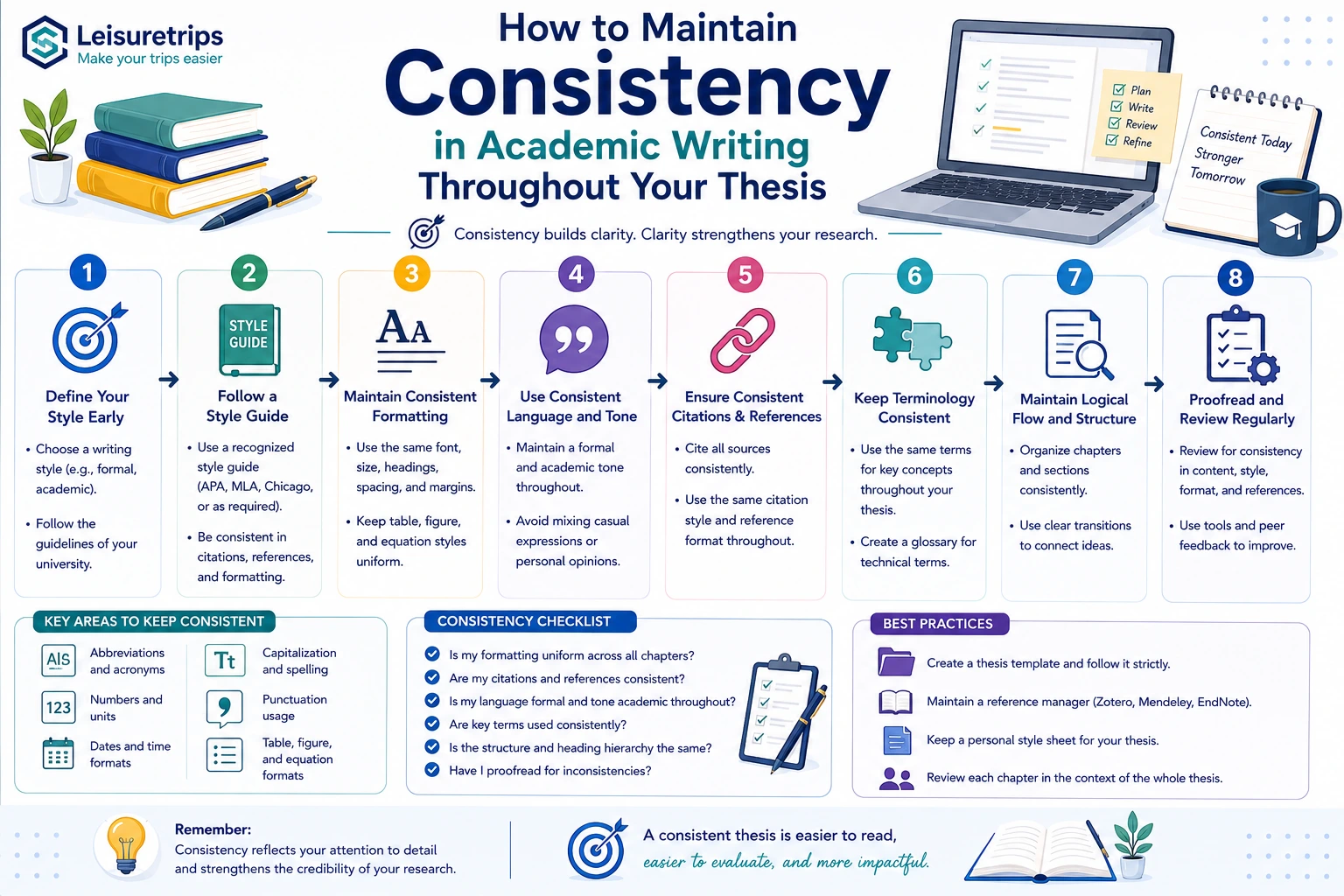
Writing a PhD thesis is one of the most demanding academic tasks a research scholar will undertake. It requires months—or even years—of reading, analyzing, writing, revising, and refining ideas into a coherent document. While many scholars focus on conducting quality research and collecting reliable data, they often overlook one essential aspect that significantly impacts the quality of their thesis: consistency in academic writing.
A thesis that lacks consistency can confuse readers, weaken arguments, and create an impression of poor organization, even when the research itself is strong. In contrast, a well-written thesis with consistent language, formatting, terminology, tone, and structure reflects professionalism and academic maturity.
Whether you are pursuing a PhD in Management, Engineering, Education, Commerce, Social Sciences, Law, Healthcare, or any other discipline in India, maintaining consistency throughout your thesis is essential for producing a high-quality dissertation that meets university standards.
This comprehensive guide explains why consistency matters, the different areas where it should be maintained, and practical strategies to help you write a clear, professional, and cohesive thesis.
What Does Consistency in Academic Writing Mean?
Consistency in academic writing means maintaining uniformity throughout your thesis in terms of:
- Writing style
- Academic tone
- Terminology
- Formatting
- Citation style
- Grammar
- Tense
- Structure
- Argument development
- Visual presentation
Every chapter should feel like part of the same research document rather than separate essays written at different times.
For example, if you refer to "Small and Medium Enterprises (SMEs)" in Chapter 1, avoid switching to "small businesses" or "small firms" interchangeably unless the terms are clearly defined.
Why Is Consistency Important in a Thesis?
Consistency improves both the readability and credibility of your research.
1. Enhances Professionalism
A consistent thesis appears polished and well-organized, leaving a positive impression on supervisors and examiners.
2. Improves Readability
Readers can follow your arguments more easily when terminology, structure, and writing style remain consistent.
3. Strengthens Logical Flow
Consistency ensures that every chapter builds upon the previous one, creating a coherent narrative.
4. Reduces Confusion
Using the same terms, definitions, and abbreviations prevents misunderstandings.
5. Supports Academic Integrity
Consistent citation and referencing reduce the risk of plagiarism and improve the reliability of your work.
Areas Where Consistency Is Essential
Maintaining consistency goes beyond grammar. It applies to every aspect of your thesis.
1. Research Terminology
Choose standard terms for your key concepts and use them consistently.
For example:
Correct:
- Employee Engagement
- Organizational Commitment
- Job Satisfaction
Avoid switching between:
- Employee involvement
- Staff engagement
- Workforce participation
unless they have different meanings in your study.
2. Research Objectives and Questions
The research objectives introduced in Chapter 1 should align with:
- Literature Review
- Methodology
- Data Analysis
- Discussion
- Conclusion
Do not introduce new objectives midway through your thesis.
3. Academic Tone
Academic writing should remain formal throughout.
Instead of writing:
"I think social media has changed marketing."
Write:
"The findings suggest that social media has significantly influenced marketing practices."
Avoid:
- Slang
- Informal expressions
- Emotional language
- Personal opinions without evidence
4. Writing Style
Maintain similar sentence structure throughout.
Example:
Good:
- The study investigates...
- The research examines...
- The analysis indicates...
Avoid mixing highly technical writing with overly conversational language.
5. Verb Tense
Different sections typically require different tenses.
Present Tense
Use for:
- Established theories
- General facts
- Definitions
Example:
"The Technology Acceptance Model explains user adoption behavior."
Past Tense
Use for:
- Methodology
- Data collection
- Completed research activities
Example:
"Data were collected using structured questionnaires."
Present Perfect
Use when discussing previous research.
Example:
"Several studies have examined consumer behavior in digital markets."
Switching tenses unnecessarily can confuse readers.
Maintain Consistent Chapter Structure
Each chapter should follow a logical format.
Example:
Introduction
↓
Purpose
↓
Discussion
↓
Summary
This pattern helps readers understand your organization.
Keep Formatting Uniform
Formatting inconsistencies are among the most common reasons for thesis revisions.
Ensure consistency in:
- Font style
- Font size
- Heading levels
- Margins
- Line spacing
- Paragraph spacing
- Bullet styles
- Page numbering
Example:
Heading 1
16 pt Bold
Heading 2
14 pt Bold
Heading 3
12 pt Italic
Follow your university's formatting guidelines consistently.
Use One Citation Style
Never mix citation styles.
Examples include:
- APA
- MLA
- Chicago
- Harvard
- IEEE
- Vancouver
If your university requires APA 7th edition, every in-text citation and reference entry should follow APA guidelines.
Keep Tables and Figures Consistent
Maintain uniformity in:
- Table numbering
- Figure numbering
- Captions
- Fonts
- Alignment
- Colors (if allowed)
Example:
Table 3.1
Table 3.2
Table 3.3
Avoid inconsistent labels such as:
Table 1
Chart 2
Figure 3
unless required by your formatting style.
Maintain Consistency in Data Presentation
When presenting statistical findings:
Choose one format.
Example:
Mean = 4.25
SD = 0.82
Do not alternate between:
Mean
Average
Arithmetic Mean
unless distinctions are necessary.
Keep Definitions Consistent
Define technical terms once.
Example:
Artificial Intelligence (AI)
After defining it, consistently use:
AI
Avoid alternating between:
Artificial Intelligence
AI Technology
Machine Intelligence
unless specifically discussing different concepts.
Develop a Personal Style Guide
Many experienced researchers create a writing guide before drafting their thesis.
Include:
- Preferred terminology
- Capitalization rules
- Abbreviations
- Citation format
- Heading hierarchy
- Spelling preferences (British or American English)
This document helps maintain consistency across all chapters.
Choose One English Variant
Indian universities generally accept both British and American English.
Examples:
British English
- Organisation
- Analyse
- Behaviour
- Centre
American English
- Organization
- Analyze
- Behavior
- Center
Do not mix both styles in one thesis.
Use Transition Words Consistently
Transitions improve logical flow.
Useful examples:
Addition
- Furthermore
- Moreover
- In addition
Contrast
- However
- Nevertheless
- Conversely
Cause and Effect
- Therefore
- Consequently
- As a result
Comparison
- Similarly
- Likewise
Conclusion
- Overall
- In summary
- Finally
These words help connect ideas smoothly.
Maintain Consistency Across Chapters
Every chapter should support your central research problem.
For example:
Introduction
Research Problem
↓
Literature Review
Supports the problem
↓
Methodology
Investigates the problem
↓
Analysis
Answers research questions
↓
Discussion
Explains findings
↓
Conclusion
Addresses objectives
Avoid introducing unrelated discussions that do not contribute to your research aims.
Create a Thesis Writing Checklist
A checklist helps identify inconsistencies before submission.
Review:
- Terminology
- Headings
- Numbering
- Citations
- References
- Tables
- Figures
- Grammar
- Tense
- Formatting
Using the same checklist for every chapter improves quality.
Edit in Multiple Rounds
Professional researchers rarely finish editing in one attempt.
First Review
Focus on content.
Second Review
Improve clarity and organization.
Third Review
Check consistency.
Fourth Review
Correct grammar and punctuation.
Final Review
Verify formatting and references.
Editing in stages is more effective than trying to fix everything at once.
Use Technology to Improve Consistency
Several tools can help maintain consistency in academic writing.
Microsoft Word Styles
Apply built-in heading styles for consistent formatting.
Grammarly
Identifies grammar, punctuation, and style issues.
LanguageTool
Checks grammar and writing consistency.
Zotero
Maintains consistent citations and references.
Mendeley
Automatically formats references according to the selected citation style.
EndNote
Useful for managing large reference libraries.
Common Mistakes That Reduce Consistency
Many PhD scholars unintentionally make these errors.
Using Different Terms for the Same Concept
Example:
Employee Motivation
Worker Motivation
Staff Motivation
Personnel Motivation
Unless intentionally distinguished, this creates confusion.
Changing Citation Styles
APA in Chapter 2
Harvard in Chapter 5
This is unacceptable.
Mixing British and American English
Example:
Behaviour
Behavior
Analyse
Analyze
Choose one style and use it consistently.
Inconsistent Heading Formats
Chapter headings should follow one hierarchy throughout the thesis.
Different Writing Styles
Some chapters may sound highly formal, while others become conversational.
Maintain the same academic tone throughout.
Practical Tips for Indian PhD Scholars
If you are writing a thesis in an Indian university, these recommendations can help:
- Download your university's thesis formatting guidelines before you begin writing.
- Use a thesis template approved by your institution.
- Maintain a document listing approved terminology and abbreviations.
- Schedule weekly reviews to check for consistency rather than waiting until the end.
- Use citation management software from the beginning of your research.
- Share chapters with your supervisor for periodic feedback instead of submitting the complete thesis at once.
Frequently Asked Questions (FAQs)
Why is consistency important in academic writing?
Consistency improves readability, strengthens the logical flow of your research, enhances professionalism, and ensures your thesis meets academic standards.
Can I use both British and American English in my thesis?
No. Choose one variety of English and use it consistently throughout the entire document.
How can I maintain consistency in citations?
Use a reference management tool such as Zotero, Mendeley, or EndNote and follow your university's required citation style consistently.
What is the best way to keep formatting consistent?
Use built-in heading styles in your word processor, apply a standard thesis template, and follow your university's formatting guidelines for fonts, spacing, headings, and page layout.
Should I edit my thesis only after completing it?
No. Review each chapter after drafting it and perform multiple rounds of editing. Regular reviews make it easier to identify and correct inconsistencies before they accumulate.
Conclusion
Consistency is one of the defining characteristics of a well-written PhD thesis. While original research, sound methodology, and meaningful findings are essential, the way your ideas are presented can significantly influence how your work is evaluated. A thesis with consistent terminology, structure, formatting, citation style, and academic tone is easier to read, more persuasive, and reflects a high level of scholarly discipline.
Developing consistency requires planning, attention to detail, and regular revision. Create a personal style guide, follow your university's formatting requirements, use reference management software, and edit your work in multiple stages. Most importantly, ensure that every chapter aligns with your research objectives and contributes to a unified narrative.
For Indian PhD scholars, maintaining consistency is not merely about avoiding errors—it is about demonstrating professionalism, clarity of thought, and academic excellence. By applying the strategies outlined in this guide, you can produce a thesis that is coherent, credible, and capable of making a lasting contribution to your field of research.
Call / WhatsApp: +91 96438 02216
Website:www.ThesisLikho.com