
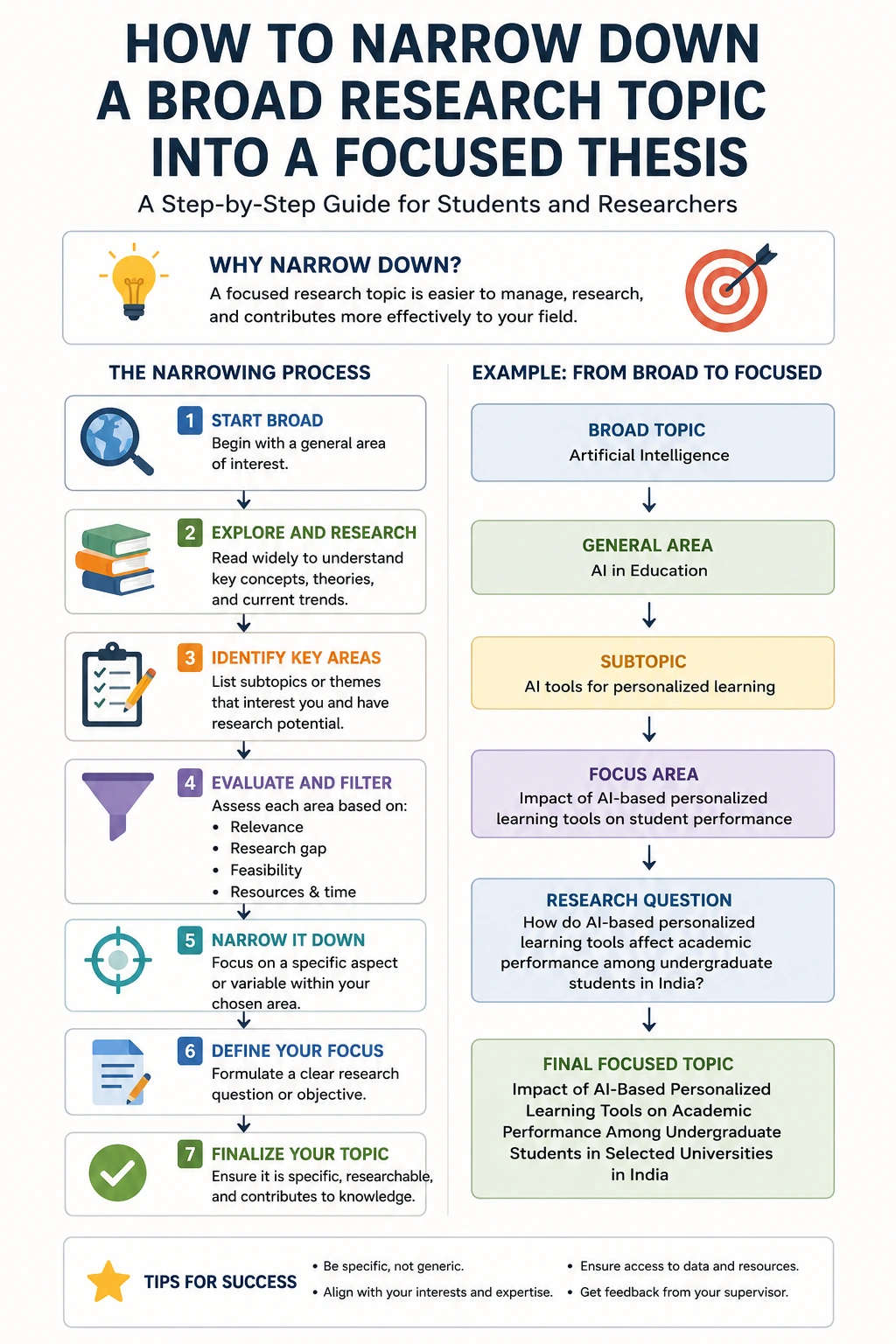
Choosing a research topic is one of the most important decisions in any academic journey. Whether you are pursuing a PhD, MPhil, Master's dissertation, or undergraduate thesis, your research topic forms the foundation of your entire study. However, many students begin with an idea that is simply too broad to investigate effectively.
Topics like Artificial Intelligence in Education, Climate Change, Digital Marketing, or Employee Satisfaction sound interesting, but they are far too extensive for a single thesis. Without narrowing your focus, your research may become confusing, difficult to manage, and lack meaningful conclusions.
The good news is that every broad research topic can be refined into a focused, researchable thesis. The process involves identifying a specific problem, defining clear boundaries, selecting a target population, and creating research questions that are realistic within your available time and resources.
In this comprehensive guide, you'll learn step-by-step methods to transform a broad idea into a focused thesis topic suitable for Indian universities and international academic standards.
Why a Focused Research Topic Matters
A focused research topic provides direction throughout your study. It helps you conduct a meaningful literature review, choose appropriate research methods, collect relevant data, and produce findings that contribute to existing knowledge.
A focused topic also offers several advantages:
- Easier literature review
- Clear research objectives
- Better data collection
- More manageable workload
- Higher quality analysis
- Stronger thesis structure
- Greater chances of publication
On the other hand, an overly broad topic often leads to information overload, unclear objectives, and difficulty completing the research within deadlines.
Signs Your Research Topic Is Too Broad
Many students don't realize their topic is too broad until they begin writing their literature review.
Here are common warning signs:
- Your topic includes multiple industries or disciplines.
- Thousands of research articles appear during your database search.
- Your objectives cover several unrelated issues.
- You cannot explain your study in one sentence.
- Your variables are difficult to define.
- Data collection seems impossible within your timeline.
For example:
Too Broad:
Impact of Technology on Education
This could include:
- Artificial Intelligence
- Online Learning
- Smart Classrooms
- Virtual Reality
- Mobile Learning
- Digital Assessment
- Educational Apps
- Higher Education
- School Education
Clearly, this is impossible for one thesis.
Step 1: Start with Your Area of Interest
Every thesis begins with a general area rather than a perfectly defined topic.
Examples include:
- Artificial Intelligence
- Healthcare Management
- Human Resource Management
- Finance
- Consumer Behaviour
- Supply Chain
- Environmental Sustainability
- Educational Technology
- Mental Health
- Entrepreneurship
At this stage, don't worry about making it specific.
Simply list topics that genuinely interest you.
Step 2: Conduct Preliminary Literature Review
Before selecting your topic, read existing research.
Search databases such as:
- Google Scholar
- Scopus
- Web of Science
- PubMed
- JSTOR
- ScienceDirect
- IEEE Xplore
Look for:
- Frequently studied topics
- Research gaps
- Emerging trends
- Recent publications
- Future recommendations
Most research papers include a section suggesting areas for future research. These recommendations often become excellent thesis topics.
Step 3: Identify a Research Gap
The best thesis topics solve unanswered questions.
Ask yourself:
- What hasn't been studied?
- Which population is underrepresented?
- Which variables have not been examined together?
- What conflicting findings exist?
- Has technology changed previous conclusions?
For example:
Broad Topic:
Digital Marketing
Research Gap:
Influence of Instagram Reels on purchase decisions among rural consumers in India.
Notice how much narrower the topic becomes.
Step 4: Narrow by Population
One of the easiest ways to focus a topic is by selecting a specific group of people.
Instead of studying everyone, focus on one population.
Examples:
Broad Topic:
Employee Satisfaction
Focused Population:
- Nurses
- Teachers
- Bank employees
- IT professionals
- Start-up employees
- Government officers
- Manufacturing workers
Instead of:
Employee Satisfaction in India
Choose:
Employee Satisfaction among IT Professionals in Bengaluru
Step 5: Narrow by Geographic Location
Location significantly reduces the scope.
Instead of studying an entire country, focus on:
- One state
- One district
- One city
- One university
- One organization
Example:
Broad Topic:
Women's Entrepreneurship
Focused Topic:
Challenges Faced by Women Entrepreneurs in Jaipur's Handicraft Industry
Geographical boundaries make research realistic.
Step 6: Narrow by Time Period
Research becomes more focused when studying a specific timeframe.
Examples:
Instead of:
Impact of COVID-19
Use:
Long-term Impact of COVID-19 on Online Learning Adoption Between 2021 and 2025
Time boundaries improve clarity and analysis.
Step 7: Narrow by Industry
Different industries have unique challenges.
Examples include:
- Banking
- Healthcare
- Hospitality
- Education
- Manufacturing
- Retail
- Information Technology
- E-commerce
Example:
Broad Topic:
Artificial Intelligence
Focused Topic:
Adoption of AI-Based Chatbots in Indian E-commerce Companies
Step 8: Narrow by Variables
Many topics become manageable by selecting only two or three variables.
Broad Topic:
Social Media
Possible Variables:
- Brand Trust
- Customer Loyalty
- Purchase Intention
- Customer Engagement
- Consumer Satisfaction
- Brand Awareness
Instead of studying every outcome, select one.
Example:
Effect of Instagram Influencer Marketing on Purchase Intention among Gen Z Consumers
Step 9: Develop Research Questions
Research questions naturally narrow your topic.
Example:
Topic:
Remote Work
Research Questions:
- Does remote work improve employee productivity?
- What factors influence remote work satisfaction?
- How does remote work affect work-life balance?
- What challenges do HR managers face?
Each question creates a more focused study.
Step 10: Check Research Feasibility
Ask yourself several practical questions before finalizing your topic.
Can you:
- Access participants?
- Collect data?
- Finish within your timeline?
- Afford the research costs?
- Obtain ethical approval?
- Access required software?
- Find enough literature?
If the answer is "No" to several questions, narrow your topic further.
SMART Framework for Choosing a Thesis Topic
A good thesis topic should be SMART.
Specific
Clearly defines the problem.
Measurable
Variables can be measured.
Achievable
Research can be completed.
Relevant
Contributes to the field.
Time-bound
Can be completed within your academic schedule.
Common Mistakes Students Make
Choosing an Overly Ambitious Topic
Trying to solve multiple research problems in one thesis often results in superficial analysis.
Ignoring Existing Literature
Always review previous research before selecting a topic.
Selecting Topics with Limited Data
A unique topic is valuable only if sufficient data exists.
Choosing a Trend Without Interest
Topics like Artificial Intelligence or Blockchain may be popular, but long-term motivation matters more than trends.
Ignoring Supervisor Guidance
Your supervisor understands feasibility and academic expectations. Discuss your topic before finalizing it.
Practical Example: Narrowing a Research Topic
Let's start with a broad topic.
Step 1
Technology
↓
Step 2
Artificial Intelligence
↓
Step 3
AI in Education
↓
Step 4
AI Chatbots in Higher Education
↓
Step 5
AI Chatbots among MBA Students
↓
Step 6
AI Chatbots among MBA Students in Private Universities in Delhi NCR
↓
Final Thesis Topic
Impact of AI Chatbots on Academic Performance and Learning Satisfaction among MBA Students in Private Universities in Delhi NCR
Notice how each step adds clarity and reduces the research scope.
Questions to Ask Before Finalizing Your Topic
Before submitting your research proposal, answer these questions:
- Is the topic specific?
- Is there sufficient literature?
- Can I collect the required data?
- Does the topic address a research gap?
- Can I complete it within my timeline?
- Does it align with my career goals?
- Will my supervisor approve it?
- Is the research ethically feasible?
- Are my variables measurable?
- Can I explain my topic in one sentence?
If you answer "Yes" to most of these, your topic is likely well-focused.
Best Tools for Narrowing a Research Topic
Several tools can simplify the process:
- Google Scholar for discovering existing studies.
- Scopus for identifying high-quality research.
- Connected Papers for visualizing related research.
- ResearchRabbit for exploring citation networks.
- Zotero or Mendeley for organizing references.
- Notion or Microsoft OneNote for brainstorming ideas and notes.
These resources help you identify trends, research gaps, and influential papers while keeping your literature organized.
Tips for Indian PhD and Master's Students
Students in India often work within university guidelines that require a clearly defined research problem, achievable objectives, and a manageable methodology. Keep these tips in mind:
- Review your university's thesis format and topic approval guidelines.
- Discuss your topic with your supervisor before investing significant time in the literature review.
- Choose a topic relevant to current industry or societal challenges in India.
- Ensure access to respondents if your study involves surveys or interviews.
- Avoid selecting topics solely because they are popular; focus on originality and feasibility.
- Consider future publication opportunities by choosing a topic with academic and practical significance.
Frequently Asked Questions (FAQs)
How broad is too broad for a thesis topic?
If your topic covers multiple industries, populations, or variables, it is likely too broad. A thesis should focus on one clearly defined problem within a manageable scope.
How can I identify a research gap?
Read recent journal articles, review systematic literature reviews, and examine the "future research" sections of published papers. Research gaps often emerge where findings are inconsistent or where specific populations have not been studied.
Can I change my research topic after starting?
Many universities allow modifications during the proposal stage. However, changing topics later may require additional approvals and could delay your research timeline.
How many variables should a thesis include?
There is no fixed rule, but most quantitative studies focus on two to five key variables to maintain clarity and statistical validity.
Should I choose a trending topic?
Trending topics such as Artificial Intelligence or sustainability can be valuable, provided they align with your interests, expertise, available resources, and research objectives.
Conclusion
Narrowing a broad research topic into a focused thesis is one of the most critical steps in producing high-quality academic research. A well-defined topic provides direction, simplifies the literature review, improves methodology, and increases the likelihood of completing your thesis successfully.
Begin with a broad area that genuinely interests you, then refine it by identifying a research gap, defining a specific population, limiting the geographical area, selecting measurable variables, and assessing feasibility. Throughout the process, seek feedback from your supervisor and rely on current academic literature to support your decisions.
Remember, a focused thesis is not about studying everything—it is about investigating one meaningful problem in depth. By investing time in refining your topic at the beginning, you lay a strong foundation for a well-structured, impactful, and publishable thesis that contributes valuable insights to your field of study.
This version is optimized for SEO with a keyword-rich title, logical H2/H3 structure, semantic keywords, FAQs, tables, and natural keyword placement while maintaining readability for both users and search engines.
Contact ThesisLikho
Call / WhatsApp: +91 96438 02216
Website:www.ThesisLikho.com