
Introduction
The literature review is one of the most important chapters of a PhD thesis. It demonstrates your understanding of existing research, identifies knowledge gaps, establishes the theoretical foundation of your study, and justifies why your research is necessary. However, many PhD scholars struggle with one major challenge: how to organise a literature review effectively.
After reading dozens or even hundreds of journal articles, books, conference papers, reports, and theses, researchers often find themselves overwhelmed with information. They know what the literature says but are unsure how to structure it into a coherent and academically rigorous chapter.
A common mistake among doctoral students is treating the literature review as a simple summary of previous studies. In reality, a high-quality literature review should synthesize, compare, critique, and connect existing knowledge to your research objectives.
This comprehensive guide provides a practical, step-by-step method for organizing a literature review for a PhD thesis. Whether you are in the early stages of your doctoral journey or preparing your final thesis draft, this article will help you build a literature review that is clear, logical, and publication-worthy.
What Is a Literature Review?
A literature review is a critical examination and synthesis of existing research related to your study topic.
Its purpose is to:
- Summarize current knowledge
- Identify research gaps
- Evaluate previous studies
- Develop theoretical foundations
- Justify the need for your research
- Position your study within the existing body of knowledge
A literature review is not merely a collection of article summaries. Instead, it should tell a coherent story about how knowledge in a field has developed and where your research fits within that story.
Why Is Organising the Literature Review So Important?
A well-organized literature review helps readers:
- Understand the research landscape
- Follow your argument logically
- Recognize existing research gaps
- See the relevance of your study
- Appreciate the theoretical framework supporting your research
Poorly organized literature reviews often appear fragmented, repetitive, and difficult to follow.
Common Problems Faced by PhD Scholars
Many doctoral students encounter similar challenges.
Information Overload
Researchers may collect hundreds of articles but struggle to organize them.
Lack of Structure
The literature review becomes a list of summaries rather than a critical discussion.
Repetition
Similar findings are discussed multiple times.
Weak Research Gap Identification
The connection between previous studies and the current research remains unclear.
Difficulty Synthesizing Sources
Researchers summarize studies individually rather than integrating them.
Fortunately, these challenges can be addressed using a systematic organizational method.
Step 1: Clarify Your Research Topic and Objectives
Before organizing literature, you must clearly define:
- Research problem
- Research objectives
- Research questions
- Hypotheses (if applicable)
Your literature review should directly support these elements.
Example
Research Topic:
"Impact of Artificial Intelligence on Consumer Purchase Decisions in India"
Research Objectives:
- Examine AI applications in marketing
- Analyze consumer behavior changes
- Identify challenges and opportunities
These objectives will guide the organization of your literature review.
Step 2: Conduct a Comprehensive Literature Search
A strong literature review begins with a systematic search strategy.
Common databases include:
- Google Scholar
- Scopus
- Web of Science
- JSTOR
- PubMed
- ScienceDirect
- Emerald Insight
- SpringerLink
Use relevant keywords and combinations.
Example Keywords
- Artificial Intelligence in Marketing
- Consumer Purchase Behavior
- AI-Powered Personalization
- Digital Consumer Experience
Document your search strategy for future reference.
Step 3: Organize Sources Using Reference Management Software
Managing references manually becomes difficult as your collection grows.
Popular tools include:
- Zotero
- Mendeley
- EndNote
These tools help you:
- Store articles
- Create folders
- Generate citations
- Add notes and annotations
- Organize themes
A well-maintained reference library significantly simplifies the writing process.
Step 4: Read Critically, Not Passively
Many scholars read articles without extracting meaningful insights.
For each article, record:
Research Objective
What problem did the study address?
Methodology
What methods were used?
Key Findings
What were the major results?
Limitations
What weaknesses were identified?
Research Gaps
What future research opportunities were suggested?
Creating a literature matrix can help organize this information.
Step 5: Identify Major Themes
One of the most effective ways to organize a literature review is through thematic analysis.
Rather than discussing studies individually, group them according to common themes.
Example
For an AI marketing study, themes may include:
Theme 1: AI Applications in Marketing
- Recommendation systems
- Chatbots
- Predictive analytics
Theme 2: Consumer Behaviour
- Purchase intentions
- Trust in AI
- User engagement
Theme 3: Challenges and Risks
- Privacy concerns
- Ethical issues
- Algorithmic bias
Themes become the backbone of your literature review structure.
Step 6: Choose the Most Suitable Literature Review Structure
Several organizational approaches can be used.
Chronological Structure
Organizes literature according to time periods.
Example
- Early AI Research (2000–2010)
- Growth Phase (2011–2020)
- Recent Developments (2021–Present)
Best suited for topics that have evolved significantly over time.
Thematic Structure
Organizes literature around key themes.
Example
- Technology Adoption
- Consumer Trust
- Digital Transformation
Most commonly used in PhD theses.
Methodological Structure
Groups studies according to research methods.
Example
- Qualitative Studies
- Quantitative Studies
- Mixed Methods Research
Useful when comparing research approaches.
Theoretical Structure
Organizes literature around theoretical frameworks.
Example
- Technology Acceptance Model
- Theory of Planned Behaviour
- Diffusion of Innovation Theory
Suitable for theory-driven research.
Step 7: Create a Literature Review Outline
Before writing, develop a detailed outline.
Example Structure
Introduction
- Purpose of review
- Scope
- Organization
Theoretical Foundations
- Relevant theories
- Conceptual models
Theme 1
Discussion and synthesis
Theme 2
Discussion and synthesis
Theme 3
Discussion and synthesis
Research Gaps
Identify unresolved issues
Conceptual Framework
Link literature to your study
Summary
Transition to methodology chapter
This outline serves as your roadmap.
Step 8: Focus on Synthesis Rather Than Summary
A common weakness in literature reviews is excessive summarization.
Weak Example
Sharma (2022) studied AI adoption. Gupta (2023) examined AI adoption. Kumar (2024) investigated AI adoption.
This merely lists studies.
Strong Example
Several studies suggest that AI adoption positively influences customer engagement (Sharma, 2022; Gupta, 2023; Kumar, 2024). However, researchers disagree regarding its long-term impact on customer trust.
This approach synthesizes findings and identifies patterns.
Step 9: Compare and Contrast Studies
Critical analysis is essential.
Consider:
Similarities
What findings are consistent?
Differences
Where do studies disagree?
Methodological Variations
Did different methods produce different results?
Contextual Differences
Do findings vary across countries or industries?
Comparative analysis demonstrates deeper understanding.
Step 10: Identify Research Gaps
The literature review should reveal why your research is necessary.
Research gaps may include:
Theoretical Gaps
Lack of theoretical development.
Methodological Gaps
Overreliance on specific methods.
Contextual Gaps
Limited research in certain regions or industries.
Population Gaps
Understudied groups.
Empirical Gaps
Conflicting findings requiring further investigation.
Clearly linking these gaps to your research objectives strengthens your study's justification.
Step 11: Develop a Conceptual Framework
A conceptual framework visually or conceptually illustrates relationships among variables.
It emerges from your literature review.
Example
Artificial Intelligence Features
↓
Customer Experience
↓
Purchase Intention
The framework helps connect existing literature to your research model.
Step 12: Maintain Logical Flow Between Sections
Each section should naturally lead to the next.
Use transition statements.
Example
"While previous studies have explored AI applications in marketing, less attention has been given to consumer trust. Therefore, the following section examines trust-related literature."
Transitions improve readability.
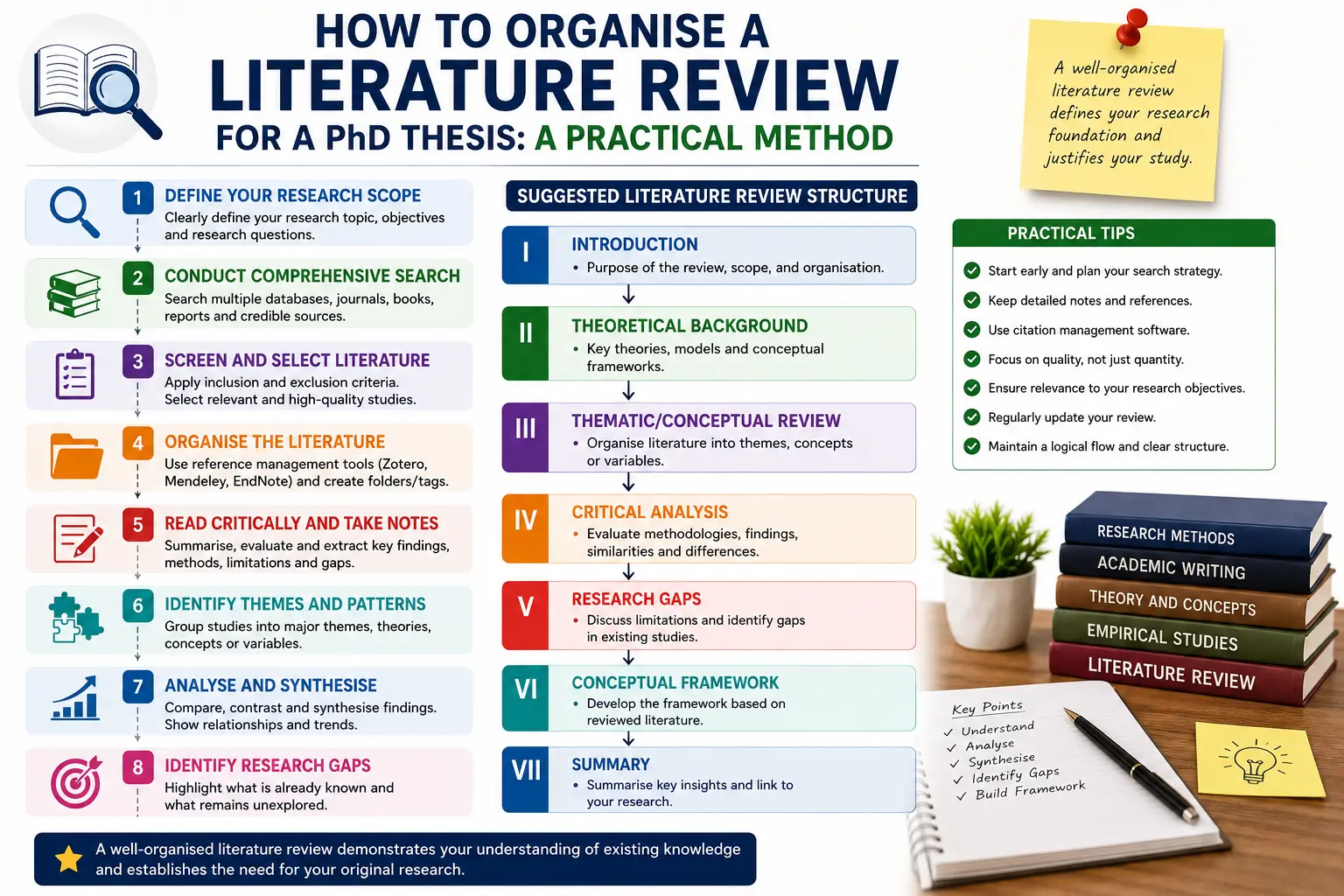
Recommended Structure for a PhD Literature Review
A practical structure includes:
1. Introduction
Overview and purpose.
2. Theoretical Background
Key theories and models.
3. Major Themes
Theme-based discussion.
4. Critical Evaluation
Strengths and weaknesses of existing studies.
5. Research Gaps
Unresolved issues.
6. Conceptual Framework
Proposed model.
7. Summary
Key takeaways and chapter transition.
Common Mistakes to Avoid
Writing an Annotated Bibliography
A literature review is not a collection of article summaries.
Ignoring Contradictory Findings
Discuss both supporting and opposing evidence.
Lack of Critical Analysis
Avoid simply reporting findings.
Weak Research Gap Identification
Clearly explain what remains unknown.
Using Outdated Sources
Prioritize recent peer-reviewed studies.
Poor Organization
Use clear themes and subheadings.
Practical Example of Organising a Literature Review
Suppose your research topic is:
"Impact of Social Media Marketing on Consumer Purchase Decisions."
A possible structure:
Introduction
Research context.
Theoretical Framework
- Technology Acceptance Model
- Consumer Behaviour Theory
Social Media Marketing
- Content Marketing
- Influencer Marketing
- Brand Engagement
Consumer Purchase Behaviour
- Decision-making process
- Trust and credibility
Relationship Between Social Media and Purchases
Empirical evidence.
Research Gaps
Limited studies in Indian markets.
Conceptual Framework
Proposed research model.
This structure creates a logical flow.
Best Practices for Writing a High-Quality Literature Review
Start Early
Literature review development should begin at the start of your PhD.
Read Widely
Explore both foundational and recent studies.
Stay Organized
Maintain detailed notes and reference libraries.
Use Thematic Analysis
Themes improve coherence.
Focus on Synthesis
Integrate studies rather than summarizing them individually.
Update Regularly
Incorporate newly published research throughout your doctoral journey.
Seek Feedback
Consult supervisors and peers regularly.
Tools That Can Help Organize Literature Reviews
Useful tools include:
Zotero
Reference management.
Mendeley
Citation and PDF organization.
EndNote
Advanced reference management.
NVivo
Qualitative literature analysis.
Excel
Literature matrices.
Notion
Research note organization.
These tools can significantly improve efficiency.
Conclusion
Organizing a literature review for a PhD thesis requires more than collecting and summarizing research articles. A successful literature review systematically synthesizes existing knowledge, identifies research gaps, develops theoretical foundations, and establishes the rationale for your study.
The most effective approach involves defining clear research objectives, conducting a comprehensive literature search, organizing studies into meaningful themes, critically evaluating findings, and creating a logical structure that guides readers through the research landscape. By focusing on synthesis rather than summary and by connecting existing knowledge to your own research questions, you can produce a literature review that demonstrates scholarly maturity and academic rigor.
For PhD scholars, mastering the art of organizing a literature review is a crucial step toward completing a high-quality thesis and contributing meaningful knowledge to their field.
Website: www.thesislikho.com
Call/WhatsApp: +91 96438 02216