
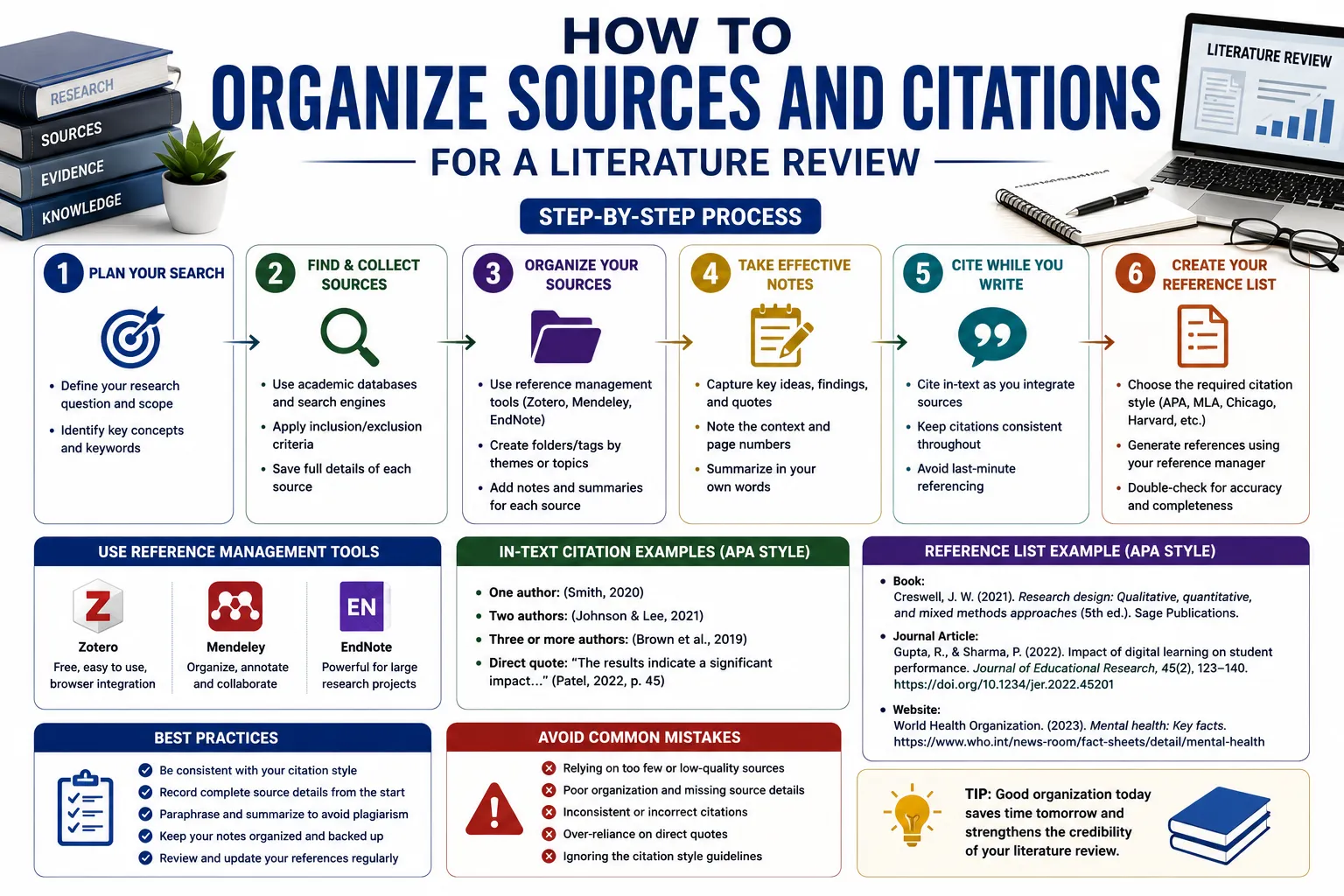
If you've got forty downloaded PDFs scattered across three folders, a half-remembered quote you can't trace back to its source, and a growing sense of panic every time you open your reference list — you're facing exactly the problem this guide solves. Learning how to organize sources and citations for a literature review isn't just about tidiness. It's what separates a literature review that reads as a coherent argument from one that reads as a pile of summaries with footnotes attached.
This guide is written specifically for first-time thesis writers in India who want a practical, repeatable system — not just an explanation of why organization matters.
Why Source Organization Makes or Breaks Your Literature Review
Most first-time thesis writers treat source organization as an afterthought — something to sort out once all the reading is done. In practice, disorganized sources are the single biggest reason literature reviews come out reading like a list of summaries rather than a genuine argument. Learning how to organize sources and citations for a literature review properly, from the very first source you save, is what lets you write a review organized around ideas and themes instead of one source per paragraph.
ThesisLikho's PhD-qualified mentors, who've guided over 10,000 scholars through the literature review stage, see the same pattern every semester: students who build an organization system early — before they've read even a dozen sources — write faster, cite more accurately, and produce reviews with genuinely synthesized arguments. Students who postpone organization until "later" almost always end up re-reading sources they'd already read, just to figure out what each one actually said.
Step 1: Choose Your Citation Management Tool
Before you read your first source for your literature review, pick a reference management tool and commit to logging every source in it from day one. The two most common choices for Indian thesis writers are:
- Mendeley — free, widely used in academic settings, and combines reference library management with PDF annotation. It imports PDFs and metadata automatically, lets you highlight passages and attach notes directly to specific documents, and includes "Mendeley Cite," a panel that inserts in-text citations and generates a formatted bibliography directly inside Microsoft Word (Source: Mendeley Guides).
- Zotero — also free and open-source, with somewhat more advanced organizational features for large libraries, including nested collections, saved searches, and flexible tagging, along with strong Google Docs integration.
Both tools let you organize references into folders/collections, tag them by theme, and share libraries with your supervisor or co-authors — useful if your department reviews your reading progress periodically. Neither tool is objectively "correct"; what matters far more than which one you pick is that you log every single source the moment you download it, rather than trying to reconstruct your reading list from memory weeks later.
Step 2: Build a Synthesis Matrix Before You Write
This is the single most valuable organizational habit a first-time thesis writer can build, and it's the step most scholars skip. A synthesis matrix is a table — built in Excel, Google Sheets, or even inside your reference manager's notes field — that lists your sources as rows and key attributes as columns: author and year, research method, key findings, and identified gaps or limitations.
Author (Year)
Mention the author(s) and publication year of each study. This helps you track sources accurately and cite them correctly in your literature review.
Method
Briefly note the research method used, such as a survey, case study, experiment, or secondary data analysis. Include the sample size or analysis technique if relevant.
Key Finding
Summarize the main result or conclusion of the study in one or two sentences, focusing on findings related to your research topic.
Theme
Identify the main topic or research area the study belongs to, making it easier to group similar studies in your literature review.
Gap Identified
Record the limitations or unanswered questions highlighted by the authors. These gaps can help justify the need for your own research.
As you fill this in source by source, patterns emerge on their own — you'll notice which sources cluster around the same theme, where findings agree or conflict, and exactly where the "gap" column across multiple rows starts pointing toward your own research contribution. This is fundamentally different from reading each source in isolation and writing a paragraph about it; the matrix forces synthesis before you've written a single sentence of your actual review.
Step 3: Decide Your Organizational Structure
Once your synthesis matrix reveals patterns, choose how your literature review's body will be structured. The three most common approaches:
- Thematic — organized around topics or issues rather than chronology; most common for social science, management, and education theses, since it lets you group sources by concept regardless of publication date.
- Chronological — organized by the timeline of research developments; useful when showing how a field's understanding has evolved over time is itself part of your argument.
- Methodological — organized by the research methods different studies used; useful in fields where the approach taken (qualitative vs. quantitative, experimental vs. observational) is itself a meaningful axis of comparison.
Most first-time Indian thesis writers benefit from a thematic structure, since it directly mirrors how a synthesis matrix naturally organizes information — by theme columns rather than a source-by-source timeline.
Annotated Bibliography vs. Literature Review: What's the Difference?
This distinction confuses many first-time scholars, and it directly affects how you should organize your sources:
Organization
An annotated bibliography is organized source by source, with each study discussed separately. A literature review is organized by themes, methodologies, or chronology, bringing related studies together.
Purpose
The purpose of an annotated bibliography is to summarize and evaluate each source individually. A literature review goes further by synthesizing multiple studies to build a clear and logical argument.
Structure
An annotated bibliography follows a list format with one entry for each source. A literature review is written as a continuous narrative that connects ideas across different studies.
Use of Citations
In an annotated bibliography, each entry usually contains a single citation followed by its summary. In a literature review, multiple sources are integrated within the same paragraph to compare, contrast, and support key arguments.
If your synthesis matrix notes read like isolated summaries with no connections drawn between rows, that's a sign you're still thinking in annotated-bibliography mode — the fix is to go back to your matrix and actively look for where sources agree, disagree, or leave a shared gap unaddressed.
Step 4: Track Themes, Not Just Sources
As your synthesis matrix grows, add a running "themes" log alongside it — a simple list of the 4–6 recurring themes you're noticing across sources, updated as new ones emerge or existing ones split into sub-themes. This becomes your literature review's actual outline. Each theme typically becomes a subsection, and every source relevant to that theme (from your matrix's "Theme" column) becomes the citations woven into that subsection — rather than you re-reading your entire source list trying to remember which paper said what.
A practical habit worth building here: revisit your themes log every 10–15 sources rather than only at the end. Themes you identified early often need splitting once you've read more broadly — what looked like one theme ("digital marketing adoption") frequently turns out to be two distinct ones ("platform-specific adoption barriers" and "demographic differences in adoption speed") once enough sources are logged. Catching this split early means your synthesis matrix stays accurate, rather than requiring a wholesale re-categorization of forty sources right before you start writing.
Step 5: Match In-Text Citations to Your Bibliography Correctly
This step is where many otherwise well-organized literature reviews fall apart. A source sitting in your bibliography does nothing to protect you if the specific idea it supports isn't cited in-text at the exact point you use it — an unmatched bibliography entry is treated as both a citation error and a plagiarism-risk flag under Indian university plagiarism-checking systems.
Practical citation-matching habits:
- As you write each sentence that draws on a source, insert the in-text citation immediately — never write first and "add citations later," since this is exactly how mismatches happen.
- Periodically cross-check that every bibliography entry has at least one corresponding in-text citation somewhere in your draft, and vice versa.
- Keep your citation style consistent throughout — switching between APA, MLA, or a discipline-specific style partway through a chapter is a common, avoidable formatting error caught late in review.
Why UGC Plagiarism Rules Make Citation Organization Non-Negotiable
For Indian thesis writers specifically, citation organization isn't just good academic practice — it's what keeps your similarity score defensible. Under UGC's Anti-Plagiarism Regulations, 2018, several categories are excluded from your thesis's similarity-score calculation: properly quoted and attributed text, references and bibliography, acknowledgements, preface, table of contents, and standard notations or equations (Source: UGC). A well-organized, properly cited literature review benefits directly from these exclusions — a poorly cited one does not.
A commonly misunderstood detail: having a source listed in your bibliography does not automatically exempt the surrounding text from similarity checks — the exemption applies specifically to properly quoted and attributed content, not to paraphrased ideas lacking a clear in-text citation at the point they're used (Source: UGC). This is precisely why the citation-matching habit in Step 5 matters so much: sloppy citation organization is one of the most common, entirely avoidable reasons Indian scholars receive an unexpectedly high similarity score despite having "done the reading" properly.
Most Indian universities also now use INFLIBNET's ShodhShuddhi programme for free institutional access to approved plagiarism-detection software, and completed theses are typically hosted on the ShodhGanga repository — meaning your own finished thesis eventually becomes part of the comparison database future scholars are checked against, which is one more reason to get your citation organization right from the start rather than patching it up right before submission.
Comparison Table: Reference Management Tools
Cost
Both Mendeley and Zotero are free to use. However, Zotero is also open-source, allowing continuous improvements through its developer community.
PDF Import and Metadata Extraction
Both tools can automatically import PDF files and extract bibliographic information such as the title, author, journal, and publication year, saving time when organizing references.
Citation Insertion
Both applications integrate with writing software to insert citations and generate reference lists. Mendeley uses the Mendeley Cite add-in for Microsoft Word, while Zotero offers plugins for both Microsoft Word and Google Docs.
Collections and Organization
Mendeley allows users to organize references into folders, while Zotero provides nested collections, making it easier to manage large research projects with multiple topics.
Tagging
Mendeley offers basic tagging features for organizing references. Zotero provides more advanced tagging options and allows tags to be combined with saved searches for faster retrieval of sources.
Group Libraries
Both Mendeley and Zotero support shared libraries, enabling researchers and supervisors to collaborate by sharing references and documents with team members.
Best Suited For
Mendeley is an excellent choice for researchers who want simple reference management with built-in PDF annotation. Zotero is better suited for long-term academic projects that require advanced organization, flexible search options, and management of large reference libraries.
Neither tool guarantees a well-organized literature review on its own — the tool only stores what you deliberately organize. The synthesis matrix from Step 2 remains the actual thinking tool; your reference manager is where the citations and PDFs live.
Building a Theoretical Framework from Your Organized Sources
A well-organized synthesis matrix does more than support your literature review chapter — it's often the fastest route into your theoretical framework chapter as well, since the "theme" and "gap" columns you've already built typically map directly onto the theoretical constructs and relationships your framework needs to define.
Systematic Review vs. Narrative Review: Does This Change Your Approach?
Most Indian master's and PhD theses use a narrative literature review rather than a full systematic review — meaning the synthesis matrix and thematic organization approach covered above is exactly the right method. If your specific study calls for a more formal systematic review (common in health sciences or evidence-synthesis-heavy fields), your source organization needs an additional layer: a documented, reproducible search-and-screening process, typically reported using a flow structure showing how many records were identified, screened, and ultimately included — a structure widely adopted across disciplines specifically for this transparency purpose.
The organizational principles remain the same either way — a synthesis matrix, consistent in-text citation matching, and a clear thematic structure — but a systematic review additionally requires you to document your search strategy itself as part of your methodology.
Two Realistic Scenarios
Scenario 1 — From Chaos to a Synthesis Matrix
Ananya, a first-time master's thesis writer, had downloaded 45 PDFs across three different laptop folders and a WhatsApp-saved-messages list by the time she sat down to actually start writing her literature review. She couldn't remember which paper had discussed which finding, and re-reading everything from scratch felt unavoidable. Instead, she spent three focused days building a synthesis matrix — logging each source's method, key finding, and theme into a shared Google Sheet, while simultaneously importing every PDF into Mendeley. Within those three days, four clear themes emerged from her matrix's theme column, which became her literature review's four subsections. What had felt like an impossible pile of forty-five disconnected sources became a structured four-part argument almost automatically, because the matrix had already done the sorting work.
Scenario 2 — Fixing a Citation-Matching Problem Before Submission
Karan's plagiarism pre-check came back at 22% similarity — well above his university's acceptable threshold — despite having what he believed was a complete, properly formatted bibliography. On closer review with his supervisor, the issue wasn't uncited content exactly; it was that several paraphrased ideas throughout his literature review lacked in-text citations at the specific points they appeared, even though the original sources were listed in his bibliography. He went through his draft systematically, cross-checking every bibliography entry against his in-text citations and adding the missing ones at their exact points of use. His revised similarity score dropped to 8%, comfortably within his university's Level 0 threshold — not because he removed content, but because he fixed the citation-matching gap between his in-text references and his bibliography.
Both scenarios point to the same underlying lesson: the actual writing of a literature review goes faster and more safely when the organizational groundwork — a synthesis matrix and disciplined citation matching — is done before and during your reading, not scrambled together afterward.
If you need expert guidance with your literature review, citation strategy, or overall thesis writing, you can explore our Thesis Writing service, where our PhD-qualified mentors help scholars build exactly this kind of organized, citation-safe literature review from the very first source.
Common Mistakes in Organizing Sources and Citations
- Postponing organization until "after the reading is done." By then, you've usually forgotten enough detail that you end up re-reading sources anyway.
- Relying purely on your reference manager's default folder view without a synthesis matrix — a reference manager stores sources; it doesn't synthesize them for you.
- Writing your bibliography as a substitute for in-text citations. A listed source with no matching in-text citation is a plagiarism-check risk, not a safety net.
- Mixing citation styles partway through a chapter, creating avoidable formatting errors caught late in supervisor review.
- Treating your literature review as source-by-source summaries instead of theme-based synthesis — a common annotated-bibliography-in-disguise problem.
- Losing track of which sources support which specific claim, making later fact-checking or revision far slower than it needs to be.
- Not revisiting your themes log as you read more sources, leaving early, overly broad theme categories unsplit even after enough evidence has accumulated to justify separating them.
Source and Citation Organization Checklist
- A reference manager (Mendeley, Zotero, or similar) is set up before you begin serious reading
- Every downloaded source is logged in your reference manager the same day you save it
- A synthesis matrix (author, method, finding, theme, gap) is being built alongside your reading, not after
- A running themes log is updated as new themes emerge or existing ones split
- Citation style is confirmed and applied consistently from the very first draft
- Every in-text citation has a matching bibliography entry, and vice versa
- Your literature review's structure (thematic, chronological, or methodological) is deliberately chosen, not defaulted into
How Long Does This Stage Take?
Building a proper source-organization system — setting up your reference manager and starting your synthesis matrix — typically takes just 2–3 days if done at the very start of your reading process, rather than retrofitted later. From there, most scholars spend 4–8 weeks actively reading and populating their synthesis matrix before writing their literature review chapter, depending on how many sources their topic requires.
Across the full thesis, from literature review through final submission, most Indian master's theses run 6–12 months, and PhD theses run 3–5 years — a well-organized literature review stage doesn't just save time in that one chapter; it also makes your discussion and conclusion chapters faster to write later, since your synthesis matrix already contains the comparative analysis those chapters will draw on.
FAQs
How do you organize sources and citations for a literature review?
Set up a reference manager (Mendeley or Zotero) before you start reading, log every source the day you download it, and build a synthesis matrix tracking each source's method, findings, and theme. Use the matrix's theme column to structure your review thematically, and match every in-text citation to a bibliography entry as you write.
Why should I organize sources and citations for a literature review carefully?
Disorganized sources are the most common reason literature reviews read as disconnected summaries rather than a synthesized argument. Careful organization also protects your plagiarism similarity score, since unmatched in-text citations and bibliography entries are a common, avoidable cause of unexpectedly high scores under UGC-aligned plagiarism checks.
When should you organize sources and citations for a literature review?
From the very first source you download — not after you've finished reading. Building your synthesis matrix alongside your reading, rather than retrofitting it afterward, saves significant re-reading time and produces a more genuinely synthesized review.
How long does it take to complete a thesis using this approach?
Setting up your organization system takes just 2–3 days, with active literature review reading and matrix-building typically taking 4–8 weeks depending on topic scope. Full Indian master's theses commonly take 6–12 months, while PhD theses run 3–5 years.
Is professional help available to organize sources and citations for a literature review?
Yes. Many scholars work with experienced thesis mentors to build a synthesis matrix, choose the right reference manager, and ensure their citation practices meet UGC-aligned plagiarism standards — this is exactly the kind of support ThesisLikho's PhD-qualified mentors provide.
Talk to a Thesis Expert: If you're feeling overwhelmed by your source pile or want a second opinion on your citation organization before you submit, ThesisLikho's PhD-qualified mentors can help you build a system that actually works. Explore our Thesis Writing Service →