Introduction
Paraphrasing is one of the most important academic writing skills every research scholar must master. Whether you are writing a Master's dissertation, MPhil thesis, or PhD research paper, you will spend a significant amount of time reading existing literature and incorporating it into your work. However, simply copying text from published sources can lead to plagiarism, which is a serious academic offense.
This is where paraphrasing becomes essential. Effective paraphrasing allows researchers to present ideas from existing studies in their own words while preserving the original meaning and giving proper credit to the source. Unfortunately, many students struggle with paraphrasing. Some change only a few words, while others alter the meaning entirely. Both approaches can create problems in academic writing.
In 2026, with advanced plagiarism detection software and AI-powered content analysis tools being used by universities worldwide, learning to paraphrase correctly has become more important than ever.
This comprehensive guide explains how to paraphrase effectively in a thesis without losing meaning, avoid plagiarism, and maintain academic integrity.
What Is Paraphrasing?
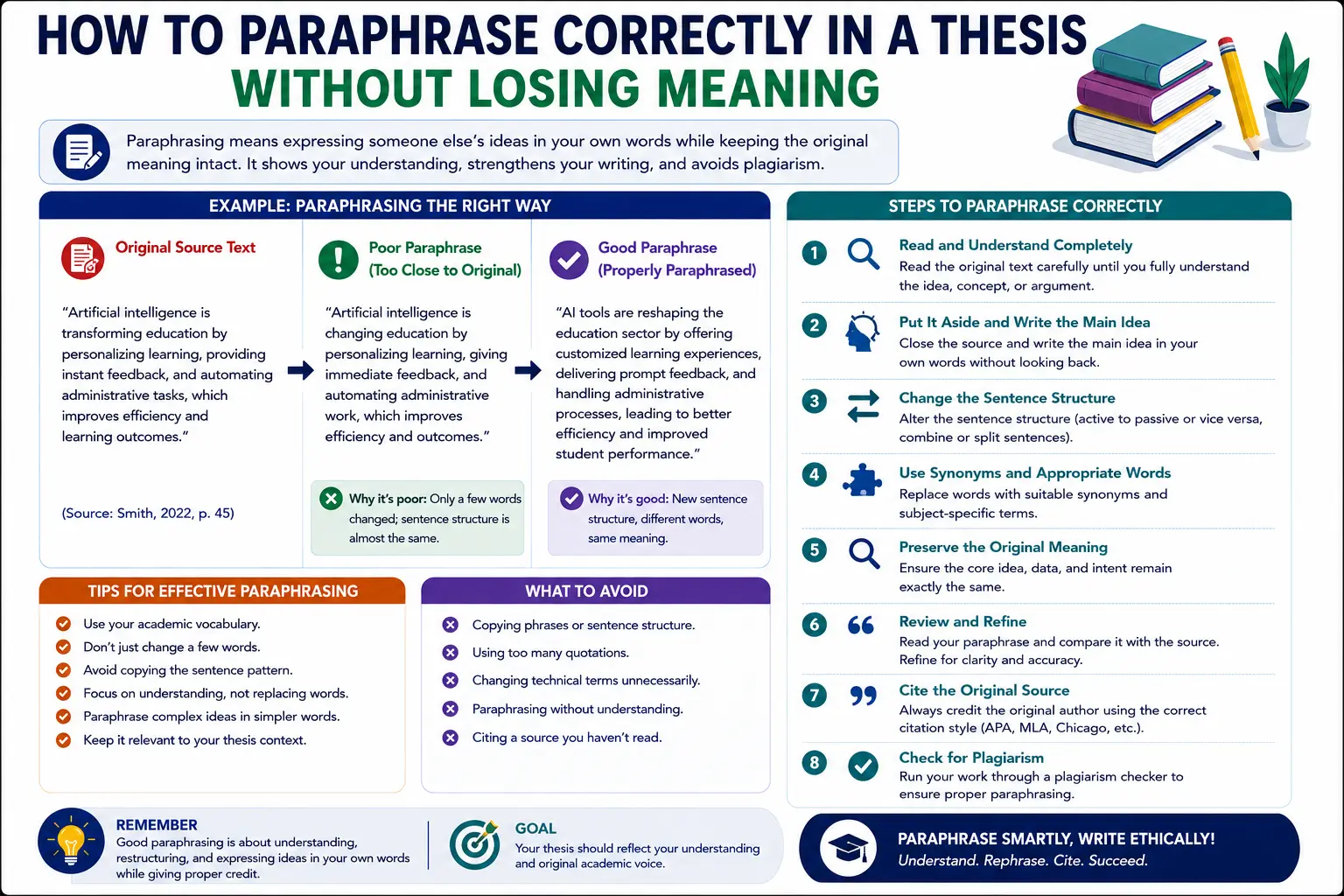
Paraphrasing means expressing someone else's ideas, findings, or arguments in your own words while retaining the original meaning.
Unlike direct quotations, paraphrasing does not require copying the exact wording. Instead, you rewrite the information using a different sentence structure, vocabulary, and style.
Example
Original Text:
"Regular physical activity significantly reduces the risk of cardiovascular diseases and improves overall health."
Paraphrased Version:
"Engaging in consistent exercise can lower the likelihood of heart-related illnesses while enhancing general well-being."
The meaning remains the same, but the wording and structure have changed.
Why Is Paraphrasing Important in a Thesis?
Academic research requires scholars to engage with existing literature while contributing original insights.
Paraphrasing helps researchers:
- Avoid plagiarism
- Demonstrate understanding of source material
- Improve readability
- Integrate sources smoothly
- Maintain academic integrity
- Build stronger literature reviews
A well-written thesis typically contains more paraphrased content than direct quotations.
The Difference Between Paraphrasing, Summarizing, and Quoting
Many students confuse these three concepts.
Paraphrasing
- Rewrites the original idea in your own words.
- Similar length to the source.
- Retains all key details.
Summarizing
- Condenses the main points.
- Much shorter than the original.
- Focuses only on essential information.
Quoting
- Uses the exact words from the source.
- Requires quotation marks.
- Includes proper citation.
Understanding these differences helps researchers choose the appropriate method in different situations.
Why Many Thesis Writers Struggle with Paraphrasing
Several common challenges make paraphrasing difficult.
Fear of Changing the Meaning
Researchers often worry that rewriting a sentence may alter the author's intended message.
Limited Vocabulary
Students may find it difficult to express complex academic concepts using different words.
Technical Terminology
Certain discipline-specific terms cannot be replaced without changing meaning.
Language Barriers
For non-native English speakers, rewriting scholarly text can be particularly challenging.
Step-by-Step Process for Effective Paraphrasing
Step 1: Read the Source Carefully
Before attempting to paraphrase, fully understand the content.
Ask yourself:
- What is the main idea?
- What evidence supports the claim?
- What conclusions are being presented?
Never paraphrase a sentence you do not understand.
Step 2: Put the Source Aside
After reading, close the book, article, or document temporarily.
This prevents accidental copying and encourages genuine rewriting.
Step 3: Write the Idea in Your Own Words
Explain the concept as if you were teaching it to someone else.
Focus on understanding rather than word replacement.
Step 4: Compare with the Original
Check whether:
- The meaning remains accurate.
- The wording is sufficiently different.
- Important details are retained.
Step 5: Add Proper Citation
Even paraphrased content requires citation.
Paraphrasing without citation is still plagiarism.
Techniques for Effective Thesis Paraphrasing
1. Change Sentence Structure
One of the best methods is restructuring the sentence.
Original
"Researchers found that social media usage influences consumer purchasing decisions."
Paraphrased
"Consumer buying behavior is significantly affected by the use of social media platforms, according to researchers."
The idea remains identical while the structure changes.
2. Use Synonyms Carefully
Replacing words with suitable alternatives can help.
Original
"The study examined factors affecting employee motivation."
Paraphrased
"The research investigated variables influencing workforce motivation."
However, avoid replacing technical terms unnecessarily.
3. Change Active Voice to Passive Voice
Original
"The researchers analyzed survey responses."
Paraphrased
"Survey responses were analyzed by the researchers."
This creates variation while preserving meaning.
4. Combine or Split Sentences
Original
"The experiment lasted six months. Data were collected weekly."
Paraphrased
"Over a six-month period, researchers gathered data every week."
5. Use Different Word Forms
Original
"The implementation of technology improved efficiency."
Paraphrased
"Implementing technology enhanced operational efficiency."
Common Paraphrasing Mistakes to Avoid
Changing Only a Few Words
This is often called patchwriting.
Poor Example
Original:
"Climate change affects biodiversity worldwide."
Paraphrased:
"Climate change impacts biodiversity globally."
Although a few words changed, the structure remains nearly identical.
Changing the Meaning
Incorrect paraphrasing can distort the author's findings.
Original
"Exercise may reduce stress levels."
Incorrect Paraphrase
"Exercise eliminates stress completely."
The meaning has changed significantly.
Forgetting Citations
Many students assume paraphrased content no longer requires citation.
This is incorrect.
The idea still belongs to the original author.
Overusing Synonyms
Replacing every word with a synonym can make writing unnatural and confusing.
Focus on rewriting ideas rather than merely changing vocabulary.
Examples of Good and Poor Paraphrasing
Original Text
"Online education provides flexible learning opportunities for students who cannot attend traditional classrooms."
Poor Paraphrase
"Online learning offers flexible learning opportunities for students who cannot attend traditional classrooms."
Only a few words changed.
Good Paraphrase
"Students unable to participate in conventional classroom settings can benefit from the adaptability and accessibility offered by digital education platforms."
The structure, wording, and flow have changed while preserving meaning.
How Much Should a Paraphrase Differ from the Original?
There is no exact percentage.
However, effective paraphrasing should involve:
- New sentence structure
- Different vocabulary where appropriate
- Reorganized information
- Original writing style
The final text should read naturally as your own writing.
Paraphrasing Literature Reviews
The literature review is where paraphrasing is most frequently used.
Researchers often synthesize findings from multiple studies.
Example
Instead of discussing each study separately:
"Sharma (2022) found that online learning improves accessibility. Gupta (2023) reported increased student engagement in digital classrooms."
You can write:
"Recent studies indicate that digital education enhances both accessibility and student engagement (Sharma, 2022; Gupta, 2023)."
This demonstrates synthesis rather than simple reporting.
Paraphrasing in Different Thesis Chapters
Introduction
Use paraphrasing to explain theories and concepts.
Literature Review
Summarize and synthesize previous studies.
Methodology
Paraphrase methodological approaches from established research.
Discussion
Compare your findings with existing literature using paraphrased references.
Using AI Tools for Paraphrasing: Is It Safe?
AI-powered writing tools are increasingly popular among researchers.
However, scholars should be cautious.
Advantages
- Grammar improvement
- Sentence restructuring
- Writing suggestions
- Clarity enhancement
Risks
- Altered meanings
- Incorrect interpretations
- AI detection concerns
- Overdependence
Researchers should always review and edit AI-generated paraphrases manually.
The final version should reflect their understanding and academic voice.
How Plagiarism Checkers Evaluate Paraphrased Content
Modern plagiarism detection software examines:
- Text similarity
- Sentence patterns
- Phrase matching
- Structural overlap
Tools such as Turnitin can identify poorly paraphrased content even when several words have been changed.
Effective paraphrasing significantly reduces similarity scores while maintaining accuracy.
Tips for Improving Paraphrasing Skills
Read More Academic Literature
Exposure to scholarly writing improves vocabulary and sentence construction.
Practice Regularly
Paraphrasing is a skill that improves with repetition.
Build Subject Knowledge
The better you understand a topic, the easier it becomes to explain it differently.
Use Note-Taking Strategies
Write notes in your own words while reading articles.
Seek Feedback
Ask supervisors or peers to review your paraphrased sections.
Best Practices for Thesis Writers in 2026
To paraphrase effectively:
- Understand the source fully.
- Rewrite ideas rather than words.
- Change sentence structure significantly.
- Retain the original meaning.
- Use citations correctly.
- Avoid patchwriting.
- Review for accuracy.
- Check plagiarism reports.
- Maintain your academic voice.
- Use AI responsibly and ethically.
Paraphrasing Checklist Before Thesis Submission
Before submitting your thesis, ask:
- Have I understood the source correctly?
- Is the wording substantially different?
- Have I preserved the original meaning?
- Have I cited the source?
- Does the paragraph fit my writing style?
- Is the text plagiarism-free?
If the answer is yes to all these questions, your paraphrasing is likely effective.
Conclusion
Paraphrasing is more than replacing words with synonyms. It is the process of understanding an idea deeply and expressing it in a new way without changing its meaning. For thesis writers, strong paraphrasing skills are essential for creating high-quality, plagiarism-free academic work.
As universities adopt more sophisticated plagiarism and AI detection systems in 2026, researchers must focus on genuine comprehension, ethical writing practices, and proper citation. Effective paraphrasing not only protects academic integrity but also demonstrates critical thinking and scholarly maturity.
By mastering the techniques discussed in this guide, Master's and PhD scholars can confidently integrate literature into their thesis while maintaining originality, credibility, and academic excellence.
FAQs
Can I paraphrase without citing the source?
No. Even when using your own words, you must cite the original source.
How much should I change when paraphrasing?
You should significantly alter sentence structure and wording while preserving the original meaning.
Is paraphrasing better than quoting in a thesis?
In most cases, yes. Paraphrasing demonstrates understanding and improves the flow of academic writing.
Can Turnitin detect paraphrased content?
Yes. Poor paraphrasing or patchwriting may still be identified by plagiarism detection software.
Are AI paraphrasing tools acceptable for academic writing?
They can assist with language improvement, but scholars should carefully review and revise all AI-generated suggestions before using them in a thesis.
What is the biggest paraphrasing mistake students make?
Changing only a few words while keeping the original sentence structure, which can still be considered plagiarism.
Contact ThesisLikho Today
Call / WhatsApp: +91 96438 02216
Visit: ThesisLikho.com