
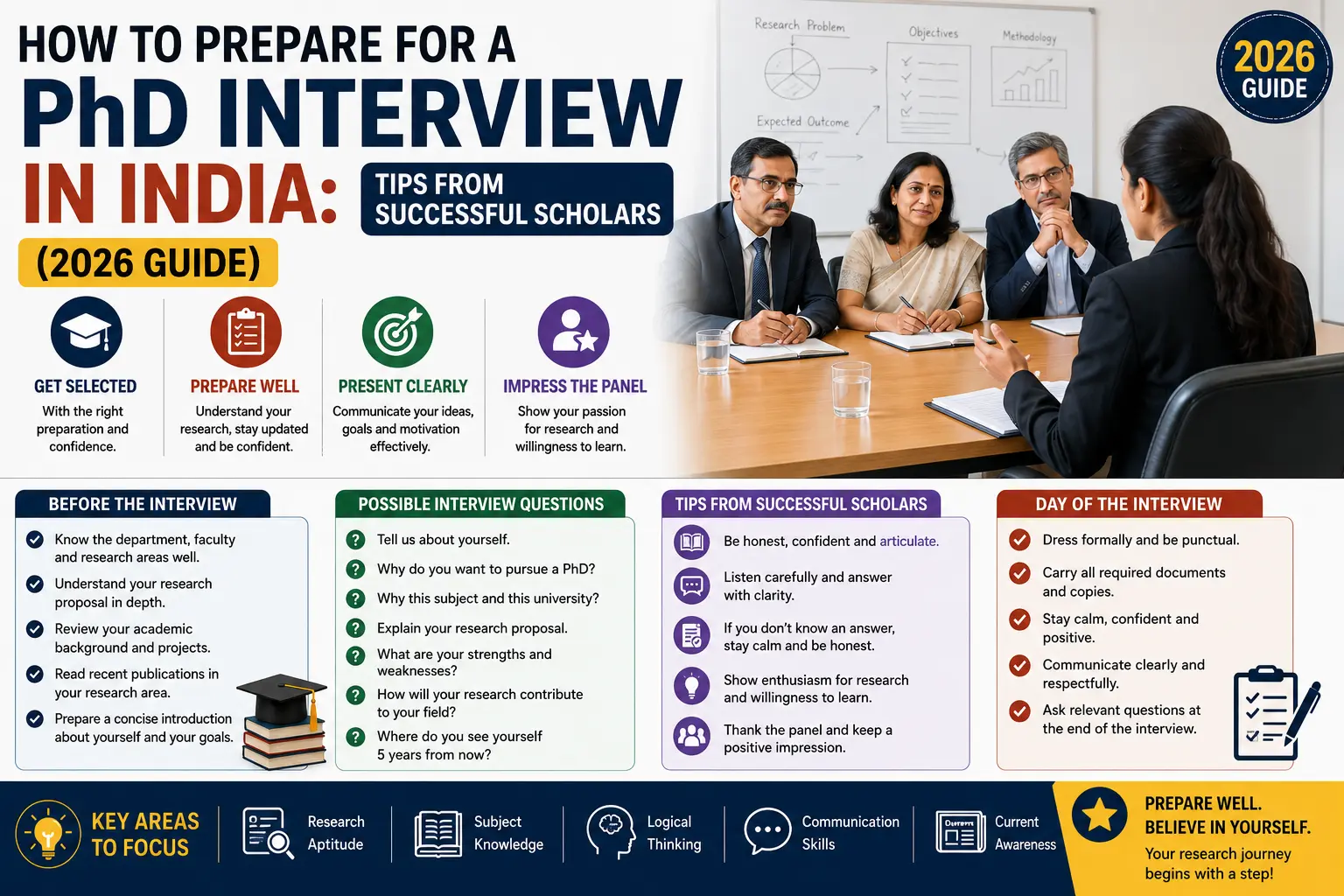
Securing a PhD admission in India is a significant achievement, but clearing the PhD interview is often the most crucial and challenging step in the selection process. Every year, thousands of candidates qualify for entrance examinations such as UGC NET, JRF, GATE, CSIR NET, CAT, and university-specific tests, yet many fail to convert their applications into admissions because they are not adequately prepared for the interview stage.
A PhD interview is not merely a test of subject knowledge. It evaluates your research aptitude, critical thinking abilities, communication skills, academic preparedness, and suitability for doctoral research. Interview panels want to determine whether you have the potential to contribute meaningful research and complete a doctoral program successfully.
Successful PhD scholars often emphasize that interview preparation requires much more than revising textbooks. It involves understanding your research interests, preparing a strong research proposal, anticipating questions, and demonstrating genuine enthusiasm for research.
In this comprehensive guide, we will discuss how to prepare for a PhD interview in India, common interview questions, expert tips from successful scholars, mistakes to avoid, and strategies that can significantly improve your chances of selection in 2026.
Why Is the PhD Interview So Important?
Most Indian universities now follow a multi-stage admission process:
- Application Screening
- Entrance Examination
- Research Proposal Evaluation
- Personal Interview (Viva Voce)
Even candidates with excellent entrance scores may be rejected if they perform poorly in the interview.
The interview helps the selection committee assess:
- Research aptitude
- Subject expertise
- Analytical thinking
- Communication skills
- Motivation for pursuing a PhD
- Alignment with faculty research interests
In many universities, interview performance carries substantial weightage in the final merit list.
What Do Interview Panels Look For?
Before preparing, it is important to understand what professors expect from candidates.
They generally evaluate:
Academic Foundation
Candidates should possess a strong understanding of their postgraduate subject.
Research Potential
The panel wants evidence that you can conduct independent research.
Clarity of Goals
You should have a clear reason for pursuing a PhD.
Research Awareness
Interviewers assess whether you understand current developments in your field.
Communication Ability
Researchers must communicate ideas effectively through writing and presentations.
Understanding the PhD Interview Format in India
The format varies across institutions but generally includes:
Personal Introduction
You may be asked to briefly introduce yourself.
Example:
"Tell us about your academic background and research interests."
Research Proposal Discussion
The panel may ask detailed questions regarding:
- Research objectives
- Research gap
- Methodology
- Expected outcomes
Subject-Specific Questions
Questions are usually based on:
- Postgraduate syllabus
- Core concepts
- Recent developments
Research Methodology Questions
Interviewers often test understanding of:
- Qualitative research
- Quantitative research
- Data analysis
- Literature review
Career-Oriented Questions
You may be asked about:
- Academic aspirations
- Future plans
- Reasons for choosing a PhD
Step 1: Understand Your Research Topic Thoroughly
One of the biggest mistakes candidates make is proposing a topic they barely understand.
Successful scholars consistently recommend:
Study Your Topic in Depth
Understand:
- Research background
- Existing studies
- Research gaps
- Future opportunities
Be Prepared to Explain
You should be able to answer:
- Why is this topic important?
- What problem does it solve?
- Why did you choose this topic?
Interviewers often probe deeply into your chosen area.
Step 2: Prepare a Strong Research Proposal
Your research proposal often becomes the centerpiece of the interview.
A strong proposal should clearly explain:
Research Problem
What issue are you investigating?
Research Objectives
What do you intend to achieve?
Literature Review
What have previous researchers found?
Methodology
How will you conduct the research?
Expected Contribution
How will your work add value?
A well-structured proposal demonstrates research readiness.
Step 3: Revise Core Subject Knowledge
Many candidates focus only on the proposal and neglect subject fundamentals.
However, interview panels frequently ask:
- Basic theoretical concepts
- Key models and frameworks
- Important researchers
- Recent developments
For example:
Engineering Candidates
May be asked about:
- Core engineering principles
- Current technologies
- Industry applications
Management Candidates
May face questions on:
- Organizational behavior
- Marketing theories
- Financial concepts
Science Candidates
Should revise:
- Research techniques
- Experimental methods
- Scientific principles
Step 4: Learn Research Methodology
Research methodology is one of the most commonly tested areas.
Interviewers expect candidates to understand:
Qualitative Research
Examples:
- Interviews
- Focus groups
- Case studies
Quantitative Research
Examples:
- Surveys
- Statistical analysis
- Experimental designs
Mixed Methods
Combining qualitative and quantitative approaches.
Be prepared to explain:
- Why you selected a specific methodology
- Advantages and limitations
- Data collection procedures
Step 5: Read Recent Research Papers
Successful PhD scholars often recommend reading recent journal articles before interviews.
Benefits include:
- Understanding current trends
- Identifying research gaps
- Improving academic vocabulary
- Demonstrating research awareness
Focus on:
- Scopus-indexed journals
- Web of Science publications
- High-impact journals
Reading recent studies helps you discuss your topic confidently.
Step 6: Research the Faculty and Department
Before attending an interview, learn about:
Faculty Members
Review:
- Research interests
- Publications
- Ongoing projects
Department Research Areas
Understand:
- Current research priorities
- Available facilities
- Potential supervisors
This preparation allows you to explain why you selected that university.
Step 7: Prepare Your Personal Introduction
Nearly every interview begins with:
"Tell us about yourself."
Your answer should cover:
- Educational background
- Academic achievements
- Research interests
- Career goals
Keep it concise and professional.
Example structure:
- Name and educational qualifications
- Relevant academic experience
- Research interests
- Reason for pursuing a PhD
Step 8: Prepare Answers to Common Questions
Below are frequently asked PhD interview questions in India.
Why do you want to pursue a PhD?
Interviewers want genuine motivation.
Strong answers focus on:
- Research interests
- Academic goals
- Knowledge creation
Avoid saying:
"I want a higher salary."
Why did you choose this topic?
Discuss:
- Personal interest
- Research gap
- Social or industrial relevance
Why did you choose this university?
Demonstrate awareness of:
- Faculty expertise
- Research facilities
- Academic reputation
What contribution will your research make?
Highlight:
- Practical applications
- Theoretical significance
- Innovation potential
What are your future career plans?
Possible responses include:
- Academic career
- Research scientist role
- Industry research position
Step 9: Improve Communication Skills
Many capable candidates struggle due to poor presentation.
Tips include:
Speak Clearly
Avoid rushing.
Be Structured
Answer questions logically.
Use Academic Language
Demonstrate professionalism.
Maintain Confidence
Confidence reflects preparedness.
Step 10: Participate in Mock Interviews
Mock interviews are among the most effective preparation strategies.
Practice with:
- Professors
- Research scholars
- Mentors
- Academic peers
Benefits include:
- Improved confidence
- Better articulation
- Reduced nervousness
Common Mistakes to Avoid
Successful scholars frequently highlight these mistakes.
Memorizing Answers
Interview panels can easily identify rehearsed responses.
Instead:
Understand concepts thoroughly.
Weak Research Proposal
A vague proposal indicates poor preparation.
Lack of Subject Knowledge
Failure to answer basic questions raises concerns.
Overconfidence
Arrogance can negatively affect impressions.
Poor Communication
Unclear explanations reduce credibility.
Not Reading Recent Literature
Outdated knowledge signals weak research engagement.
Tips from Successful PhD Scholars
Students who successfully secured admission at IITs, IIMs, central universities, and research institutes often share the following advice.
Focus on Research, Not Memorization
Interviewers value original thinking more than rote learning.
Know Every Detail of Your Proposal
Expect detailed questions regarding:
- Objectives
- Methodology
- Expected outcomes
Stay Updated
Research evolves rapidly.
Read:
- Recent papers
- Industry reports
- Academic journals
Demonstrate Curiosity
Panels appreciate candidates genuinely interested in learning and discovery.
Practice Explaining Complex Ideas Simply
Strong researchers communicate clearly.
How to Handle Difficult Questions
Sometimes interviewers intentionally ask challenging questions.
If you don't know the answer:
Stay Calm
Do not panic.
Be Honest
It's acceptable to say:
"I am not fully familiar with that area, but I would be interested in exploring it further."
Show Analytical Thinking
Discuss your reasoning process.
Interviewers often value thoughtfulness over perfect answers.
Online PhD Interview Preparation Tips
Many universities now conduct virtual interviews.
Prepare by:
- Testing your internet connection
- Using a quiet environment
- Checking audio and video quality
- Keeping documents nearby
- Maintaining eye contact with the camera
Professional presentation remains important in virtual interviews.
Day Before the Interview Checklist
Review:
✔ Research proposal
✔ Academic fundamentals
✔ Faculty profiles
✔ Recent publications
✔ University information
Organize:
✔ Certificates
✔ Mark sheets
✔ ID proof
✔ Research proposal copy
✔ Resume/CV
Rest Well
Adequate sleep improves concentration and confidence.
What to Do During the Interview
Arrive Early
Whether online or offline.
Listen Carefully
Understand the question before responding.
Be Honest
Do not fabricate information.
Stay Positive
Maintain enthusiasm throughout the discussion.
Thank the Panel
Professional courtesy leaves a positive impression.
How the Interview Can Influence Final Selection
Many universities assign significant weightage to interviews.
The panel often evaluates:
- Research potential
- Motivation
- Communication ability
- Supervisor compatibility
Therefore, strong interview performance can compensate for minor weaknesses elsewhere in your application.
Conclusion
Preparing for a PhD interview in India requires a strategic combination of subject knowledge, research awareness, communication skills, and confidence. While entrance examinations may help you secure a shortlist, the interview ultimately determines whether you possess the aptitude and commitment required for doctoral research.
Successful PhD scholars consistently emphasize the importance of understanding your research proposal, revising core concepts, reading recent literature, and practicing mock interviews. Rather than memorizing answers, focus on developing a genuine understanding of your field and demonstrating curiosity, analytical thinking, and academic maturity.
By preparing thoroughly and approaching the interview with confidence, you can significantly improve your chances of securing admission to a prestigious PhD program in India in 2026 and beyond.
Frequently Asked Questions (FAQs)
1. What is the purpose of a PhD interview in India?
The interview evaluates research aptitude, subject knowledge, communication skills, academic preparedness, and suitability for doctoral research.
2. How long does a PhD interview usually last?
Most interviews last between 15 and 45 minutes, depending on the university and research discipline.
3. What are the most common PhD interview questions?
Common questions focus on research interests, research proposals, subject fundamentals, career goals, methodology, and reasons for pursuing a PhD.
4. Is a research proposal mandatory for a PhD interview?
Many universities require a research proposal either during application submission or at the interview stage.
5. How important is subject knowledge in the interview?
Very important. Interviewers frequently ask questions from postgraduate-level coursework and core concepts.
6. What should I do if I don't know an answer?
Remain calm, answer honestly, and demonstrate your thought process rather than guessing or providing incorrect information.
7. Can working professionals apply for PhD programs?
Yes. Many universities offer part-time and executive PhD programs suitable for working professionals.
8. How can I improve my confidence before the interview?
Mock interviews, thorough preparation, reading recent research papers, and understanding your proposal can greatly improve confidence.
9. Are online PhD interviews different from offline interviews?
The evaluation criteria remain similar, but online interviews require additional preparation related to technology and presentation.
10. What is the most important factor for success in a PhD interview?
A clear understanding of your research interests and proposal, combined with strong subject knowledge and effective communication, is often the key to success.
Contact ThesisLikho Today
Call / WhatsApp: +91 96438 02216
Visit: ThesisLikho.com