
Introduction
The PhD viva voce is the last hurdle in the long journey of obtaining your PhD. It consists of an oral examination and the formal defense of your thesis in front of a panel of examiners in India. The viva voce is more than just a test of your knowledge; it is an assessment of your ability to explain, assert, and defend your research.
The viva voce can be an overwhelming experience for a researcher. However, if you are properly prepared, the viva voce is an excellent opportunity to display your knowledge on the subject you have spent years researching. This blog is estimated to be 2,000 words and will contain the information you will need to prepare for a PhD viva voce in India, what examiners will be looking for, and how to be successful in this process.
1. The Viva Voce in India
The viva voce will take place once your thesis has been sent for external evaluation and has been evaluated. The viva voce usually consists of:
A presentation of your research.
A question and answer session with the examiners.
A discussion regarding your methods, results, and your research's contributions.
Clarifications for issues raised in the written evaluation.
The panel of examiners will usually consist of:
Your supervisor.
An internal/external examiner (from your institution).
An external examiner (from some other university/research institute).
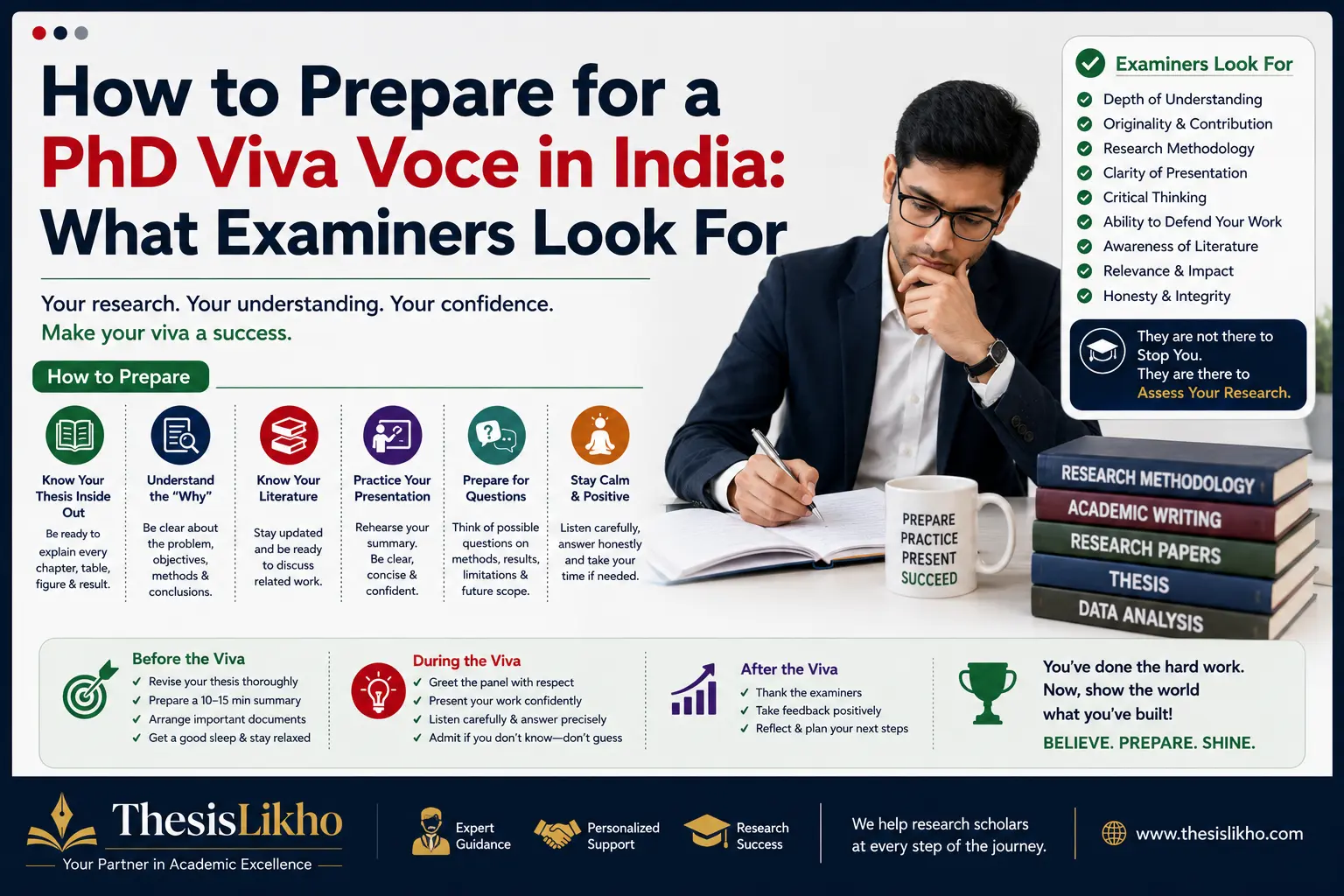
2. What Examiners Look For
a) Depth of Knowledge
When it comes to your subject, the examiners will want to see a comprehensive understanding. They may question:
How does your study place itself in the literature that exists?
What is the rationale for your selection of certain methods?
What are the guiding theories for your research?
b) Originality
A true original contribution is defining for a PhD. Assessors ask:
What does your thesis contribute?
How are your results novel?
For what future research pathways does your thesis provide scaffolding?
c) Methodological Rigor
You will likely be asked:
Why employ qualitative versus quantitative methods?
How did you ensure validity and reliability?
What are the drawbacks of your methods?
d) Critical Thinking
You should be able to demonstrate self-evaluation. Assessors could ask:
If you had the opportunity to do this again, what would you do differently?
How do you account for the shortcomings of your research?
What are the other possible conclusions for your work?
e) Communication Skills
Assessors will look for the ability to evaluate and explain complicated concepts and the presence of a logical structure in your work. Maintain professionalism.
3. Viva Preparation
a) Your Thesis
Know each part of your thesis as you are likely to be asked to explain your methodologies and findings.
b) You Will Present
You will need to explain your work in a 15 to 20 minute presentation. Less slides are better.
c) Expect Questions
You should be prepared to explain how your work is of value to the academic and general public.
d) You Will Defend
Assessors will be interested in your field’s critical literature. You should be prepared to discuss the important theories and contributions.
e) You Will Be Challenged
Assessors may question your assumptions. Be calm, defend your assumption, and acknowledge the limits of your work.
4. You Will Be Successful
a) You Will Be Successful
You should be able to defend your work with explanation and detail without being arrogant. Would be your best bet.
b) Clarity in Communication
Steer clear of jargon. Do not leave your audience to guess.
c) Professionalism
Using the correct dress code and arriving on time is essential. Maintain positive body language.
d) Difficult Questions
Indicate how you will investigate an answer when you do not know.
e) Time Management
Be succinct. Long answers will lose your main idea.
Note the following:
Firstly, examine your over-dependence on your supervisor. They want to know how much you understand.
Secondly, examine your defensiveness. Get used to accepting constructive feedback.
Lastly, examine your presentation skills. Unclear and/or distracting slides will weaken your defense.
6. Outcomes of the Viva Voce
PhD awarded with corrections.
Major corrections required.
Very rarely: outright rejection (most frequently because of plagiarism or gross academic fraud).
When corrections to the thesis are made, and the thesis is resubmitted, the award of the PhD is made.
PhD Viva Voce in India: FAQ
1. How long does a viva voce take?
2–3 hours is the general time frame. It is dependent on the size of the thesis and also the number of questions asked.
2. Do I get to use slides in the viva?
Yes, but make your slides tell your thesis (or your defense) and not be too much of a visual distraction.
3. What do I do when I don’t know an answer?
Say so, and indicate how you will investigate an answer.
4. Do examiners read the whole thesis?
Yes. External examiners read the whole thesis. Internal examiners read parts the thesis.
5. How crucial is Body Language?
Very. Make a positive impression with your Body Language by being confident, maintaining eye contact, and being calm.
6. Is failing a viva voce in India an option?
It is unlikely. Normally, most candidates are asked to implement recommended changes instead of failing them.
7. Do you think the entire thesis has to be memorized?
Definitely not, but you should memorize a fair bit of supporting evidence, central arguments, key data, etc.
8. What is the best way to prepare for the possibility of an unanticipated question?
The best approach is to keep revising, participating in a lot of mock viva, and developing your ability to think on your feet.
9. Is viva voce a public occasion?
Typically, in most Indian universities, it is not a public occasion and is attended by faculty members and sometimes students.
10. What generally happens after the viva is passed?
Once passed, you are expected to submit the corrections, and then submit the finalized thesis, and only then you are conferred the PhD degree.
Conclusion
The culmination of years of research and study is the Indian PhD viva voce. The examiners look for the candidate's ability to think critically, and the candidate's grasp of the subject, originality and the thoroughness and the quality of the methodology. For the candidate, the viva may be a very formative experience if the candidate has prepared for it.
The viva is not designed to create fear; it is intended to examine the quality of the candidate's research. A humble and reasonable approach to the viva is the best way to obtain the degree and the title of Doctor of Philosophy and is strong evidence of your standing as a scholar.
ThesisLikho supports scholars throughout the dissertation process helping them turn research ideas into quality academic contributions that meet university and publication standards.
Contact ThesisLikho
Website: www.ThesisLikho.com
Call/WhatsApp: +91 96438 02216