
Introduction
Publishing a research paper in an international journal is a significant milestone for Master's students, PhD scholars, researchers, and academic professionals. A publication in a reputable journal not only validates the quality of your research but also increases your academic visibility, strengthens your curriculum vitae (CV), improves career prospects, and contributes to the advancement of knowledge in your field.
However, publishing in an international journal is far more than simply completing a research paper and clicking the "Submit" button. Every year, thousands of manuscripts are rejected—not because the research lacks value, but because authors fail to follow journal guidelines, present their findings clearly, meet ethical standards, or demonstrate the novelty and significance of their work.
Journal editors and peer reviewers evaluate manuscripts based on originality, methodological rigor, clarity of writing, relevance to the journal's scope, and adherence to publication standards. Even a well-conducted study can face immediate rejection if it is poorly structured, incorrectly formatted, or submitted to an unsuitable journal.
The good news is that many of these challenges can be avoided with careful preparation. By understanding the publication process and following best practices before submission, you can significantly improve the quality of your manuscript and increase its chances of acceptance.
This comprehensive guide walks you through every stage of preparing your research paper for international journal submission, from selecting the right journal to responding to reviewers' comments after peer review.
Why Publish in an International Journal?
Publishing internationally offers numerous academic and professional advantages.
Some of the key benefits include:
- Sharing your research with a global audience.
- Establishing credibility as a researcher.
- Strengthening your academic profile.
- Increasing citation opportunities.
- Enhancing prospects for scholarships, grants, and promotions.
- Meeting university degree requirements.
- Building collaborations with researchers worldwide.
For PhD students, international publications often strengthen thesis quality and demonstrate research competence.
Step 1: Ensure Your Research Is Publication-Worthy
Before selecting a journal, evaluate whether your research makes a meaningful contribution.
Ask yourself:
- Does the study address an important problem?
- Does it fill a research gap?
- Are the findings original?
- Is the methodology scientifically sound?
- Are the conclusions supported by evidence?
Editors look for manuscripts that provide new insights rather than simply repeating existing knowledge.
Step 2: Select the Right Journal
Choosing the right journal is one of the most important decisions in the publication process.
Consider the following factors:
Scope
Ensure the journal regularly publishes research in your subject area.
Audience
Choose a journal whose readership will benefit from your findings.
Indexing
Look for journals indexed in reputable databases such as:
- Scopus
- Web of Science
- PubMed (where applicable)
- DOAJ (for suitable open-access journals)
- Subject-specific indexing services
Reputation
Review the journal's editorial board, publication history, acceptance standards, and peer-review process.
Publication Model
Understand whether the journal is:
- Subscription-based
- Open access
- Hybrid
Choose a model that aligns with your funding requirements and publication goals.
Step 3: Read the Author Guidelines Carefully
Every journal has detailed submission requirements.
These commonly include:
- Manuscript structure
- Word limits
- Reference style
- Figure specifications
- Table formatting
- File formats
- Supplementary materials
- Ethical declarations
Ignoring these instructions is one of the most common reasons for desk rejection.
Create a checklist based on the journal's requirements before making final revisions.
Step 4: Structure Your Research Paper Correctly
Although journals vary slightly, most research papers follow the IMRAD structure:
Title
Write a concise and informative title that reflects the study accurately.
Abstract
Summarize:
- Background
- Objectives
- Methods
- Results
- Conclusions
Many readers decide whether to continue reading based on the abstract alone.
Keywords
Select five to eight relevant keywords that improve discoverability in academic databases.
Introduction
Explain:
- Research background
- Existing knowledge
- Research gap
- Objectives
- Significance
Literature Review
Provide a critical synthesis of previous studies rather than simply listing them.
Methodology
Describe:
- Research design
- Participants
- Sampling method
- Data collection
- Instruments
- Statistical or qualitative analysis
- Ethical approval
Results
Present findings objectively using appropriate tables and figures.
Discussion
Interpret your findings, compare them with previous research, discuss implications, and acknowledge limitations.
Conclusion
Summarize the contribution of your research and suggest future research directions.
References
Ensure every citation is complete, consistent, and formatted according to the journal's required style.
Step 5: Improve the Quality of Your Writing
Excellent research deserves excellent writing.
Your manuscript should be:
- Clear
- Concise
- Logical
- Professional
- Grammatically accurate
Avoid:
- Long, confusing sentences
- Unnecessary jargon
- Repetition
- Informal language
- Unsupported opinions
Editors appreciate manuscripts that communicate ideas effectively.
Step 6: Demonstrate Novelty and Contribution
Editors frequently ask:
"What is new about this study?"
Clearly explain:
- What research gap you addressed.
- Why previous studies were insufficient.
- How your findings advance knowledge.
- Practical or theoretical implications.
Your contribution should be visible in the introduction, discussion, and conclusion.
Step 7: Ensure Ethical Compliance
Ethical publishing is essential.
Before submission, confirm that you have:
- Obtained ethical approval (where required).
- Received informed consent from participants.
- Protected participant confidentiality.
- Declared conflicts of interest.
- Reported funding sources.
- Avoided plagiarism.
- Followed research integrity guidelines.
Many journals require ethics statements within the manuscript.
Step 8: Check for Plagiarism
Even accidental plagiarism can lead to immediate rejection.
Use plagiarism detection software before submission and:
- Paraphrase appropriately.
- Cite all sources.
- Use quotation marks for direct quotations when necessary.
- Avoid self-plagiarism by disclosing reused material where appropriate.
Aim for originality in both ideas and expression.
Step 9: Format Tables and Figures Properly
Tables and figures should enhance understanding—not create confusion.
Best practices include:
- Number them consecutively.
- Use descriptive titles.
- Refer to every table and figure in the text.
- Ensure readability.
- Avoid duplicating information already described in the text.
- Use high-resolution images if required by the journal.
Proper formatting creates a professional impression.
Step 10: Review Statistical Analysis
If your study includes quantitative data, verify that:
- Statistical methods are appropriate.
- Assumptions are checked.
- Results are reported accurately.
- Effect sizes and confidence intervals are included where relevant.
- Tables match the reported findings.
Incorrect statistical reporting is a common reason for reviewer criticism.
Step 11: Write an Effective Cover Letter
A cover letter introduces your manuscript to the journal editor.
A professional cover letter should include:
- The manuscript title.
- A brief summary of the study.
- The novelty and significance of the research.
- Confirmation that the manuscript is original.
- Confirmation that it is not under review elsewhere.
- Any required ethical declarations.
Keep the letter concise, professional, and tailored to the journal.
Step 12: Perform a Final Quality Check
Before submission, review every aspect of your manuscript.
Confirm that:
- All author information is correct.
- References are complete.
- Figures and tables are numbered correctly.
- Spelling and grammar are accurate.
- Formatting matches journal requirements.
- Supplementary files are included.
- Keywords are appropriate.
- Ethical statements are present.
A final review prevents avoidable mistakes.
Understanding the Peer Review Process
After submission, your manuscript typically undergoes several stages.
Editorial Screening
The editor determines whether the manuscript fits the journal's scope and basic quality requirements.
Peer Review
Experts evaluate:
- Originality
- Methodology
- Significance
- Writing quality
- Validity of conclusions
Editorial Decision
Possible outcomes include:
- Accepted
- Minor revisions
- Major revisions
- Rejected
Revisions are a normal part of academic publishing and should be viewed as opportunities to improve your work.
How to Respond to Reviewer Comments
Receiving reviewer feedback can be challenging, but responding professionally is essential.
Best practices include:
- Read every comment carefully.
- Respond respectfully.
- Address each point individually.
- Explain any disagreements with evidence.
- Highlight changes made in the revised manuscript.
- Thank reviewers for their constructive suggestions.
A detailed response letter often improves the likelihood of acceptance.
Common Reasons Research Papers Are Rejected
Understanding common rejection reasons helps you avoid them.
These include:
- Poor journal selection
- Lack of originality
- Weak research questions
- Inadequate methodology
- Small or unjustified sample size
- Poor academic writing
- Unsupported conclusions
- Formatting errors
- Ethical concerns
- Plagiarism
- Failure to follow author guidelines
Many of these issues are preventable through careful preparation.
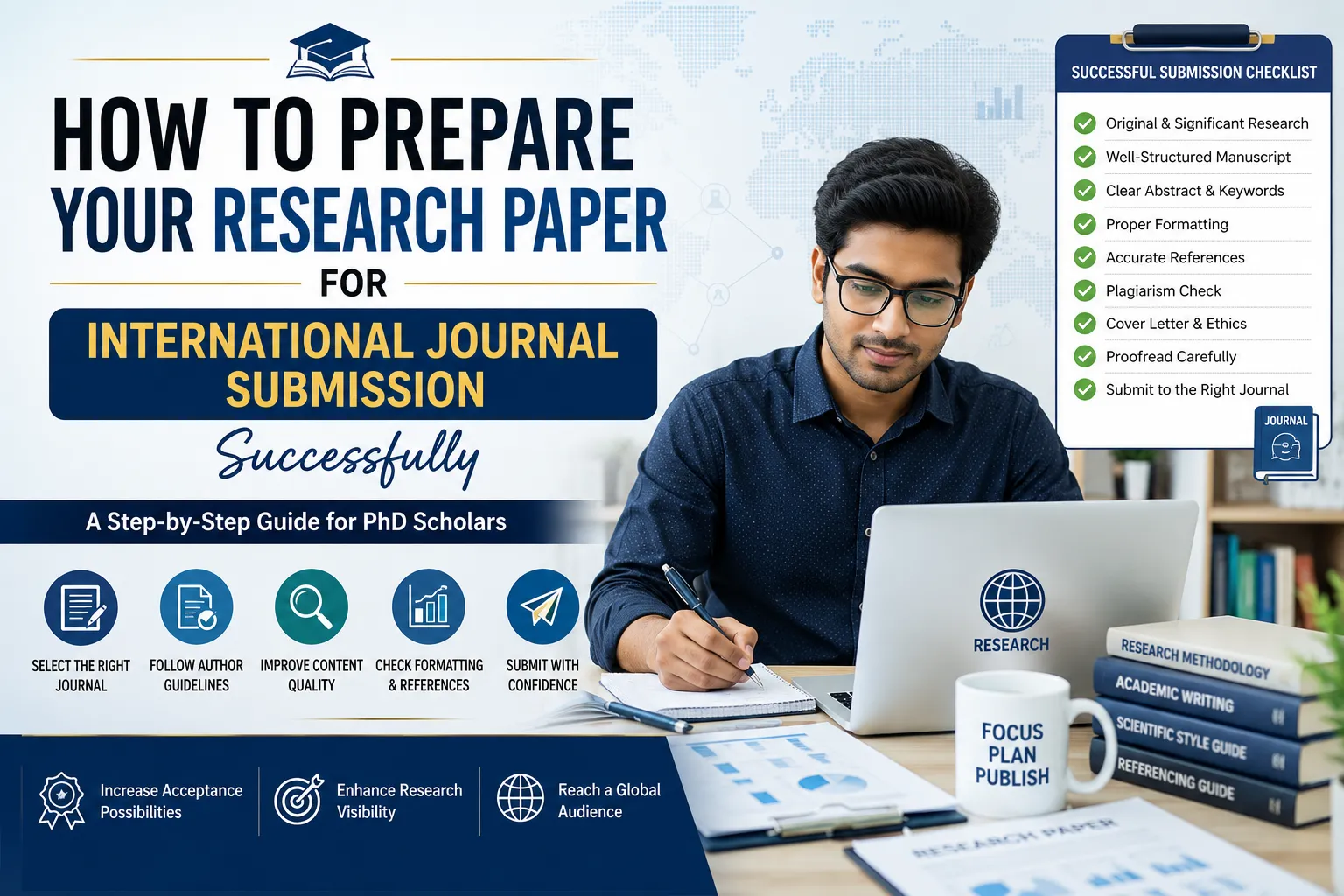
Practical Checklist Before Journal Submission
Before clicking "Submit," ensure that you can answer "Yes" to the following questions:
- Does my study make an original contribution?
- Have I selected the right journal?
- Does my manuscript follow the journal's author guidelines?
- Is the title informative and concise?
- Does the abstract accurately summarize the study?
- Have I included appropriate keywords?
- Is my methodology described clearly?
- Are the results reported accurately?
- Does the discussion explain the significance of the findings?
- Are all references complete and correctly formatted?
- Have I checked for plagiarism?
- Is the manuscript free from grammar and spelling errors?
- Have I written a professional cover letter?
- Have all authors approved the final version?
Completing this checklist reduces the likelihood of avoidable rejection.
Tips for Increasing Your Chances of Acceptance
Although no submission is guaranteed to be accepted, you can improve your chances by following these recommendations:
- Target a journal that aligns closely with your research topic.
- Read several recently published articles from your chosen journal to understand its style and expectations.
- Highlight the novelty and practical significance of your work.
- Write clearly and avoid unnecessary complexity.
- Use current, high-quality references.
- Ensure your figures and tables are publication-ready.
- Revise the manuscript multiple times before submission.
- Seek feedback from supervisors or experienced colleagues.
- Be prepared to revise the manuscript based on reviewer comments.
Persistence is a key part of academic publishing. Even experienced researchers receive revision requests and occasional rejections.
Conclusion
Preparing a research paper for international journal submission is a detailed process that extends well beyond completing the research itself. Successful publication requires careful journal selection, adherence to author guidelines, strong academic writing, ethical compliance, accurate data presentation, and thoughtful responses to reviewer feedback. Every stage—from crafting a compelling title and abstract to formatting references correctly—contributes to the overall quality and professionalism of your manuscript.
By focusing on originality, methodological rigor, clarity, and attention to detail, you can significantly improve your chances of publication in reputable international journals. Remember that rejection is not necessarily a reflection of poor research; it is often part of the scholarly publishing process. Constructive reviewer feedback can strengthen your work and prepare it for eventual acceptance.
Whether you are submitting your first manuscript or expanding your publication record, approaching the process systematically will help you avoid common mistakes and present your research with confidence. With persistence, continuous learning, and a commitment to high academic standards, your research can reach a global audience and make a meaningful contribution to your field.
Call / WhatsApp: +91 96438 02216
Website:www.ThesisLikho.com