
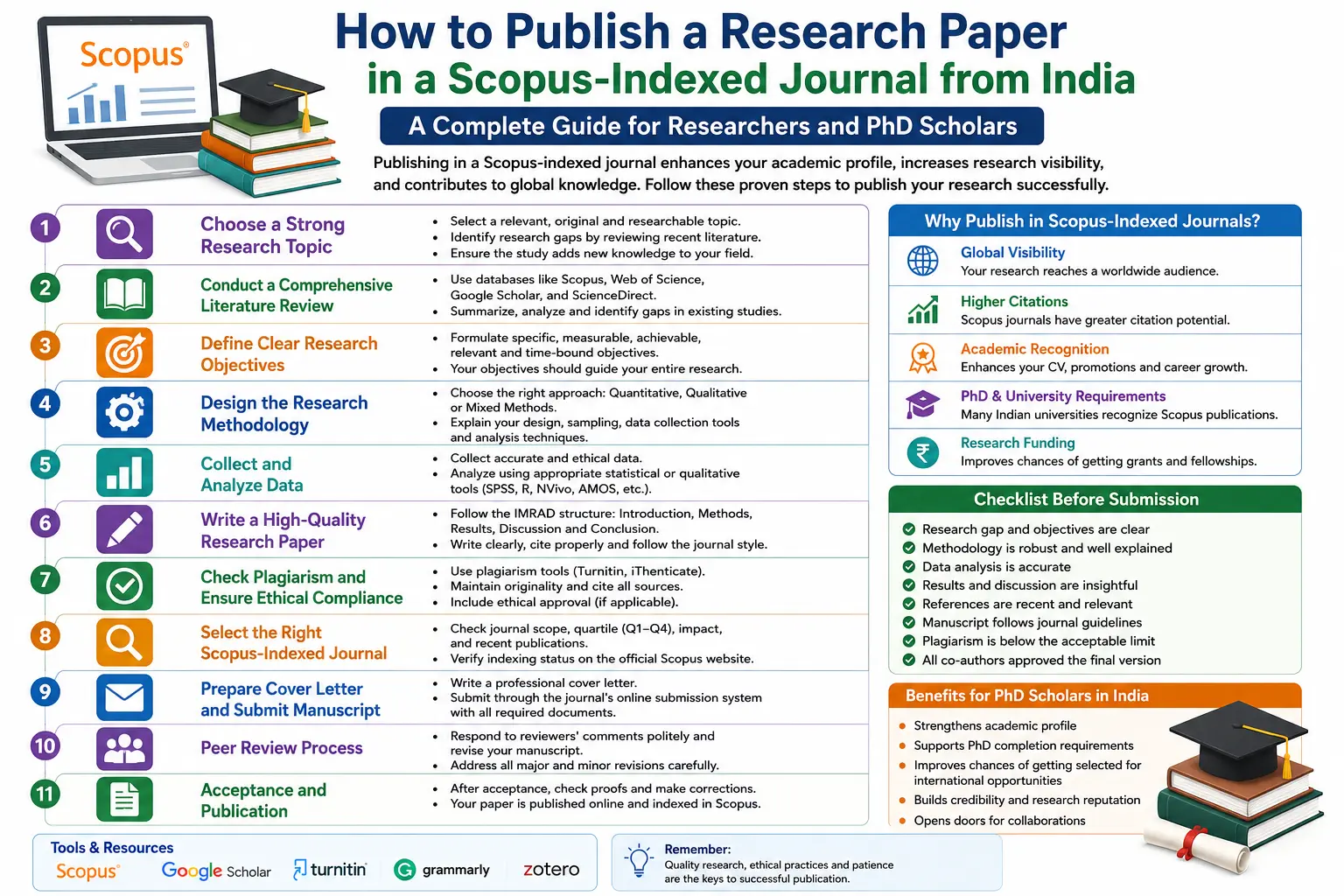
Publishing a research paper in a Scopus-indexed journal is a significant milestone for any researcher, faculty member, or PhD scholar. In India, Scopus publications are often considered a benchmark of academic excellence and are highly valued by universities, research institutions, employers, and funding agencies.
Whether you are pursuing a PhD, working as a faculty member, or conducting independent research, publishing in a Scopus-indexed journal can improve your academic profile, increase research visibility, and open doors to global collaborations.
However, many Indian researchers struggle to understand the publication process. Questions like "How do I get my paper published in a Scopus journal?", "How much does it cost?", "How long does it take?", and "How can I avoid fake journals?" are extremely common.
This comprehensive guide explains the complete process of publishing a research paper in a Scopus-indexed journal from India.
What Is a Scopus-Indexed Journal?
Scopus is one of the world's largest databases of peer-reviewed academic literature. It indexes thousands of high-quality journals across disciplines including engineering, management, medicine, social sciences, computer science, education, and humanities.
A Scopus-indexed journal is a journal that has passed strict evaluation criteria related to:
- Peer-review quality
- Editorial standards
- Research ethics
- Publication consistency
- Citation impact
- Academic contribution
Because of these standards, Scopus-indexed journals are considered credible and internationally recognized.
Why Is Publishing in a Scopus Journal Important?
Publishing in a Scopus-indexed journal provides several academic and professional benefits.
International Recognition
Research published in Scopus journals becomes accessible to scholars worldwide.
Higher Citation Potential
Scopus journals generally receive greater visibility, increasing the likelihood of citations.
Strong Academic Profile
Publications strengthen:
- PhD applications
- Academic CVs
- Faculty recruitment applications
- Promotion cases
Better Career Opportunities
Many universities and organizations prefer candidates with Scopus publications.
Funding and Grants
Funding agencies often evaluate publication quality before awarding grants.
Who Should Publish in Scopus Journals?
Scopus publications are valuable for:
- PhD Scholars
- Research Scholars
- Faculty Members
- Assistant Professors
- Associate Professors
- Scientists
- Industry Researchers
- Postgraduate Students
Even MBA and MTech students can benefit from publishing quality research.
Step 1: Choose a Strong Research Topic
The publication journey starts with selecting the right research topic.
A strong topic should be:
Original
The study should contribute new knowledge.
Relevant
The topic should address current challenges or opportunities.
Researchable
Sufficient data and resources should be available.
Significant
The findings should matter to researchers, practitioners, or policymakers.
How to Find a Research Gap
Most publishable papers emerge from identifying a gap in existing literature.
You can identify research gaps by:
- Reading recent journal articles
- Reviewing systematic literature reviews
- Examining limitations of previous studies
- Exploring emerging technologies and trends
Questions to ask include:
- What remains unanswered?
- What contradictions exist in previous findings?
- What new perspective can I provide?
Step 2: Conduct an Extensive Literature Review
A literature review helps establish the theoretical foundation of your study.
It allows researchers to:
- Understand existing knowledge
- Identify gaps
- Develop hypotheses
- Build conceptual frameworks
Use trusted sources such as:
- Scopus
- Google Scholar
- Web of Science
- PubMed
- IEEE Xplore
- ScienceDirect
Avoid relying on blogs and non-academic websites.
Step 3: Develop Research Objectives
Research objectives guide the entire study.
Good objectives should be:
- Clear
- Specific
- Measurable
- Relevant
Example:
"To investigate the impact of artificial intelligence adoption on business performance among Indian SMEs."
Well-defined objectives improve manuscript quality and reviewer acceptance.
Step 4: Select an Appropriate Research Methodology
A robust methodology is essential for publication success.
The methodology explains how the research was conducted.
Quantitative Research
Involves numerical analysis.
Examples include:
- Surveys
- Experiments
- Statistical modeling
Qualitative Research
Focuses on understanding experiences and perceptions.
Methods include:
- Interviews
- Focus groups
- Case studies
Mixed Methods Research
Combines quantitative and qualitative approaches.
Many high-impact studies use mixed methods.
Step 5: Collect and Analyze Data
Data collection should follow scientific and ethical standards.
Common methods include:
- Online surveys
- Interviews
- Observations
- Experiments
- Secondary databases
Data Analysis Tools
Researchers commonly use:
- SPSS
- R
- Python
- STATA
- SmartPLS
- AMOS
- NVivo
The selected analytical method should align with the research objectives.
Step 6: Write the Research Paper
Most Scopus journals follow the IMRAD format.
IMRAD stands for:
- Introduction
- Methods
- Results
- And
- Discussion
Writing an Effective Title
The title should:
- Clearly describe the study
- Include important keywords
- Reflect the main contribution
Example:
"The Impact of Artificial Intelligence Adoption on Operational Efficiency in Indian Manufacturing SMEs"
Avoid vague titles that do not explain the research focus.
Writing the Abstract
The abstract summarizes the paper.
It typically includes:
- Background
- Objectives
- Methodology
- Key findings
- Conclusion
Many readers decide whether to read the full paper based on the abstract.
Writing the Introduction
The introduction should explain:
- Background of the study
- Research problem
- Literature gap
- Research objectives
- Significance of the study
A compelling introduction captures the attention of reviewers and editors.
Writing the Literature Review
The literature review should:
- Discuss relevant studies
- Compare findings
- Identify gaps
- Establish theoretical foundations
Avoid simply summarizing previous papers.
Instead, synthesize information into meaningful themes.
Writing the Methodology Section
This section should describe:
Research Design
Explain the overall approach.
Sampling
Describe sample selection procedures.
Data Collection
Explain how data were gathered.
Analysis Techniques
Specify statistical tests and software used.
Transparency increases credibility.
Writing Results
Present findings objectively.
Use:
- Tables
- Charts
- Graphs
- Statistical outputs
Do not over-interpret findings in this section.
Writing Discussion and Conclusion
The discussion should explain:
- What the findings mean
- How they compare with previous studies
- Practical implications
- Theoretical contributions
The conclusion should summarize key findings and provide recommendations for future research.
Step 7: Check for Plagiarism
Before submission, ensure originality.
Most journals use plagiarism-detection tools.
To avoid plagiarism:
- Cite all sources properly
- Use quotation marks where necessary
- Paraphrase carefully
- Avoid copying text
Generally, lower similarity scores improve publication prospects.
Step 8: Identify the Right Scopus Journal
Choosing the correct journal significantly improves acceptance chances.
Check Journal Scope
Read the journal's aims and scope carefully.
Your manuscript should align closely with the journal's focus.
Review Previously Published Articles
Analyze:
- Research topics
- Methodologies
- Writing style
This helps determine journal suitability.
Understand Journal Quartiles
Scopus journals are categorized into:
Q1
Top 25% journals in a field.
Q2
Strong journals with good impact.
Q3
Moderate-impact journals.
Q4
Entry-level indexed journals.
First-time authors often begin with Q3 or Q4 journals.
Step 9: Verify Journal Authenticity
Many predatory journals falsely claim Scopus indexing.
Always verify indexing independently.
Red Flags
Avoid journals that:
- Guarantee publication
- Promise acceptance within days
- Have fake editorial boards
- Lack peer-review information
- Send aggressive solicitation emails
Legitimate journals never guarantee publication.
Step 10: Prepare a Cover Letter
A professional cover letter introduces your manuscript to the editor.
Include:
- Manuscript title
- Research significance
- Originality statement
- Journal relevance
- Conflict of interest declaration
A strong cover letter creates a positive first impression.
Step 11: Submit Your Manuscript
Most journals use online submission systems.
Typically required documents include:
- Manuscript
- Cover letter
- Figures and tables
- Ethical declarations
- Author information
Carefully review all files before submission.
Step 12: Understand the Peer Review Process
After submission, the manuscript enters peer review.
Reviewers evaluate:
- Originality
- Methodology
- Literature review
- Data analysis
- Contribution to knowledge
Possible decisions include:
Accept
Rare during the first review cycle.
Minor Revision
Small changes required.
Major Revision
Substantial improvements requested.
Reject
The manuscript is unsuitable in its current form.
Most accepted papers undergo at least one revision round.
Step 13: Respond to Reviewer Comments
Respond professionally and systematically.
Best practices include:
- Address every comment
- Remain respectful
- Explain revisions clearly
- Highlight manuscript changes
A detailed response letter significantly improves acceptance chances.
Step 14: Acceptance and Publication
Once accepted:
- Copyediting begins
- Proofs are generated
- Final corrections are made
- Online publication occurs
The entire process may take anywhere from three months to one year depending on the journal.
How Much Does It Cost to Publish in a Scopus Journal?
Publication costs vary.
Some journals charge:
- No fees at all
- Article Processing Charges (APCs)
- Open-access publication fees
Charges can range from a few thousand rupees to several lakhs depending on the publisher and publication model.
Always review fee policies before submission.
Common Reasons Scopus Papers Get Rejected
Many papers are rejected because of:
- Weak research design
- Poor methodology
- Limited originality
- Journal mismatch
- Poor academic writing
- Inadequate literature review
- Ethical issues
- Statistical errors
Understanding these issues helps researchers avoid common pitfalls.
Tips for Indian Researchers
Start Publishing Early
Do not wait until the final year of your PhD.
Focus on Quality
Quality matters more than quantity.
Seek Guidance
Work closely with supervisors and mentors.
Improve Academic Writing
Clear writing improves reviewer perception.
Stay Updated
Read recent journal articles regularly.
Future Trends in Academic Publishing
Research publishing continues to evolve.
Important trends include:
- Open Access Publishing
- AI-Assisted Editorial Systems
- Open Peer Review
- Research Data Sharing
- Interdisciplinary Collaboration
Researchers who adapt to these developments will remain competitive in the global academic landscape.
Final Checklist Before Submission
✅ Research gap identified
✅ Literature review completed
✅ Objectives clearly defined
✅ Methodology explained
✅ Results accurately presented
✅ Discussion completed
✅ References formatted correctly
✅ Plagiarism checked
✅ Journal selected carefully
✅ Cover letter prepared
Conclusion
Publishing a research paper in a Scopus-indexed journal from India is a valuable achievement that enhances academic credibility, career prospects, and research visibility. Although the process may appear complex, it becomes manageable when approached systematically. By selecting a meaningful research problem, conducting rigorous research, writing a high-quality manuscript, choosing the right journal, and responding professionally to reviewer feedback, researchers can significantly improve their chances of publication success.
For PhD scholars, faculty members, and aspiring researchers, Scopus publications represent more than academic requirements—they are opportunities to contribute to global knowledge, establish expertise, and build a strong research career. With careful planning, persistence, and commitment to quality, publishing in a Scopus-indexed journal is an achievable goal.
Contact ThesisLikho Today
Call / WhatsApp: +91 96438 02216
Visit: ThesisLikho.com