
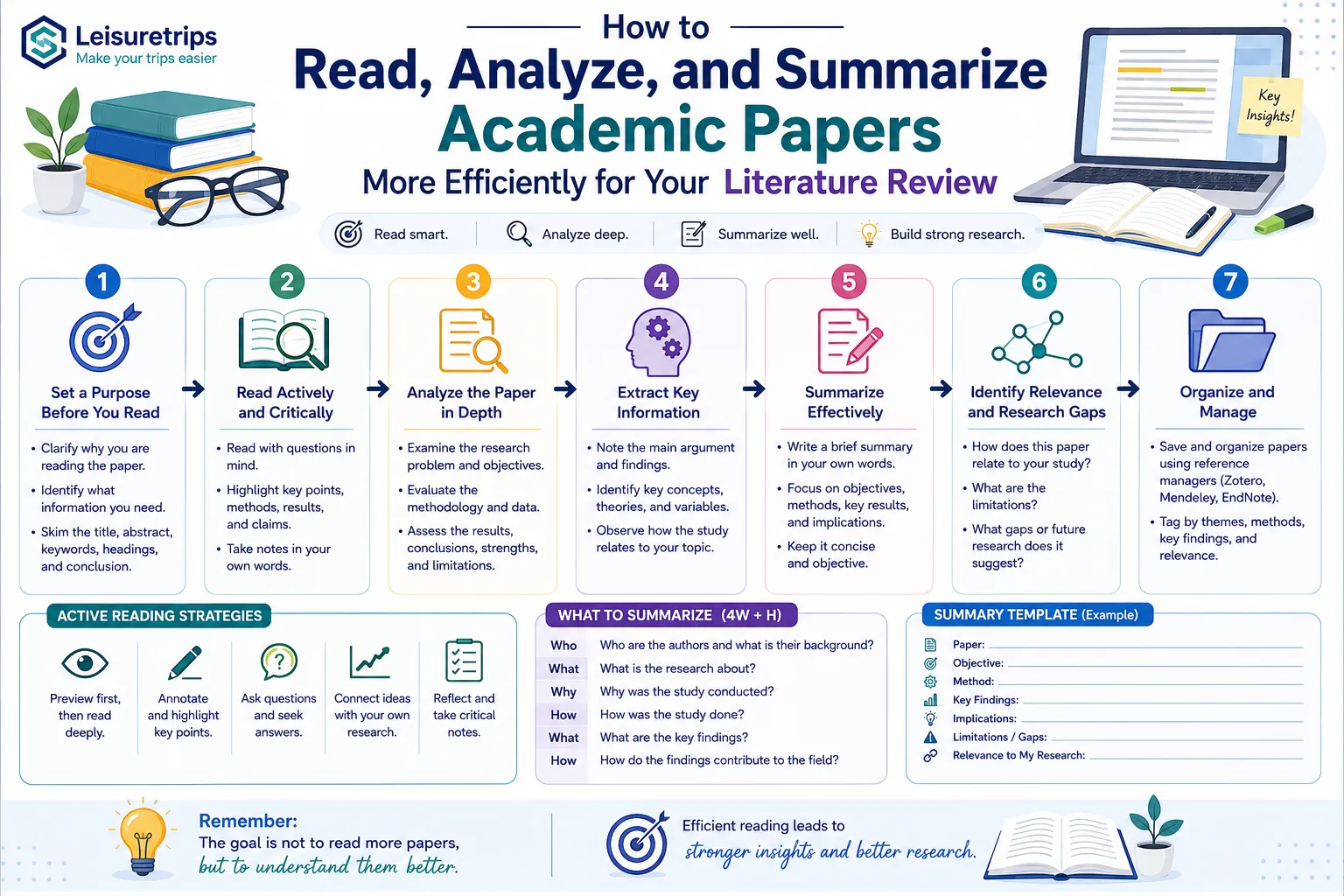
One of the biggest challenges every PhD scholar faces is reading academic papers efficiently. A literature review often requires reading hundreds of journal articles, conference papers, books, theses, and reports. However, many researchers make the mistake of trying to read every paper from beginning to end like a textbook. This approach is time-consuming, mentally exhausting, and often unproductive.
The purpose of reading academic papers is not simply to collect information—it is to critically evaluate existing research, identify gaps, compare methodologies, understand theories, and build a strong foundation for your own study.
For Indian PhD scholars, efficient reading and summarization skills are particularly important because universities expect a comprehensive and critical literature review rather than a simple collection of article summaries. Learning how to analyze research papers strategically can save hundreds of hours and significantly improve the quality of your thesis.
This comprehensive guide explains how to read, analyze, and summarize academic papers more efficiently, helping you write a stronger literature review while avoiding common mistakes.
Why Reading Academic Papers Efficiently Matters
A literature review is not about reading the greatest number of papers. It is about understanding the most relevant and high-quality research.
Efficient reading helps you:
- Save valuable research time.
- Identify research gaps quickly.
- Understand different research methodologies.
- Build stronger theoretical arguments.
- Compare findings across multiple studies.
- Avoid duplicate research.
- Improve critical thinking.
- Write a coherent literature review.
Instead of spending several hours on one paper, an experienced researcher often determines its relevance within 15–30 minutes.
Understanding the Purpose of Your Literature Review
Before reading any article, remind yourself why you are reading it.
A literature review aims to:
- Understand existing knowledge.
- Identify unresolved problems.
- Compare theories and models.
- Examine research methodologies.
- Evaluate strengths and weaknesses.
- Identify future research opportunities.
Every paper you read should contribute to one or more of these objectives.
Step 1: Define Your Research Focus First
Many scholars begin downloading articles before clearly defining their research topic. This often leads to information overload.
Before searching for papers, write down:
- Research topic
- Research problem
- Objectives
- Research questions
- Keywords
- Related concepts
Example:
Research Topic:
"Digital Financial Inclusion Among Rural Women in India."
Keywords:
- Digital banking
- Financial inclusion
- Rural finance
- Mobile banking
- FinTech
- Women's empowerment
- Digital literacy
Having a clear focus helps you filter irrelevant studies.
Step 2: Search Reliable Academic Sources
Use trusted databases instead of relying on random internet searches.
Recommended sources include:
- Google Scholar
- Scopus
- Web of Science
- JSTOR
- ScienceDirect
- SpringerLink
- Wiley Online Library
- Taylor & Francis Online
- IEEE Xplore (Engineering)
- PubMed (Medical Sciences)
- Shodhganga (Indian theses)
- UGC CARE-listed journals
Choose recent, peer-reviewed publications whenever possible, while including seminal papers that are foundational to your topic.
Step 3: Don't Read Every Paper Completely
A common misconception among new researchers is that every paper must be read line by line.
Instead, use a three-stage reading strategy.
Stage 1: Quick Screening (5 Minutes)
Read:
- Title
- Abstract
- Keywords
- Conclusion
Ask:
- Is this relevant?
- Does it match my objectives?
- Is it recent?
- Is it peer-reviewed?
If the answer is "no," move on.
Stage 2: Strategic Reading (15–20 Minutes)
If the paper appears useful, focus on:
- Introduction
- Literature review
- Methodology
- Results
- Discussion
Highlight:
- Main arguments
- Research methods
- Variables
- Key findings
- Limitations
Stage 3: Critical Reading
Only conduct a detailed reading for papers that are highly relevant to your research.
These studies may later become central references in your thesis.
Step 4: Learn the Structure of an Academic Paper
Understanding how research papers are organized helps you locate information quickly.
Title
Indicates the study's main focus.
Abstract
Provides a concise overview of:
- Objectives
- Methodology
- Findings
- Conclusions
Introduction
Explains:
- Background
- Research problem
- Objectives
- Significance
Literature Review
Summarizes previous studies and identifies research gaps.
Methodology
Describes:
- Research design
- Sample
- Data collection
- Analytical methods
Results
Presents findings through tables, figures, and statistical analyses.
Discussion
Interprets findings and compares them with existing literature.
Conclusion
Summarizes the study and suggests future research directions.
Knowing this structure allows you to focus on sections most relevant to your review.
Step 5: Ask Critical Questions While Reading
Reading should be an active process.
Ask yourself:
- What problem does this study address?
- Why is the study important?
- Which theory is used?
- What methodology was adopted?
- What are the major findings?
- What are the limitations?
- How does this study relate to my research?
- What research gap still exists?
These questions encourage analytical thinking rather than passive reading.
Step 6 : Identify Research Gaps
Your literature review should do more than summarize studies—it should reveal what is still unknown.
Look for:
- Small sample sizes
- Limited geographical coverage
- Contradictory findings
- Outdated data
- Methodological weaknesses
- Underrepresented populations
- Emerging technologies
- New policy contexts
These gaps often provide opportunities for original research.
Step 7 : Summarize Papers in Your Own Words
Never copy text directly unless quoting.
Instead of writing:
"Technology adoption depends upon organizational readiness."
Write:
The study concluded that organizations with higher levels of preparedness were more likely to adopt new technologies successfully.
Paraphrasing demonstrates understanding and reduces the risk of plagiarism.
Step 8: Organize Papers by Themes
Instead of arranging articles chronologically, group them by themes.
Example:
Theme 1: Digital Banking Adoption
- Trust
- Security
- Ease of use
Theme 2: Financial Inclusion
- Rural populations
- Government initiatives
- Digital literacy
Theme 3: Technology Acceptance
- TAM
- UTAUT
- Innovation Diffusion Theory
A thematic organization creates a more coherent literature review.
Use the SQ3R Method for Academic Reading
The SQ3R method is an effective strategy for processing research papers.
Survey
Skim the paper to understand its structure.
Question
Develop questions before reading.
Read
Read actively to answer those questions.
Recite
Summarize the key points in your own words.
Review
Revisit your notes after a few days to reinforce understanding.
Use a Literature Matrix
A literature matrix allows you to compare multiple studies efficiently.
Suggested columns include:
- Author
- Year
- Country
- Objectives
- Theory
- Methodology
- Sample
- Variables
- Findings
- Limitations
- Research Gap
- Relevance
Updating the matrix after reading each paper will make writing your literature review much easier.
Best AI and Digital Tools for Reading Academic Papers
Technology can significantly improve your reading efficiency.
Zotero
- Organizes references
- Stores PDFs
- Creates citations
- Adds notes
Mendeley
- PDF annotation
- Citation management
- Collaboration
EndNote
- Advanced reference organization
- Thousands of citations
- Multiple citation styles
Notion
Ideal for organizing summaries, themes, and research plans.
Microsoft OneNote
Useful for structured note-taking and multimedia content.
ChatGPT
Can help explain complex concepts, summarize ideas you've already read, generate comparison tables, and suggest thematic groupings. Always verify outputs against the original source and avoid using AI-generated summaries as substitutes for reading the paper yourself.
Common Mistakes Researchers Make
Avoid these common pitfalls.
Reading Everything
Not every article deserves detailed attention.
Ignoring the Research Gap
Many students summarize papers without identifying what remains unexplored.
Highlighting Entire Pages
Too much highlighting defeats the purpose.
Highlight only essential points.
Reading Without Notes
Information is easily forgotten.
Always summarize immediately after reading.
Copy-Pasting
Copying text increases plagiarism risk.
Paraphrase instead.
Ignoring Older Landmark Studies
While recent research is important, foundational theories and landmark papers should not be overlooked.
Practical Tips for Indian PhD Scholars
If you are pursuing a PhD in India, these strategies can improve your literature review:
- Follow your university's preferred citation style (APA, MLA, Chicago, IEEE, etc.).
- Include relevant Indian studies alongside international research.
- Use Shodhganga to explore completed Indian theses.
- Review UGC CARE-listed journals for credible sources.
- Maintain a chapter-wise folder for your reading materials.
- Discuss important papers with your supervisor to ensure they are relevant to your research direction.
- Set a weekly reading target, such as five to ten quality papers, instead of downloading large numbers that remain unread.
Weekly Literature Review Workflow
A structured workflow helps maintain consistency.
Monday: Search for new papers using relevant databases.
Tuesday: Screen abstracts and download the most relevant studies.
Wednesday: Read and annotate selected papers.
Thursday: Summarize findings and update your literature matrix.
Friday: Identify common themes, contradictions, and research gaps.
Weekend: Review your notes and discuss key insights with your supervisor or research group if possible.
This routine helps you build your literature review gradually rather than rushing at the end.
Frequently Asked Questions (FAQs)
How many papers should I read for a PhD literature review?
There is no fixed number. Focus on reading enough high-quality, relevant literature to understand your research area, identify gaps, and justify your study. Quality is more important than quantity.
How long should it take to read one academic paper?
An initial screening usually takes 5–10 minutes. A strategic reading may take 20–30 minutes, while an in-depth analysis of a highly relevant paper can take an hour or more.
Should I read every section of a paper?
No. Start with the title, abstract, introduction, and conclusion. Read the methodology and results in detail only if the paper is closely related to your research.
How do I avoid plagiarism when summarizing papers?
Write summaries in your own words, include proper citations, record page numbers for direct quotations, and avoid copying sentences unless they are quoted appropriately.
What is the best way to organize academic papers?
Use a reference management tool such as Zotero, Mendeley, or EndNote, create topic-based folders, and maintain a literature matrix to compare studies systematically.
Conclusion
Reading academic papers efficiently is a skill that every PhD scholar develops over time. Rather than attempting to read every article from beginning to end, focus on strategic reading, critical analysis, and structured note-taking. By understanding the purpose of each paper, asking analytical questions, comparing studies, and organizing your findings thematically, you can build a literature review that is both comprehensive and insightful.
For Indian PhD scholars, combining disciplined reading habits with modern research tools such as Zotero, Mendeley, Notion, and literature matrices can dramatically improve productivity and reduce the stress of thesis writing. Most importantly, remember that the goal of a literature review is not to summarize everything that has been published—it is to critically evaluate existing knowledge, identify meaningful research gaps, and establish a strong foundation for your own original contribution to the field.
A well-organized and thoughtfully analyzed literature review not only strengthens your thesis but also demonstrates the depth of your scholarship and your ability to engage critically with academic research.
Call / WhatsApp: +91 96438 02216
Website:www.ThesisLikho.com