
Introduction
Writing a thesis is one of the most significant milestones in a student's academic journey. Whether you are pursuing a Master's degree, MPhil, or PhD, your thesis demonstrates your ability to conduct independent research, analyze information critically, and contribute original knowledge to your field. However, one of the biggest challenges researchers face during thesis writing is avoiding plagiarism.
Plagiarism is not limited to intentionally copying someone else's work. In many cases, students unknowingly commit plagiarism by improperly paraphrasing sources, forgetting citations, reusing content, or relying too heavily on existing literature. With universities increasingly using advanced plagiarism detection software such as Turnitin, iThenticate, and Ouriginal, even minor mistakes can result in high similarity scores and delays in thesis approval.
In 2026, academic institutions are paying closer attention to research integrity than ever before. Therefore, understanding how to reduce plagiarism effectively is essential for every research scholar.
This comprehensive guide explores ten practical and proven strategies that help reduce plagiarism in your thesis while maintaining academic quality and originality.
What Is Plagiarism in a Thesis?
Plagiarism occurs when you use another person's ideas, words, data, images, or research findings without proper acknowledgment.
Common forms of plagiarism include:
- Direct copying
- Improper paraphrasing
- Missing citations
- Self-plagiarism
- Mosaic plagiarism
- Source-based plagiarism
Even accidental plagiarism can lead to serious academic consequences.
Why Reducing Plagiarism Is Important
Reducing plagiarism is about more than simply lowering a similarity percentage.
A plagiarism-free thesis helps:
- Demonstrate original thinking
- Improve academic credibility
- Meet university requirements
- Avoid disciplinary action
- Increase publication opportunities
- Strengthen research integrity
Universities expect scholars to build upon existing knowledge while clearly distinguishing their own contributions from previous research.
Understanding Similarity Score vs Plagiarism
Many students assume that any similarity percentage automatically indicates plagiarism.
This is not always true.
Similarity Score
A similarity score simply indicates how much text matches existing sources.
Plagiarism
Plagiarism occurs when those matches are not properly cited or acknowledged.
For example:
- Correctly cited quotations may increase similarity.
- Reference lists may contribute to similarity.
- Technical terms often produce unavoidable matches.
Therefore, the goal should not be achieving a zero similarity score but ensuring proper attribution and originality.
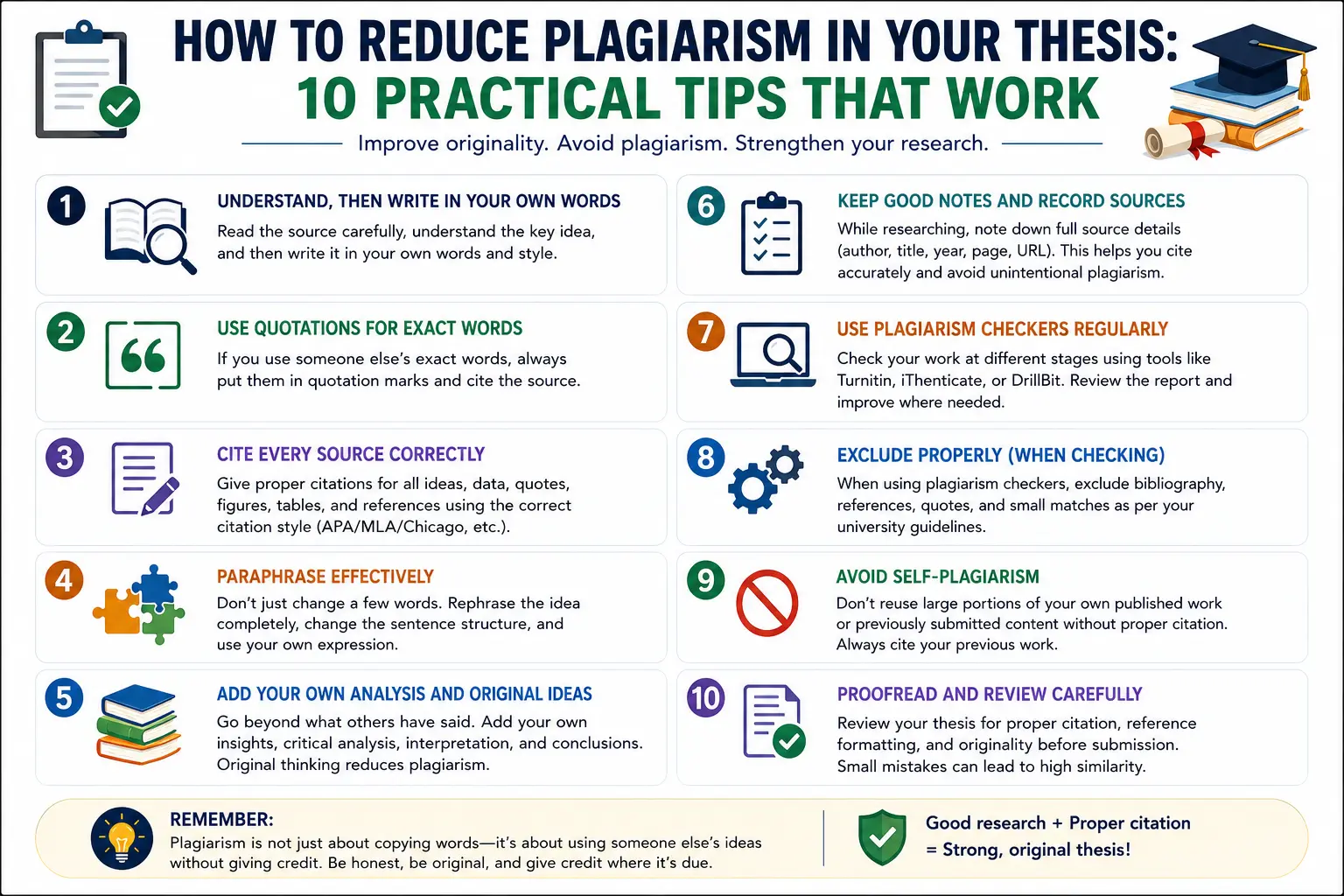
10 Practical Tips to Reduce Plagiarism in Your Thesis
1. Start Writing in Your Own Words from the Beginning
One of the most effective ways to avoid plagiarism is to write notes in your own words while reading research papers.
Many students copy passages into their notes with the intention of editing them later. Unfortunately, these copied sections often remain unchanged and eventually appear in the thesis.
Better Approach
Instead of copying:
- Read a paragraph.
- Understand the concept.
- Close the source.
- Write the idea in your own words.
This habit significantly reduces plagiarism risks.
Benefits
- Improves comprehension
- Enhances critical thinking
- Produces more original writing
2. Learn Proper Paraphrasing Techniques
Paraphrasing is one of the most important academic writing skills.
Many researchers believe replacing a few words with synonyms is sufficient.
It is not.
Poor Paraphrasing Example
Original:
"Climate change significantly affects agricultural productivity."
Poor paraphrase:
"Climate change greatly impacts agricultural productivity."
The structure remains almost identical.
Effective Paraphrasing
"Agricultural output is increasingly influenced by changing climatic conditions."
The sentence structure and wording are different while preserving meaning.
Key Rule
Rewrite ideas—not just words.
3. Cite Every Source Correctly
Proper citation is the foundation of ethical academic writing.
Whenever you use:
- Ideas
- Data
- Statistics
- Theories
- Models
- Images
- Tables
you must provide appropriate citations.
Common Citation Styles
- APA
- MLA
- Chicago
- Harvard
- IEEE
Always follow your university's preferred format.
Why It Matters
Even perfectly paraphrased content requires citation because the original idea belongs to another author.
4. Keep Detailed Research Notes
Poor note-taking often contributes to accidental plagiarism.
Researchers frequently forget where specific information originated.
Best Practices
Create organized notes containing:
- Author name
- Publication year
- Journal title
- Key findings
- Page numbers
- Direct quotations
Using reference management software can simplify this process.
Recommended Tools
- Zotero
- Mendeley
- EndNote
Good note organization reduces citation errors significantly.
5. Use Quotations Sparingly and Correctly
Direct quotations have a place in academic writing but should be used carefully.
When to Quote
Use quotations when:
- The wording is particularly important.
- The statement is historically significant.
- The original phrasing carries special meaning.
How to Quote
- Use quotation marks.
- Include page numbers.
- Provide proper citations.
Avoid Overuse
A thesis filled with quotations may appear less original.
Most supervisors prefer paraphrased content supported by citations.
6. Avoid Copy-Pasting from Multiple Sources
Many students unintentionally create what is known as mosaic plagiarism.
This occurs when content from multiple sources is combined with minor modifications.
Example
Taking:
- One sentence from Article A
- Two sentences from Article B
- Several phrases from Article C
and combining them into one paragraph.
Even if the sources are cited, excessive reliance on copied phrasing can still be problematic.
Better Strategy
Read multiple sources, understand the overall concept, and then create a completely original synthesis.
7. Use Plagiarism Detection Software Before Submission
Never wait for your university to conduct the first plagiarism check.
Perform your own review beforehand.
Popular Tools
- Turnitin
- iThenticate
- Ouriginal (Urkund)
- Grammarly Plagiarism Checker
- Copyleaks
What to Look For
Review:
- High similarity sections
- Uncited matches
- Poorly paraphrased content
- Repeated phrases
Early detection allows time for corrections.
8. Be Careful with Self-Plagiarism
Many researchers focus only on avoiding plagiarism from others and overlook self-plagiarism.
What Is Self-Plagiarism?
Self-plagiarism occurs when you reuse your previously published work without proper acknowledgment.
Common Examples
- Reusing journal articles in a thesis
- Copying conference papers
- Recycling literature review sections
Solution
Always cite your earlier work when reusing content.
Transparency is essential.
9. Synthesize Information Instead of Rewriting Source by Source
One hallmark of high-quality research writing is synthesis.
Poor Literature Review
"Author A found X. Author B found Y. Author C found Z."
This approach often leads to excessive dependence on source material.
Strong Literature Review
"Recent studies suggest that digital learning environments improve student engagement, accessibility, and academic performance."
This integrates multiple findings into a cohesive argument.
Benefits
- Demonstrates critical thinking
- Improves originality
- Reduces plagiarism risk
10. Leave Time for Editing and Revision
Many plagiarism issues arise because students rush submissions.
When deadlines approach, researchers may:
- Copy text temporarily
- Forget citations
- Skip proofreading
Revision Strategy
Allocate time for:
- Citation checks
- Paraphrasing review
- Similarity analysis
- Supervisor feedback
A well-edited thesis is usually a more original thesis.
Common Causes of High Similarity Scores
Understanding why similarity occurs helps researchers address problems effectively.
Technical Terminology
Certain terms cannot be paraphrased.
Standard Methodology Descriptions
Research procedures often require specific language.
Literature Review Overlap
Extensive discussion of established theories may produce unavoidable similarities.
Improper Citation
Missing references significantly increase plagiarism concerns.
How Much Similarity Is Acceptable?
There is no universal standard.
Different universities have different thresholds.
Typical expectations may range between:
- Below 10%: Excellent
- 10–20%: Generally acceptable
- Above 20%: May require revision
However, context matters more than percentages.
A 15% similarity score with proper citations is often less problematic than a 5% score containing uncited copied text.
The Role of AI in Thesis Writing
In 2026, many students use AI tools to assist with writing.
Acceptable Uses
- Grammar improvement
- Outline creation
- Brainstorming
- Language refinement
Risks
- AI-generated plagiarism
- Incorrect citations
- Fabricated references
- Overdependence
Researchers should always review and personalize AI-assisted content.
Best Practices for Maintaining Academic Integrity
To ensure a plagiarism-free thesis:
Write Regularly
Develop your own academic voice.
Understand Before Writing
Never paraphrase content you do not understand.
Track Every Source
Maintain accurate citation records.
Use Reference Managers
Automate citation management where possible.
Review Similarity Reports Carefully
Interpret matches thoughtfully rather than focusing solely on percentages.
Plagiarism Reduction Checklist
Before submitting your thesis, ask yourself:
- Have I cited every source?
- Have I paraphrased effectively?
- Have I checked quotations?
- Have I reviewed similarity reports?
- Have I cited reused content?
- Have I verified references?
- Have I synthesized literature appropriately?
If the answer is yes, your thesis is likely much closer to meeting academic integrity standards.
Future of Plagiarism Detection in 2026 and Beyond
Academic integrity technologies continue to evolve.
Emerging developments include:
AI-Powered Similarity Analysis
Detection of conceptual overlap rather than exact wording.
AI Writing Detection
Identification of machine-generated text.
Citation Verification Systems
Automatic checking of reference accuracy.
Integrated Research Integrity Platforms
Combining:
- Plagiarism detection
- AI detection
- Citation analysis
- Data verification
Researchers must adapt to these increasingly sophisticated systems.
Conclusion
Reducing plagiarism in a thesis is not about manipulating similarity scores or finding shortcuts. It is about developing strong academic writing habits, understanding source material, citing correctly, and contributing original insights to your field.
The ten practical strategies discussed in this guide—ranging from proper paraphrasing and citation practices to plagiarism checking and literature synthesis—provide a solid foundation for producing ethical, high-quality research.
As universities strengthen academic integrity standards in 2026, scholars who prioritize originality and transparency will not only achieve lower similarity scores but also become better researchers and writers.
A plagiarism-free thesis is ultimately a reflection of genuine scholarship, critical thinking, and respect for the academic community.
Frequently Asked Questions (FAQs)
How can I reduce plagiarism in my thesis quickly?
Focus on proper paraphrasing, accurate citations, and reviewing plagiarism reports before submission.
What is the best similarity score for a thesis?
Most universities prefer lower similarity scores, but proper citation is more important than the percentage itself.
Can Turnitin detect paraphrased content?
Yes. Advanced plagiarism software can identify poorly paraphrased material.
Does citing a source eliminate plagiarism?
Citations help, but copied text still requires quotation marks if used verbatim.
Can AI-generated content increase plagiarism?
Yes. AI-generated text may resemble existing sources and should always be reviewed carefully.
What is the most common cause of plagiarism in a thesis?
Improper paraphrasing and missing citations are among the most frequent causes.
Contact ThesisLikho Today
Call / WhatsApp: +91 96438 02216
Visit: ThesisLikho.com