
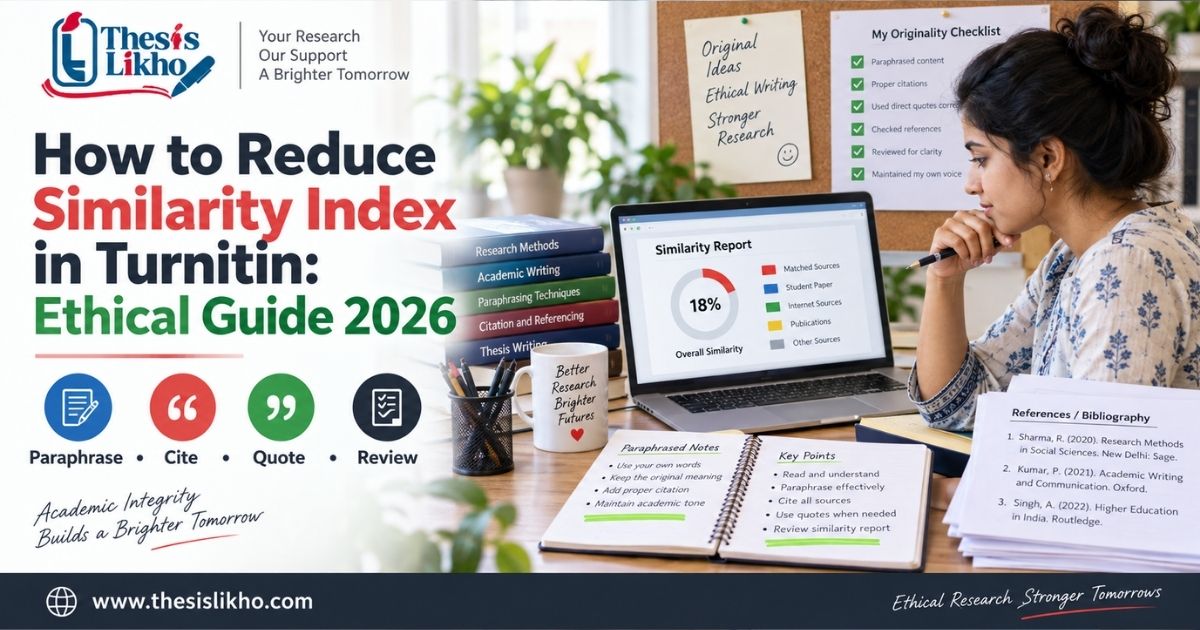
A high Turnitin score can be worrying, but lowering a number without examining the matched sources can create new academic-integrity problems. If you want to know how to reduce the similarity index in Turnitin, begin by reading the Similarity Report match by match. Correct copied wording, weak paraphrasing, missing citations, excessive quotations, repeated template language, and accidental overlap with an earlier submission. ThesisLikho provides ethical report review, citation correction, academic editing, and thesis-formatting support based on your university’s rules. The aim is clearer, properly attributed work—not manipulating Turnitin, hiding sources, or promising an artificial zero score.
Quick Answer
To reduce Turnitin similarity ethically, inspect every significant match, read the source, rewrite the idea from understanding, cite it correctly, limit unnecessary quotations, and correct repeated or copied passages. References or quoted material should be excluded only when your institution permits it. A lower score alone does not prove originality.
Table of Contents
- #similarity-score-is-not-a-plagiarism-verdict
- #common-reasons-for-high-similarity
- Quick Similarity-Correction Guide
- How to Reduce Similarity Index in Turnitin
- What Not to Do
- #synopsis-and-thesis-difference
- #similarity-review-and-editing-support
- Working Process
- #documents-deliverables-cost-and-timeline
- Quality, Ethics and Confidentiality
- #frequently-asked-questions
Similarity Score Is Not a Plagiarism Verdict
Turnitin describes the displayed percentage as a Similarity score, not a plagiarism score. It measures how much submitted text matches material in Turnitin’s databases. A match may be an improperly copied passage, but it may also be a properly quoted sentence, a citation, bibliographic material, a standard technical phrase, or text from the student’s earlier submitted draft. Therefore, the colour or overall percentage cannot be judged without opening the report and reviewing the sources.
A high score does not automatically prove plagiarism, and a low score does not automatically prove that a document follows academic-integrity rules. One uncited copied paragraph may be serious even when the total score is low. Conversely, a paper containing legitimate quotations and references may show a higher percentage while still using sources transparently.
The correct target is the limit and interpretation policy specified by your university, department, supervisor, or journal. Turnitin states that there is no universal “acceptable” or perfect score. Avoid generic claims such as “every university accepts 10%” unless the current policy of the named institution is linked and verified.
Common Reasons for High Similarity
Direct Copying Without Clear Attribution
Text copied from a journal article, thesis, website, report, book, or another student’s work will normally create a strong match. Adding a citation after copied wording does not make the passage a paraphrase. Direct wording must be placed in quotation marks when quotation is permitted, or rewritten independently with proper attribution.
Patchwriting and Synonym Replacement
Changing a few words while preserving the source sentence’s structure is not strong paraphrasing. It may still match, and it can misrepresent another author’s expression as your own. Good paraphrasing requires reading, understanding, setting the source aside, and explaining the idea in a new structure while citing the source.
Missing or Incorrect Citations
A source may be named in the reference list but not cited beside the borrowed idea. The opposite can also occur: an in-text citation exists, but the reference-list entry is incomplete. Both situations require correction even if they do not always change the score substantially.
Excessive Quotations
Correctly quoted material may still appear as matched text. Quotations are useful when the original wording itself matters, such as a legal provision or definition, but a literature review built mainly from quotations shows limited synthesis. Use them selectively and follow disciplinary rules.
Previously Submitted Drafts
If an earlier version was stored in a repository, the final version may match that submission. The student should not disguise the wording. Ask the instructor or authorised administrator to examine the matched repository source and follow the institution’s resubmission procedure.
Standard Material, Templates and References
Declarations, institutional formats, questionnaires, technical terminology, titles, common phrases, and bibliographies may contribute to matches. Their treatment depends on context and institutional settings; they should not be deleted merely to lower the number.
Quick Similarity-Correction Guide
Uncited copied sentenceRewrite from understanding and cite the sourceSynonym swappingNecessary exact quotationUse quotation marks, citation and page number where requiredPresenting it as original wordingCorrect idea but missing attributionAdd a valid in-text citation and reference entryInventing a citationSeveral sources saying similar thingsSynthesise and compare the sourcesWriting one paragraph per sourceMatch to your older submissionInform the supervisor and verify repository handlingTrying to disguise self-overlapBibliography or quoted-text matchUse authorised filters only for report interpretationDeleting valid referencesStandard method descriptionMake it specific to the actual study and cite established methodsChanging technical meaning merely to avoid a matchWrongly attributed matchInspect the underlying source and document the issueAssuming every highlight is misconduct
How to Reduce Similarity Index in Turnitin
Step 1: Read the Report by Source, Not Only by Percentage
Open the Match Overview or source list. Start with the largest or most concerning matches, then inspect smaller matches that contain distinctive wording. Identify the actual problem in each passage: direct copying, missing quotation marks, poor paraphrasing, citation error, common terminology, template text, or prior submission.
Create a correction sheet with four columns: page/section, matched source, reason for the match, and required action. This prevents random rewriting and makes supervisor review easier.
Step 2: Verify Every Matched Source
Open the source where access is legitimate and compare the complete context. Do not rely only on Turnitin’s highlighted fragments. Confirm the author, year, title, publication, page or section, and whether the source is the original authority or another document quoting it.
If the idea is important but the source is weak, locate and cite a stronger primary or authoritative source. Never create a reference that you have not checked.
Step 3: Paraphrase From Understanding
Read the passage until you understand its claim, evidence, and limitations. Set it aside and write the point in a structure appropriate to your argument. Then compare both versions to ensure that you have not copied the wording or sentence order and that the meaning has not changed. Add the citation because paraphrased ideas still require attribution.
Weak approach: changing only selected words in the original sentence.
Better approach: combining findings from multiple verified studies, explaining how they agree or differ, and connecting that synthesis to the research question.
Step 4: Turn the Literature Review Into Synthesis
Many literature reviews produce similarity because they repeat article abstracts or standard summaries. Organise the review by theme, method, population, theory, result, or debate. Compare studies within each paragraph. A useful synthesis paragraph normally includes:
- a clear thematic claim;
- evidence from more than one relevant source;
- comparison or contrast;
- a limitation, inconsistency, or missing context;
- a link to the present research problem.
This approach improves both originality and scholarly value.
Step 5: Quote Only When Exact Wording Matters
Retain direct wording only when paraphrasing would weaken accuracy or when the wording itself is being analysed. Use quotation marks or block-quote formatting and provide the citation details required by the chosen style. Do not turn every matched passage into a quotation simply to make it technically cited.
Step 6: Correct In-Text Citations and References
Match every in-text citation with one complete reference-list entry and check that every listed source is actually cited. Verify author names, year, title, journal or publisher, volume, issue, pages, DOI or URL where required. Apply one style—such as APA, IEEE, Vancouver, MLA, Harvard, or the university’s prescribed format—consistently.
Step 7: Make Methodology Language Study-Specific
Method sections often contain standard terminology, but large copied blocks are unnecessary. Explain the actual design, setting, population, sampling, instruments, variables, procedures, analysis, and ethical approval of your study. Cite established scales, protocols, definitions, or analytical methods rather than copying their descriptions.
Do not change precise scientific or technical terms purely to reduce similarity. Accuracy is more important than artificial wording variation.
Step 8: Review Self-Similarity Transparently
If text, tables, or data appeared in your proposal, conference paper, preprint, dissertation, or earlier publication, follow the university or journal’s disclosure and reuse rules. Cite related published work where required and obtain permission when applicable. Self-plagiarism cannot be solved responsibly by superficial rewriting.
Step 9: Use Filters Only According to Policy
Turnitin reports may allow authorised users to exclude bibliography, quoted material, citations, or small matches. Turnitin’s guidance explains that filters refine the report; they do not transform copied writing into original writing. Settings and permissions may be controlled by the institution, and exclusions should be used only for legitimate interpretation under its rules.
See Turnitin’s guide to filters and exclusions.
Step 10: Recheck Meaning, Evidence and Formatting
After revision, read the document without looking at the score. Confirm that arguments remain accurate, citations support the correct statements, quotations are clearly marked, references are complete, and the writing still sounds coherent. A reduced percentage is not useful if the revision changes the scientific meaning or breaks the logical flow.
If resubmission is permitted, follow the university’s authorised draft-check process. Repeatedly uploading a manuscript to unknown third-party repositories may expose confidential work or create future self-matches.
What Not to Do
Do not use tactics designed only to confuse text-matching systems. These can damage readability, accessibility, academic integrity, or document formatting:
- replacing letters with visually similar characters;
- inserting hidden text, white text, images, symbols, or zero-width characters;
- adding quotation marks around copied paragraphs without a legitimate reason;
- translating copied text and presenting it as original;
- using automatic synonym spinners;
- inventing references or citing sources you did not consult;
- deleting citations or references merely to lower the score;
- changing technical facts, definitions, or results to avoid matches;
- asking for a guaranteed zero or fixed similarity score.
These actions do not improve scholarship. The appropriate solution is source-based revision and transparent attribution.
Synopsis and Thesis Difference
The keyword “synopsis and thesis difference” refers to two documents at different research stages. Their length and purpose affect how similarity should be reviewed, but the same citation and originality principles apply.
PurposeProposes and justifies the planned researchReports the completed research in fullStagePrepared before or early in the studyPrepared after substantial research and analysisLengthShort and focusedDetailed, multi-chapter documentTypical contentProblem, brief literature review, gap, objectives, proposed method and planFull literature review, methodology, results, discussion, conclusion and annexuresData and findingsUsually proposed; final findings are not yet availableIncludes actual approved data, analysis and findingsSimilarity risksReused proposal templates, copied background, standard objectivesLarge copied literature sections, repeated method text, source misuse and overlap with earlier drafts/publicationsReview approachCheck originality of problem framing, gap and proposed methodReview the complete document section by section and source by source
Do not expand a synopsis into a thesis through filler or paraphrasing alone. The thesis must reflect the research actually conducted, the approved method, real results, limitations, and the researcher’s own interpretation.
Similarity Review and Editing Support
Scholars may need help when the report is difficult to interpret, citations are inconsistent, a literature review contains patchwriting, or extensive editing is required without changing the academic meaning. A scoped review can include:
- source-by-source analysis of significant matches;
- identification of direct copying, patchwriting, quotation, citation, bibliography, template, and self-match issues;
- ethical paraphrasing and synthesis guidance;
- academic-language and paragraph-level editing;
- citation and reference-list consistency checks;
- thesis, dissertation, synopsis, or research-paper formatting;
- review of supervisor or journal comments;
- a correction log explaining the type of changes made.
Support does not include fabricated content, data, references, results, ethics approvals, or authorship. It does not include tricks intended to bypass Turnitin or other integrity checks. No fixed score, approval, grade, or publication outcome should be guaranteed.
Quick Service Highlights
Similarity diagnosisSignificant matches grouped by causePriority correction planLiterature reviewSource use, synthesis and citationEdited text with commentsLanguage editingClarity, grammar, tone and flowTrack Changes and clean copy, if agreedReference reviewIn-text and reference-list consistencyCorrected reference presentationFormattingUniversity or journal requirementsConsistently formatted documentFinal quality checkMeaning, evidence, citations and scopeReview note or correction log
Working Process
- Requirement submission: Share the research level, subject, document type, university or journal rule, editable draft, and authorised report.
- Confidential diagnostic review: An expert checks the report, document structure, high-priority matches, citation issues, and scope.
- Written scope: Confirm the sections covered, review depth, deliverables, timeline, revision terms, and exclusions.
- Section-wise correction: Work proceeds through agreed sections while preserving technical meaning and researcher-supplied evidence.
- Citation and language review: In-text citations, references, academic tone, coherence, tables, headings, and formatting are checked as agreed.
- Researcher verification: The scholar reviews every material change, verifies sources and academic accuracy, and shares consolidated feedback.
- Revision and delivery: Agreed corrections are completed, and final deliverables are supplied in the confirmed format.
What Is Included and Not Included
Similarity Report interpretationGuaranteed zero or fixed similarity scoreEthical rewriting and synthesis guidanceTurnitin-bypass techniquesCitation and reference correctionInvented or unverified sourcesEditing, proofreading and formattingFabricated data, findings or approvalsTrack Changes and reviewer commentsImpersonation or undisclosed authorshipRevision within confirmed scopeGuaranteed acceptance, marks or publication
Research Areas and Tools
Support may be available for management, commerce, economics, law, education, psychology, social sciences, humanities, computer science, engineering, life sciences, biotechnology, pharmacy, medical and interdisciplinary research, subject to genuine expert availability.
The workflow may use an authorised Turnitin Similarity Report supplied by the scholar or institution, Microsoft Word Track Changes, spreadsheets for match logs, reference-management software, DOI and bibliographic verification tools, and the university or journal’s official format. Tools assist review; they do not replace expert judgment or researcher responsibility.
Documents, Deliverables, Cost and Timeline
Documents Required
- editable manuscript in DOC or DOCX format;
- complete authorised Similarity Report showing matched sources;
- university, department, supervisor, or journal similarity policy;
- required citation and formatting style;
- supervisor or reviewer comments, if applicable;
- approved synopsis or proposal when alignment must be checked;
- deadline and required delivery format.
Remove personal participant data and unnecessary confidential information before sharing. Do not upload unpublished work to unverified public checkers.
Expected Deliverables
Depending on the agreed scope, deliverables may include a similarity-diagnosis sheet, edited manuscript with Track Changes, clean copy, citation/reference corrections, formatting review, correction log, or notes requiring the researcher’s decision. A new Turnitin report should be supplied only through an authorised process and only if included in the confirmed service.
Cost and Timeline Factors
Pricing and turnaround depend on document length, similarity distribution, number and seriousness of matched sources, subject complexity, editing level, reference count, format requirements, quality of the draft, and deadline. A 20% score spread across standard references differs from a 20% score concentrated in several uncited paragraphs; percentage alone cannot determine the workload.
Ask for a written scope and sample diagnostic assessment before confirming extensive work. Urgent turnaround should never remove the need for source verification and researcher review.
Revisions and Communication
Confirm the communication method, milestones, revision rounds, response time, and the person authorised to approve changes. Revisions should cover the agreed scope. New chapters, changed data, a different citation style, new supervisor comments, or a new report may require a revised assessment.
Quality, Ethics and Confidentiality
Quality checking should confirm more than a reduced percentage. The final document must preserve correct academic meaning, use real and relevant sources, distinguish quotations from paraphrases, link citations with reference entries, maintain coherent arguments, and follow the required format. The researcher should review every substantial change before submission.
Confidentiality practices should include purpose-limited access, secure sharing, clear retention or deletion terms, and anonymisation of sensitive participant data. Only genuine, verifiable testimonials, credentials, ratings, and service claims should appear on the page.
Academic disclaimer: ThesisLikho provides research guidance, similarity-report interpretation, editing, proofreading, citation, and formatting assistance. Researchers remain responsible for their ideas, data, source verification, institutional compliance, authorship declarations, and final submission. The service must not be used to bypass academic-integrity systems.
CTA #3: Unsure which matches require correction? [Book a Confidential Consultation] and share your document type, research stage, and report concern.
Author and Expert Review
- Author: ThesisLikho Research Content Team
- Expert reviewer: Add the real reviewer’s name, relevant degree, discipline, profile link, and photograph before publication.
- Last reviewed/updated: 14 September 2026
- Source review: Turnitin student guidance and current product documentation reviewed on the update date.
Do not repeat unsupported homepage claims, guaranteed scores, anonymous testimonials, or invented credentials.
Frequently Asked Questions
1. Is a Turnitin similarity score the same as plagiarism?
No. It shows the percentage of text matching sources in Turnitin’s databases. Each match needs human review because quotations, citations, references, common wording, and prior submissions can also contribute to similarity.
2. How can I reduce plagiarism percentage in Turnitin ethically?
Inspect the matched sources, replace copied or patchwritten wording with genuine explanation, cite every borrowed idea, use quotations selectively, synthesise multiple sources, and correct the references. Do not use hidden-text or synonym-spinning tricks.
3. What similarity percentage is acceptable in Turnitin?
There is no universal acceptable score. Follow the current rule of your university, department, supervisor, publisher, or journal. The type and location of matches matter as much as the overall percentage.
4. Why does my bibliography increase the similarity score?
References often resemble correctly formatted records in other documents. Turnitin may allow authorised bibliography exclusions, but settings depend on the institution. Do not delete valid references simply to lower the percentage.
5. Can a previous draft create a high Turnitin match?
Yes, if the earlier submission was stored in a repository. Inform your supervisor or administrator and follow the authorised resubmission process rather than disguising the overlap.
6. What is the synopsis and thesis difference for similarity checking?
A synopsis is a short research plan, while a thesis reports completed research in detail. A synopsis review focuses on the problem, gap, and proposed method; a thesis requires chapter-wise review of literature, method, results, discussion, citations, and prior-work overlap.
7. What documents are required for similarity-reduction support?
Usually, an editable draft, a complete authorised Similarity Report, applicable university or journal policy, citation style, and deadline are required. Supervisor comments and an approved synopsis may also help define the scope.
8. Can any service guarantee a zero similarity score?
No responsible service should guarantee zero similarity, university approval, or publication. Standard phrases, references, legitimate quotations, and technical terminology may match. The goal should be ethical attribution and clear original scholarship.
Conclusion
Learning how to reduce similarity index in Turnitin begins with understanding the report, not chasing a colour or percentage. Review the largest and most meaningful matches, verify each source, paraphrase from understanding, cite borrowed ideas, synthesise the literature, and retain exact quotations only when they are necessary. Apply bibliography or quotation exclusions only when authorised, and handle matches to earlier submissions transparently. Whether the document is a short synopsis or a complete thesis, the final responsibility remains the same: accurate evidence, original academic contribution, and honest attribution. If your report contains complex source overlap, citation problems, or extensive patchwriting, request a confidential scope-based review before making random changes that could alter the meaning of your research.
📞 Call/WhatsApp: +91 96438 02216
Website: https://thesislikho.com/