
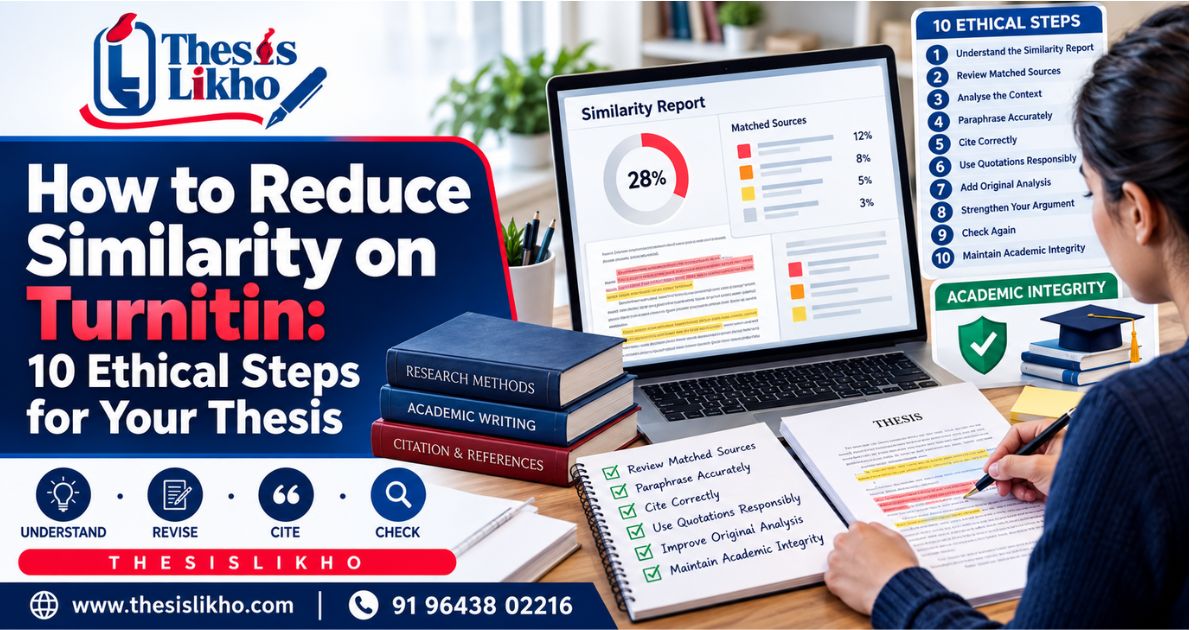
Your similarity report shows 38%; your submission is close, and you are searching for how to reduce similarity on Turnitin. Start with the highlighted passages, not the percentage alone. A report can include properly quoted material, references, standard terminology and earlier versions of your own work alongside text that genuinely needs revision.
The useful question is: Which matches show borrowed wording or ideas that I have not handled correctly? You may need to rewrite a passage from your own understanding, add a missing citation, shorten an unnecessary quotation or ask your supervisor about a match to a previous draft. This guide explains how to read the report, prioritise corrections and check the revised document without changing your research findings just to reach a number.
Quick answer: Open the Similarity Report and inspect the largest matches in context. Correct uncited borrowing, paraphrase from understanding, cite the underlying sources and keep quotations only where their exact wording matters. Ask your institution which report exclusions it permits, then recheck the revised draft. A lower percentage alone does not establish academic integrity.
In this guide
- What the score means
- Why a score can be high
- How to read the report
- Ten ethical revision steps
- Advice by thesis chapter and for research papers
- Common mistakes and FAQs
What is a Turnitin similarity score?
A similarity score is the percentage of submitted text that Turnitin identifies as matching sources in its comparison databases. Similarity is not automatically plagiarism. A cited quotation can match; an uncited idea expressed in different words may still raise an academic integrity problem. Read the passages and their sources before judging the result.
Is 10% the acceptable limit?
India’s UGC 2018 regulations describe Level 0 as similarities up to 10%, with no penalty under that level. That does not make 10% a universal Turnitin pass mark for every thesis or journal. Your institution’s current rules, permitted exclusions, discipline and review process determine what you must submit. Confirm the requirement with your supervisor or research office.
Why is my Turnitin score high?
Text copied from a sourceIs it a necessary quotation with a clear citation, or wording you need to rewrite?Surface-level paraphrasingDid you retain the source’s sentence structure while swapping a few words?References or quotationsAre they included in the report calculation under your institution’s settings?Standard methods or technical termsIs the match routine terminology, or a copied explanation?Your earlier publication or thesis draftHave you disclosed and cited reused material where required?A previous submitted draftAsk the instructor to inspect the source and submission settings before assuming misconduct.
How to read a Turnitin Similarity Report
Open each substantial match and read your passage, the matched source and the surrounding context. A colour highlight tells you where text matches; it does not explain whether the use is appropriate. Turnitin’s report can show matches to internet material, publications and submitted papers. Its available filters depend on the product and assignment settings.
Website or publicationShared wording with a published sourceCheck attribution; quote briefly or rewrite from understandingStudent paperMatch with a submitted documentAsk your supervisor to verify the source and whether it is your draftReferences or quoted textExpected overlap may be countedCheck citation and permitted report settingsShort phraseCommon wording or a meaningful repeated phraseRead it in context before dismissing it
Image suggestion: Add a screenshot of a report you are authorised to use, with names, submission details and confidential research content obscured. Label one match to show readers how to inspect its source.
Need a second look at your report? [Insert verified ThesisLikho report review offer and contact link.] Remove identifying or confidential participant data before sharing a file.
How to reduce plagiarism percentage in Turnitin: 10 ethical steps
The phrase “reduce plagiarism percentage” is common in searches, but the report displays similarity. Use these steps to improve the draft itself.
1. Review the largest matches first
Sort through long, continuous matches before spending time on isolated phrases. Read the source and decide whether the passage needs a quotation, a citation, a genuine rewrite or no change.
2. Paraphrase from understanding
Read the source, set it aside, and explain its finding in the context of your research question. Then check your wording against the source and cite it. Merely replacing synonyms can preserve too much of the original structure.
“Long clinical shifts can leave residents with limited time to organise research records.”“Extended clinical duties leave residents little time to arrange research records.”“Because participants worked rotating shifts, this study used a short weekly data-entry schedule. Previous research on residents’ time constraints informed that decision [cite relevant source].”
The better version adds a study-specific decision. Its citation is still necessary if it relies on published research.
3. Quote exact wording only when necessary
If the precise words matter, use quotation marks or the required block-quote format and give a citation with the appropriate page or location information. Do not turn a long section into a series of quotations to avoid rewriting it.
4. Summarise long source passages
If several sentences make one point, identify that point and summarise it accurately. Cite the source. Keep details only when readers need them to understand your argument or method.
5. Add your own analysis
In a literature review, explain how studies agree, differ or leave a gap. In a discussion, interpret your findings against the evidence. Original analysis gives the chapter a purpose beyond repeating published text.
6. Check every citation and reference
Match in-text citations to the reference list and follow your department’s required style, whether APA, Vancouver, IEEE or another format. Adding a citation does not permit to reproduce a source’s wording without quotation marks.
7. Check quotation and bibliography exclusions
Turnitin provides settings that can exclude quoted text and bibliographies from the report. Ask your instructor which settings your institution uses and permits. An exclusion changes what the report counts; it does not fix an incorrectly cited passage.
8. Review small matches with your supervisor
A permitted short-match filter may make a report easier to inspect. Do not use one to conceal repeated copying. Check the institution’s rules and examine meaningful matches even when each is short.
9. Make the methodology specific to your study
Standard methods can produce overlap. State what you actually did: your sample, instrument, variables, analysis choices and reasons. Cite a published method when you adapted it, and preserve required technical terminology.
10. Recheck the revised draft
Read the final document for accuracy as well as similarity. Confirm that quotations, citations, tables, participant details and conclusions still mean what you intend. If you resubmit, ask how your assignment handles earlier drafts; report behaviour can vary with submission and repository settings.
Working to a deadline? [Insert verified ThesisLikho review offer and contact link.] Share the matched passages, source details and submission requirements so the review focuses on substantive corrections.
How to lower Turnitin similarity score in each thesis chapter
IntroductionBackground copied from reports or websitesNarrow the background to your research problem and cite the evidenceLiterature reviewOne paragraph summarising each article in similar wordingCompare findings by theme, method and research gapMethodologyGeneric descriptions copied from earlier thesesDescribe your actual design and cite adapted proceduresResultsReused narrative around tablesReport your own observations accurately; retain required technical termsDiscussionPublished interpretations repeated as your ownExplain what your results support, where they differ and their limitations
This is a revision checklist, not a promised score reduction. Some accurate technical wording may continue to match.
How to remove similarity from a research paper before journal submission
You cannot responsibly promise to remove all similarity from a research paper. Before submitting to a journal:
- Check the journal’s current author instructions and originality policy; do not assume one percentage applies to every journal.
- Review any text reused from your thesis, preprint or earlier paper. Disclose related work and cite it as the journal requires.
- Check the language around methods, results and discussion against the matched sources.
- Read the revised manuscript for scientific accuracy and authorship compliance.
A journal may use a different screening system or settings from your university’s Turnitin assignment, so the percentages need not match.
Shortcuts that weaken your submission
Replacing letters with lookalike characters, hiding text, turning paragraphs into images and using unreviewed rewriting output do nothing to improve attribution or reasoning. They can also violate institutional rules. If you use a writing tool where permitted, check every claim, source, quotation and final sentence yourself.
Before and after: preserve the meaning
Draft: “Several studies prove online learning improves every student’s performance. Online learning improves flexibility and students perform better because they can study anywhere.”
Revision: “The studies reviewed here report mixed academic outcomes. Their findings suggest that scheduling flexibility may help some students, while access to devices and course design can affect the result [insert and verify relevant citations].”
The revision replaces an unsupported universal claim with a more precise one. No “45% to 8%” result is claimed: that figure would require actual reports from a documented before-and-after test.
How ThesisLikho can help
If ThesisLikho offers similarity review, describe the service accurately on the live page: review of matched passages, citation checking, editing feedback and support in revising the author’s own draft. Add the verified price or pricing method, realistic turnaround and genuine client feedback only after confirming them. The researcher must remain responsible for the work, sources, data and final submission.
Suggested enquiry fields: Name, WhatsApp number, current similarity percentage, institution’s requirement and deadline. Ask for the report only through a suitable upload or contact process, and request a copy with confidential data removed.
Frequently asked questions
What is an acceptable Turnitin similarity percentage?
There is no universal percentage that proves a thesis is acceptable. Check your institution’s policy and examine the matched material. India’s UGC 2018 regulations identify similarities up to 10% as Level 0, but your submission requirements still need to be verified locally.
How can I reduce my Turnitin score quickly before a deadline?
Review the longest matches, fix missing attribution and revise passages that closely follow a source. Ask your supervisor about previous-draft matches or permitted exclusions. Leave enough time to check that the revisions remain accurate.
Do references count in Turnitin similarity?
They can, depending on the assignment and report settings. Turnitin offers bibliography exclusions, but the setting should be applied according to your institution’s policy.
Can a paraphrasing tool or AI rewrite make my work acceptable?
A changed sentence still needs accurate meaning and appropriate attribution. Check your institution’s tool-use policy, verify every citation and take responsibility for the submitted text.
How do I remove similarity from a research paper intended for a Scopus-indexed journal?
Check the specific journal’s author instructions. Revise copied wording, cite and disclose related work, and review the manuscript’s originality. Indexing in Scopus does not establish one shared similarity limit for all journals.
Why did my score change after resubmission?
The compared sources, assignment settings and handling of earlier submissions can affect the report. Ask the instructor to inspect the new matches and settings before making further edits.
Conclusion
To reduce similarity on Turnitin, inspect the matches, correct borrowed wording and attribution, strengthen your own analysis, and check the final draft against your institution’s rules. The aim is a thesis you can explain and defend, with every source used transparently.