
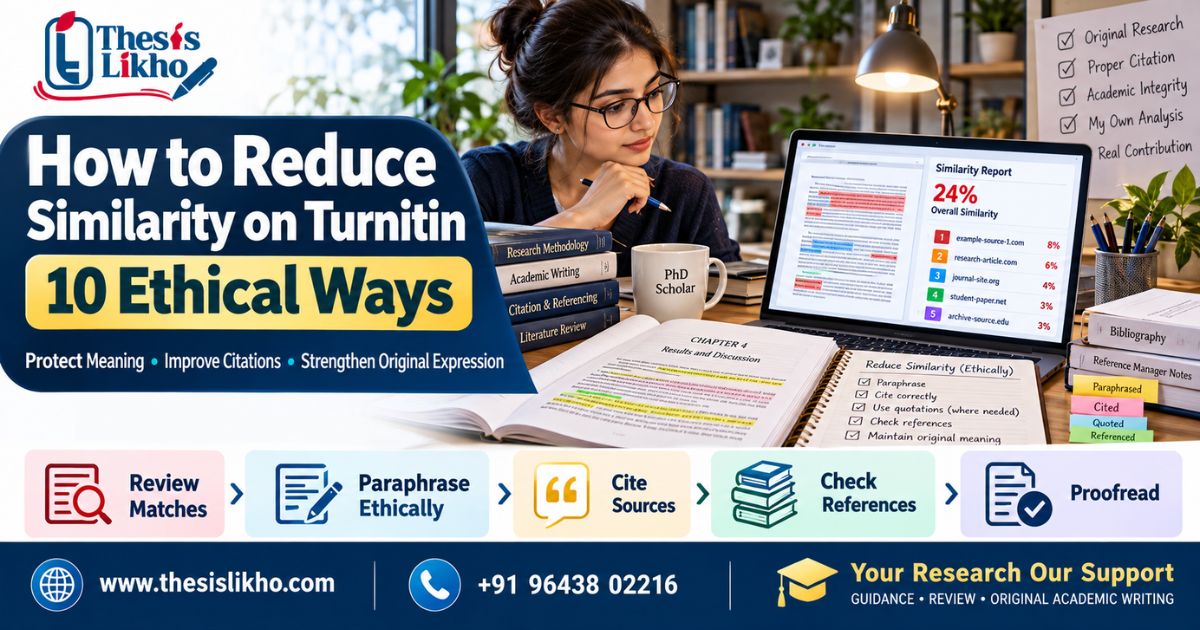
Opening a Turnitin report and seeing a higher similarity percentage than expected can be stressful, especially when your thesis submission deadline is close. However, the percentage alone does not explain whether the problem comes from copied passages, correctly quoted material, references or standard academic wording.
Understanding how to reduce similarity on Turnitin starts with reading the matched passages carefully. Your aim should be to improve originality, acknowledge borrowed ideas and present your research clearly—not simply change words until the percentage falls.
This guide explains how to review your report, paraphrase responsibly, correct citations and strengthen your own analysis. Whether you are preparing a dissertation, research paper or PhD thesis, these steps can help you address avoidable overlap while preserving technical accuracy and following your institution’s submission requirements.
Quick Answer: How Can You Reduce Turnitin Similarity?
To reduce Turnitin similarity ethically, review each matched passage, rewrite overly close paraphrases from your understanding, cite borrowed ideas and quote exact wording correctly. Add your own analysis where needed. Check permitted report exclusions with your supervisor, then review the revised document using your institution’s required settings.
Important: Turnitin measures text similarity; its percentage is not a plagiarism verdict. A report needs human interpretation, and correctly cited material can still produce matches.
Table of Contents
- What Turnitin similarity means
- How to reduce similarity on Turnitin: step-by-step guide
- Documents and formatting needed for review
- Common mistakes to avoid
- Useful tips for original academic writing
- Related information: acceptable scores and previous submissions
- ThesisLikho support
- Frequently asked questions
- Conclusion
What Does Turnitin Similarity Mean?
Turnitin compares submitted text against material available in its comparison databases and identifies overlapping wording. The report helps reviewers investigate those matches.
For example, a highlighted paragraph could contain:
- An exact quotation with a valid citation.
- A passage copied without attribution.
- A paraphrase that follows the source too closely.
- A reference entry or commonly used academic phrase.
These situations require different responses. Rewriting a correctly formatted reference is unnecessary, while adding a citation to copied wording may still leave a quotation problem.
Start with the matched text, its source and its context before deciding what to change.
Why Can a Properly Referenced Thesis Still Show Similarity?
References, quotations and standard wording can overlap with existing publications. Turnitin’s documentation explains that highlighted matches do not always indicate plagiarism.
However, a citation does not automatically make every passage acceptable. If you reproduce an author’s exact language, you normally need quotation formatting as well as attribution, subject to your discipline’s referencing rules.
How to Reduce Similarity on Turnitin: Step-by-Step Guide
If you are looking for how to reduce the similarity index in Turnitin, begin with a source-by-source review. The following ten steps focus on improving the document rather than manipulating the report.
1. Read the Report Before Editing
Open the highlighted passages and inspect their matched sources. Do not rewrite the entire thesis just because the overall score looks high.
Create a simple review table:
Long passage with no citationWhere the wording or idea originatedRewrite independently and cite the sourceExact wording with a citationWhether quotation formatting is missingQuote correctly or paraphrase with attributionClosely paraphrased passageWhether wording and structure follow the sourceRebuild the explanation from understandingBibliography or reference matchWhether the entry follows the required styleKeep it accurate; check permitted exclusionsMatch to your earlier workWhich submission or publication is involvedDiscuss reuse and submission history with your supervisor
Address substantial passages first. A long borrowed paragraph deserves more attention than a short, standard phrase.
2. Understand the Source Before Paraphrasing
Read the source until you can explain its argument without looking at the original sentences.
Make brief notes covering:
- The main claim.
- The evidence supporting it.
- The study’s context.
- Its limitations.
- Its relevance to your research.
Then draft from those notes and compare your version with the source for accuracy. Keep the citation because the idea still belongs to the original author.
3. Change the Explanation, Not Just Individual Words
Replacing a few terms with synonyms often leaves the original sentence structure intact. Effective paraphrasing requires a fresh explanation that preserves the meaning.
Illustrative source sentence:
“Flexible working arrangements improved employee satisfaction by increasing control over working hours.”
Overly close revision:
“Flexible work arrangements increased employee satisfaction by improving control over work timings.”
More independent paraphrase:
“The reported benefit concerned employees’ ability to organise their schedules: greater control over when they worked was associated with higher satisfaction.”
The final version still requires a citation to the actual source. It should also preserve whether the study reported an association or demonstrated a causal effect.
4. Correct Missing and Incomplete Citations
Check every statement based on another researcher’s findings, theory, definition or data.
Confirm that:
- In-text citations identify the correct source.
- Each cited source appears in the reference list.
- Author names and publication years agree.
- Page numbers are included where required.
- You have read the source supporting the claim.
Do not add unrelated references merely to make a paragraph appear well supported.
5. Use Direct Quotations Selectively
Keep exact wording when it matters—for example, when analysing a legal provision, a participant’s statement or a particular definition.
Use quotation marks or block quotation formatting as required by your referencing style. Include the necessary citation and locator.
Avoid filling the literature review with quotations when a clear paraphrase and your own discussion would serve the reader better.
6. Synthesise Sources in the Literature Review
A literature review should explain relationships between studies, rather than reproduce one summary after another.
Organise paragraphs around questions such as:
- Where do researchers agree?
- Why do their findings differ?
- How do methods or samples affect the conclusions?
- What remains unresolved?
- How does your study address that gap?
For example, compare studies on employee retention by examining their industries, populations and measures. Cite each relevant source and explain what the comparison means for your research.
7. Make the Methodology Specific to Your Study
Generic methodology templates can produce repetitive writing and weak explanations.
Describe your actual decisions:
- Why the research design fits your objectives.
- How participants or observations were selected.
- Which instrument or dataset was used.
- How variables were measured.
- Which analysis procedures were followed.
- What ethical permissions applied.
Keep recognised technical terms accurate. Do not rename established methods merely to reduce matching text.
8. Strengthen Your Results and Discussion
Your discussion should explain what your findings mean, how they relate to earlier evidence and where their limits lie.
For each major result, consider:
- What did the analysis show?
- How does it answer the research question?
- Does it support or differ from previous studies?
- What could explain that relationship?
- What limitation affects the interpretation?
Adding relevant analysis improves the thesis. Adding filler solely to enlarge the word count does not resolve copied material.
9. Check Exclusions With Your Supervisor
Depending on the Turnitin product and report settings, exclusions can help reviewers focus on meaningful matches by filtering material such as quotations or bibliographies. They do not replace a review of attribution.
Use only the settings permitted by your institution. In Turnitin’s documented student workflow, student-applied exclusions are temporary and do not change the official score seen by the instructor.
10. Review the Revised File Carefully
Before resubmitting, check that your changes have preserved:
- The meaning of each cited source.
- Technical terminology.
- Numerical results.
- Citation placement.
- Chapter consistency.
- Your research argument.
If resubmission is permitted, compare the remaining matches under consistent settings. Ask your supervisor about unresolved passages instead of repeatedly changing accurate wording.
Documents and Formatting Needed for a Similarity Review
Prepare the following before starting a detailed revision:
Editable thesis or manuscriptAllows targeted revisions and commentsFull similarity reportShows matched passages and sourcesInstitutional similarity policyEstablishes the applicable review requirementsRequired referencing styleGuides citations, quotations and referencesOriginal source papers or notesSupports accurate paraphrasingSupervisor feedbackIdentifies academic prioritiesPrevious submission detailsHelps investigate matches to earlier work
Follow your institution’s file and formatting instructions. Keep a clearly labelled original draft and a revised version so that changes can be reviewed.
Use readable text, consistent headings and a properly labelled reference section. Formatting should support accurate review.
Common Mistakes When Trying to Lower Similarity
Replacing Words Without Understanding the Passage
Synonym substitution can distort meaning while leaving the borrowed structure unchanged. Rebuild the explanation after understanding the source.
Removing References or Necessary Quotations
Deleting legitimate attribution can make the document academically weaker. Correct the citation or quotation format instead.
Relying on Automatic Rewriting Without Checking Accuracy
A rewritten sentence may change a statistical claim, technical definition or research conclusion. Verify every revision against the source.
Changing Established Technical Terms
Terms such as “multiple linear regression” have specific meanings. Preserve them and improve the surrounding explanation where necessary.
Using Hidden Text or Character Substitution
Invisible characters, altered letters and text converted into images do not improve originality. They can compromise the document and its academic review.
Assuming a Lower Percentage Guarantees Approval
A percentage cannot establish whether an uncited passage is acceptable. Review the substance of the matches and follow your institution’s policy.
Useful Tips: How to Avoid Similarity in Turnitin While Writing
The most practical answer to how to avoid similarity in Turnitin is to develop sound writing habits before submission.
- Separate quotations from notes. Mark copied wording immediately so it cannot accidentally enter your draft as your own writing.
- Record sources as you read. Save the citation details and relevant page numbers.
- Draft from understanding. Avoid writing while continuously looking at the source paragraph.
- Build paragraphs around an argument. Use evidence to support a point, then explain its relevance.
- Review chapters in stages. Resolve citation and paraphrasing issues before the final deadline.
- Keep a revision log. Note the passage, the issue and the correction made.
- Check references manually. Citation software helps organise sources, but entries still need verification.
The goal is accurate, independently expressed scholarship. Some legitimate text overlap may remain.
Related Information: Acceptable Scores and Previous Submissions
What Similarity Percentage Is Acceptable?
Turnitin does not set a universal acceptable percentage. Consult your university, department or journal’s requirements and ask how the report should be interpreted.
Do not treat online claims such as “below 10% is always safe” as a substitute for the applicable policy.
What If Turnitin Matches Your Previous Draft?
Check where and how the earlier document was submitted. A match involving previous work needs investigation before you rewrite the passage.
Turnitin documents that resubmissions which overwrite an earlier submission do not match against those overwritten versions in that workflow. Other submission circumstances should be reviewed with your instructor.
Can You Guarantee a Specific Score After Editing?
No responsible review can guarantee a particular score. The result depends on the document, matching sources and report settings. Editing should resolve identifiable writing and attribution issues.
Need Help Reviewing Your Thesis? Contact ThesisLikho
Do not leave a difficult similarity report until the final submission day.
If you are unsure which passages need revision, contact ThesisLikho to discuss support for report interpretation, citation checking, academic editing and literature review improvement.
Share your draft, similarity report, institutional requirements and deadline when requesting a review. Ask for a clear scope covering the chapters to be checked, proposed revisions and expected turnaround.
Request a Thesis Similarity Review
Turn unclear matches into a practical revision plan. Strengthen your writing, preserve your research meaning and prepare a document you can explain confidently.
Academic support should preserve your authorship and follow your institution’s rules. A review cannot guarantee a similarity percentage or submission acceptance.
Frequently Asked Questions
1. How to reduce similarity on Turnitin without changing the meaning of my thesis?
Identify the passages that follow sources too closely, understand the original ideas and rewrite their explanations independently. Keep citations, technical terms and numerical results accurate. Compare each revision with the source before accepting it.
2. How to reduce similarity index in Turnitin for a PhD literature review?
Organise the review around themes, debates and research gaps. Compare studies and explain their relevance rather than closely paraphrasing each paper in sequence. Cite the sources supporting each part of your discussion.
3. How to lower Turnitin similarity score when references are highlighted?
Keep correctly formatted references. Check with your supervisor whether bibliography exclusions are permitted and whether they have been applied to the official report. Deleting references is not an appropriate solution.
4. How to avoid similarity in Turnitin when using standard definitions?
Paraphrase a definition accurately when its exact wording is unnecessary and cite its source. If the wording itself matters, use a properly attributed quotation. Preserve essential disciplinary terminology.
5. Why is my Turnitin similarity high even after adding citations?
Citations acknowledge sources, but overlapping wording can remain. A passage may need quotation formatting, a more independent paraphrase or further analysis. Inspect the highlighted text to determine the appropriate correction.
6. Can Turnitin similarity become zero after ethical editing?
Some documents may receive a zero score, but it is not a necessary target for every thesis. References, quotations and standard terminology can create legitimate matches. Focus on originality, attribution and the applicable institutional requirements.
7. Can I reduce Turnitin similarity in one day before submission?
You may be able to correct a limited number of citation or paraphrasing issues in one day. Extensive overlap across several chapters needs more time. Prioritise substantial matches and discuss unresolved issues with your supervisor before the deadline.
Final Conclusion
Learning how to reduce similarity on Turnitin means understanding the report and correcting the underlying writing issues. Review substantial matches, paraphrase from understanding, cite borrowed ideas and strengthen your own interpretation.
Preserve accurate references, necessary quotations and technical language. Use your institution’s requirements to guide the final review.
Need a clear revision plan before submission? Contact ThesisLikho to discuss your draft, report and deadline.
Call / WhatsApp: +91 96438 02216
Website: www.thesislikho.com