
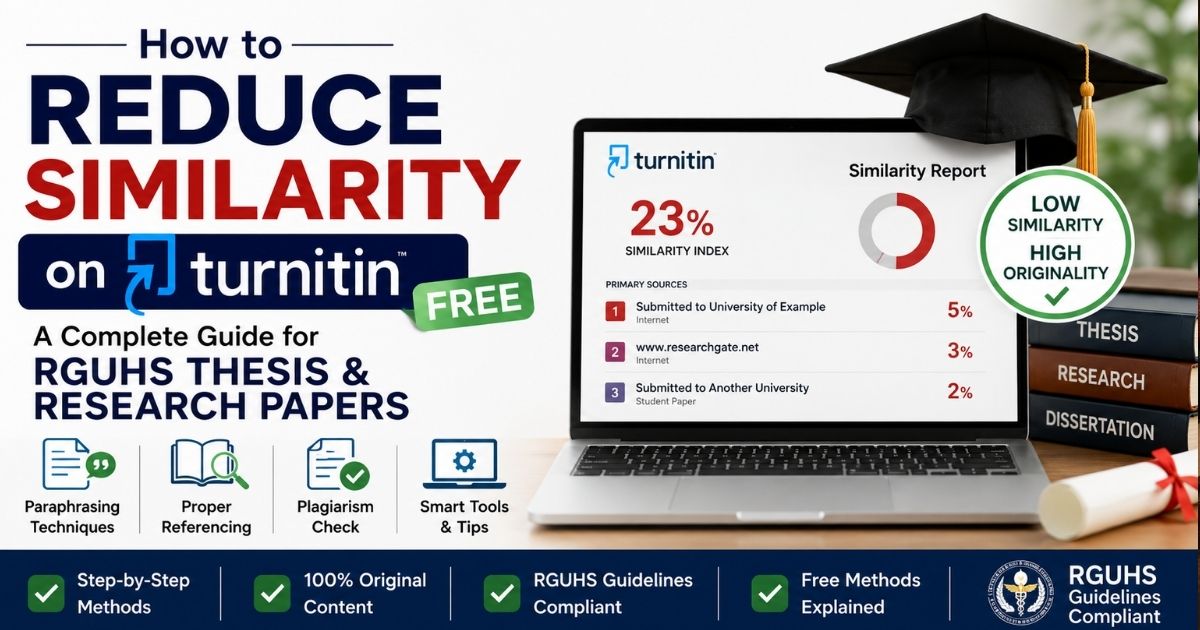
For students, research scholars, and faculty members, one of the biggest concerns before thesis or journal submission is the Turnitin Similarity Report. Whether you are preparing an RGUHS thesis, an MDS dissertation, an MD/MS thesis, a PhD dissertation, or a research paper, understanding how to reduce similarity on Turnitin for free is essential.
A high similarity percentage does not automatically mean plagiarism, but it can indicate excessive overlap with previously published content, common phrases, or improperly cited material. The key is to improve originality through ethical writing practices—not by attempting to manipulate the similarity score.
This guide explains proven and ethical methods to reduce similarity while maintaining academic integrity.
What Is a Turnitin Similarity Score?
Turnitin compares your document with:
- Published journal articles
- Books
- Internet sources
- Student papers (where included)
- Institutional repositories
It highlights matching text and calculates a similarity percentage. The report should be interpreted carefully—small matches, references, and technical terms can legitimately contribute to the score.
Why Is Similarity Important for an RGUHS Thesis?
Many universities, including health sciences institutions such as RGUHS, use similarity reports as part of the thesis review process. Students are generally expected to submit original work that follows institutional policies on plagiarism and academic integrity.
Maintaining a low and justified similarity score helps:
- Improve acceptance chances
- Demonstrate research originality
- Avoid delays in submission.
- Meet institutional quality standards.
Always refer to your department's current thesis guidelines for any required similarity thresholds.
Common Reasons for High Similarity
1. Copying Literature Review Without Rewriting
Many students directly copy published paragraphs into the literature review.
Solution: Read multiple sources, understand the concepts, and write the ideas in your own words with proper citations.
2. Improper Citation
Even correctly quoted material may increase similarity if not cited appropriately.
Best practices include:
- Follow your required citation style.
- Cite every borrowed idea.
- Use quotation marks for direct quotations when appropriate.
3. Excessive Direct Quotations
Too many quotations can raise the similarity score.
Instead:
- Summarize
- Paraphrase accurately
- Critically analyze the source.
4. Repetitive Technical Sentences
Medical, legal, engineering, and scientific writing often contains standard terminology.
Where possible:
- Rewrite explanatory text
- Keep essential technical terms unchanged.
- Avoid repeating identical sentence structures.
How to Reduce Similarity on Turnitin Free
Write Before You Cite
Read the source first, close it, then explain the concept in your own words before adding the citation.
Improve Your Paraphrasing
Good paraphrasing means:
- Changing sentence structure
- Using different wording where appropriate
- Preserving the original meaning
- Adding your own analysis
Poor paraphrasing is simply replacing a few words with synonyms.
Summarize Instead of Copying
If a paper contains several paragraphs explaining one concept:
- Read the section
- Identify the key message.
- Write a concise summary.
- Cite the original source.
Use Multiple References
Instead of relying on one article, compare findings from several high-quality studies and synthesize them into a new discussion.
This approach strengthens originality and demonstrates critical thinking.
Add Your Own Interpretation
After discussing previous studies, explain:
- Why the findings matter
- How they relate to your research
- Any limitations
- Practical implications
Your own analysis reduces dependence on existing text.
Check Citations Carefully
Incorrect or missing citations can create avoidable problems.
Verify that:
- Every borrowed idea is referenced.
- Citation style is consistent.
- Reference list entries are complete.
Review Figures and Tables
If using existing figures or tables:
- Obtain permission where required.
- Cite the original source.
- Prefer creating your own diagrams or tables from your analysis.
Ethical Ways to Improve Originality
The goal is not just a lower percentage—it is better scholarship.
Focus on:
- Independent analysis
- Clear arguments
- Original interpretation
- Logical organization
- Accurate referencing
These practices naturally improve originality and may also reduce similarity.
How to Reduce Similarity in a Research Paper
Research papers often have repeated phrases in methods or technical descriptions. You can still improve originality by:
- Writing the introduction from your own understanding
- Comparing findings instead of copying discussions
- Presenting your own conclusions
- Using current references
- Explaining the significance of your results
RGUHS Thesis Similarity Tips
If you are preparing an RGUHS thesis:
- Start writing early to allow time for revisions.
- Follow your university's formatting and citation requirements.
- Keep detailed records of every source used.
- Write each chapter in your own words.
- Review the similarity report carefully before final submission.
- Discuss any concerns with your supervisor or research guide.
Mistakes to Avoid
Do not:
- Copy text and replace a few words with synonyms.
- Use AI tools to rewrite without checking accuracy.
- Remove citations to lower similarity.
- Translate copied text from another language and present it as original.
- Purchase or submit someone else's thesis.
These practices can violate academic integrity policies.
Best Practices Before Submission
- Proofread the entire document.
- Verify citations and references.
- Check consistency in terminology.
- Ensure every chapter reflects your own analysis.
- Ask your supervisor for feedback before the final submission.
Benefits of an Original Thesis
An original thesis can help you:
- Meet university requirements
- Improve publication opportunities
- Build academic credibility
- Support future PhD or research applications.
- Contribute meaningful knowledge to your field.
Conclusion
Understanding how to reduce similarity on Turnitin for free is about improving the quality and originality of your writing—not finding shortcuts. Whether you are preparing an RGUHS thesis or learning how to reduce similarity in a research paper, the most effective approach is to write independently, paraphrase ethically, synthesize multiple sources, and cite every borrowed idea correctly.
Original research supported by accurate referencing is the best way to produce a strong thesis and meet academic standards.
Frequently Asked Questions (FAQs)
1. What is a good Turnitin similarity score?
There is no universal acceptable percentage. Institutions set their own policies, and similarity reports should always be interpreted in context.
2. Does a high similarity score always mean plagiarism?
No. Similarity reports identify matching text, but not every match is plagiarism. Properly quoted and cited material may still appear in the report.
3. Can I reduce similarity by paraphrasing?
Yes, when paraphrasing is done correctly. Rewrite ideas in your own words, change the structure, and always cite the original source.
4. How can I improve originality in my research paper?
Use multiple references, add your own analysis, summarize instead of copying, and write conclusions based on your own interpretation of the evidence.
5. Should I follow RGUHS-specific thesis guidelines?
Yes. Always follow the latest guidelines issued by your department or university regarding formatting, citations, and similarity requirements.
Call to Action
Need support with thesis editing, academic proofreading, citation formatting, or improving the originality of your research paper? Work with your supervisor or qualified academic editors to refine your manuscript ethically, strengthen your analysis, and ensure it meets your university's academic integrity and formatting requirements before submission.