
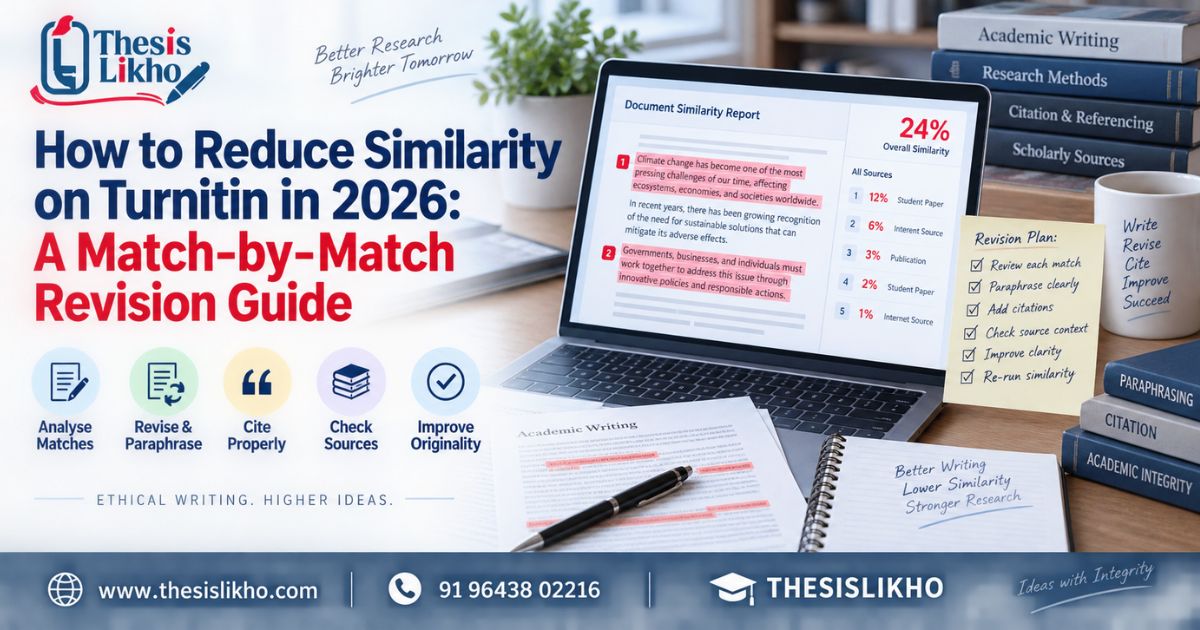
You upload a thesis chapter, open the report and see a large highlighted section. Your first instinct may be to rewrite every sentence. That can waste time and even make the work less accurate. If you want to know how to reduce similarity on Turnitin, begin by identifying why each passage matched. A properly quoted definition, a reference entry, a close paraphrase and an unattributed copied paragraph require different responses.
This guide gives students and research scholars a practical way to inspect a Similarity Report, prioritise meaningful matches and revise their own work without misrepresenting sources. It also explains why the percentage alone cannot tell you whether a document contains plagiarism. Follow your supervisor’s instructions and your institution’s current policy when deciding what needs correction.
Quick answer
To reduce similarity on Turnitin, inspect the matched passages and their sources before editing. Correct missing attribution, quote necessary wording properly, rewrite close paraphrases from your understanding and add your own analysis where the draft merely repeats sources. Recheck the complete document afterward. A lower percentage cannot substitute for accurate citation or compliance with your institution’s rules.
Table of contents
- What does Turnitin similarity mean?
- Why does a thesis show matched text?
- How to review and revise a Similarity Report
- What to change in each thesis section
- Documents and tools to keep ready
- Common mistakes and academic risks
- Final submission checklist
- When is an expert review useful?
- Frequently asked questions
- Conclusion
Quick highlights
ItemRecommended actionMain problemMatching text has been treated as one issue, although matches have different causesBest approachReview source, context and attribution for each substantial matchInformation neededFull Similarity Report, current draft, original sources, citation style and university rulesMajor risksPatchwriting, missing citations, altered meaning and attempts to hide genuine copyingFinal actionRecheck the revised document and discuss unresolved matches with your supervisor
What does Turnitin similarity mean?
A Turnitin similarity percentage indicates how much text in a submission matches material in the sources available to the report. It is a starting point for review, not a plagiarism verdict. A passage may match. It was copied without attribution, because it was quoted and cited, or because it uses common wording. The report must be read in context.
The terms in searches such as “how to reduce plagiarism percentage in Turnitin” can be misleading. Similarity is the measured match. Plagiarism concerns the improper presentation of another person’s work or ideas as your own, as judged under the applicable academic rules. A low percentage does not excuse an unattributed copied passage, and a high percentage does not automatically prove misconduct.
Start with three questions for any substantial highlight: What source matched? Is the source acknowledged? Does my wording or analysis make an independent contribution?
Why does a thesis show matched text?
A report may contain several different kinds of matches:
- Direct copying without attribution. The source’s words appear in the draft without a clear quotation or citation.
- Patchwriting. A sentence retains the source’s structure while replacing a few words.
- Repeated source summaries. The literature review strings together descriptions of papers with little comparison or synthesis.
- Necessary or standard wording. Names of methods, instruments, laws or technical concepts may have limited sensible alternatives.
- Quotation and references. Correctly presented quotations and bibliographic details can still appear as matches.
- Reuse of earlier work. Material from a prior submission may match; permission and disclosure rules vary by institution.
- Templates and required statements. Cover pages, declarations or prescribed headings can contribute matching text.
The type of match determines the next step. Do not alter a correct technical term merely to change a colour in the report. Do correct a sentence that borrows a source’s wording or reasoning without proper acknowledgement.
How to review and revise a Similarity Report
Step 1: Read the assignment or university policy
Confirm the relevant citation style, quotation rules, resubmission process and any institution-specific threshold or exclusions. Ask your supervisor how they interpret matched methodological or template text.
Verify: You are using the rules for your document and programme.
Risk: A number mentioned in a general blog may not be your institution’s requirement.
Step 2: Open the full report, not only the percentage
Look at the highlighted passages and the sources connected to them. Start with long, continuous matches and passages central to your argument. A small match containing an important unattributed idea may also need attention.
Verify: You can locate the source for each priority match.
Risk: Editing solely from the overall score misses the actual issue.
Step 3: Classify each priority match
Label it as a quotation, a correctly cited paraphrase, a too-close paraphrase, uncited copying, common terminology, a reference, a template or possible reuse of earlier work. Note what the source says and how your text uses it.
Verify: Your decision is based on the passage and source, not highlight colour.
Risk: Treating all matches alike can remove valid quotations while leaving weak paraphrases.
Step 4: Repair attribution first
Add missing citations to borrowed ideas and check that quotations are marked and referenced according to your required style. If a substantial borrowed passage is unnecessary, remove it and explain the point yourself using evidence.
Verify: Each retained source-based claim can be traced to a real source.
Risk: Rewording a borrowed idea without citing it does not solve attribution.
Step 5: Rewrite close paraphrases from understanding
Read the source, put it aside and write the point in terms that fit your own argument. Reopen the source to check accuracy and add the citation. Changing word order or substituting synonyms while keeping the source’s sentence pattern is not a sound paraphrase.
Verify: Both meaning and attribution remain correct.
Risk: Mechanical rewriting can distort a result or still resemble the source closely.
Step 6: Add synthesis where appropriate
A literature review should compare evidence, methods and limitations rather than present one source summary after another. State where findings agree, where they conflict and how that comparison leads to your research question.
Verify: Your paragraph makes a point that belongs to your review.
Risk: Adding superficial connecting phrases does not create original analysis.
Step 7: Check figures, tables and earlier submissions
Review captions, permissions and attribution for material you did not create. If you reuse your own previously submitted writing or data, check your institution’s disclosure and reuse rules. Do not assume that being the original author automatically permits undisclosed reuse.
Verify: The provenance of each item is clear.
Risk: Focusing only on highlighted prose can miss other integrity issues.
Step 8: Recheck the complete revised document
Read the revised chapter for coherence. Check that citations still support the claims, references still match, and edits have not broken the methods or results. Use an authorised resubmission route if available and retain the report version reviewed by your supervisor.
Verify: The document is accurate and ready under your institution’s rules.
Risk: A lower score achieved through poor revisions may weaken the thesis.
What to change in each thesis section
Proposal and introduction: Explain the research problem in your own words. Cite prior work when identifying a gap; do not present another author’s rationale as your original discovery.
Literature review: Reduce repetitive source-by-source summaries. Compare studies by question, method and finding. ThesisLikho’s literature-review guide can help you plan a synthesis.
Research methodology: Some standard terminology is unavoidable. Describe the actual design, setting, sampling and procedure accurately, and cite any adopted instrument or method. Do not replace precise methodological terms with strange synonyms to avoid a match.
Data analysis: Report the analysis actually performed. Check that table labels, variables and statistical descriptions correspond to your data. Similarity editing must never alter findings.
Results and discussion: Results should report your genuine observations. In the discussion, distinguish those observations from other researchers’ findings and cite the comparison. A claim about a research gap should be supported by the literature you examined.
Citations and references: Match every in-text citation to the correct reference. Open sources to verify authors, titles, publication details and quoted wording. A citation does not make an unnecessary block of copied text good academic writing.
Formatting and final submission: Apply the required style consistently. Ask the supervisor how quotations, references and prescribed text should be treated in the report; student-applied report filters may not alter the official view available to an instructor.
Documents and tools to keep ready
- The full Similarity Report: Shows passages, match sources and report settings.
- Your editable draft: Allows careful revisions and version tracking.
- Original articles, books or official documents: Needed to check whether each paraphrase is accurate.
- University policy and supervisor comments: Determine acceptable quotation, reuse, review and submission practices.
- A reference manager or source log: Helps reconcile citations with the bibliography.
- A short match-review sheet: Record the passage, source, issue and correction so you can explain what changed.
For the meaning of the score and report options, use Turnitin’s similarity-score guide, student report overview and exclusions guidance.
Common mistakes and academic risks
MistakeWhy it failsBetter correctionChasing a universal “safe percentage”Policies and the meaning of matches differFollow your institution’s rule and inspect the reportReplacing words with synonymsStructure and borrowed ideas remainWrite from understanding and cite the sourceRemoving citations to change the scoreAttribution becomes worseKeep accurate citations even if text still matchesQuoting large passages unnecessarilyThe chapter contributes little analysisQuote only when wording matters; analyse the sourceUsing a paraphraser without checking its outputMeaning, terminology or citations may be alteredMake and verify your own scholarly revisionsHiding text or manipulating formattingIt evades review rather than improves workCorrect the substantive matchIgnoring the largest matched sourceA continuous borrowed passage remains unresolvedOpen the source and review it line by lineAssuming report exclusions erase an issueDisplay settings do not decide integrityDiscuss legitimate matches with the instructor
Final submission checklist
- I reviewed meaningful matches against their sources.
- Quotations are necessary, marked and cited correctly.
- Paraphrases use my own explanation and acknowledge the ideas used.
- The literature review compares and evaluates studies.
- Method descriptions remain accurate after revision.
- Results and data have not been altered to affect a score.
- Every in-text citation has a matching, verified reference.
- Tables and figures have appropriate attribution.
- The formatting and report process follow current university rules.
- My supervisor has reviewed unresolved questions where required.
- The final file is the correct revision and opens properly.
When is an expert review useful?
An independent review can help when a long match has several possible causes, when paraphrasing may have changed the technical meaning, or when a literature review still reads like a sequence of borrowed summaries. Ask the reviewer for a marked explanation of each issue and a clear scope of work.
The scholar must decide which revisions are accurate, acknowledge sources and comply with institutional rules. For a defined academic review, consult ThesisLikho’s thesis support page and academic services overview. No reviewer can guarantee a particular percentage or an examiner’s decision.
Frequently asked questions
How can I reduce similarity on Turnitin without changing my research meaning?
Work from the source and your evidence. Keep precise technical terms where they are necessary, cite borrowed ideas and rewrite close paraphrases after you understand the underlying point. Add your own comparison or interpretation where the draft merely repeats sources. Check the revised wording against the original article and your results so the effort to improve attribution does not introduce an inaccurate claim.
Is a high Turnitin similarity index always plagiarism?
No. The percentage reports matching text, which can include properly quoted material, references and standard wording. It can also reveal problematic copying. Review the matched source and surrounding passage to understand the cause. Your institution or instructor assesses academic integrity under its rules; neither a colour nor the overall number makes that decision alone.
Does adding a citation automatically reduce the similarity percentage?
Not necessarily. A citation acknowledges the source but does not make identical wording stop matching. If the exact wording is important, quote and cite it according to your style. If it is not, explain the idea independently and still cite its source. Whether the displayed score changes depends on the text and the report’s settings.
What should I do when my methodology has many matches?
Check whether the match comes from necessary method names, a cited standard instrument, prescribed wording or copied description. Keep accurate terms and cite the underlying method. Rewrite the account of what you actually did: setting, participants or materials, procedure and analysis. Ask your supervisor about required templates rather than altering technical language simply to make it look different.
Can I use Turnitin filters to reduce the official score?
Filters can help you inspect a cleaner report by excluding certain matches. Turnitin says student-applied exclusions may be temporary and need not change the official similarity score seen by the instructor. Use filters to understand the report, not to conceal a source. If a legitimate quotation or bibliography is affecting interpretation, discuss it with your instructor.
Can someone guarantee that my thesis will score below 10%?
No responsible reviewer can guarantee a particular result. Scores depend on the submitted text, available comparison sources and report settings. More importantly, a numerical target cannot replace honest attribution and original research. Request a source-by-source review, make corrections you understand and follow the threshold or procedure stated by your own institution.
Conclusion
To learn how to reduce similarity on Turnitin, treat the report as a set of passages to investigate. Fix unattributed borrowing, improve close paraphrases, build genuine synthesis and preserve accurate technical and research meaning. Then check the complete thesis against your university’s current policy and obtain supervisor feedback where needed.
If you want a chapter-level review of matches, citations or literature-review structure, send ThesisLikho a WhatsApp enquiry describing the document and the specific problem. Academic-integrity note: The scholar remains responsible for original work, authentic data, accurate attribution and the final submission.