
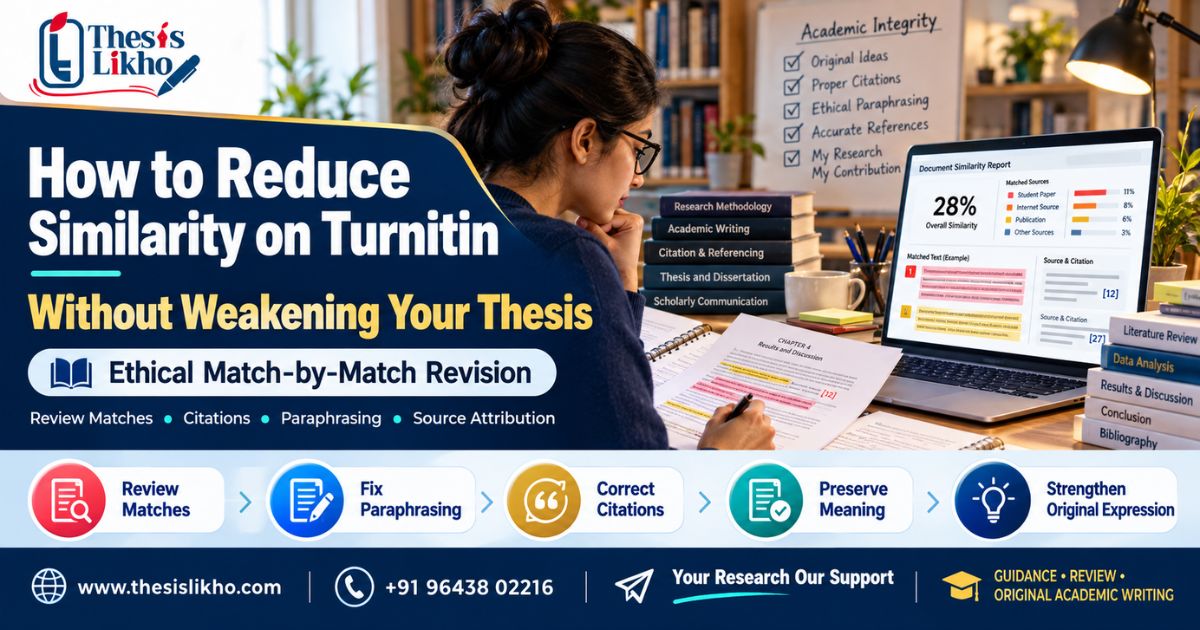
You open the Turnitin report and see a percentage higher than you expected. What should you edit first: the references, the methodology, or every highlighted line?
Start with the passages, not the number. A report can pick up a correctly quoted definition, a standard research term, a reference entry, a paragraph that follows another author's wording too closely, or text from your own earlier submission. Those matches look similar on screen, but they call for different decisions. Turnitin itself says the score measures matching text; it does not decide whether plagiarism has occurred. Read Turnitin's explanation of the score.
Quick answer: To reduce similarity on Turnitin responsibly, open the main matches and compare each passage with its source. Fix unattributed ideas, rewrite close paraphrases from your understanding, and use quotations only where the exact words matter. Keep accurate data and technical terms. Then check the revised report under your university's rules. There is no universal percentage that proves a thesis is acceptable.
First, Find Out What Is Matching
The overall score does not tell you where the problem lies. A series of short matches in a reference list is a different matter from two consecutive paragraphs matching one article in the literature review. Look at the length of each match, the source, the chapter, and whether your own text includes a citation.
If you cannot access a matched source, do not guess at its contents. Check the paper or book you actually used and ask your supervisor or librarian for help when necessary. Keep a simple revision note: page or chapter, matched source, what is wrong, and what you changed. This is especially useful when a long thesis has several rounds of edits.
A short quoted definitionIs it marked and cited correctly? Is the exact wording needed?Keep it if necessary; otherwise explain the concept in your own words and cite it.A reference-list matchIs the entry accurate?Correct formatting errors. Do not remove a source simply to alter the score.A long match to one studyDoes your paragraph follow its wording or sequence?Rebuild the paragraph around your own point and cite the study.A standard method termWould changing it make the method inaccurate?Keep the correct term and describe your actual procedure more specifically.Text from your previous workIs reuse allowed and disclosed?Follow the institution's and, if relevant, publisher's rules.
Some Turnitin report versions allow filters for quotations, references, citations or small matches. Access and settings vary. A student's temporary filter may not change the official report viewed by an instructor, so ask which settings your institution uses. Turnitin's student guide explains the filters.
How to Reduce Similarity on Turnitin: 10 Useful Revisions
1. Fix the longest source-dependent passages first
Open a substantial match and read your paragraph beside the source. Has the wording changed while the order of ideas remains the same? If so, the passage needs more than a few synonyms. Decide what point you need that evidence to support, then write toward that point.
2. Trace every borrowed claim to its source
A citation is needed for another researcher's finding, theory, argument, data or distinctive definition, even if you have paraphrased it. Check that the cited paper actually supports your sentence. A reference at the end of a long paragraph may leave it unclear which claims came from where.
3. Paraphrase after you understand the study
Read the source, make a short note of its findings and limitations, and close it while drafting. Then compare your version with the original to catch accidental close phrasing. Preserve the meaning and add a citation. Merely replacing “significant” with “important,” for example, leaves the underlying sentence intact.
4. Turn article summaries into a discussion
A literature review often becomes repetitive when every paragraph begins with a different author and ends with a result. Bring studies together around a question: Where do their findings agree? Which methods differ? What remains uncertain for your population or setting? This gives the reader a reason to follow the research and makes your own analysis visible.
5. Use fewer quotations, but keep necessary ones
Exact wording can matter in legal texts, policy statements, definitions you are analysing, or a participant's words. Mark and cite those quotations correctly. When the wording itself is not the subject, explain the idea and its relevance instead of filling the chapter with quoted sentences.
6. Describe the research you actually conducted
Methodology chapters contain shared terminology. Do not rename a statistical test or alter an established method to make it look different. Explain your sample, recruitment, instrument, procedure, analysis and decisions with the detail appropriate to your discipline. Cite a method you adopted or adapted.
7. Separate your findings from other people's findings
Your results section should faithfully report your analysis. In the discussion, identify when you are interpreting your own results and when you are comparing them with a published study. The latter needs a citation; both need accurate wording. Never modify a number to lower text overlap.
8. Check material you have used before
A published article, conference paper, protocol, or previously submitted chapter can match your thesis. Whether and how you may reuse it depends on university rules and sometimes publication rights. Discuss the overlap with your supervisor and disclose or cite it as required.
9. Cut repetition that does not help the reader
A thesis may repeat the same definition or background explanation across chapters. Keep the context each chapter needs, but shorten passages that say nothing new. This is an editing decision for clarity, not a way to hide a borrowed idea.
10. Read the next report as carefully as the first
If your institution permits another check, inspect the remaining substantial matches after editing. Also read the revised chapter normally. An awkward rewrite can lower overlap while making your argument harder to understand. Your final test is whether the thesis is accurate, attributed and clear.
A Paraphrasing Example
Consider a fictional study of 120 postgraduate students. Suppose it found an association between regular supervisor feedback and clearer research objectives.
A draft sentence might say: “Regular feedback from supervisors was associated with clearer research objectives among 120 postgraduate students (Author, 2024).” It includes a citation, yet it may still track the source's wording and sequence closely.
A more useful literature-review sentence would explain why the finding matters: “Supervisor feedback may help scholars refine an initially broad question. In one study of 120 postgraduate students, those receiving regular feedback reported clearer objectives (Author, 2024). Because the study observed an association, it cannot by itself show that feedback caused the change.”
The second version adds a purpose and a limitation. It also makes a claim about study design that would need checking against the real paper. Never add that detail automatically: a sound paraphrase must remain faithful to the evidence.
Where to Focus in Each Thesis Chapter
Introduction: Recheck definitions, general background claims and descriptions of the research problem. Attribute sourced claims while making your own objective unmistakable.
Literature review: This often needs the most careful editing. Compare evidence across studies, identify disagreements, and show how the gap leads to your research question.
Methodology: Keep the accepted terms and describe what you actually did. Generic copied descriptions of an instrument or analysis rarely tell a reader enough about your project.
Results and discussion: Preserve the data. Cite external datasets and studies used for comparison. Show clearly which conclusion comes from your analysis.
Conclusion: Return to your objectives and findings. Avoid lifting whole paragraphs from earlier chapters when a concise synthesis will do.
Chapter-by-chapter checks can help if your access and university process allow them. Review the complete final document before submission as well.
What Should You Avoid?
Do not delete citations, change technical terms inaccurately, use a synonym spinner, or replace text with images or hidden characters. These moves can damage both the scholarship and the document. If you use an AI writing tool, follow your institution's policy, check its output against your sources, and do not let it invent citations or disguise copied passages.
Also resist chasing “0% similarity.” A well-referenced thesis may contain legitimate overlap, while a low score does not guarantee proper attribution. Turnitin makes the same distinction in its guidance on similarity and plagiarism.
Before You Submit
Read each substantial match once more. Can you identify its source? Is the idea attributed? Does the wording reflect your own understanding? Are exact quotations marked? Do the cited studies actually support your claims? Finally, compare in-text citations with the reference list and check any rules on your own previously submitted work. These questions are more useful than checking the percentage alone.
Frequently Asked Questions
Is a high Turnitin score always plagiarism?
No. A match may be a quotation, reference entry, standard phrase, or properly attributed passage. Examine the content and your institution's rules before concluding.
What is an acceptable similarity percentage for a thesis?
There is no universal threshold. Your university or department may have specific requirements, and the nature of the matches matters as much as the total.
Does citing a source remove its match?
A citation gives credit; it does not necessarily remove textual overlap. If your wording closely follows the source, revise the prose as well.
Can I keep technical terms that Turnitin highlights?
Yes, when those terms accurately name a method or concept. Explain their application to your own study and cite an adopted method where appropriate.
Can AI help me edit a high-similarity thesis?
It may help with clarity if your institution permits it. You must still verify the wording, evidence and citations and comply with its rules on AI use and confidential material.
Final Thought
The best revision usually makes the research easier to follow: a literature review that weighs evidence, a method section that describes your real decisions, and a discussion that connects findings to earlier work. The score may change as a result, but your aim is a thesis you can explain and defend.
Publishing note: Add the verified brand CTA, contact details, actual author/reviewer, and links to relevant live service or guide pages. If you already have a Turnitin article earning clicks, improve that page at its existing URL instead of publishing a near-duplicate.
Call / WhatsApp: +91 96438 02216
Website: www.thesislikho.com