
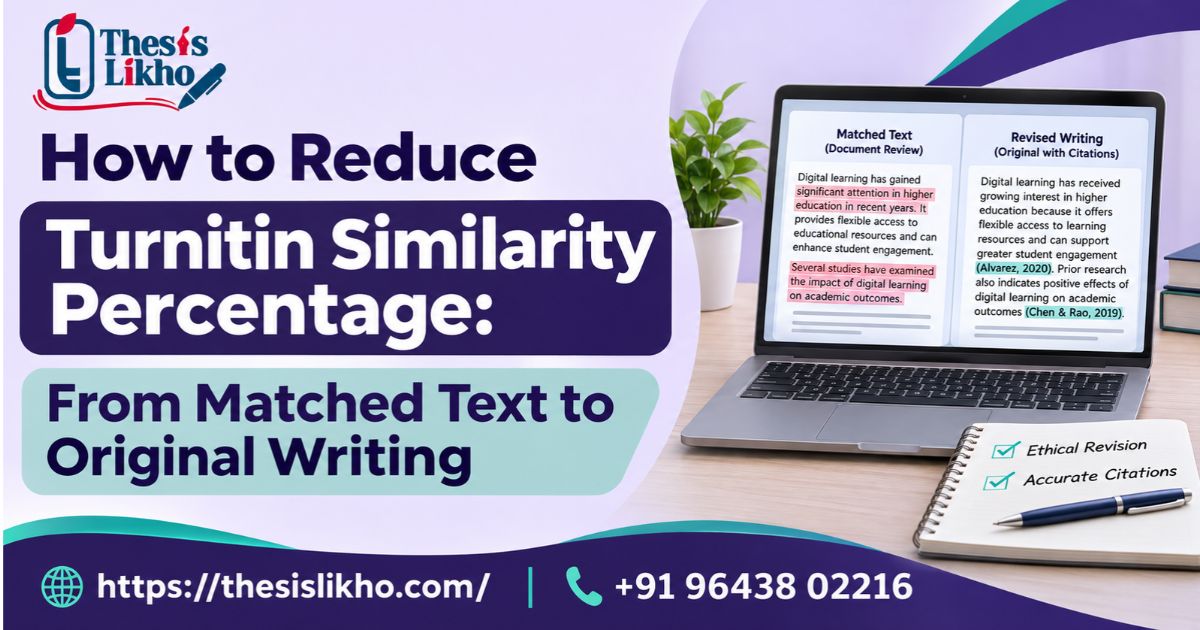
You have finished your draft, checked the references and uploaded the document. Then the similarity report shows a percentage higher than you expected. With a submission deadline approaching, the temptation is to start changing every highlighted sentence.
A better starting point is to understand how to reduce Turnitin similarity percentage by identifying what each match means. A copied explanation, a correctly quoted definition and a reference entry need different responses. This guide explains how to review those matches, revise passages that depend too heavily on source wording and make your own contribution clearer.
Quick Answer
Review the matched passages before changing your draft. Rewrite overly close paraphrases from your understanding, cite borrowed ideas and quote exact wording where necessary. Keep accurate references and discuss permitted exclusions with your instructor. Turnitin measures matching text; its percentage alone does not establish whether plagiarism has occurred.
Table of Contents
- Before You Edit: What Is Actually Increasing Your Score?
- Match Type → Best Next Step
- A Five-Step Revision Workflow
- A Worked Paraphrasing Example
- #fixing-similarity-in-literature-reviews-and-methodology-chapters
- Why Correctly Cited Text Can Still Match
- Similarity Percentage and Plagiarism
- #final-submission-checklist
- #frequently-asked-questions
Before You Edit: What Is Actually Increasing Your Score?
Start with the highlighted passages in your report. Read each one beside the matching source and ask: Does this passage accurately represent my own writing and properly acknowledge borrowed material?
Turnitin can highlight quotations, bibliography entries and other legitimate similarities. Its report supplies evidence for review, so individual matches matter more than the overall number on its own.
Use these questions to decide where to focus:
- Are whole sentences or paragraphs matching? Examine whether you have reproduced another author’s explanation.
- Does one source appear throughout a chapter? Check whether your argument relies too heavily on that source’s structure.
- Are the matches mainly titles, references or quotations? Review formatting and assignment requirements before editing.
- Have you cited the source but retained its wording? Exact wording may need quotation marks or block quotation formatting.
- Is the source your earlier submission? Ask your instructor how previous work should be handled.
A useful revision note is specific: “Paragraph three follows the source sentence by sentence.” A note such as “reduce this chapter by 5%” gives you no clear academic problem to solve.
Match Type → Best Next Step
An uncited copied passageAre the wording and ideas borrowed?Explain the idea independently and cite it, or quote and cite essential wording.A close paraphraseDoes it retain the source’s sentence structure?Rebuild the explanation around your understanding and retain attribution.Exact wording with a citationIs it clearly presented as a quotation?Apply the quotation format required by your referencing style.A reference entryIs the bibliographic information accurate?Keep the entry accurate and check the institution’s exclusion policy.Necessary technical terminologyWould replacing the term change its meaning?Retain precise terminology and review the surrounding explanation.An earlier submissionIs reuse permitted and acknowledged?Consult your instructor before making changes or requesting an exclusion.
Avoid treating this table as an automatic deletion list. The right response depends on what the passage contributes to your work.
How to Lower the Similarity in Turnitin: A Five-Step Revision Workflow
If you are deciding how to lower the similarity in Turnitin, work through one substantial match at a time. Trying to rewrite an entire document in one sitting makes it easier to introduce errors.
1. Review Substantial Matches
Begin with extended passages and repeated source wording in the main chapters. Mark the issue beside each passage: missing attribution, close paraphrasing, unnecessary quotation or excessive dependence on one source.
Prioritise passages where the reader cannot clearly distinguish your explanation from the source author’s contribution.
2. Read and Understand the Original Source
Read the surrounding section of the source, including any qualifications or limitations. A highlighted sentence may describe an association, a finding from one setting or an argument the author later challenges.
Before rewriting, identify:
- The central claim.
- The evidence supporting it.
- The population or context it applies to.
- Its relevance to your research question.
This helps prevent a common revision error: changing the wording while accidentally strengthening the claim.
3. Draft the Explanation Independently
Set the source aside and explain the idea from brief notes. Choose an order that suits your paragraph rather than following the original sentence.
For example, your paragraph might need to begin with a limitation, compare two findings or explain why a result matters to your study. That purpose should shape the writing.
If you cannot explain the idea without repeatedly consulting the original sentence, return to the source and clarify your understanding first.
4. Add Your Interpretation and Citation
After explaining the source’s contribution, show what it means for your argument.
You might identify a limitation in its sample, explain how its findings relate to another study or show why its method is relevant to your project. Keep your interpretation distinguishable from the author’s findings.
Cite borrowed ideas even when every sentence has been written independently.
5. Compare for Accuracy and Overly Similar Wording
Reopen the source and check your revision.
Have you retained a distinctive phrase without quotation marks? Does your explanation preserve the original level of certainty? Have you kept the citation close enough to the borrowed claim?
Finish by reading the paragraph in context. A successful revision should improve the chapter’s clarity as well as its independence.
A Worked Example: From Close Paraphrase to Clear Academic Writing
The following passage is invented for illustration.
Illustrative source passage
“Flexible working arrangements improved employee retention when staff also received consistent managerial support.”
Weak synonym-swapped version
Flexible work arrangements increased staff retention when employees also obtained regular management support.
The second version follows the same sequence and sentence structure. Replacing “improved” with “increased” does little to demonstrate independent understanding.
Improved explanation
The reported retention benefit depended on more than access to flexible hours: employees also needed reliable support from their managers ([Author, Year]).
Possible analytical follow-up
This suggests that the present study should examine managerial support alongside flexible working arrangements.
The revised explanation foregrounds the condition attached to the finding. The follow-up then connects that finding to a research decision.
Replace the citation placeholder with a verified source when applying this approach to real writing. An independently written paraphrase still needs attribution, and no particular revision can guarantee a numerical score reduction.
Fixing Similarity in Literature Reviews and Methodology Chapters
These chapters often require different editing decisions. A literature review needs synthesis, while methodology needs an accurate account of what you actually did.
Literature Reviews: Organise Around Questions and Findings
A literature review can become source-dependent when each paragraph follows the same pattern: one author’s background, method, results and conclusion.
Try organising the discussion around a question instead.
For a study on employee retention, useful questions might include:
- Under what conditions does flexible working help?
- Why do findings differ across organisations?
- Which employee groups are underrepresented?
- How have researchers measured retention?
Prepare a comparison table in your notes before drafting:
Main findingWhat did the study report?ContextWhere and with whom was it conducted?MethodHow was the evidence collected?LimitationWhat remains uncertain?RelevanceHow does it inform your research question?
Then write across the studies. Explain agreements, differences and gaps, with citations attached to the relevant claims. This gives the reader a reason to encounter each source.
Methodology: Describe Your Actual Research Decisions
Keep established names for instruments, statistical procedures and technical concepts. Replacing precise terminology with unusual alternatives can make the chapter less accurate.
Focus your independent explanation on decisions such as:
- Why the design suited your research question.
- How participants or records were selected.
- How data collection was carried out.
- What analytical choices you made.
- How limitations affected interpretation.
Cite established methods where appropriate. If wording from a published protocol must be reproduced, discuss the required attribution and quotation approach with your supervisor.
Why Correctly Cited Text Can Still Match
A citation identifies a source, but the surrounding words may still match it. A direct quotation deliberately preserves another author’s wording, and reference entries contain standard publication details.
Turnitin provides filters for material such as quotations and bibliographies. Their availability and use depend on the report experience and assignment settings. Review the applicable policy with your instructor before relying on an exclusion.
Use this distinction when reviewing a highlighted passage:
A cited paraphrase needs an independent explanation of the borrowed idea.
A direct quotation needs accurate wording, appropriate quotation formatting and a citation.
A reference entry needs complete, correct bibliographic information.
Do not remove valid citations or alter publication titles to make a report look cleaner. Those changes would weaken the document’s traceability.
How to Reduce Plagiarism Percentage in Turnitin: What the Question Really Means
People often search for how to reduce plagiarism percentage in Turnitin when they mean that their similarity result is higher than expected. Turnitin reports similarity rather than a measured amount of plagiarism.
There is no single acceptable percentage for every submission. A higher result may contain legitimate quotations, while a lower result still requires examination of the matched passages. Follow your institution’s and assignment’s requirements.
Two checks are therefore necessary:
Check the writing: Are borrowed ideas attributed? Is exact wording quoted? Does your analysis make a clear contribution?
Check the submission rules: Which sections are assessed? What exclusions apply? What does the department require?
If you are asking how to reduce Turnitin percentage, begin with the writing problems you can identify. A target number alone cannot tell you whether a passage is academically sound.
Common Revision Mistakes That Weaken a Draft
Changing words without understanding the passage. This can preserve the source’s structure and distort its meaning.
Removing citations from highlighted sentences. A match does not make the citation unnecessary.
Adding unrelated material to dilute the percentage. Extra text should develop the research argument.
Rewriting every technical expression. Established terminology often provides essential precision.
Using a rewriting tool without checking its output. Any assisted revision still needs verification for meaning, evidence and attribution.
Making last-minute edits without proofreading. A revised paragraph can introduce inconsistencies in terminology, references or argument.
Final Submission Checklist
Before uploading your revised document, confirm that:
- Substantial matches have been reviewed against their sources.
- Borrowed ideas have clear citations.
- Exact quotations are marked and referenced correctly.
- Paraphrases preserve meaning without following the original wording too closely.
- Literature review paragraphs explain relationships between studies.
- Methodology describes your actual procedures.
- In-text citations and reference entries correspond.
- Previous-work matches have been discussed where necessary.
- The revised document has been proofread for accuracy and flow.
Keep a short record of what you changed and why. It can help you explain the revision to your supervisor and avoid repeating the same writing problems.
Need help reviewing a similarity report?
Request academic editing assistance for close paraphrasing, citation consistency and chapter clarity. Share the relevant passages, source material and institutional requirements so the review addresses specific writing issues.
Frequently Asked Questions
Does a high Turnitin similarity score always mean plagiarism?
No. The report may include legitimate quotations, references and other matches. The passages require human review before conclusions are drawn.
Will adding a citation remove a similarity match?
A citation acknowledges the source; it does not change the borrowed wording. If you retain exact words, use the appropriate quotation format. Report filters may affect what is displayed.
Is changing a few words enough to paraphrase properly?
Usually, that leaves the explanation too close to the source. Understand the idea, write it independently, check its accuracy and cite it.
Should I remove references to reduce the percentage?
Keep accurate references. If bibliography matches need separate treatment, check the permitted report settings with your instructor.
How should I handle a match to my own earlier work?
Check the institution’s reuse rules and speak with your instructor. Earlier authorship does not automatically establish permission to reuse the material in a new assessment.
Can anyone guarantee a specific similarity percentage?
A guarantee cannot establish that the writing meets academic requirements. Focus on accurate attribution, independent explanation and the rules governing your submission.
What is the best place to begin revising?
Start with substantial matches in the main argument. Identify the source, diagnose the writing issue and make the correction that the passage needs.
Call / WhatsApp: +91 96438 02216
Website: www.thesislikho.com