
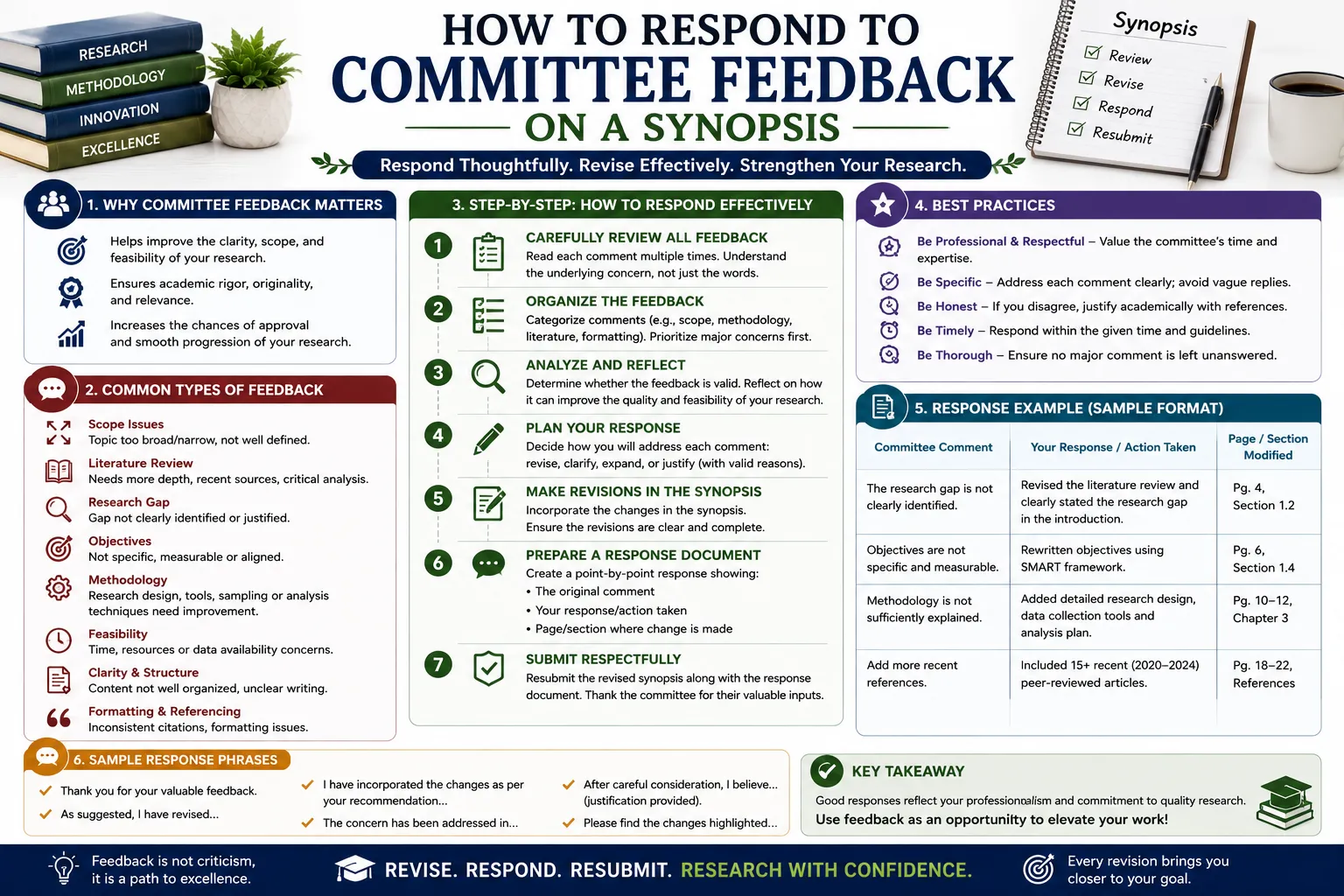
Getting your synopsis back from the Doctoral Research Committee with a page of comments attached can feel like a setback, but it's actually one of the most normal, expected parts of the process — very few synopses are approved without at least some requested changes on the first pass. Learning how to respond to committee feedback on a synopsis is a skill in itself: reading criticism without reacting defensively, prioritizing what genuinely needs to change, and revising in a way that demonstrably addresses every concern rather than making surface-level tweaks and hoping for the best.
This guide walks through exactly how to process committee feedback, categorize and prioritize the changes it calls for, structure your revision and response, and avoid the reactions that turn a manageable round of feedback into a drawn-out, frustrating resubmission cycle. We've grounded this in established academic revision practice and the patterns we see across scholars ThesisLikho supports through the synopsis revision stage.
Why Feedback Is a Normal Part of the Process, Not a Failure
It's worth stating plainly: committee feedback on a synopsis, even substantial feedback, is not a sign that your research idea is weak or that you've done something wrong. Multiple rounds of revision are a completely standard part of academic proposal and manuscript review at every level, from PhD synopses to grant applications to journal submissions — committees and reviewers are not looking to reject your work, they're looking to help you submit the strongest possible version of it before you commit years of research time to executing the plan.
Reframing feedback this way matters practically, not just emotionally, because how you interpret the feedback shapes how well you respond to it. Scholars who treat committee comments as a normal, expected checkpoint tend to revise more effectively than scholars who treat the same comments as a personal or intellectual failure, since the second reaction often produces either defensive minimal changes or panicked overcorrection — neither of which serves the revision well.
The First Read: Don't Respond Immediately
The most reliable first step, recommended consistently across academic revision guidance at every level, is to read through the full set of feedback once, and then deliberately set it aside for a day or two before reading it again. An immediate reaction to critical feedback — especially feedback that feels unexpected or points to something you were genuinely proud of — is rarely your most useful response, and rushing into revisions based on that first emotional read often produces changes that miss what the committee actually meant.
On your second read, after some distance, you'll typically find the feedback reads more clearly and less personally than it did the first time — patterns become more visible, and you can start separating genuinely substantive concerns from comments that were more about phrasing or presentation than the underlying research plan.
Categorizing Feedback: Major Versus Minor Issues
Once you're ready to work through the feedback constructively, the next step is sorting every comment into major and minor categories, and prioritizing your revision time accordingly. Major issues typically involve the core structure of your research plan: an unclear or unfeasible objective, a methodology that doesn't match your stated research questions, an inadequately justified sample size, or a literature review that hasn't clearly established a genuine gap. Minor issues typically involve presentation, wording, formatting, or smaller clarifications — a citation format inconsistency, a sentence that could be phrased more precisely, a request for a bit more detail in an already largely sound section.
This categorization matters because major and minor issues call for different kinds of attention: major issues usually require you to rethink and rebuild a section, possibly discussing it with your supervisor before you attempt a revision; minor issues can typically be addressed directly and quickly. Working through major issues first, rather than getting drawn into easy minor fixes before tackling the harder structural concerns, is generally the more efficient use of your revision time.
When to Seek Clarification Before Revising
Committee feedback isn't always written with perfect clarity — a comment like "methodology needs strengthening" or "objectives lack focus" tells you something needs attention without necessarily telling you exactly what to change. When a specific comment is genuinely ambiguous, seeking clarification from your supervisor or, where appropriate, directly from the committee, is standard and entirely acceptable practice — far better than guessing at what was meant and potentially revising in the wrong direction, which risks producing a second round of similar feedback on a resubmission.
A brief, specific clarification request — "Could you clarify what aspect of the sampling approach in Objective 2 needs strengthening?" — is a normal part of the process and reads as diligence, not as an inability to understand feedback on your own.
Building a Point-by-Point Response Document
The most effective way to respond to committee feedback, and increasingly an expected practice at many universities, is a structured, point-by-point response document that addresses every comment individually rather than a general revised synopsis with no accompanying explanation of what changed and why. For each comment: quote or paraphrase the original feedback, describe specifically what you changed in response, and note exactly where in the revised synopsis that change appears.
This kind of structured response document serves two purposes at once: it makes the committee's re-review considerably faster and easier, since they don't have to re-read the entire synopsis hunting for what changed, and it forces you to genuinely confirm you've addressed every single point raised, rather than half-remembering the feedback and hoping you covered everything.
Deciding When to Push Back on a Comment
Not every piece of feedback needs to be implemented exactly as written, and respectfully disagreeing with a specific comment — when you have genuine, well-reasoned grounds to do so — is a legitimate part of the revision process, not something to avoid entirely. If a committee member's suggestion would genuinely weaken your research design, or reflects a misunderstanding of something you believe was actually stated clearly, it's appropriate to explain your reasoning in your response document rather than simply complying with every comment regardless of your own assessment.
The key is doing this carefully and rarely, with clear, specific reasoning rather than a defensive tone — "we considered this suggestion but retained the original approach because..." followed by a concrete explanation reads very differently than simply ignoring the comment or dismissing it without justification. Reserve this kind of pushback for genuinely well-grounded disagreements; using it as a way to avoid doing the harder work of addressing a legitimate concern tends to be obvious to a committee and rarely goes well.
Revising Without Losing Your Synopsis's Strengths
A common and avoidable mistake during revision is over-correcting so heavily in response to feedback that the genuine strengths of your original synopsis get diluted or lost in the process. If a committee praised your literature review's depth while flagging your methodology as needing more detail, resist the temptation to substantially rewrite the literature review too, just because you're in a general revision mindset — focus your revision energy specifically where the feedback indicated it's needed, and preserve what was already working well.
This is part of why the point-by-point response approach helps: by tracking exactly what needs to change against each specific comment, you're less likely to drift into unnecessary, unrequested changes to sections that were already strong.
Distinguishing Fixable Issues From Fundamental Ones
Most committee feedback points to fixable issues — a sample size that needs better justification, an objective that needs sharper wording, a methodology section that needs more specific detail. Occasionally, though, feedback signals something more fundamental: a research question that isn't genuinely researchable as framed, a methodology that's mismatched with the underlying research philosophy in a way that can't simply be patched, or a literature review that reveals the research gap isn't as clear as initially believed.
Recognizing which category your feedback falls into matters considerably for how you approach revision. Fixable issues call for targeted, specific changes to the relevant sections. Fundamental issues sometimes call for a genuinely substantial rethink — potentially returning to your research design stage rather than attempting a surface-level revision of the existing synopsis structure. If you're uncertain which category you're dealing with, this is exactly the kind of situation worth discussing directly with your supervisor before drafting any revision at all.
Tone: Professional, Not Defensive
Regardless of how you feel about specific pieces of feedback, maintaining a professional, appreciative tone throughout your response — even where you're pushing back on a specific point — consistently produces better outcomes than a defensive or frustrated tone, which tends to color how a committee reads your entire resubmission. Acknowledging the feedback's value, even briefly, before explaining your specific response to it goes a long way: committee members are typically volunteering considerable time and expertise to strengthen your proposal, and a response that reflects genuine engagement with their input — rather than grudging compliance — generally receives a more favorable second read.
This doesn't mean performing enthusiasm you don't feel; it means keeping your response focused on the substance of the revision rather than on how the feedback made you feel receiving it.
Tracking Changes Across Multiple Revision Rounds
It's genuinely common for a synopsis to go through more than one round of committee feedback before final approval — this isn't unusual and shouldn't be read as a negative signal about your research, particularly for more ambitious or methodologically complex proposals. If you find yourself facing a second or even third round of feedback, keeping a clear running record of what's been raised and addressed across each round becomes increasingly important, since it's easy to lose track of exactly what changed when, or to inadvertently reintroduce an issue a much earlier round of feedback had already resolved.
A simple running log — dated by revision round, with each comment and your corresponding response — serves you well here, both for your own clarity and, if a later committee member questions why a particular section reads the way it does, as a ready record showing the reasoning trail behind your current version. This is particularly valuable if committee composition shifts slightly between rounds, since a new reader benefits from being able to see the fuller history of how your synopsis reached its current form, rather than evaluating it as if it were a first draft.
If you notice the same type of concern being raised across multiple rounds despite genuine attempts to address it, that's a useful signal worth discussing directly and explicitly with your supervisor — it may indicate the underlying issue hasn't actually been resolved, only reworded, and deserves a more fundamental look rather than another surface-level pass.
Real Feedback Response Examples
Example 1 — Major methodology feedback. A scholar received committee feedback stating her proposed sample size of 50 respondents was inadequately justified for the multiple regression analysis her methodology described. Rather than simply increasing the number without explanation, she consulted her supervisor, ran a proper power analysis for her specific model, and revised her methodology section to state a justified target of 220 respondents with the power calculation explicitly referenced. Her response document quoted the original comment, described the specific change, and noted the exact page where the revised justification appeared — a response the committee approved without further questions on resubmission.
Example 2 — Respectful pushback on a suggestion. A scholar received a committee suggestion to switch his qualitative interview study to a survey-based design for broader generalizability. After discussing it with his supervisor, he concluded the switch would genuinely undermine his research question, which specifically concerned the depth and meaning-making process behind a decision, not its prevalence across a population. His response document acknowledged the generalizability concern directly, explained specifically why his research question required qualitative depth rather than quantitative breadth, and proposed instead to more explicitly frame his conclusions as context-specific rather than broadly generalizable — a response that addressed the underlying concern without abandoning the design his research question genuinely required.
Common Mistakes When Responding to Feedback
- Responding immediately and defensively, without giving yourself time to process feedback objectively before drafting a revision.
- Making only cosmetic changes — adjusting wording without genuinely addressing the substance of a major comment — and resubmitting essentially the same synopsis.
- Over-revising and losing the synopsis's original strengths, changing sections that weren't actually flagged as needing attention.
- Guessing at ambiguous feedback rather than seeking clarification, risking a revision that misses what the committee actually intended.
- Ignoring or dismissing a specific comment without addressing or explaining the omission, rather than engaging with every point raised.
- Submitting a revised synopsis with no accompanying response document, forcing the committee to re-read everything to identify what actually changed.
- Being combative or defensive in tone, even when respectfully disagreeing with a specific point, which colors how favorably the entire resubmission is received.
- Treating every comment as equally urgent, spending equal time on minor wording suggestions and major structural concerns rather than prioritizing accordingly.
Feedback Response Checklist
Before resubmitting your revised synopsis, confirm you have:
- Read the full feedback once, then again after a day or two, before beginning any revision
- Categorized every comment as major or minor and prioritized major issues first
- Sought clarification on any genuinely ambiguous feedback before revising
- Built a point-by-point response document addressing every comment individually
- Clearly reasoned any respectful disagreement with a specific comment, rather than simply ignoring it
- Confirmed your revisions are targeted to the flagged sections, without unnecessarily altering sections that were already strong
- Reviewed whether any feedback signals a fundamental issue requiring deeper rethinking, not just a surface fix
- Checked the overall tone of your response document is professional and appreciative throughout
For guidance on the broader resubmission process if your synopsis requires a more substantial second attempt, see our related guide, [how to resubmit a rejected synopsis successfully]. And if you're trying to understand common patterns behind synopsis rejection before you even reach this stage, see [common reasons PhD synopsis gets rejected by committees].
How Long Does It Take to Complete a Synopsis Using This Approach?
Responding thoroughly to committee feedback typically takes two to four weeks, depending on how substantial the requested changes are — a synopsis needing mostly minor clarifications can often be revised within a week, while major methodology or objective revisions, particularly ones requiring supervisor consultation or a genuine rethink, can reasonably take three to four weeks to address properly. Rushing a response to meet a resubmission deadline without genuinely addressing the substance of the feedback often costs more time overall, since inadequately addressed feedback tends to resurface in a second review round.
Is Professional Help Available to Respond to Committee Feedback on a Synopsis?
Yes — many scholars work with academic mentors or research consultancies to interpret ambiguous committee feedback, prioritize major versus minor revisions, and build a clear, professional response document that demonstrates every concern has been genuinely addressed. ThesisLikho's PhD-qualified research experts have supported synopsis writers through exactly this stage, helping ensure revisions are targeted, well-justified, and presented in a way that gives committees confidence the feedback has been taken seriously — all while keeping the underlying research and decisions entirely your own. Explore ThesisLikho's synopsis writing services for one-on-one guidance.
FAQs
How do you respond to committee feedback on a synopsis? Read the feedback fully, set it aside briefly before re-reading it objectively, categorize comments into major and minor issues, seek clarification on anything ambiguous, and build a point-by-point response document addressing every comment specifically, with clearly reasoned justification for any respectful disagreement.
How long does it take to complete a synopsis using this approach? Responding thoroughly typically takes two to four weeks, depending on whether the requested changes are largely minor clarifications or major methodology and objective revisions requiring deeper rework.
Is professional help available to respond to committee feedback on a synopsis?
Yes. Research consultancies and academic mentors, including ThesisLikho's PhD-qualified experts, help scholars interpret feedback, prioritize revisions, and build clear response documents while preserving full ownership of the underlying research.
Why should I respond to committee feedback on a synopsis carefully?
Because a rushed, defensive, or superficial response often produces a second round of similar feedback, while a thorough, well-organized response demonstrates genuine engagement and gives the committee confidence to approve your revised synopsis without further delay.
When should you respond to committee feedback on a synopsis for a synopsis?
Begin processing feedback as soon as you receive it, but deliberately delay drafting your actual revisions until you've had time to read the comments objectively — typically a day or two — rather than reacting immediately while the feedback still feels personal or unexpected.
Ready to turn committee feedback into an approved synopsis?
Get Synopsis Help Now → https://thesislikho.com/writing-services/synopsis-writing