
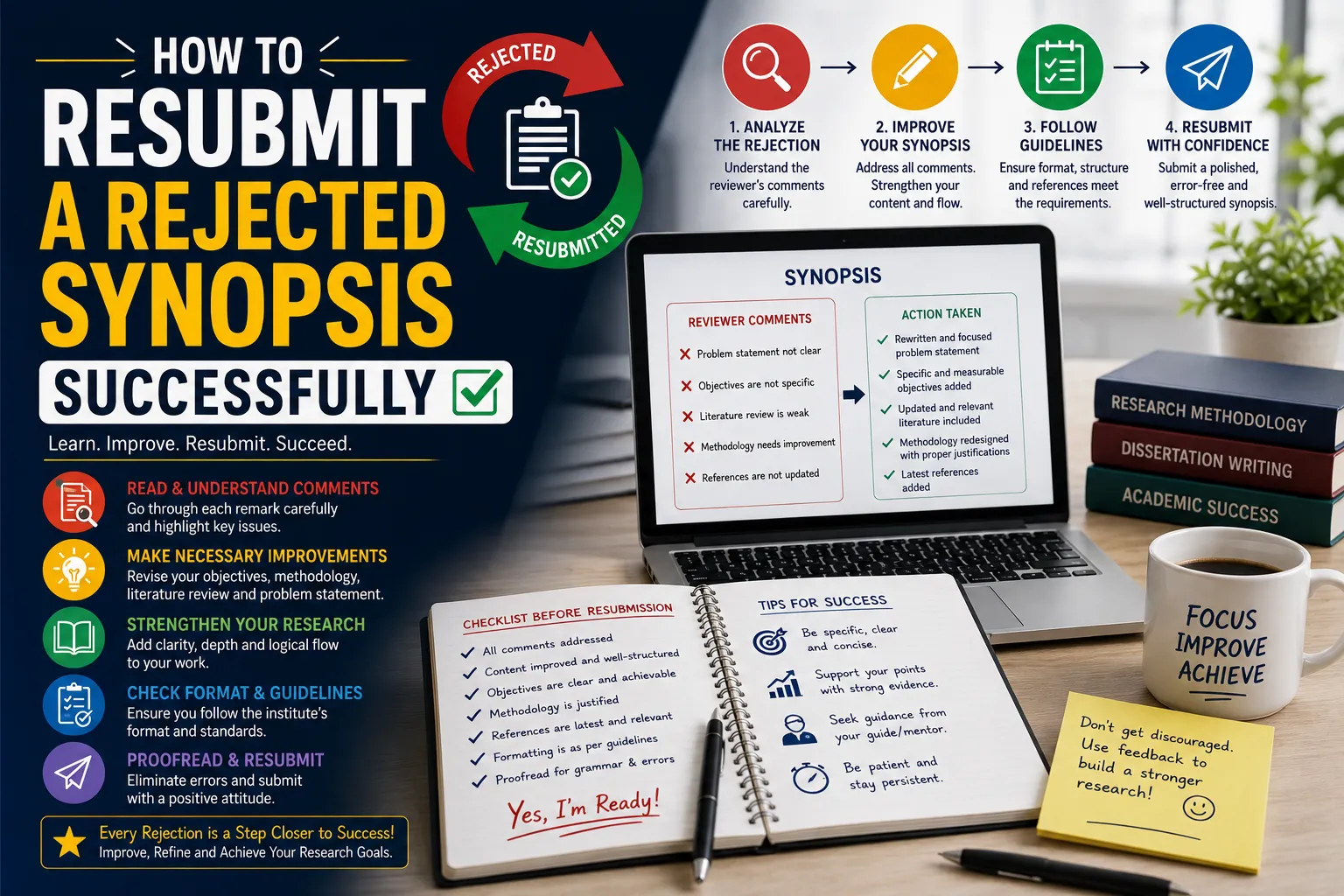
Getting your synopsis sent back doesn't feel like "feedback" in the moment — it feels like a verdict. But a rejected synopsis is closer to a peer reviewer's revision request than a final judgment: it's the Doctoral Research Committee telling you, specifically, what needs to change before they can approve the project. The scholars who resubmit successfully aren't the ones who happened to have a stronger idea to begin with — they're the ones who treat the revision process as genuine, structured work rather than a quick patch-up.
This guide walks through how to resubmit a rejected synopsis successfully the way an experienced research supervisor would — plainly, with the specific steps that separate a resubmission that gets approved from one that gets sent back again. If you're a first-time PhD thesis writer without a strong research background, this is written specifically for you.
At ThesisLikho, our PhD-qualified mentors have guided more than 10,000 scholars through synopsis writing and resubmission across disciplines. What follows draws on that mentoring experience, checked against established guidance on academic revision and resubmission processes and current UGC direction on doctoral research in India.
1. Reframe the Rejection Before You Do Anything Else
Most students treat a rejection or revision request as a verdict on their intelligence or their research idea. It rarely is. In academic publishing, a "revise and resubmit" decision is generally considered a positive sign — it means the reviewers saw something worth pursuing and are inviting you to strengthen it, not closing the door. The same logic applies almost exactly to a synopsis sent back by a Doctoral Research Committee: it usually means the committee could see a feasible project underneath the current draft, but the draft itself wasn't yet doing enough to demonstrate that clearly.
This reframe matters practically, not just emotionally. Scholars who treat the rejection as a diagnosable, fixable craft problem — this section was too vague, that gap wasn't clearly stated — move through revision efficiently. Scholars who treat it as a judgment on their ability tend to either freeze, rewrite far more than necessary out of anxiety, or make only superficial changes because they're avoiding fully engaging with the criticism. Neither of those responses leads to a strong resubmission.
It's also worth knowing this experience is genuinely common, not a sign you're behind your peers. A substantial share of first synopsis submissions receive at least one revision request, and most scholars who engage seriously with that feedback resubmit successfully within a reasonably short window. The scholars who eventually struggle aren't the ones whose synopsis got sent back once — they're the ones who respond to that setback by either giving up on a genuinely promising research direction or by resubmitting the same document with only surface-level changes.
2. Step 1: Read the Feedback Completely Before Reacting
Read the committee's feedback in full, ideally more than once, before you touch your synopsis document at all. Resist the urge to revise immediately after a first, emotionally charged read — the specific, accurate revision plan almost always comes from a second, calmer pass through the same comments.
If your feedback came only through your supervisor rather than a formal written committee report, ask your supervisor directly for as much specificity as they can share about which sections the committee flagged and why. Vague feedback like "the methodology needs work" is far less useful than "the sampling justification for your qualitative phase doesn't explain why purposive sampling was chosen over other options" — and it's entirely reasonable to ask for that level of specificity if it wasn't provided initially.
3. Step 2: Categorize Every Comment Before You Start Revising
Once you've read the feedback fully, sort every individual comment into major and minor categories before building your revision plan. Major issues typically involve the research topic's scope, the clarity of your research gap, your theoretical framing, or your methodology's justification — these require genuine, substantive rework. Minor issues typically involve formatting, citation consistency, clarity of specific sentences, or small structural adjustments — these are quick fixes that shouldn't consume disproportionate revision time relative to their actual weight.
This categorization step does real work: it prevents you from spending days perfecting citation formatting while the actual scope problem the committee flagged goes unaddressed, and it gives you an honest sense of how much revision time you're actually looking at before you commit to a resubmission timeline.
4. Step 3: Build a Structured Revision Plan, Not a Patch List
Rather than editing reactively, section by section, in whatever order you happen to reread the document, build a deliberate plan: list every issue from your categorized feedback, break the work into manageable tasks, and prioritize based on how significant each fix actually is to the committee's core concerns. Attach a realistic timeline to this plan, working backward from your intended resubmission date, rather than resubmiting whenever you run out of steam.
This structured approach matters especially for the major issues. If your topic was flagged as too broad, "narrowing the topic" isn't actually one task — it likely involves re-running your literature search with a tighter focus, rewriting your problem statement, adjusting your objectives and research questions to match, and possibly revising your proposed methodology to fit the narrower scope. Breaking this into its real sub-tasks, rather than treating it as a single line-item, is what prevents a rushed, incomplete revision.
5. Step 4: Address Every Comment Explicitly, Even the Ones You Disagree With
Every specific comment from your committee needs an explicit, direct response in your revised synopsis — not a hope that a general rewrite will implicitly cover it. If you disagree with a particular piece of feedback, the right move isn't to ignore it silently; it's to address it thoughtfully, explain your reasoning, and justify why you've chosen not to make that specific change, using clear academic reasoning rather than simply asserting your original choice was fine.
Where committee members give feedback that seems to point in different directions, acknowledge both perspectives directly rather than picking one silently: state which direction you've taken and provide a clear, logical justification tied to your study's actual objectives. This kind of transparent reasoning, even when it involves respectfully declining a suggested change, reads as far more credible than either blind compliance or silent omission.
This distinction between genuine engagement and box-ticking matters more than it might seem. A committee reading your resubmission isn't just checking whether specific words changed — they're checking whether the underlying reasoning behind your synopsis actually improved. Rewriting a sentence to sound more confident without changing the substance behind it is easy to spot and rarely satisfies the original concern; genuinely rethinking the point the committee raised, even if you ultimately land close to your original position, is what a real response looks like.
6. Step 5: Build a Response Document Alongside Your Revised Synopsis
Even where your university doesn't formally require one, preparing a short response document — a simple table listing each committee comment, your specific response, and where in the revised synopsis that response appears — is one of the highest-leverage things you can do for a resubmission. It demonstrates, at a glance, that you've engaged with every point raised, rather than leaving the committee to reread your entire document searching for evidence that their feedback was actually addressed.
Be specific in this document: reference actual section names or approximate locations in your revised synopsis, and briefly explain your rationale for each change, rather than vague statements like "this has been improved." Use professional, measured language throughout, even for comments you found frustrating or felt were based on a misunderstanding — a response document is not the place to relitigate your feelings about the original decision.
A simple table format works well for this: one column for the committee's original comment, one for your specific response, and one noting the page or section reference in your revised synopsis where that response is reflected. This structure isn't just for the committee's benefit — building it forces you to confirm, item by item, that you've actually addressed everything, rather than trusting your memory of which points you handled during a longer revision process spanning several sittings.
7. Step 6: Check Your University's Specific Resubmission Requirements
Before finalizing anything, confirm your specific institution's resubmission process directly — required forms, any resubmission fee, the format for your revised submission, and your resubmission deadline. These procedural details vary meaningfully by university and are easy to get wrong under the stress of revision, and a synopsis that's otherwise excellent can still stall on a missed procedural requirement.
Pay particular attention to your resubmission timeline. Many university-specific ordinances define a maximum window for resubmission after a rejection or revision request; missing this window can create serious complications for your registration timeline, so confirm your specific deadline early and build your revision plan backward from it rather than discovering the deadline late.
8. Step 7: Get a Fresh Read Before You Resubmit
Before final submission, have someone else — your supervisor at minimum, and ideally a peer or mentor less close to the work — read the full revised synopsis, not just the sections you know you changed. It's genuinely difficult to spot whether your revisions actually resolved the committee's concerns when you're the one who's been staring at the document for weeks; a fresh reader catches gaps in logic or lingering vagueness that you've become blind to through sheer familiarity.
Do not rush this final check. A revision submitted within days of receiving feedback rarely reflects genuinely thorough engagement with that feedback — reviewers and committees alike can often tell the difference between a rushed patch-up and a substantively reworked document, and building in real time for a fresh read before resubmission is part of what makes that difference visible in the final product.
9. What Not to Do When Resubmitting
- Don't make only cosmetic edits and resubmit an essentially unchanged document. This is specifically flagged as one of the most damaging things a scholar can do at this stage — committees notice immediately, and it can undermine your credibility further for any subsequent submission.
- Don't skip addressing a comment because you disagree with it. Silent omission reads very differently from a stated, reasoned disagreement — the first looks like you ignored the committee; the second looks like a scholar making an informed judgment call.
- Don't rush the resubmission purely to hit an early deadline if the revision genuinely isn't ready — a well-considered resubmission that takes a few extra weeks is almost always a better outcome than a rushed one that comes back with the same core issues unresolved.
- Don't ignore your university's specific procedural requirements in favor of a generic resubmission approach — confirm the actual forms, fees, and formatting your specific department expects.
- Don't treat the response document as optional even when not formally required — this single document does enormous work in demonstrating, quickly and clearly, that every piece of feedback was genuinely considered.
10. How Long Successful Resubmission Actually Takes
Timelines vary by the scale of revision needed, but a genuinely thorough resubmission process — reading feedback carefully, categorizing issues, building a structured plan, and getting a fresh read before finalizing — commonly takes a few focused weeks for most first-time researchers, not months, provided the underlying issues are addressed substantively rather than superficially. Where your feedback pointed to a genuinely major issue (a fundamental topic rework, a significantly redesigned methodology), it's reasonable and honest to expect a longer revision window, and communicating that realistic timeline to your supervisor and department upfront is far better than either an unrealistic rushed resubmission or an unexplained long silence.
11. Two Realistic Case Studies
Case Study 1 — Turning a Vague Committee Comment Into a Concrete Fix
A scholar's synopsis was returned with a note stating the "research design needs further development," with little additional detail. Rather than guessing at what this meant, the scholar asked their supervisor directly for clarification and learned the committee specifically felt the qualitative sampling strategy wasn't justified against the stated research questions. Armed with this specificity, the scholar rewrote the methodology section to explicitly connect the purposive sampling approach to the study's need for in-depth understanding of a specific population, added a brief note on the alternative (a broader survey) that had been considered and rejected, and included both changes in a short response document referencing the exact revised section. The synopsis was approved on resubmission without further methodology-related queries.
Case Study 2 — Choosing to Explain Rather Than Silently Comply
A first-time scholar received feedback suggesting a complete change of theoretical framework, which the scholar believed would actually weaken the study's fit with its specific research questions. Rather than either silently keeping the original framework or complying without genuine conviction, the scholar's revised synopsis retained the original framework but added a dedicated paragraph explicitly addressing the committee's concern — acknowledging the alternative framework's relevance to adjacent research, and explaining with specific reasoning why the original framework remained the better fit for this particular study's objectives. This transparent, reasoned pushback, rather than either compliance or silence, was accepted by the committee on resubmission.
If you're navigating a synopsis resubmission and want a second, structured read on your revision plan, our Synopsis Writing service works through exactly this stage with scholars.
FAQs
How do I resubmit a rejected synopsis successfully?
Read the committee's feedback completely before reacting, categorize every comment into major and minor issues, build a structured revision plan with a realistic timeline, address every comment explicitly (including ones you disagree with, using reasoned justification), and prepare a clear response document alongside your revised synopsis before final submission.
Why should I take resubmission this seriously rather than making quick edits?
Because resubmitting an essentially unchanged document with only cosmetic edits is specifically flagged as one of the most damaging mistakes a scholar can make — committees notice immediately, and it can undermine your credibility for any subsequent submission far more than the original rejection did.
When should you resubmit a rejected synopsis, relative to receiving feedback?
Don't rush it. A revision submitted within days of feedback rarely reflects genuinely thorough engagement — take the time your specific issues actually require, while still respecting your university's stated resubmission deadline, which you should confirm directly and build your timeline against.
How long does it take to complete a synopsis resubmission using this approach?
Most first-time researchers take a few focused weeks to revise and resubmit successfully once specific feedback is available, though genuinely major revisions (a substantial topic or methodology rework) may reasonably take longer — communicate a realistic timeline to your supervisor rather than rushing an incomplete revision.
Is professional help available for resubmitting a rejected synopsis?
Yes — support with diagnosing committee feedback, building a structured revision plan, and preparing a resubmission-ready synopsis is available through services such as Synopsis Writing.
Ready to turn committee feedback into an approved synopsis? Get Synopsis Help Now from ThesisLikho's PhD-qualified mentors