
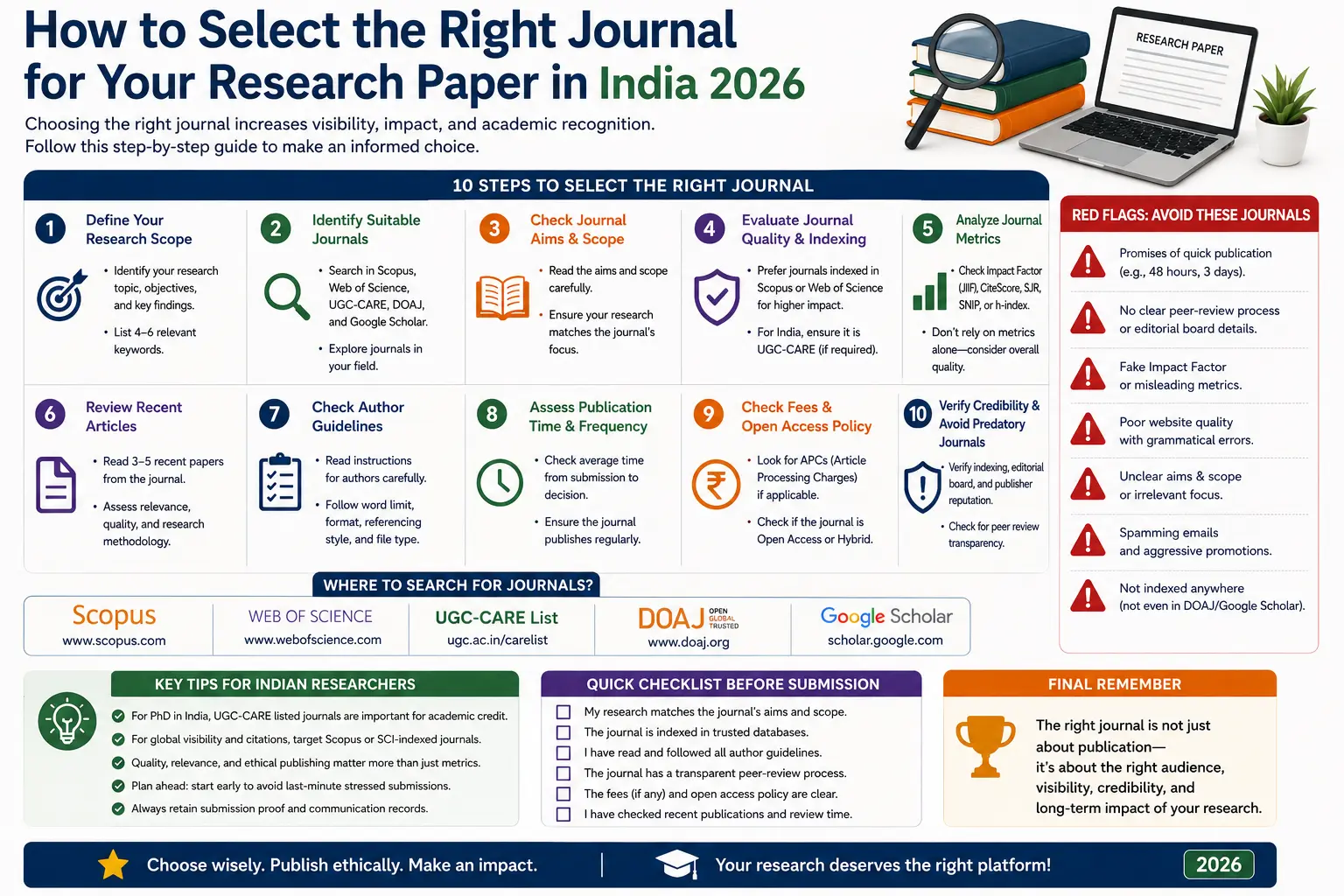
Introduction
One of the biggest challenges faced by researchers, PhD scholars, faculty members, and postgraduate students is selecting the right journal for their research paper. Even a high-quality manuscript can face rejection if submitted to an unsuitable journal.
In India, journal selection has become increasingly important due to changing academic regulations, growing competition in research publishing, and the increasing emphasis on quality publications for PhD completion, faculty promotions, research grants, and institutional rankings.
Many scholars focus only on metrics such as Impact Factor or Scopus indexing while overlooking other equally important factors such as journal scope, audience, review time, publication charges, and acceptance rates.
Choosing the right journal can significantly improve your chances of publication and ensure your research reaches the appropriate academic audience.
This comprehensive guide explains how Indian researchers can identify, evaluate, and select the most suitable journal for their research papers in 2026.
Why Journal Selection Matters
Selecting the right journal is not simply about getting published.
The journal you choose affects:
- Publication success
- Academic visibility
- Citation count
- Career advancement
- Research impact
- Funding opportunities
- Professional reputation
A carefully chosen journal increases the likelihood that your work will be read, cited, and recognized by researchers in your field.
Common Mistakes Indian Researchers Make
Before learning the selection process, let's understand common mistakes.
Submitting Based Only on Impact Factor
A journal may have a high Impact Factor but may not publish research in your specific area.
Ignoring Journal Scope
One of the leading reasons for desk rejection is mismatch with the journal's aims and scope.
Choosing Predatory Journals
Many researchers fall victim to fake journals that promise rapid publication.
Submitting Without Reading Previous Articles
Understanding previously published work is crucial before submission.
Focusing Only on Fast Publication
Quick publication should never outweigh journal quality.
Step 1: Understand Your Research Paper
Before searching for journals, clearly define your manuscript.
Ask yourself:
What Is My Research Area?
Examples:
- Computer Science
- Mechanical Engineering
- Education
- Management
- Healthcare
- Artificial Intelligence
What Type of Research Is It?
- Original Research
- Review Article
- Case Study
- Survey Paper
- Short Communication
Who Is My Target Audience?
Identify who will benefit most from your findings.
Step 2: Identify Journals That Match Your Topic
The most important criterion is journal scope.
Every journal publishes research within specific subject areas.
For example:
A paper on Artificial Intelligence in Healthcare may fit journals related to:
- Healthcare Technology
- Medical Informatics
- Artificial Intelligence
- Data Science
But it may not fit a pure medical journal.
Always read:
- Aims and Scope
- Journal Objectives
- Topics Covered
before submission.
Step 3: Check Journal Indexing
Indexing is one of the most important quality indicators.
Indian universities increasingly require publications in recognized databases.
Scopus Indexed Journals
Scopus remains one of the most respected indexing databases.
Advantages:
- Global recognition
- Citation tracking
- Better academic visibility
Suitable for:
- PhD scholars
- Faculty promotions
- Research grants
Web of Science Indexed Journals
Web of Science indexing is considered highly prestigious.
Benefits include:
- Impact Factor eligibility
- Strong academic reputation
- International visibility
PubMed Indexed Journals
Important for:
- Medicine
- Healthcare
- Life Sciences
UGC Requirements in 2026
Many Indian institutions now emphasize:
- Scopus indexing
- Web of Science indexing
- Reputable international journals
rather than relying solely on older journal lists.
Step 4: Evaluate Journal Metrics
Journal metrics provide insights into quality and influence.
Impact Factor
Impact Factor measures average citations received by published articles.
General interpretation:
Impact Factor
Quality
Below 1
Low
1–3
Moderate
3–5
Good
5–10
Very Good
Above 10
Excellent
Remember:
Impact Factor varies by discipline.
CiteScore
CiteScore is calculated using Scopus data.
Many journals display both:
- Impact Factor
- CiteScore
Comparing both metrics provides a better understanding.
SCImago Journal Rank (SJR)
SJR evaluates:
- Citation quantity
- Citation quality
Widely used by researchers.
Source Normalized Impact per Paper (SNIP)
SNIP accounts for differences in citation practices across disciplines.
Step 5: Check Journal Quartile Rankings
Quartiles help compare journals within the same field.
Q1 Journals
Top 25% journals.
Highest prestige and visibility.
Q2 Journals
Strong journals with good citation impact.
Q3 Journals
Moderate impact.
Q4 Journals
Lower-ranked journals.
Recommended for Indian Scholars
If possible, target:
- Q1 journals
- Q2 journals
These are often preferred by universities and funding agencies.
Step 6: Analyze Previously Published Papers
One of the best ways to evaluate a journal is to study recent publications.
Look at:
- Research topics
- Methodologies
- Writing style
- Sample sizes
- Statistical approaches
Ask:
"Does my paper resemble the type of research this journal publishes?"
If yes, your chances improve significantly.
Step 7: Review Author Guidelines Carefully
Every journal has unique submission requirements.
Check:
Word Limits
Some journals prefer concise papers.
Others accept lengthy manuscripts.
Formatting Style
Examples:
- APA
- IEEE
- Harvard
- Vancouver
Reference Style
Incorrect formatting can lead to immediate revisions.
Step 8: Examine Publication Fees
Many researchers are surprised by publication charges.
Open Access Journals
Typically require Article Processing Charges (APCs).
Costs may range from:
₹50,000 to ₹4,00,000 or more.
Subscription-Based Journals
Often charge no APC.
Readers pay through institutional subscriptions.
Important Tip
Never assume a journal is free.
Always verify charges before submission.
Step 9: Evaluate Review and Publication Timeline
Review speed matters, especially for:
- PhD submission deadlines
- Promotions
- Grant requirements
Check:
Average Review Time
Examples:
- 4 weeks
- 8 weeks
- 6 months
Publication Time
Acceptance does not always mean immediate publication.
Some journals have publication backlogs.
Step 10: Verify Journal Reputation
Journal reputation matters as much as metrics.
Evaluate:
Publisher Quality
Well-known publishers generally maintain stronger standards.
Examples include:
- Elsevier
- Springer Nature
- Taylor & Francis
- Wiley
- Sage
Editorial Board
Check whether editors are active researchers.
Peer Review Process
Transparent peer-review systems indicate credibility.
How to Identify Predatory Journals
Predatory journals exploit researchers by charging fees without proper peer review.
Warning signs include:
Unrealistic Acceptance Guarantees
Promises such as:
"Publication within 3 days"
are red flags.
Fake Impact Factors
Many predatory journals advertise misleading metrics.
Poor Website Quality
Look for:
- Grammar errors
- Broken links
- Missing contact details
Spam Email Invitations
Be cautious when receiving unsolicited publication offers.
Journal Selection Tools for Researchers
Several tools simplify journal discovery.
Publisher Journal Finders
Many publishers provide matching tools.
You upload:
- Title
- Abstract
- Keywords
The system recommends suitable journals.
Scopus Source List
Useful for verifying indexing status.
Web of Science Master Journal List
Helps verify Web of Science coverage.
Google Scholar Research
Analyze where similar papers are being published.
Journal Selection Strategy for PhD Scholars
For Indian PhD students, journal selection should align with institutional requirements.
Consider:
University Guidelines
Check publication requirements carefully.
Supervisor Recommendations
Experienced supervisors understand journal expectations.
Research Timeline
Choose journals that fit your academic deadlines.
Budget Constraints
Understand publication costs before submission.
Factors More Important Than Impact Factor
Many researchers obsess over Impact Factor.
However, these factors may be even more important:
Scope Alignment
Most important criterion.
Target Audience
Will the right people read your work?
Indexing
Ensures discoverability.
Peer Review Quality
Improves manuscript quality.
Acceptance Probability
A realistic target increases publication success.
Future Trends in Journal Publishing (2026 and Beyond)
Academic publishing continues to evolve.
Emerging trends include:
Open Access Growth
More journals are adopting open-access models.
AI-Assisted Peer Review
Publishers increasingly use AI tools for manuscript screening.
Research Transparency
Data-sharing requirements are becoming more common.
Interdisciplinary Publishing
Cross-disciplinary journals are growing rapidly.
Researchers should stay informed about these developments.
Best Journal Selection Checklist
Before submitting your paper, ensure the journal:
✅ Matches your research topic
✅ Is indexed in Scopus or Web of Science
✅ Has a legitimate publisher
✅ Uses peer review
✅ Meets your budget
✅ Fits your timeline
✅ Has acceptable metrics
✅ Publishes similar research
✅ Is not predatory
✅ Aligns with university requirements
Conclusion
Selecting the right journal is one of the most important decisions in the research publication process. A carefully chosen journal increases the chances of acceptance, improves visibility, and helps researchers achieve their academic and professional goals.
For Indian scholars in 2026, journal selection should go beyond Impact Factor alone. Researchers must evaluate indexing, scope, quartile ranking, publication fees, review speed, editorial quality, and relevance to their work.
The best journal is not necessarily the one with the highest Impact Factor—it is the one that aligns most closely with your research topic, audience, and academic objectives.
By following a systematic journal selection strategy, researchers can maximize publication success and ensure their work reaches the right scholarly community.
Frequently Asked Questions (FAQs)
1. How do I choose the right journal for my research paper?
Start by identifying journals that match your research topic, scope, indexing requirements, and publication goals.
2. Is Impact Factor the most important factor in journal selection?
No. Scope, indexing, audience, peer review quality, and relevance are equally important.
3. Should Indian PhD scholars publish only in Scopus journals?
Many universities prefer Scopus or Web of Science-indexed journals, but requirements vary by institution.
4. How can I verify if a journal is indexed?
Check official databases such as Scopus Source List or the Web of Science Master Journal List.
5. What is a predatory journal?
A predatory journal charges publication fees without providing proper peer review or editorial standards.
6. Are Q1 journals always better than Q2 journals?
Q1 journals generally have higher rankings, but a well-matched Q2 journal may be a better publication choice.
7. Do all journals charge publication fees?
No. Many subscription-based journals publish articles without APCs.
8. What is the biggest reason for journal rejection?
Mismatch between the manuscript topic and the journal's aims and scope is one of the most common reasons for rejection.
Contact ThesisLikho Today
Call / WhatsApp: +91 96438 02216
Visit: ThesisLikho.com