
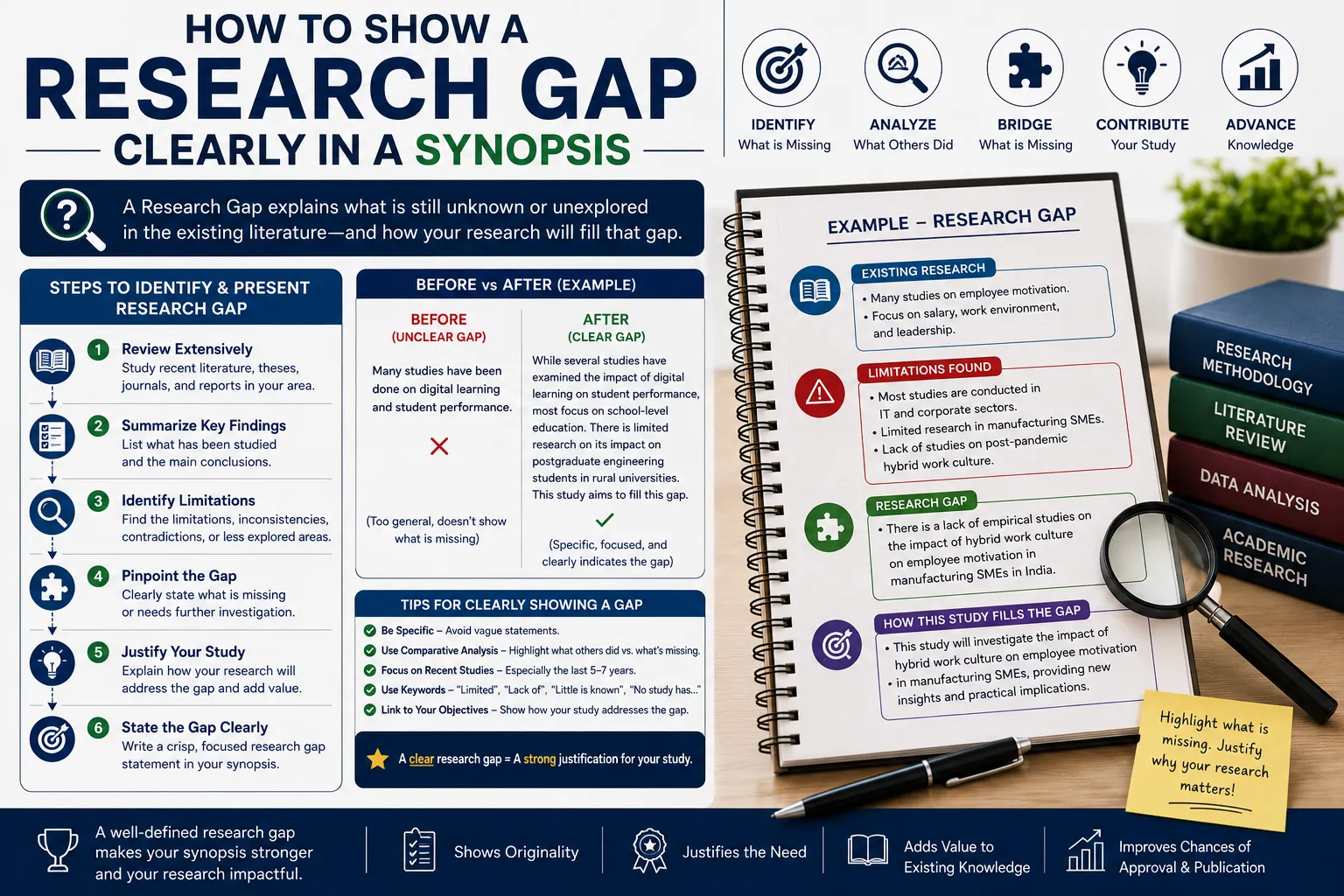
Every synopsis eventually arrives at the same make-or-break sentence: the one where you're supposed to explain, in a line or two, exactly why your proposed research needs to exist. Scholars who've done genuinely solid reading still stumble here — not because they don't understand their field, but because they haven't yet named, specifically, what kind of gap they're pointing at, or connected it clearly enough to what they're actually proposing to do.
This guide covers how to show a research gap clearly in a synopsis — the different types of gaps you might be identifying, how to state one so a Doctoral Research Committee immediately understands it, and how to avoid the vague, hand-wavy gap statements that are one of the most common reasons synopses get sent back for revision. We've written it the way an experienced synopsis mentor would talk you through your own draft, because that's genuinely the kind of guidance ThesisLikho's PhD-qualified team provides to the thousands of scholars we've supported through exactly this stage.
Why Gap Statements Are Harder Than They Look
Most scholars arrive at synopsis stage with a genuine, well-formed sense that their research matters — but "I think this matters" and "here is precisely what existing research hasn't yet addressed" are two very different statements, and only the second one satisfies a Doctoral Research Committee. The difficulty usually isn't a lack of understanding; it's that gap statements require translating a broad, intuitive sense of relevance into a specific, nameable category of absence in the existing literature.
This translation step is exactly where this guide focuses, because once you know which specific type of gap you're pointing at, writing a clear statement about it becomes considerably more straightforward.
What a Research Gap Actually Is (and Isn't)
A research gap is an area where the existing body of knowledge is incomplete, outdated, contradictory, or inadequate in some specific, identifiable way — not necessarily an area no one has ever touched at all. This distinction matters enormously for first-time scholars, many of whom mistakenly believe finding a gap means inventing an entirely unstudied topic. In reality, most genuine, thesis-worthy gaps exist within well-established research areas — they're gaps in a specific population studied, a specific method used, a specific context tested, or a specific theoretical explanation offered, not gaps in the topic's existence altogether.
Understanding this reframes the task usefully: you're not searching for something no one has ever thought of. You're searching for a specific, identifiable way that existing research falls short of fully answering the question you care about.
The Seven Types of Research Gaps
A widely cited academic framework for classifying research gaps — developed by Miles (2017), building on earlier taxonomies — identifies seven common types, and knowing them by name makes your own gap statement considerably sharper.
A population gap occurs when a specific group, context, or setting has been under-researched relative to others — this is the most commonly identified gap type across disciplines. It asks: who or where has been studied, and who's been left out? A study on urban consumer behavior that hasn't been tested among rural populations is a classic population gap.
A knowledge gap occurs when there's little to no existing research on a particular topic or phenomenon at all, commonly found in emerging fields or newly significant technologies that haven't yet accumulated a substantial research base.
A methodological gap occurs when past research on your topic has relied on narrow study designs, small sample sizes, or a single method, leaving room for a more rigorous or differently designed study to add genuine value. It asks: how has this been studied so far, and what's missing from those approaches?
An empirical gap occurs when existing findings need further verification, or when prior studies have produced conflicting results that no study has yet directly attempted to reconcile.
A theoretical gap occurs when existing theories or conceptual frameworks don't fully explain a phenomenon — the problem isn't missing data, but an incomplete or unclear explanation of how key concepts actually relate to each other. It asks: how should this phenomenon be explained, given that current frameworks fall short?
An evidence gap occurs when existing research on a topic is conflicting or simply insufficient to draw a confident conclusion, pointing toward a need for further validation.
A practical-knowledge conflict gap occurs when research findings exist and are reasonably well established, but aren't translating effectively into real-world practice — the knowledge is there, but it isn't being applied.
Matching Your Gap Type to Your Research Question
Once you can name which of these seven categories your gap falls into, your synopsis's gap statement becomes far easier to write clearly, because each type has a natural, specific way of being framed. A population gap statement should explicitly name the underserved group or context and the established finding it hasn't yet been tested against. A methodological gap statement should name the specific limitation in prior studies' designs and explain how your proposed approach addresses it. A theoretical gap statement should name the specific conceptual relationship existing frameworks fail to explain.
Vague gap statements almost always trace back to skipping this classification step — writing "not much research exists on this" without specifying which of these seven more precise problems is actually the issue.
Gap Identification vs. Gap Importance
A distinction worth taking seriously, since it's frequently conflated even by careful researchers: finding a genuine gap and finding an important gap are two separate judgments. Many gaps are entirely real but simply not consequential enough to justify a full thesis built around them — a narrow, low-stakes population gap in an already well-studied area, for instance, might technically qualify as "unstudied" without actually being worth pursuing.
A useful check before committing to a gap: does closing it have theoretical importance (does it meaningfully extend or challenge existing understanding), practical importance (does it matter to practitioners, policymakers, or a specific industry), feasibility (can you realistically study it given your access and timeline), novelty (is it genuinely under-addressed, not just under-published), and coherence with your own research trajectory (does it build naturally on your background and interests)? A gap that clears all five of these checks is considerably stronger footing for a synopsis than one that's merely technically unstudied.
How to Write a Gap Statement That Lands
A strong gap statement in a synopsis typically follows a consistent three-part structure: state what's well established in the existing literature, name precisely what remains unresolved (using the specific gap-type language covered above), and connect that gap directly to what your proposed research will investigate. This structure does double duty — it demonstrates you understand the field, and it makes the logical case for your research in a single, tight passage a committee can follow without effort.
A weak version reads: "Not much research has been done on influencer marketing in India." A strong version reads: "While influencer credibility has been consistently linked to purchase intention in Western and East Asian consumer markets, this relationship remains largely untested among Gen Z consumers of Indian direct-to-consumer brands — a population gap this research proposes to address." The second version names the established finding, identifies the specific gap type (population), and states the proposed contribution, all in two sentences.
Connecting Your Gap Directly to Your Objectives
A gap statement that isn't explicitly tied to your research objectives leaves a committee to do the connecting work themselves — which is exactly the kind of gap that invites follow-up questions or a request for revision. Once you've stated your gap clearly, make the link to your objectives equally explicit: if your gap is methodological (prior studies relied on convenience samples), your first objective should directly address that limitation (using a more rigorous stratified sampling approach). If your gap is theoretical (existing frameworks don't explain a mediating relationship), your objectives should explicitly include testing that specific relationship.
This connection is what turns your gap statement from an isolated observation into the logical backbone of your entire proposed study — every objective that follows should trace back to it clearly.
Supporting Your Gap With Credible, Current Sources
A gap claim is only as convincing as the evidence behind it, and this is where source currency matters enormously. Citing only older, foundational studies to support a claim that "this hasn't been tested" risks a committee member immediately recalling a more recent study that actually addressed it — a genuinely damaging credibility hit at exactly the wrong moment. Deliberately checking the most recent one to two years of published literature specifically for your candidate gap, before finalizing your synopsis, is one of the simplest ways to avoid this.
Elsevier Researcher Academy's guidance on positioning research within the broader literature reinforces this: a strong research contribution stakes a position on where current trends are heading, not just where the field has already been — which requires genuinely current sourcing, not just comprehensive historical coverage.
Common Mistakes When Showing a Research Gap
A frequent and easily avoidable mistake is stating a gap generically — "limited research exists" — without naming which specific type of gap (population, methodological, theoretical, and so on) is actually being claimed, leaving the statement vague and hard for a committee to evaluate. Another common issue is citing outdated sources to support a currency-dependent claim, risking the appearance that the scholar hasn't checked whether their gap has already been addressed by more recent work. Failing to connect the gap explicitly to research objectives is a frequent structural gap of its own, leaving a committee to infer the logical link themselves. And pursuing a gap that's technically real but insufficiently important — passing gap identification without checking gap importance — can produce a synopsis that's logically sound but underwhelming in its actual contribution.
A Worked Example by Gap Type
Methodological gap example: "Existing studies on remote work productivity have relied predominantly on self-reported survey data, with limited use of objective performance metrics. This research addresses this methodological gap by combining self-reported measures with organizational performance data to provide a more robust assessment of the relationship."
Theoretical gap example: "While social exchange theory has been widely applied to explain employee engagement in traditional office settings, its applicability to fully remote, asynchronous work arrangements remains theoretically underdeveloped. This research addresses this theoretical gap by examining whether and how social exchange dynamics operate differently in fully remote contexts."
Notice how each example names the established literature, specifies the exact type of gap, and states the proposed contribution — the same three-part structure applied consistently, adjusted only for the specific gap type being addressed.
Population gap example: "Studies on telemedicine adoption have concentrated almost entirely on urban patient populations with reliable internet access. Adoption patterns and barriers among rural patient populations in low-connectivity regions remain largely unexamined, representing a population gap this research proposes to address."
Empirical gap example: "Findings on the relationship between employee autonomy and productivity in hybrid work arrangements remain conflicting, with some studies reporting positive effects and others reporting no significant relationship. This research addresses this empirical gap by testing the relationship under more tightly controlled conditions than prior studies have applied."
How Gap Framing Differs Across Disciplines
While the seven-gap taxonomy applies broadly, the way a gap gets framed and evaluated shifts somewhat depending on your field, and it's worth knowing your discipline's typical emphasis. In management and social science research, population and methodological gaps are especially common and well accepted — testing an established relationship in a new industry, region, or demographic segment is a standard, legitimate way to frame a contribution. In engineering and computer science research, gaps are more often framed around performance, efficiency, or implementation limitations in prior approaches, which functions similarly to a methodological gap but is typically described in more technical, benchmark-driven language. In health and medical research, evidence gaps and empirical gaps carry particular weight, given the field's strong emphasis on resolving conflicting findings through rigorous, often systematic evidence synthesis. In humanities and interpretive social science, theoretical gaps dominate more heavily than in empirical fields, since these disciplines are often built around refining or challenging conceptual frameworks rather than testing measurable relationships.
Checking a few recently approved synopses from your own department is one of the fastest ways to see which gap types your specific field and committee tend to find most persuasive, since conventions genuinely do vary enough that a generic approach won't always land the same way across disciplines.
Two Realistic Scenarios
Scenario 1 — Devansh, a first-time master's synopsis writer Devansh's original gap statement read: "There is limited research on AI adoption in Indian small businesses." His committee's feedback asked him to be more specific about what, exactly, was missing. On reflection, he realized his actual gap was methodological — prior studies had used broad, cross-sector surveys, while his research specifically proposed sector-focused, in-depth case studies. His revised statement named this explicitly, and the reframed gap gave his entire proposed methodology a much clearer justification than his original vague version had provided.
Scenario 2 — Ritu, a PhD scholar revising a theoretical gap claim Ritu's synopsis claimed a theoretical gap in how brand loyalty models explained subscription-based service cancellation. During her DRC review, a committee member pointed out a recent publication that had already addressed a closely related question. Rather than abandoning her research direction, Ritu narrowed her gap claim to the specific sub-question the recent study hadn't covered — cancellation behavior specifically among long-tenure subscribers, a segment the cited study had explicitly excluded from its scope. This kind of precise narrowing, in response to a committee catching an overlap, is a normal and manageable part of the process, not a sign the underlying research idea was flawed.
Revising Your Gap Statement After Committee Feedback
If your synopsis comes back with feedback specifically targeting your gap statement, a few habits speed up revision. If the feedback is that your gap is too vague, the fix is almost always naming the specific gap type explicitly, rather than simply adding more words around the same generic claim. If the feedback is that a recent study has already addressed your claimed gap, the fix is narrowing your gap to the specific sub-question or context that study didn't cover, as Ritu's scenario above illustrates, rather than abandoning the research direction entirely. If the feedback is that your gap doesn't clearly connect to your objectives, revisit whether your objectives were actually derived from the gap in the first place, or whether they were drafted somewhat independently and now need to be realigned.
Most synopses that receive feedback specifically on their gap statement are approved on the next submission, provided the revision directly addresses the specificity or currency concern raised, rather than simply rephrasing the same underlying claim in different words.
Pre-Submission Checklist
Before finalizing your gap statement, confirm you've named the specific type of gap (population, knowledge, methodological, empirical, theoretical, evidence, or practical-knowledge conflict) rather than describing it generically. Confirm your gap statement follows the three-part structure: what's established, what's missing, what you'll do about it. Confirm your supporting sources are genuinely current, specifically checked against the last one to two years of publications in your area. Confirm your gap connects explicitly and directly to your stated research objectives, rather than sitting disconnected from them. And confirm you've checked your gap's importance, not just its existence, against feasibility, novelty, and relevance to your own research trajectory.
Getting Expert Support
Even experienced researchers benefit from a second, structured read on their gap statement before submission — a vague or unsupported gap claim is one of the most common, and most fixable, reasons a synopsis gets sent back for revision.
ThesisLikho's mentoring team — PhD-qualified experts who've guided over 10,000 scholars through this exact stage — offers structured synopsis review as part of our Synopsis Writing Service, helping you classify and clearly state your research gap before it reaches your committee. For guidance on how much literature engagement your synopsis needs to properly support this gap claim, our companion guide [Link: How to Write a Thesis Synopsis Before the Full Draft — covers the broader synopsis-writing process.
Frequently Asked Questions
How do you show a research gap clearly in a synopsis?
Identify which specific type of gap you're addressing — population, knowledge, methodological, empirical, theoretical, evidence, or practical-knowledge conflict — state what's already established in the literature, name precisely what remains unresolved, and connect that gap explicitly to your proposed research objectives.
How long does it take to complete a synopsis using this approach?
Identifying and clearly articulating a research gap typically takes one to two weeks of focused literature scanning once your general topic area is settled, though narrowing to a genuinely important, well-supported gap can take longer if initial candidates turn out to already be addressed or insufficiently significant.
Is professional help available to show a research gap clearly in a synopsis?
Yes — structured mentoring on gap identification, gap-type classification, and clear gap-statement framing is a standard, legitimate form of academic support. ThesisLikho's PhD-qualified mentors offer this kind of guided review for synopsis writers.
Why should I show a research gap clearly in a synopsis?
A clearly stated gap is what convinces a Doctoral Research Committee that your proposed research is genuinely necessary — a vague or generic gap statement is one of the most common reasons synopses get sent back for revision.
When should you show a research gap clearly in a synopsis?
Your gap should be clearly identified before you finalize your objectives and methodology, since it's the logical foundation everything else in your synopsis builds on — trying to write objectives before your gap is genuinely settled usually produces a mismatch a committee will catch.
Get Synopsis Help Now
If you'd like a mentor to review your research gap statement before you submit your synopsis, ThesisLikho's team is ready to help.